
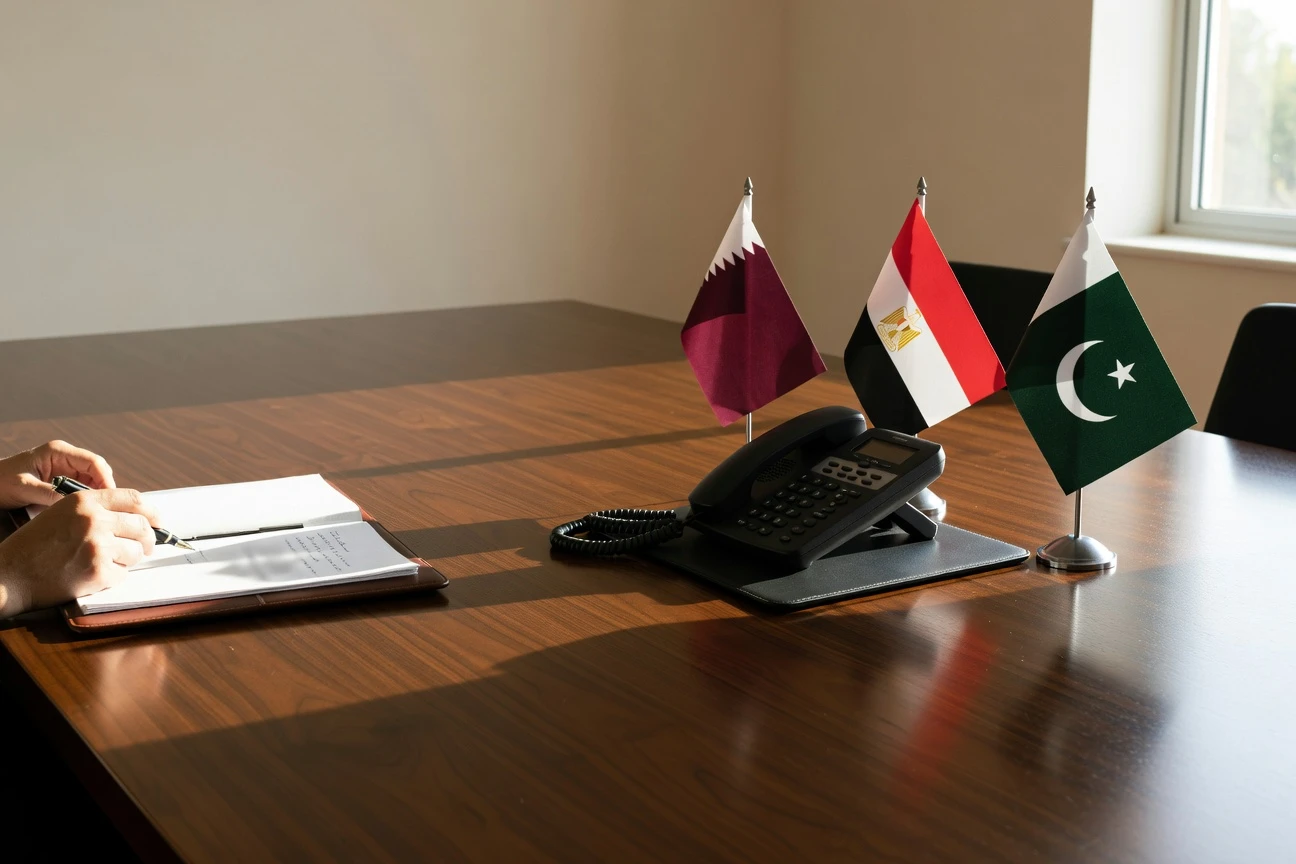
Qatar’s prime minister and Egypt’s top diplomat spent part of Saturday on the phone trading notes on a third country’s mediation. Pakistan’s. The May 23 call between Sheikh Mohammed bin Abdulrahman bin Jassim Al Thani, Qatar’s prime minister and foreign minister, and Badr Abdelatty, Egypt’s minister of foreign affairs, was framed around supporting the Islamabad-led track between Washington and Tehran, according to the official Qatari readout.
One day later, US Secretary of State Marco Rubio said negotiators had made significant progress on a one-page framework to end the war and reopen the Strait of Hormuz. The Saturday call surfaces the wider mediation web sitting behind Pakistan’s name on the file, with Qatar handling much of the Tehran-side conversation and Egypt working a parallel line into the Trump White House.
What the Doha-Cairo Call Put on Record
Per the Qatari foreign ministry’s published readout, the conversation between Sheikh Mohammed and Abdelatty covered three items. Two were bilateral, focused on strengthening ties between Doha and Cairo. The third was regional, and it carried a specific name: Pakistan-led mediation between the United States and Iran.
The phrasing matters. Qatar publicly attributing the lead role to Islamabad runs against months of background reporting that placed Doha at the center of the Iran channel. The recognition signals two things at once. Pakistan is being given the formal credit, and the smaller players are willing to coordinate underneath that banner.
| Mediator | Lead Figure | Direct Line to Iran | Direct Line to US |
|---|---|---|---|
| Pakistan | PM Shehbaz Sharif, FM Ishaq Dar | Parliamentary, via Ghalibaf | Trump, Vance, Witkoff |
| Qatar | PM Sheikh Mohammed bin Abdulrahman | Decades of bilateral ties | Rubio and Witkoff, Miami, May 9 |
| Egypt | FM Badr Abdelatty | Cairo-Tehran working channel | El-Sisi to Trump, late April |
| Saudi Arabia | Crown Prince Mohammed bin Salman | Limited, post-rapprochement | Trump direct |
The readout closed with Sheikh Mohammed pressing all parties to engage constructively and to deal with the root causes of the crisis rather than the surface flashpoints. Abdelatty’s office described the Egyptian side as aligned on that point.
Why Pakistan Sits at the Center of the Track
Islamabad’s centrality dates to April. The conditional two-week ceasefire announced on April 8 was attributed by Donald Trump directly to conversations with Shehbaz Sharif, Pakistan’s prime minister, and Field Marshal Asim Munir, the army chief. The Islamabad Talks that followed ran across April 11 and 12 at the Serena Hotel in the city’s Red Zone, with roughly 300 US officials on one side led by Vice President JD Vance and around 70 Iranian counterparts led by Parliamentary Speaker Mohammad Bagher Ghalibaf and Foreign Minister Abbas Araghchi.
The Pakistani mediating team that owned the room sat three deep:
- Shehbaz Sharif, prime minister, political lead and Trump’s primary interlocutor
- Asim Munir, field marshal and army chief, the security guarantor both sides could accept
- Ishaq Dar, deputy prime minister and foreign minister, the diplomatic coordinator
The talks themselves ended without an agreement or a memorandum of understanding, according to the UK parliamentary briefing on the US-Iran ceasefire and nuclear track. Unresolved items included Tehran’s enriched uranium stockpile, the legal status of the Strait of Hormuz, sanctions relief sequencing, and roughly six billion dollars in frozen Iranian assets. What Islamabad delivered was the room. Five weeks on, it still owns the file, but it does not yet own the deal.
Qatar’s Quieter Channel Runs Through Miami
While Islamabad carried the marquee, Qatar has been doing much of the brokerage on the Iran side. Sheikh Mohammed flew to Miami on May 9 to meet Rubio and White House envoy Steve Witkoff. The conversation, per multiple US reports, focused on a one-page memorandum designed to end the war and frame more detailed talks. Qatari interlocutors are described inside the Trump administration as unusually effective with Tehran, a reputation that predates the current war and that explains why the Miami sit-down happened on US soil rather than in the Gulf.
That Doha-Washington channel is now operating in parallel to the formal Islamabad process, not in competition with it. Saturday’s call with Abdelatty effectively put that coordination on the record. For Cairo’s role in the same triangle, our reporting on the Egypt-Qatar diplomatic balance over Gaza covered how the two capitals have learned to split mediator files without stepping on each other.
Egypt’s Open Line to Tehran
Egypt brings a different asset to the table. Cairo restored a working diplomatic channel with Tehran during the regional thaw that preceded the war and has not closed it. President Abdel Fattah El-Sisi joined a late-April call with Trump and a cluster of Arab leaders pressing for a comprehensive agreement, then kept the line open through May as the Hormuz framework drew closer.
Abdelatty has said publicly that diplomacy remains the most viable path toward long-term regional security, and Egypt’s posture across the spring has matched the words. Cairo extended limited military support to Gulf allies and condemned Iranian strikes on Arab civilian and military sites strongly, while keeping the Tehran channel intact.
Our earlier piece on Egypt’s wartime balancing act with Tehran and the Gulf tracked how that two-track approach took shape from late February onwards, after the strikes that killed Iran’s former supreme leader Ali Khamenei. His son Mojtaba Khamenei was named successor, and any final deal now needs both his and Trump’s personal sign-off.
For Cairo, the upside of backing Pakistan publicly is that it banks credit with Washington without burning the Tehran line. The downside is that, if the Islamabad process collapses, Egypt sits closer to the wreckage than it would prefer.
The Hormuz Framework Now in Play
What the mediators have built, as of Sunday, May 24, is a draft Rubio described as in principle agreed on the Strait of Hormuz piece, with the broader package still unsigned. Both Trump and Mojtaba Khamenei would have to commit personally to lock it in.
The shape of the framework, drawn from US and Iranian state-media accounts and the parliamentary briefing on reopening the Strait of Hormuz:
- Reopening the Strait to commercial shipping within roughly 30 days of signature, restoring pre-war traffic volumes
- A method, still under negotiation, for disposing of Iran’s enriched uranium stockpile
- Unfreezing of Iranian assets currently held under US sanctions, in tranches tied to compliance milestones
- Lifting of the naval blockade Trump ordered on April 13, also on a 30-day track
- A Lebanon ceasefire framework, with the operative language still disputed by Tehran
Iran’s semi-official Tasnim news agency reported that shipping through the Strait could return to pre-war levels inside that one-month window, while warning in the same dispatch that US obstruction of some clauses continues and that the agreement could yet be canceled.
Where This Deal Could Still Break
Three structural risks sit underneath the Saturday optimism. None are new, and none have been resolved by the Doha-Cairo call.
The first is the enriched uranium. Disposing of an existing stockpile is a different problem from capping future enrichment, and the parties have not agreed on whether the material leaves Iran, is diluted in place, or is sealed under a verification regime. The second is Lebanon. Tehran rejects US draft language permitting military operations there and is demanding a sustainable ceasefire instead. The third is timing. With both Trump and a relatively new supreme leader needing to sign personally, either side can pull back without losing face.
The numbers framing the next 30 days:
- 30 days: window for Hormuz reopening and naval blockade lift after signature
- $6 billion: Iranian assets reportedly frozen and under negotiation for release
- April 8: date the original two-week ceasefire took effect
- April 13: date the US naval blockade was imposed, the day after the Islamabad Talks closed
Our coverage of Egypt’s broader peace push to end the Iran war traced how Cairo’s diplomatic posture hardened after April 13, when the blockade closed the door on a quiet de-escalation and forced a more formal mediation architecture into view.
The Congressional Research Service note on the ceasefire flags an additional risk that the mediators rarely mention in public: secondary fronts. Strikes from Lebanon, the Red Sea, or Iraq, whether directed by Tehran or by groups acting under its umbrella, would test whether a paper framework survives contact with a single incident.
If the framework signs by mid-June, the Doha-Cairo call will read as the moment Arab capitals lined up publicly behind Islamabad. If it slips, the same call will read as a hedge.
