
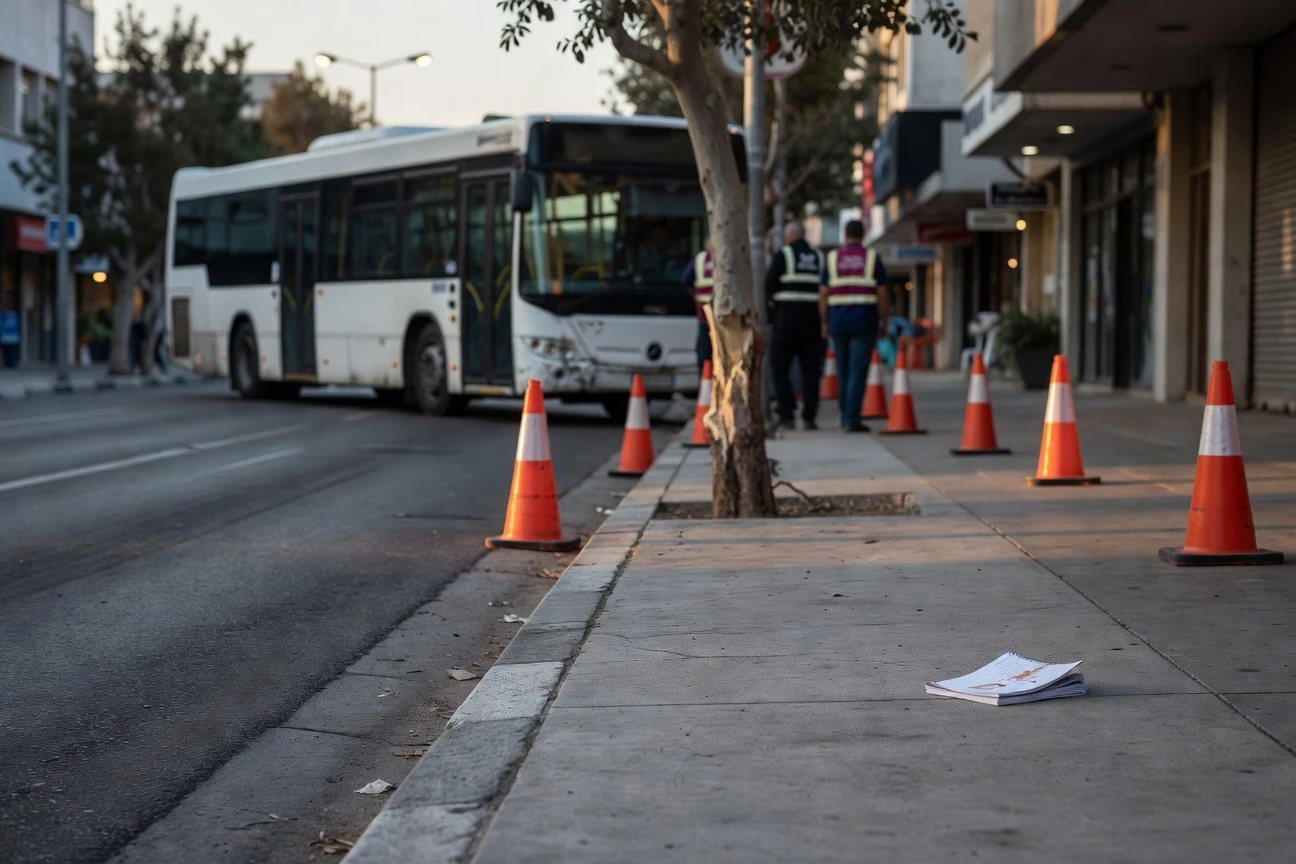
The Tel Aviv bus crash that killed Talia Chaya Timsit, 11, has turned a Monday night collision into a harder question about what protects pedestrians when a bus leaves the roadway. Ichilov Hospital announced her death on Friday, May 22, four days after she was critically injured on Dizengoff Street, where emergency teams said the bus hit a tree and a high-voltage power pole.
The case leaves investigators with basic facts still unsettled: why the bus mounted the sidewalk, whether speed, health, vehicle condition or street design played any part, and why a dense city corridor offered so little margin once control was lost.
A Fatal Crash on a Street Built for Crowds
Timsit was a pedestrian, according to Magen David Adom personnel quoted from the scene. She was taken to Tel Aviv Sourasky Medical Center, widely known as Ichilov Hospital, with severe head, limb and possible chest injuries after the Monday, May 18 crash.
The latest hospital account listed nine others injured: a 76-year-old man and a 49-year-old woman in serious condition, a 39-year-old man in moderate condition and six people with minor injuries. Fire and rescue teams also worked to free a person trapped inside the bus. Local residents reported a power outage after preliminary accounts said a high-voltage pole was hit during the collision.
That casualty pattern matters because the harm did not stay inside the vehicle. It reached the sidewalk, where the people with the least protection rely on the street edge, the curb line, traffic discipline and fixed infrastructure to do their jobs. In this case, **the sidewalk became the crash zone**.
The Timeline Leaves One Central Unknown
Authorities have not released a final cause. That makes the early sequence important, but also risky to overstate. The known facts show a short chain of events with several points where the investigation still has to separate cause from consequence.
- The bus was traveling in central Tel Aviv on Monday evening before it left the normal path of traffic.
- Emergency accounts placed the impact at a tree and a high-voltage pole, with pedestrians among those hurt.
- Medical teams treated casualties at the scene and evacuated the most seriously injured to hospital care.
- Hospital staff later announced on Friday that the 11-year-old girl had died of her injuries.
For investigators, **the sequence matters** more than the wreckage. A bus can leave the roadway because of driver incapacitation, a steering or braking problem, contact with another road user, excessive speed, surface conditions or a combination of smaller failures. The public answer has to identify the first failure, not just the most visible damage.
Why the Sidewalk Became the Stakeholder
Tel Aviv-Yafo has long sold itself as a walkable city by Israeli standards. A municipal sustainability report described the city as flat and congested, with walking serving daily trips and access to bus stops, parking, schools, shops and recreation. The same Tel Aviv municipal sustainability report cited a 2016 survey in which 39.4% of children walked to school.
That is why this crash lands beyond one driver and one bus. A city that depends on walking has to treat the sidewalk as public safety infrastructure, not leftover space beside the road. The question is whether each layer did enough work before the bus reached people.
| Street Layer | What It Is Supposed to Do | What the Crash Tests |
|---|---|---|
| Roadway | Keep heavy vehicles in a predictable travel path | Whether speed, alignment, lane conditions or driver control failed first |
| Curb and sidewalk | Give pedestrians a protected zone beside traffic | Whether the edge offered enough separation from a bus-sized vehicle |
| Trees and utility poles | Provide shade, services and urban structure | Whether fixed objects reduced harm, added danger or both |
| Emergency response | Limit deaths after impact | Whether rescue access and power hazards slowed lifesaving work |
The uncomfortable point is simple: **the last safety layer was the sidewalk**. When that layer fails, a dense, popular street can change from a place of movement to a place with no refuge.
Israel’s Road Safety Numbers Were Already Flashing Red
The crash also arrives in a bad national year for road safety. Israel’s Central Bureau of Statistics said 459 people were killed in road accidents in 2025, the highest figure in 19 years, even as the number of reported injury crashes fell. The Central Bureau of Statistics road casualty release listed 7,602 expanded road accidents with casualties and 13,261 total casualties for the year.
A separate annual summary from the National Road Safety Authority put the pedestrian risk in sharper terms. Its National Road Safety Authority annual summary said pedestrians made up 28% of people killed in road crashes and that a pedestrian was killed, on average, every three days.
- 459 people were killed on Israeli roads in 2025, compared with 439 in 2024, according to the statistics bureau.
- 128 pedestrians died in 2025, about 15% above the average for 2022 through 2024, according to the safety authority.
- 109 deaths occurred in crashes involving heavy vehicles over 3.5 tons, the authority said.
Those numbers do not explain this crash. They explain why a single sidewalk death in central Tel Aviv fits a wider pattern that officials already considered severe before Monday night.
The Investigation Has to Follow the Machine and the Street
A serious bus crash has two investigations running in parallel, even when only one appears in public. One follows the driver and vehicle. The other follows the street. If either path is skipped, the final answer risks becoming too narrow.
The Ministry of Transport’s Traffic Administration says it oversees vehicle safety, licensing, driver training and the Safety Officers’ Unit, which deals with the fitness and maintenance of vehicles owned by companies. Its Traffic Administration role description is a reminder that bus safety is built before the moment of impact, through maintenance records, inspection routines and professional driving systems.
Infrastructure is the second file. The ministry’s Infrastructure Planning and Development Administration says it prepares multi-year plans for transportation development and safety improvements. That makes the street edge, pole placement, curb geometry, tree condition and pedestrian exposure part of the same safety question.
- The bus file should cover maintenance, brakes, steering, event data if available, driver hours and medical factors.
- The street file should cover lane layout, curb height, pedestrian volumes, fixed objects, signal timing and prior crash history.
- The response file should cover rescue access, electrical hazards, ambulance staging and how quickly trapped victims could be reached.
This is where a public investigation earns trust. It has to say what happened inside the vehicle and what the street did once that vehicle crossed the line.
Dizengoff’s Promise Runs Into Its Weakest Edge
The most striking sentence from the scene did not come from a planner. It came from Yaron Sheff, a United Hatzalah paramedic who responded after the crash.
I have 41 years of experience and still don’t understand how this accident happened
Sheff said he arrived to find a bus that had hit a tree significantly, with a trapped person still being rescued. His reaction matters because it came from someone used to bad scenes. When a veteran paramedic says the mechanics make little sense, the burden shifts to investigators to produce a clear public sequence, not a fog of partial explanations.
World Health Organization road safety guidance treats speed, roadsides, vehicles and users as linked parts of a Safe System approach. The WHO’s speed management guidance for road safety says safe speeds belong with safe roads, roadsides, vehicles and road users. That approach fits this case because the harm appears to have crossed from vehicle control into pedestrian space within seconds.
A Child’s Death Changes the Burden of Proof
Timsit’s death will not be answered by one technical finding if the final report stops there. A medical episode, a mechanical failure or a driver error would explain the beginning. It would not fully answer why the street gave pedestrians so little reserve once a heavy vehicle moved onto the sidewalk.
The harder answer may require Tel Aviv and national transport officials to look at similar corridors before the next crash, not after it. Streets with buses, children, trees, utility poles, outdoor commerce and heavy pedestrian use need more than painted order. They need physical forgiveness when order breaks.
If investigators find an isolated failure, the city may fix the bus, the driver system or the damaged pole and move on. If they find that the street edge itself offered too little protection, the crash becomes a design warning for every crowded corridor built on the same assumptions.
