
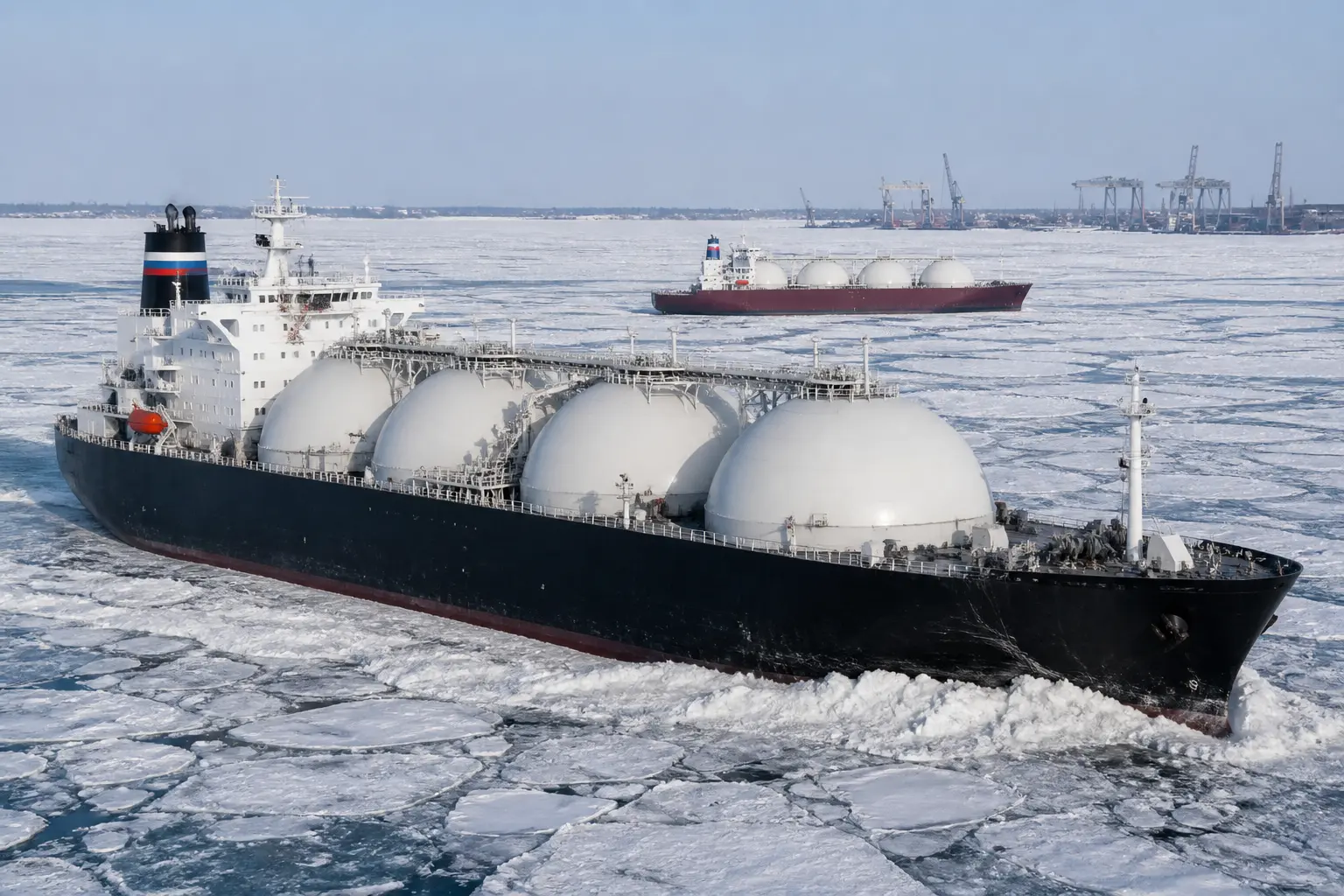
Russia has expanded its shadow LNG tanker fleet to 25 vessels, adding at least eight second-hand ships in six months plus two newbuilds from the Zvezda yard, ahead of the EU’s complete ban on Russian gas imports that takes effect for long-term contracts on 1 January 2027.
The move mirrors the oil dark fleet that already exceeds 1,000 ships. It arrives while European buyers still take nearly every cargo from the Yamal plant that supplies most of the revenue.
Twenty-Five Tankers and Counting
Financial Times reporting, carried by United24 Media, shows the specialized gas fleet now stands at 25 after the latest second-hand acquisitions. Four of the newer ships, Kosmos, Orion, Merkuryy and Luch, fly the Russian flag and already move cargoes through sanctioned transshipment hubs.
Zvezda delivered the Aleksey Kosygin, which has carried gas from the sanctioned Arctic LNG 2 project since December, and named the Konstantin Posyet this month. Four more hulls remain under construction there. Six completed vessels stay blocked by sanctions at South Korea’s Hanwha yard.
- Second-hand LNG tankers redirected in the past six months: at least eight
- New Zvezda deliveries in service or named: two
- Additional Zvezda hulls under construction: four
- Sanction-blocked ships at Hanwha: six
- Typical newbuild cost: around $300 million each
These carriers keep gas liquid at minus 162 degrees Celsius. Most register through shell companies in Dubai, Hong Kong and Singapore under flags of convenience. Operators rely on AIS signal jamming and ship-to-ship transfers to blur origins. Ice-class requirements for Arctic routes raise the technical bar further. French containment specialist GTT cut contracts with Russia in January 2023, leaving domestic yards short of key know-how.
The mix of second-hand buys and slow domestic output shows a dual track. Ready hulls enter service now. Zvezda work fills gaps later. The six blocked Korean ships remain a stranded asset until ownership or sanction status changes.
The Ban That Still Leaves Months of Cash Flow
The Council of the EU’s 19th sanctions package set a ban on imports of Russian LNG from January 2027 for long-term contracts and within six months for short-term deals. It also listed 117 more shadow vessels, pushing the designated total to 557 at the time, and banned reinsurance for the fleet.
The 20th package added a prohibition on LNG terminal services from 2027, phased restrictions on technical assistance and financing for LNG tankers and icebreakers, and further vessel listings that took the sanctioned total past 630. European firms that breach the rules after the deadline face fines of up to 3.5 percent of global annual turnover.
Short-term contracts already face tighter limits from April 2026. Yet the long runway to full closure has left a clear window. Novatek’s Yamal plant and the still-constrained Arctic LNG 2 together generate more than 65 percent of Russian LNG. Gazprom’s Sakhalin-2 supplies most of the rest.
That phased design means revenue continues while the fleet grows. Each package tightens paper controls. Physical cargoes still clear European berths under existing contracts until the final cut-off dates arrive.
Europe Still Takes Nearly Every Yamal Cargo
In the first half of 2026 Europe absorbed 136 of the 140 cargoes shipped from Yamal, equal to 9.97 million tonnes or 97 percent of output. That volume rose 16 percent from the same period in 2025. Asia-bound deliveries collapsed 84 percent to just four cargoes.
| Destination | Cargoes | Volume (mt) |
|---|---|---|
| France | 51 | 3.74 |
| Belgium | 37 | 2.70 |
| Spain | 34 | 2.50 |
| Netherlands | 12 | 0.88 |
| Portugal | 2 | 0.15 |
| China | 4 | 0.28 |
Urgewald’s analysis of Kpler data put the estimated bill at €5.96 billion for Yamal cargoes in H1 2026. France, Belgium and Spain led the intake. Zeebrugge, Dunkerque and Montoir handled the bulk of discharges. The average daily haul into the EU reached 55,000 tonnes, or one cargo roughly every 1.3 days.
The concentration leaves little spare capacity for sudden redirection. When nearly every cargo already lands in a handful of ports, any later terminal ban hits both volume and routing at once.
Who Still Moves the Gas
International operators keep the trade alive. Seapeak entities linked to the UK and Canada carried about 40 percent of Yamal volumes. Greek-linked Dynagas handled roughly 35 percent. MOL/COSCO vessels covered the rest, including many of the ship-to-ship transfers in Murmansk that still ended in European ports.
| Operator group | Share of Yamal volumes |
|---|---|
| Seapeak (UK/Canada-linked) | about 40 percent |
| Dynagas (Greek-linked) | roughly 35 percent |
| MOL/COSCO | the remainder |
Yamal’s Arc7 ice-class tankers need fast European turnarounds during the ice season. Conventional ships can only support the project in the summer window. Without those ports the same specialized fleet would face far longer voyages and lower annual output. Denmark’s Fayard yard remains the last EU facility known to service the Arc7s; up to six vessels were expected to need work before the full maritime-services ban lands.
Key H1 2026 markers
- 97 percent of Yamal cargoes discharged in the EU
- €5.96 billion estimated payments to Russia
- 16 percent rise in EU-bound volume year on year
- 84 percent drop in Asia-bound volume
Sebastian Rötters of Urgewald put the dependence in plain terms.
Yamal LNG depends on a small, specialised fleet, European ports and European services to keep exports flowing. Europe continues to provide all three.
The campaigner noted the figures while Russia intensified missile and drone attacks on Ukrainian cities.
Boarding Actions Meet Hard Limits
On 2 August an Italian-led EUNAVFOR MED IRINI team, supported by Polish and Greek assets, boarded the sanctioned Cameroon-flagged tanker Toa Payoh west of Pantelleria. The ship had sailed from Benin toward Istanbul. The captain initially refused cooperation, so Italian personnel fast-roped from a helicopter off the flagship ITS Thaon di Revel. The two-hour inspection checked documents and flag status. IRINI lacks authority to seize such vessels; the tanker continued after the check.
The operation was the second of its kind in weeks. A Visegrád 24 post sharing the boarding video drew more than 58,000 views and replies that noted the contrast with other maritime enforcement debates. Crowd commentary treated the raid as visible pressure that still leaves the structural trade intact. Shadow ships continue to operate outside Western insurance and classification societies, switching flags and ownership through opaque layers.
Parallel Ukrainian strikes on Russian oil infrastructure deep inside Siberia show another pressure point on energy revenues, yet the LNG logistics chain has so far proved more resilient.
- October 2025: 19th package introduces the LNG import ban timeline and lists 117 more vessels.
- April 2026: 20th package bans LNG terminal services from 2027, adds tanker assistance restrictions and further vessel and port listings including Murmansk and Tuapse.
- H1 2026: Europe takes 97 percent of Yamal output while Russia acquires second-hand LNG hulls.
- 2 August 2026: IRINI boards Toa Payoh in the central Mediterranean.
- 1 January 2027: long-term LNG contracts and related terminal services prohibited.
Longer Voyages and Higher Friction Ahead
Once European terminals close, Russia must push more cargoes east. Arctic LNG 2 already sells only to China and relies on an aging 11-ship fleet. Longer Asia routes multiply voyage times and require far more conventional LNG carriers plus ship-to-ship capacity in places such as Murmansk. Analysts estimate dozens of extra vessels would be needed simply to hold current volumes.
The oil shadow fleet demonstrated the model: older tankers bought from European owners, reflagged, insured outside the West, and used for ship-to-ship transfers that obscure origin. Greek owners supplied a large share of that capacity in earlier years. The same ownership transfer pattern now appears in the LNG segment. Secondary sanctions on Chinese terminals or buyers could raise the cost further, yet none have fully closed the door.
Technical barriers remain. Ice-class ships are scarce. Containment systems are hard to replace after the GTT cutoff. Domestic construction at Zvezda proceeds slowly. Still, the 25-ship base plus the blocked Korean hulls give Russia a starter kit that did not exist two years ago.
Each extra day at sea cuts the number of annual trips a single hull can complete. That arithmetic turns a modest fleet shortfall into a larger capacity gap once the short European legs disappear.
Shadow Gas Ships Follow the Oil Playbook
The oil dark fleet already exceeds 1,000 ships. The LNG effort is smaller and more specialized, yet the methods match. Second-hand tonnage leaves European owners, passes through shell companies in Dubai, Hong Kong and Singapore, and reappears under flags of convenience.
AIS jamming and ship-to-ship transfers blur the paper trail in both trades. Insurance and classification shift outside Western societies. Greek-linked owners featured heavily in earlier oil transfers; Dynagas now holds a large LNG share. The pattern repeats with different cargo and higher technical demands.
- Oil dark fleet: more than 1,000 ships
- LNG shadow fleet: 25 vessels and growing
- Shared tools: reflagging, shell ownership, STS transfers, non-Western cover
- Key difference: ice-class scarcity and containment know-how after the GTT cutoff
Scale still favors oil. Gas carriers cost around $300 million new and must hold cargo at minus 162 degrees Celsius. Those constraints slow the copy, but they have not stopped it.
Why Arctic Ice Class Limits the Options
Yamal’s Arc7 tankers need fast European turnarounds in the ice season. Conventional ships can support the project only in the summer window. That seasonal split makes European ports and the last EU service yard, Denmark’s Fayard, operational linchpins rather than optional stops.
Up to six Arc7s were expected to need work before the full maritime-services ban lands. After that, repair options shrink. Ice-class hulls are scarce on the second-hand market, so losses or delays hit harder than in the conventional oil fleet.
Zvezda’s two delivered ships and four remaining hulls form the domestic answer. Progress is slow. The six completed vessels blocked at Hanwha add further idle capacity that sanctions keep offline. Together these limits explain why the 25-ship base still depends on European discharge and service to keep annual output high.
Revenue Bridge Meets Enforcement Reality
Every cargo Europe still accepts extends the cash flow that funds fleet purchases and war spending. The same ports that discharge Yamal cargoes also give the Arc7 tankers the rapid turnaround that keeps the Arctic project viable through winter. When those services end, the economics worsen, yet the vessels already acquired will still sail.
Enforcement actions like the Toa Payoh boarding raise the risk premium and generate paperwork that can support later seizures by national authorities. They do not yet stop the broader network. Shadow operators simply absorb higher insurance costs and longer detours. Similar risks to gas shipping near the Suez route show how quickly alternative paths can face their own threats.
Russia is betting that partial market access in Asia plus a home-built and second-hand LNG fleet will preserve enough export volume to blunt the revenue hit. Europe’s own purchases through mid-2026 supplied both the money and the operational proof-of-concept for that bet. The ban closes one door. The ships now gathering will test how tightly the others can be locked.
