
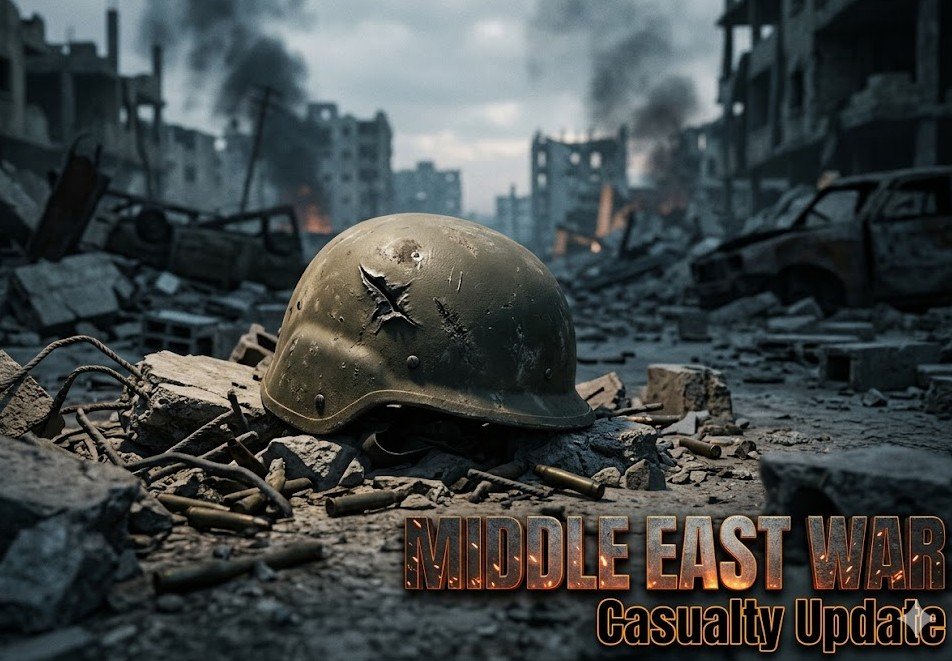
The conflict that erupted at the end of February has rapidly expanded across the Middle East, leaving tens of thousands dead, injured, or displaced across several countries. What began as joint strikes by the United States and Israel against Iran has spiraled into a region‑wide crisis with military and civilian casualties mounting by the day.
This article breaks down the latest verified figures from credible sources and outlines where the war stands now. The numbers reflect data from governments, health authorities, and independent monitoring agencies.
Iran Casualties and Civilian Impact
Iran remains at the centre of the worst losses in the conflict.
• Iranian figures are difficult to independently confirm, but multiple credible trackers show that over 3,000 people have been killed in Iran’s war zones, with thousands more injured.
• Independent groups such as the Human Rights Activists News Agency report that at least 1,400 of the dead are civilians, including hundreds of children who perished in strikes on populated areas.
• Health facilities and infrastructure in major cities have been heavily damaged, overwhelming local hospitals with casualties.
• Iranian officials have not released full updated totals in recent days, but health ministry figures and external tallies align that the human cost continues to rise.
The toll in Iran reflects the brutal intensity of the campaign against military as well as urban targets, with school strikes and residential bombardments adding to civilian deaths.
Lebanon and Hezbollah Region
In Lebanon, the health ministry reports more than 1,000 people killed and nearly 3,000 wounded since fighting intensified in early March.
• The figures include civilians, local responders, and medical workers.
• Losses attributed directly to Hezbollah combatants have not been officially released, but the group is heavily engaged on the front lines of clashes with Israeli forces.
The conflict’s spillover into Lebanon has contributed to one of the highest civilian loss counts outside Iran itself.
Israel Casualties and Internal Losses
Israel’s official figures show:
• At least 15 civilians killed by Iranian missile strikes, including multiple minors and foreign workers killed in attacks on populated areas.
• Approximately 450 people have been injured due to incoming missiles and retaliatory violence.
• Two Israeli military personnel have been confirmed killed in combat operations.
• One additional civilian death occurred due to mistaken artillery fire on Israeli territory.
Israel’s advanced missile defence systems have intercepted many threats, but no defence system is fully foolproof in intense conflict.
Casualties Beyond Iran and Israel
The war has spread beyond its original frontlines:
• Iraq has reported dozens of fighters and civilians killed in cross‑border engagements.
• United Arab Emirates, Kuwait, Qatar, Bahrain, and Saudi Arabia have all seen casualties from missile or drone strikes, though generally smaller numbers than the main combatants.
• United States military personnel have also suffered losses. Official counts indicate around a dozen American service members killed and hundreds wounded in the conflict, including incidents such as a mid‑air refuelling plane crash connected to operations.
Across the region, these multi‑national totals reflect how deeply the war has moved beyond a bilateral dispute.
Humanitarian Crisis and Regional Strain
The sheer scale of suffering goes beyond battlefield deaths.
• Hospitals are overwhelmed. Medical supplies are in short supply in many areas of Iran and Lebanon.
• Displacements are on the rise, with tens of thousands fleeing combat zones.
• Infrastructure such as energy pipelines and ports has been attacked or damaged, contributing to economic instability and long‑term hardship for civilians.
• Global oil markets have been shaken by concerns over closure or disruption of key shipping routes such as the Strait of Hormuz, after naval mines were confirmed there.
Climate and environment experts also warn that large‑scale destruction has released millions of tonnes of carbon dioxide, linking humanitarian crises with broader ecological costs.
International and Military Reactions
This war has drawn global responses:
• The United States has mobilised additional units, including airborne divisions, to the region, signalling readiness for a wider confrontation.
• World leaders have expressed concern and called for de‑escalation, while diplomatic channels remain strained.
• Peace talks and negotiations are reportedly underway in neutral forums, though active fighting has not stopped.
Why These Numbers Matter
Counting casualties in an active war is never precise, but these figures show the brutal human toll on both military and civilian populations. They highlight:
• The rapid geographical spread of hostilities
• The impact on everyday people, not just soldiers
• The broader regional destabilisation
• The escalatory nature of modern warfare, where missiles can strike capitals and energy infrastructure alike
Casualty figures help the world understand the scale of suffering and the urgency of diplomatic solutions. They remind us that each number represents a life uprooted or lost.
At this stage, there is no clear end in sight, but the international community continues to monitor and push for negotiation channels.
We invite readers to share their thoughts and reflections on the human cost of this war. Engage with others and add your voice to the conversation on social platforms.
