
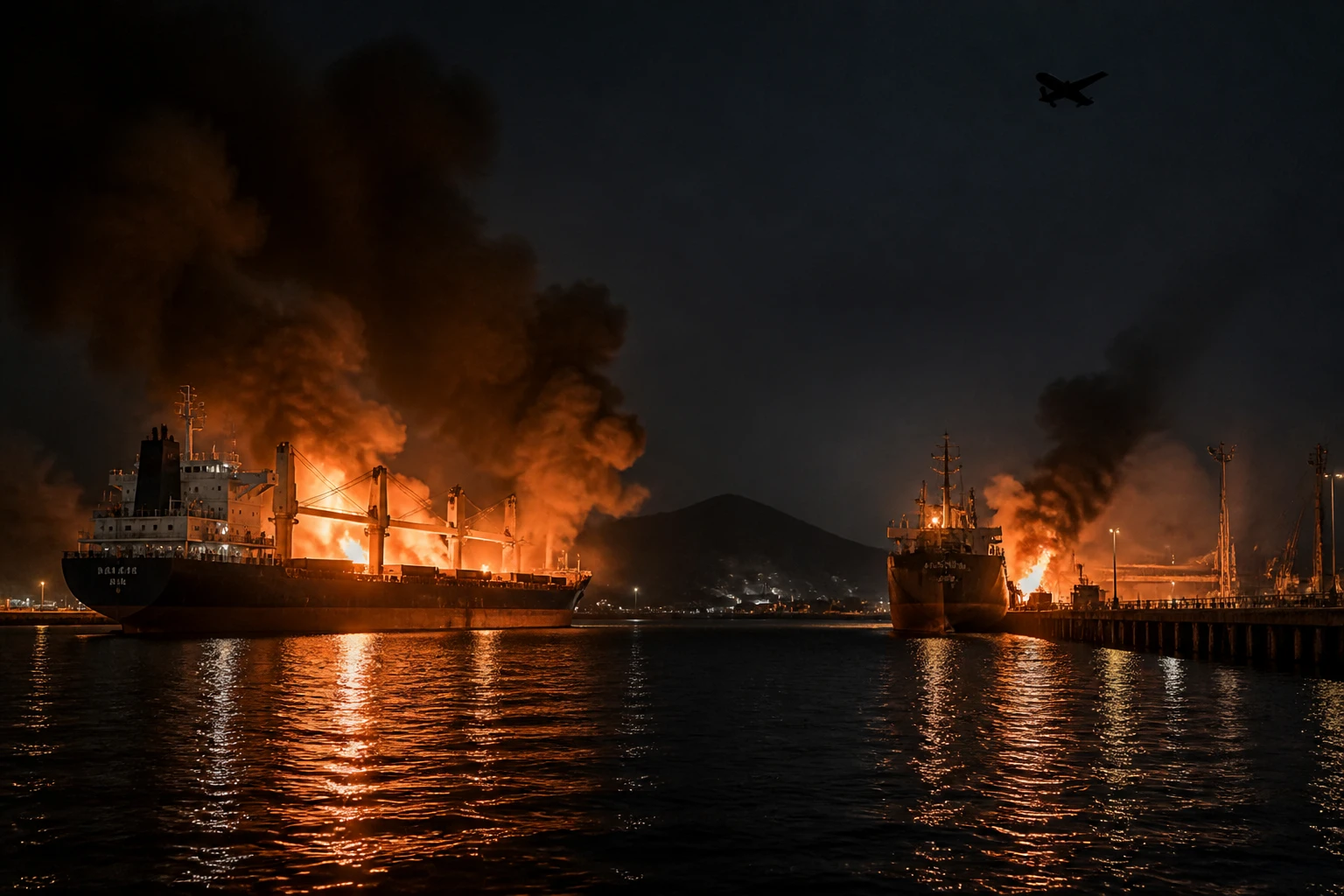
Houthi forces fired missiles and drones at Yemen’s government-held Mokha port on 9 August 2026, killing at least seven people and wounding more than a dozen, while the group claimed separate drone strikes that sparked a fire at a Saudi Aramco refinery in Jizan. Saudi Arabia said the blaze was extinguished with no casualties. UN Special Envoy Hans Grundberg told the Security Council days later that Yemen now faces a more serious risk of return to large-scale conflict than at any point since the 2022 truce.
The strikes land as the wider US-Israel war with Iran already squeezes the Strait of Hormuz and Red Sea shipping. Local front-line fighting and cross-border drones now share the same escalation ladder.
Missiles at Mokha, Drones Over Jizan
Yemeni government-allied National Resistance Forces reported four troops and three civilians killed at Mokha, with 15 civilians injured. Fayed al-Noman of the information ministry said missiles and drones hit port buildings, piers, commercial goods and food supplies. The Houthis claimed they targeted Saudi-linked soldiers, equipment and warehouses with ballistic missiles and drones.
Yahya Saree, the Houthi military spokesperson, said the group also struck an Aramco refinery in Jizan with a drone. He framed it as a response to Saudi drones entering airspace over Saada and Hajjah. A second claimed strike hit an Aramco site near Najran, roughly 300 kilometers away. The Saudi Energy Ministry confirmed a fire at a Jizan facility early on 9 August, stating industrial security teams put it out with no injuries and that authorities were completing procedures. It did not attribute a cause.
- Mokha port: missiles and drones, at least seven dead, infrastructure and food stocks damaged
- Jizan Aramco: claimed single-drone precise hit, confirmed fire extinguished, zero casualties
- Najran area: claimed second drone operation that “achieved its objective”
- Prior week: Houthi naval blockade declaration on Saudi Red Sea shipping and earlier facility claims
Reports on the exact Mokha death toll ranged from seven to eight or higher in early accounts. The core fact holds: a working Red Sea port that handles cargo avoiding Houthi-held Hodeidah took direct fire.
Why the 2022 Calm Is Breaking
The UN-brokered truce of April 2022 largely froze major front-line fighting for four years, even after its formal six-month term expired. Parties kept relative quiet inside Yemen through earlier regional spikes. That buffer is gone.
Grundberg listed intensified activity in Ma’rib, Hadramawt, Mokha and elsewhere, plus renewed Houthi attacks on commercial vessels that the Council had already condemned. An unauthorized flight from Tehran toward Sanaa in July was followed by airstrikes on Sanaa airport and missile hits on Abha airport and Saudi oil sites. The Houthis announced a naval blockade on Saudi Arabia in late July, citing a claimed siege. A Saudi-led coalition answered with strikes on Hodeidah facilities it linked to shipping threats.
These steps sit inside the larger Iran confrontation that began with US and Israeli strikes on 28 February. Yemen is no longer a separate civil war file. Cross-border drones and Red Sea threats now feed the same pressure that already disrupts Hormuz energy flows.
Six Million Near Famine While Fronts Reopen
UN humanitarian chief Tom Fletcher briefed the same Council session on 13 August. Over half of Yemen’s population faces acute food insecurity. Six million people face Emergency levels of deprivation, the highest such number globally and bordering on famine. In June more than 60 percent of households reported inadequate food consumption across every governorate.
Stats snapshot
- Over half the population in acute food insecurity
- 6 million at Emergency (IPC Phase 4) levels
- Nearly 11 million women and girls need humanitarian support
- Three women die daily from preventable pregnancy complications
Funding for the humanitarian appeal sits near 20 percent. Clinics close and rations shrink when money stops. El Niño forecasts point to a 40 percent rainfall drop in key farm areas, hitting crops and water already under stress. Access incidents topped 200 in the prior twelve months. Seventy-three UN personnel remain arbitrarily detained by Houthi authorities, along with NGO, civil society and diplomatic workers. Their detention blocks aid delivery for millions.
| Indicator | Figure | Source timing |
|---|---|---|
| Acute food insecurity share | Over half the population | August 2026 briefing |
| Emergency-level deprivation | 6 million people | August 2026 |
| UN staff detained | 73 | Ongoing since 2024 |
| Humanitarian appeal funding | Barely 20 percent | August 2026 |
| Conflict-related detainees agreed for release | More than 1,600 | May deal, slow progress |
A return to full-scale fighting would hit a population already exhausting coping strategies: selling land or homes for food, skipping medicine, pulling children from school.
Red Sea Routes Absorb the Second Blow
Mokha sits on the Red Sea coast and was upgraded to handle ships that skip Hodeidah. Damage to its piers and food stocks raises insurance and diversion costs for vessels already navigating Houthi threats and the Hormuz squeeze. Grundberg noted a missile attack on a commercial vessel two days before his briefing that killed several crew members.
Houthi claims of precise Aramco hits, even when Saudi reports only brief fires with no injuries, keep markets and shippers on edge. Earlier July strikes on Jizan and Yanbu produced temporary production interruptions that Aramco’s chief later said carried no material financial impact. The pattern still adds risk premium. The group’s declared naval blockade complements pressure on the Strait of Hormuz, where Iran and Oman have discussed temporary transit arrangements under wider war conditions.
Crowd reaction on X mixed Houthi victory videos of fires with maritime operators noting rising threat levels near Bab al-Mandeb. Some circulating clips appeared to reuse July damage footage, illustrating how information warfare itself becomes part of the cost. The practical result is the same: higher premiums, longer routes, delayed food and fuel for Yemen itself.
Who Can Still Pull the Off-Ramp
Grundberg argued a negotiated exit remains open. He has shuttled to Riyadh and Muscat proposing de-escalation steps the parties already know.
Four years of calm can be lost in a few weeks of escalation. I am not asking this Council today merely for statements of support. I am asking every member with influence over the parties to use it to steer Yemen away from the battlefield and back to the negotiating table.
Hans Grundberg told the Security Council on 13 August. He listed three requirements: immediate military de-escalation and a robust ceasefire that restores front-line calm, ends shipping attacks and stops cross-border strikes; economic de-escalation that resumes oil exports under security guarantees, reopens Sanaa commercial flights and lets vessels reach Yemeni ports; and sustained UN engagement on an inclusive political process.
The Military Coordination Committee channel already exists. Parties reaffirmed commitment to releasing more than 1,600 conflict-related detainees agreed in May, yet technical work with the ICRC moves slowly and could stall further under escalation. The 73 UN detainees remain a separate, unresolved demand.
Rashad al-Alimi, head of Yemen’s presidential council, told a US envoy the international community must move beyond containing Houthi threats to addressing their sources. Saudi Arabia has signed new defence arrangements with Türkiye and Pakistan amid the regional strain. Those pacts sit alongside the earlier pattern of earlier Jazan Aramco claims before the Mecca pact and the drone hit on Jazan days after the pact.
How the Truce Held Then Frayed
- April 2022, UN brokers two-month truce that freezes major fighting and opens limited economic steps; it is extended and then largely observed beyond formal expiry.
- 2023-2025, Relative calm inside Yemen survives regional turmoil; political roadmap talks stall after wider escalation.
- July 2026, Unauthorized Tehran-Sanaa flight, Sanaa airport strikes, Abha and Saudi oil missiles; Houthi naval blockade announcement; coalition strikes on Hodeidah.
- Early August 2026, Front-line spikes in Ma’rib, Hadramawt and elsewhere, including the Ma’rib drone strike that opened a third front; commercial vessel attacks resume.
- 9 August 2026, Mokha port missiles kill at least seven; claimed Jizan and Najran Aramco drones; Saudi confirms Jizan fire out, no injuries.
- 13 August 2026, Grundberg and Fletcher brief the Security Council on war risk and hunger.
The truce was always a means to negotiations, not an end state. Without a political settlement, calm proved temporary once the regional war raised the temperature.
Stalled Releases and the Price of Delay
Preparations for the 1,600-plus detainee exchange continue but risk derailment. The 73 UN staff and other detained workers remain in place. Fletcher allocated an initial $10 million from the Central Emergency Response Fund for food security; he called it a stopgap. Largest donors include the European Commission, Saudi Arabia, the UK, Germany and South Korea.
Every week of renewed shelling and closed access deepens the food emergency that already places six million people at the edge of famine. Shipping costs rise for the same vessels that must still deliver Yemen’s imports. The second-order link is direct: local missiles at Mokha and drones over Jizan do not stay local when the Red Sea and Hormuz are already contested. Yemenis absorb the first and heaviest cost. Global energy and trade routes absorb the next.
The parties retain the ability to reverse course through the existing military coordination channel and UN mediation. So far the trajectory points the other way.
