
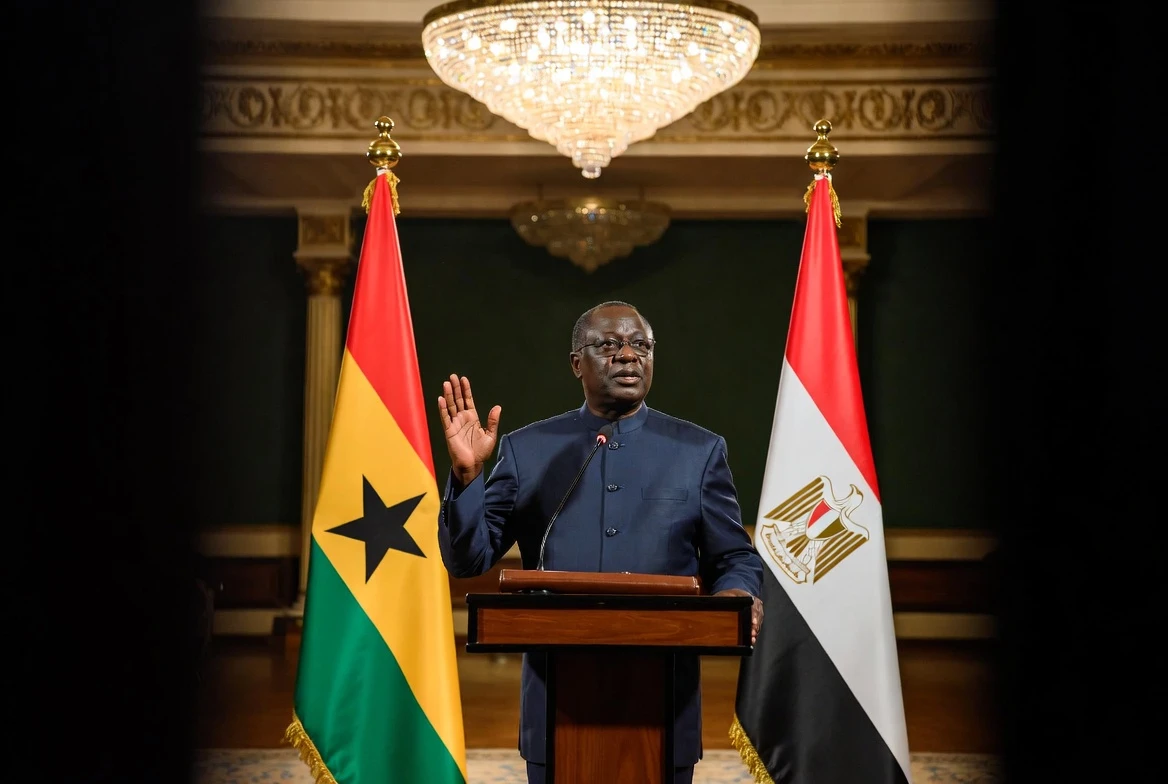
Ghana’s newly accredited Ambassador to Egypt used a Cairo reception to pitch a sweeping ten-sector cooperation plan and to renew an invitation to President Abdel Fattah El-Sisi for an official state visit to Accra. Egyptian hosts replied with a warning: they may consider reciprocal measures against the Ghana Embassy in Cairo over a Bank of Ghana levy on foreign-currency withdrawals.
The reception followed his presentation of Letters of Credence to President El-Sisi and served as his first official engagement in the post. The Egyptian capital is the operational base for a four-country posting that also covers Lebanon, Palestine and Sudan.
Ghana’s New Man in Cairo Lays Out an Agenda
Egyptian business leaders, members of the Egyptian African Businessmen Association, representatives of AFRIXM Bank and the Confederation of African Football, and members of the Ghanaian community in Egypt filled the room. Embassy staff also attended. The room was Korantwi-Barimah’s first formal audience in Cairo as ambassador.
Korantwi-Barimah used the platform to deliver greetings from Ghana’s President John Dramani Mahama and Foreign Minister Samuel Okudzeto Ablakwa, the ModernGhana write-up of the reception shows. He anchored the moment in Mahama’s standing invitation for President Al-Sisi to undertake an official state visit to Ghana. The cooperation pitch ran across ten sectors, from trade to cultural exchange. Two recent high-level contacts: the AU 7th Mid-Year Coordination Meeting in Malabo and the November 2025 inauguration of the Grand Egyptian Museum, bookended the run-up to this reception.
He framed the renewed engagement in the long arc of a partnership rooted in Ghana’s founding President Osagyefo Dr. Kwame Nkrumah and Egypt’s former President Gamal Abdel Nasser, whose shared vision of African unity and solidarity continues to shape cooperation between the two nations. “The relationship between our two countries must not only be anchored in our common history but also inspired by our shared aspirations for the future,” he said at the reception. The Ambassador told the Ghanaian community that the embassy would remain open, accessible, and responsive to their needs.
On January 13, 2026, he had presented his Open Letters at the Egyptian Foreign Ministry in Cairo, the embassy’s own post on the ceremony shows. He called on the Chief of Protocol and Assistant Foreign Minister, Ambassador El Dessouki Youssef. The courtesy visit set out the substantive asks he carried into the following months. He is also accredited to Lebanon, Palestine and Sudan, so his remit spans four countries with Cairo as the anchor. The reception in Cairo is the political arrival of his posting, not its beginning.
Ten Sectors and an AfCFTA Pitch to Egyptian Capital
The reception was a pitch. Korantwi-Barimah identified ten sectors as the corridor for cooperation: trade and investment, agriculture, manufacturing, renewable energy, pharmaceuticals, tourism, education, digital innovation, infrastructure development, and cultural exchange. He called on Egyptian businesses to anchor capital in Ghana, framing the country as one of Africa’s stable democracies with a favourable investment climate and strategic access to the West African market through the AfCFTA Secretariat headquartered in Accra. Industrial development, technology transfer, and job creation ran through the pitch.
- Trade and investment
- Agriculture
- Manufacturing
- Renewable energy
- Pharmaceuticals
- Tourism
- Education
- Digital innovation
- Infrastructure development
- Cultural exchange
The Secretariat’s presence in Accra, not any specific trade volume, was the structural lever the Ambassador leaned on. Ghana’s pitch tied its democratic stability to Egyptian risk appetite. The geographic story is regional, even if the trade pitch is bilateral. No target contract, project, or company was named at the reception. The corridors inside the corridor run through each named sector.
A Visa Waiver for Diplomats, a Work-Permit Fight for Staff
The two clearest asks from the January Open Letters presentation still carry weight. Korantwi-Barimah proposed a reciprocal visa waiver agreement for diplomatic and service passport holders between Ghana and Egypt. He also asked Cairo to facilitate work permit visas for Ghanaian local staff permanently working at the Mission in Cairo, ending the tourist visa status they currently hold. He pressed both in person on Ambassador El Dessouki Youssef. The framing was procedural and bilateral, not political. Both items were tabled on the same day in the same meeting room.
Al Dessouki Youssef’s response was measured. He confirmed some work had been done on the visa waiver and said the proposal would be forwarded to the relevant Egyptian authorities. On the work permits, he said the host Foreign Ministry would liaise with the Ministry of Interior to resolve what is impeding residence permits for the Ghanaian local staff. He also advised Ghana to consider relocating its embassy to Egypt’s New Administrative Capital, where land prices are moderate but may rise.
Felicitation from Foreign Minister Ablakwa to his Egyptian counterpart Badr Abdel-Aati went out in parallel, the Diplomatic Times account of the courtesy call shows. The visa and work-permit items now sit alongside the high-political cooperation track, treated as deliverables in their own right.
The Bank of Ghana Levy That Snapped the Cordial Tone
The same courtesy call produced a friction. Al Dessouki Youssef raised Egypt’s concern about a Bank of Ghana 2025 directive to commercial banks that introduced a 5% levy on foreign currency cash withdrawals from accounts funded by electronic transfers or cheques. He said the measure negatively affects the operations of the Egyptian Embassy in Accra. The tax dispute sat inside the bilateral renewal.
Korantwi-Barimah replied that the Mission would bring the matter to the attention of Ghana’s Ministry of Foreign Affairs and the relevant authorities for amicable resolution. The Egyptian envoy, the Diplomatic Times account shows, warned that Egypt may be compelled to consider a reciprocal measure to the Ghana Embassy in Cairo if the situation remains in effect.
The friction ran through the same courtesy call: a ceremony built on warmth ended on a tax dispute between central banks. Korantwi-Barimah held the diplomatic line in public while the operational file was routed back to Accra. The tax line runs through the Bank of Ghana; the political line runs through the Presidency. The leverage, for now, sits with Cairo.
Al Dessouki Youssef pivoted back to warmth afterward, recalling fond memories of his immediate past tenure as Egypt’s Ambassador to Ghana. He told the Ambassador that bilateral relations had grown over the decades and that the PJCC should be reactivated. Ambassadorial warmth could not lift the 5% levy file off the table.
From Nkrumah and Nasser to a State Visit Pitch
Korantwi-Barimah paid tribute to Nkrumah and Nasser for championing Pan-Africanism and the liberation of the continent. The strong foundation built by the two statesmen has enabled Ghana and Egypt to maintain close diplomatic ties over the decades, he said. The partnership continues to serve as a model for African solidarity and cooperation. Two recent high-level contacts frame the renewed era: the AU 7th Mid-Year Coordination Meeting in Malabo and the November 2025 inauguration of the Grand Egyptian Museum.
On regional peace and security, the Ambassador reaffirmed Ghana’s support for Egypt’s long-running efforts toward lasting peace in the Middle East. He echoed Egypt’s advocacy for the legitimate rights of the Palestinian people and for unhindered humanitarian assistance. The cooperation frame now extends into multilateral forums.
On multilateral cooperation, he congratulated Egypt on the election of Dr. Khaled El-Enany as Director-General of UNESCO. El-Enany is the first Director-General from an Arab country, and the second from Africa since Amadou Mahtar Mbow of Senegal held the post from 1974 to 1987, UNESCO’s announcement of the result shows. The election took place in Samarkand on November 6, 2025; El-Enany received 172 of 174 ballots. Ghana will work closely with Egypt within regional and international organisations to advance shared African priorities.
El Alamein in October and a Commission to Reactivate
Mahama and Al-Sisi are expected to meet on the sidelines of the 8th African Union Mid-Year Coordination Meeting, scheduled to take place in El Alamein in October 2026, the GhanaWeb write-up of the credentials event shows. Korantwi-Barimah called for the reactivation of the Ghana-Egypt Permanent Joint Commission for Cooperation (PJCC), a vehicle for collaboration in trade, investment, agriculture, infrastructure, education, tourism, technology, and other sectors. He framed Ghana as ready to learn from Egypt’s Public-Private Partnership record. The PJCC would be the operational spine of that exchange.
Ghana embraces Egypt’s development model and is ready to learn and share useful experiences.
The next milestone is operational, not ceremonial: a reconvened PJCC, a working visa waiver track, and a Bank of Ghana levy file that Egypt has now put on the bilateral agenda. Each is a working file, not a press item. Cooperation will be measured in signed instruments, not speeches.
Bilateral reset at a glance:
- More than six decades of Ghana-Egypt relations, anchored in Nkrumah-era ties.
- 5% levy on foreign-currency cash withdrawals introduced by Bank of Ghana in 2025, flagged by Egypt.
- October 2026: 8th African Union Mid-Year Coordination Meeting in El Alamein, expected Mahama and Al-Sisi meet.
- November 6, 2025: UNESCO elected Egypt’s Dr. Khaled El-Enany Director-General with 172 of 174 ballots.
- Ten-sector corridor pitched to Egyptian investors: trade and investment, agriculture, manufacturing, renewable energy, pharmaceuticals, tourism, education, digital innovation, infrastructure development, cultural exchange.
