
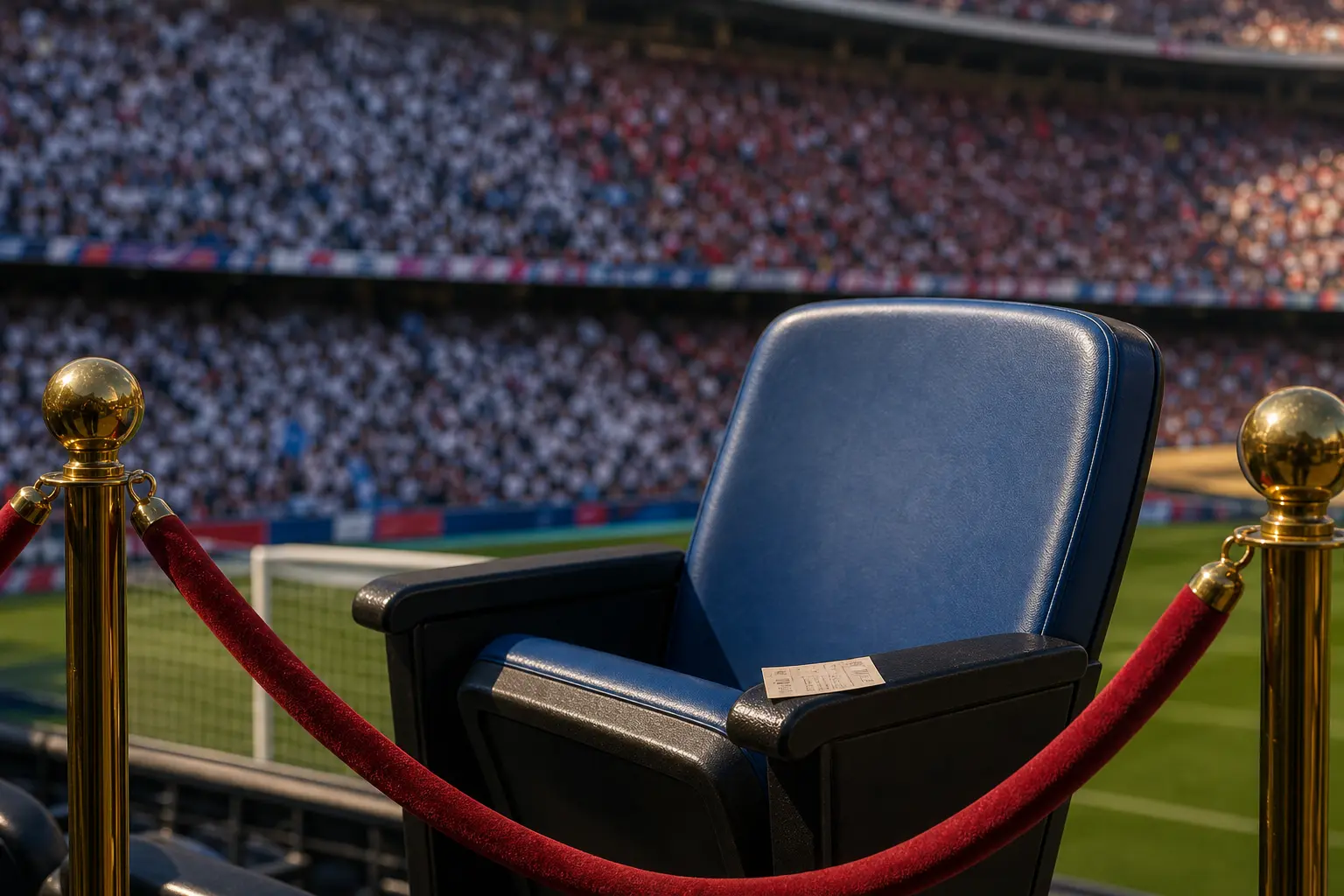
Four seats behind the goal at MetLife Stadium carried an asking price of $2,299,998.85 apiece on FIFA’s own resale marketplace this week. The same exact price sat on that marketplace in April, three months before Sunday’s World Cup final kicked off.
FIFA collects a cut on every legitimate resale through that marketplace, whether the listing ever sells or not, at a rate two state attorneys general are now scrutinizing. The going rate for an actual seat, meanwhile, fell hard in the three days before kickoff, a detail the seven figure headline number never captured.
The $2.3 Million Seats That Never Left the Shelf
ESPN reported on April 23 that four tickets for the final, located behind a goal in the lower deck at Block 124, Row 45, Seats 33 to 36, were listed on FIFA’s Resale/Exchange Marketplace at $2,299,998.85 each. CNN confirmed the same listing the next day, noting the four seats together would run more than $9 million.
That figure resurfaced in mid July as the tournament reached its final weekend. Sports Illustrated reported resale asks as high as $2.3 million for a Category 3 seat, alongside separate six figure listings at $575,000 and $595,000, adding that even if none of the top end tickets sell, they still speak to the summer’s pricing mania. Front Office Sports and Al Jazeera both cited the same roughly $2.3 million figure on the eve of the match.
Nothing in the public record shows any of those seats actually changed hands. The price simply reappeared, month after month, attached to some of the same blocks first flagged in April.
Demand for the tournament overall was real. More than half of the 72 group stage matches sold out entirely, and FIFA said 99.7% of seats were filled across the preliminary rounds, according to Reuters. Scott Friedman, a ticketing expert, put it plainly: “FIFA, to their credit, they set the prices high, and people ended up paying them.”
FIFA Takes a Cut No Matter Who Buys
FIFA does not just sell the original ticket. It also owns the exchange where fans resell it, and it charges for that too.
The organization runs the only official resale and exchange marketplace for standard World Cup tickets, and its own support pages spell out the math: a 15% fee charged to the buyer, plus a separate 15% deducted from whatever the seller collects, for a combined cut of up to 30% on every transaction that clears. FIFA’s help center describes it as 15% of the total price, inclusive of taxes, on both ends of the deal.
Fortune’s investigation into the pricing system reported that FIFA historically ran a more conventional model, with fee caps around 10% or less. For 2026, the organization dropped price caps entirely in the United States and Canada, arguing that caps would only push sellers toward outside platforms like StubHub. It built its own exchange instead, and kept the fee.
One economist Fortune interviewed for that investigation, identified by the surname Kessler, argued the fee structure gives FIFA a reason to let prices run rather than rein them in, saying it allows the organization to collect “being able to make 30% on the secondary market allows them to collect without as much backlash.”
Not every market got the same deal. Mexico and matches in Ontario, Canada operate under stricter rules that cap resale at face value or lower.
| Market | Resale Price Rule | Marketplace Fee |
|---|---|---|
| United States and most of Canada | No cap; sellers set their own price | 15% buyer fee plus 15% seller fee |
| Ontario, Canada | Capped at the original FIFA price or lower under provincial law | 15% buyer fee plus 15% seller fee |
| Mexico | Capped at the original FIFA price or lower | 15% buyer fee plus 15% seller fee |
The cap difference explains why a seat that sells for thousands of dollars over face value in New Jersey could not legally do the same a few hundred miles north in Toronto.
Subpoenas Land From Two State Capitals
The pricing model has drawn more than headlines. Fortune’s reporting said New York and New Jersey’s attorneys general subpoenaed FIFA in late May over the structure, though neither office has publicly detailed what the subpoenas seek.
The scrutiny arrived alongside separate pressure from Washington. By early May, Fortune reported, FIFA had nearly tripled its best available final ticket price to $32,970, up from a prior high of $10,990, the same day members of Congress pushed the organization for more transparency on how those prices were set.
FIFA has defended the system publicly. A FIFA spokesperson told CNN Sports the marketplace
provides a safe, transparent and secure environment for fans to sell or transfer tickets
and said the fees charged are aligned with standards across North American sports and entertainment.
The Real Price Crashed as Kickoff Neared
Away from the seven figure outliers, the actual market for a final ticket moved constantly, and mostly in one direction by the end.
Mid tournament, once the United States, Mexico and Canada were eliminated, resale prices hit their lowest point of the summer as home crowd demand cooled and FIFA released extra inventory, according to the tracking site SeatPick. Once Spain and Argentina secured their places in the final, prices jumped back, with the average resale ticket climbing toward $11,272 and premium seats reaching into six figures.
Then, in the final 72 hours, the cheapest ticket fell hard.
- Saturday: the get in price for the final sat around $10,000, according to TicketData’s live price tracker for World Cup tickets.
- Sunday, 12:45 p.m. ET: the same get in price had dropped to $6,826, a 12% decline over the previous three days, as sellers who had held out for higher offers began dumping inventory hours before the 3 p.m. kickoff.
- Same weekend: official partner Ticketmaster’s own final ticket listings showed resale inventory moving in real time as fans who could not travel offloaded seats.
MetLife Stadium holds 80,663 spectators for World Cup matches, the highest official FIFA capacity of any US venue by more than 10,000 seats over the next largest. That scale meant FIFA stood to collect millions more in ticket revenue by staging the final there rather than at Dallas, which had also been in contention for the match.
How Does the Final Compare to America’s Other Big Tickets?
The World Cup final’s crashed get in price of $6,826 still dwarfed the cheapest seats at America’s other marquee sporting events this year, even after the late slide. Only the NBA Finals came close.
| Event | Cheapest Resale Seat | Context |
|---|---|---|
| World Cup Final 2026 (MetLife Stadium) | $6,826 | Get in price Sunday afternoon, down from $10,000 two days earlier |
| Super Bowl LX 2026 (Levi’s Stadium) | About $4,500 | Get in price three days before kickoff |
| NBA Finals Game 3, 2026 (Knicks vs. Spurs) | About $7,000 | Opening get in price |
| World Cup Final 2022 (Qatar) | About $1,600 | Top face value seat, not a resale figure |
Bloomberg reported that this year’s Super Bowl carried the second highest average ticket price in the game’s history, at roughly $8,230, trailing only the 2024 Super Bowl in Las Vegas. Even that record sits well below what FIFA’s own marketplace listed for a single World Cup final seat.
Argentina Falls to Spain as the Rarest Ticket Goes Unclaimed
Spain beat Argentina in extra time to win the tournament, denying Lionel Messi a second consecutive title. Argentina had entered the match hoping to become the first team to win back to back World Cups since Brazil in 1962.
Messi, 39, was widely expected to be playing in his last World Cup. He arrived at the final with a chance to win the Golden Boot and Golden Ball together, a double achieved only three times in the tournament’s history and not since Italy’s Salvatore Schillaci in 1990, according to Sports Illustrated’s pre match reporting.
Argentina reached the final by beating England in a semifinal that left Jude Bellingham furious with goalkeeper Jordan Pickford and split opinion among English pundits afterward. Spain got there by eliminating France.
The last time the World Cup was played in North America, in 1994, a South American team lifted the trophy too, with Brazil winning it in the United States. This time a European side denied the repeat.
Ronan Evain, executive director of Football Supporters Europe, had described the tournament as an event for what he called “a happy few,”
pointing to visa denials and travel hurdles that kept fans from several countries away entirely while wealthier European supporters could still afford the trip. The seats behind the goal, listed at $2.3 million, were still unsold when the final whistle blew.
Frequently Asked Questions
Did the $2.3 million World Cup final ticket actually sell?
There is no evidence it did. The identical $2,299,998.85 listing for seats behind a goal at MetLife Stadium first appeared on FIFA’s resale marketplace in April and was still listed at kickoff in July, suggesting it functioned more as a market test than a real offer anyone expected to accept.
How much does FIFA charge to resell a World Cup ticket?
FIFA charges a 15% fee to the buyer and a separate 15% fee to the seller on every resale through its official marketplace. On a $10,000 ticket, that works out to roughly $8,500 paid to the seller after fees and about $11,500 charged to the buyer once the fee is added.
Can fans in Mexico resell World Cup tickets for a profit?
No. FIFA’s rules cap resale listings in Mexico, and separately for matches in Ontario, Canada, at the original price paid or lower, unlike the uncapped marketplace used across the rest of the United States and Canada.
What was the cheapest way to get into the World Cup final?
FIFA’s marketplace listed accessible seating, reserved for fans with disabilities, at around $8,050 in the tournament’s final hours, making it one of the cheapest categories still available going into Sunday’s match.
