
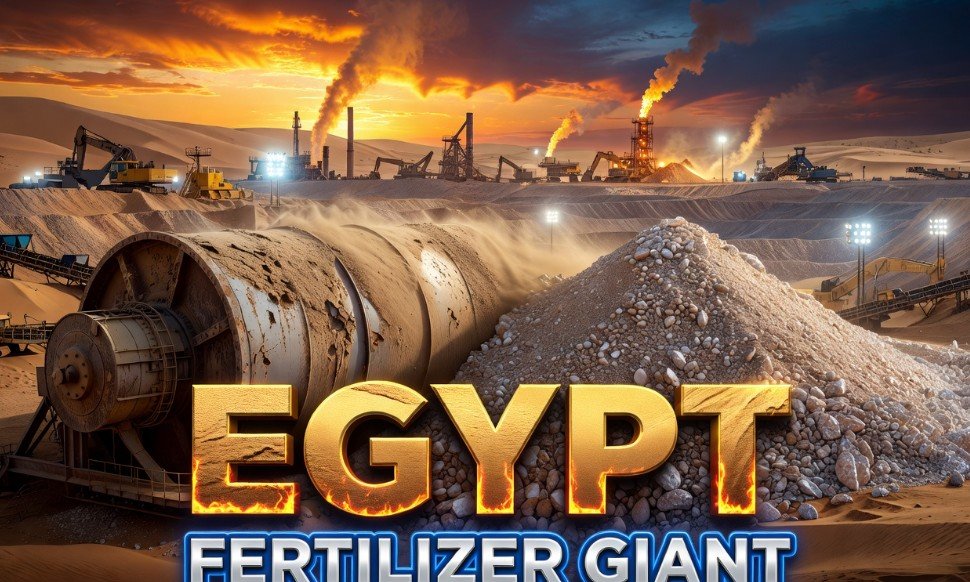
Egypt is done playing small in the global fertilizer game. With the world’s second-largest phosphate reserves sitting beneath its desert sands, Cairo is now pushing hard to move from raw rock exporter to full-scale fertilizer powerhouse, and the moves it is making right now could reshape the global supply chain.
Egypt’s Massive Reserves Are Finally Getting the Attention They Deserve
For decades, Egypt sat on an extraordinary natural treasure while others cashed in. According to the US Geological Survey, Egypt holds 2.8 billion metric tons of phosphate reserves, making it second only to Morocco globally.
Yet despite this enormous underground wealth, Egypt ranked only eighth in global phosphate production. The country produced 5 million metric tons of phosphate in 2024, a figure that tells just half the story of what Egypt is truly capable of.
The tide is clearly turning. Egypt’s phosphate ore production surged to approximately 16 million tons between July 2024 and April 2025, compared to just 11 million tons during the entire fiscal year 2023/2024. That kind of jump does not happen by accident.
Deposits are spread across three major regions: the New Valley at Abu Tartour, the Nile Valley stretching between Edfu and Qena, and the Red Sea coastal areas including Safaga, El-Hamrawein, and El Quseir. The Abu Tartour mine alone holds estimated reserves of up to 1 billion tons of ore, grading up to 31% phosphorus pentoxide content.
The Government Just Made Its Biggest Move Yet
On May 10, 2026, Prime Minister Moustafa Madbouli chaired a high-level meeting in Cairo to review the state of phosphate mining projects and the government’s push to build value-added industries around this strategic resource. The meeting drew in top officials from the petroleum ministry, the armed forces, and state mining bodies.
Madbouli made the direction crystal clear: Egypt will stop shipping raw phosphate rock and start exporting finished fertilizer products instead. Cabinet Spokesman Ambassador Mohamed el-Homosani confirmed that discussions covered current production capacity, the operational status of fertilizer plants, and active projects being implemented with local and international partners.
Minister of Petroleum and Mineral Resources Karim Badawi used the occasion to highlight a structural reform already underway. The Egyptian Mineral Resources Authority is being transformed into a fully economic body, now named the Egyptian Mineral Resources and Mining Industries Authority, specifically to attract more investment and accelerate the creation of new mining industries.
Cairo has also set a target to attract $1 billion in mining investment annually by 2030, while pushing to grow the sector’s contribution to GDP from about 1% today to 6% within the same timeline.
New Factories, New Partners, and a Billion-Dollar Bet
The ambition is backed by real projects already in motion. Here is what is happening on the ground right now.
- Ain Sokhna DAP Plant: Misr Phosphate is building a DAP/MAP/NPK fertilizer plant at Ain Sokhna in northeast Egypt, with construction set to begin in Q2 2026. The plant will have an annual capacity of 600,000 tonnes of diammonium phosphate (DAP), supported by a phosphoric acid capacity of 320,000 tonnes and sulfuric acid capacity of over 1 million tonnes per year.
- CJN Complex: Prime Minister Madbouli witnessed the signing of a $1 billion contract between Elsewedy Industrial Development and China’s CJN to build one of the largest phosphate chemical complexes in the Middle East within the Sokhna Industrial Zone. Phase one begins in 2026, with commercial operations expected by 2028.
- Abu Tartour Phosphoric Acid Complex: A major phosphoric acid complex is under construction at the heart of the Abu Tartour mine itself, with estimated first-phase construction costs of $573 million.
- Indorama Partnership: Singapore-headquartered global materials company Indorama Corporation signed a phosphate ore supply contract with Misr Phosphate, with a partnership for a fertilizer plant at Ain Sokhna involving a minimum investment of $500 million.
The three-phase CJN project at Sokhna tells the full story of Egypt’s long-term vision in one glance.
| Phase | Timeline | Focus |
|---|---|---|
| Phase 1 | Starts 2026, operates 2028 | Phosphoric acid, DAP and TSP fertilizers (300,000 tons each) |
| Phase 2 | Starts 2029, operates 2031 | High-purity phosphate chemicals, food-grade phosphoric acid |
| Phase 3 | Starts 2032, operates 2034 | Electric battery materials including lithium iron phosphate (LFP) |
That third phase is particularly telling. Egypt is not just chasing fertilizer dollars. It is positioning itself to supply the global clean energy supply chain too.
Global Markets Are Opening Up Fast for Egypt
The timing of Egypt’s push is no coincidence. The global fertilizer market is going through one of its biggest shake-ups in decades, and Egypt is right in the middle of it.
The European Union approved a new tariff structure on Russian and Belarusian fertilizers in mid-2025, with duties set to rise steeply through 2028. That is essentially eliminating two of Europe’s biggest traditional suppliers from the market. Egypt is stepping directly into that gap.
Misr Phosphate supplied around 600,000 tonnes of phosphate rock to Europe in just the first ten months of 2025, already surpassing the 433,000 tonnes the EU imported from Egypt in all of 2024. The company solved a long-standing barrier to European market access by developing “de-dusted” phosphate rock, which can now be safely unloaded at European ports that previously rejected Egyptian product due to fine particle content.
At the same time, Egypt is rapidly gaining ground in Southeast Asia. Phosphate rock shipments to Vietnam jumped from just 2,000 tonnes in 2023 to 47,000 tonnes in 2024, and then to 150,000 tonnes in 2025 alone. Some market participants now project Vietnamese phosphate rock demand could reach 1 million tonnes by 2026, with Egypt as a primary supplier.
In China, Egypt and Jordan together made up 99.5% of China’s phosphate rock import volume in October 2025. The global fertilizer market, valued at around $180 billion in 2024, is expected to grow steadily. The phosphate fertilizer segment alone is projected to reach $69.75 billion by 2029.
Egypt’s fertilizer exports already hit $2.19 billion in 2024. The government has also raised the export quota for fertilizer companies from 45% to 55% of total output, giving producers more room to capture the booming global demand. Egypt is also the largest urea fertilizer producer in the Arab world, with an annual output of around 7.6 million metric tons, making it a multi-front force in the global agricultural supply landscape.
Egypt is also investing in the knowledge that will sustain all of this. In March 2026, the country approved a national geomapping initiative with Xcalibur Smart Mapping, marking the first comprehensive aerial geological survey in more than 40 years. Drilling programs near El-Dakhla in southwest Egypt are already targeting new reserve identification, while the government plans to secure additional mining licenses in 2026 to expand its resource base even further.
Egypt’s phosphate ambitions are no longer a blueprint gathering dust on a government shelf. They are a construction site, a signed contract, a ship leaving port for Vietnam, and a factory being built to produce the materials that will power electric cars. The country that once sold raw rock cheap is now building the infrastructure to sell finished products at a premium, creating jobs, earning more foreign currency, and writing itself into the future of global food security and clean energy. For a country that has long had so much beneath its feet and so little to show for it, this moment feels like something genuinely new, and for the millions of Egyptians watching their country’s economic story unfold, it cannot come soon enough.
