
BUSINESS
Egypt’s Seven EGPC Blocks Went to Familiar Operators
Egypt’s June 2025 EGPC round gave 17 wells to companies already in the country, while arrears clearance and EGAS gas awards did the heavier lifting.

Egypt awarded seven EGPC oil and gas blocks in June 2025, with a minimum of 17 wells, to companies already producing in the country. The Ministry of Petroleum and Mineral Resources posted the results on June 19 after bids on the Egypt Upstream Gateway.
Sixteen months later, Western Desert oil has ticked up and partner arrears are gone. The gas shortage that pushed Egypt back to imports is a different race, run offshore.
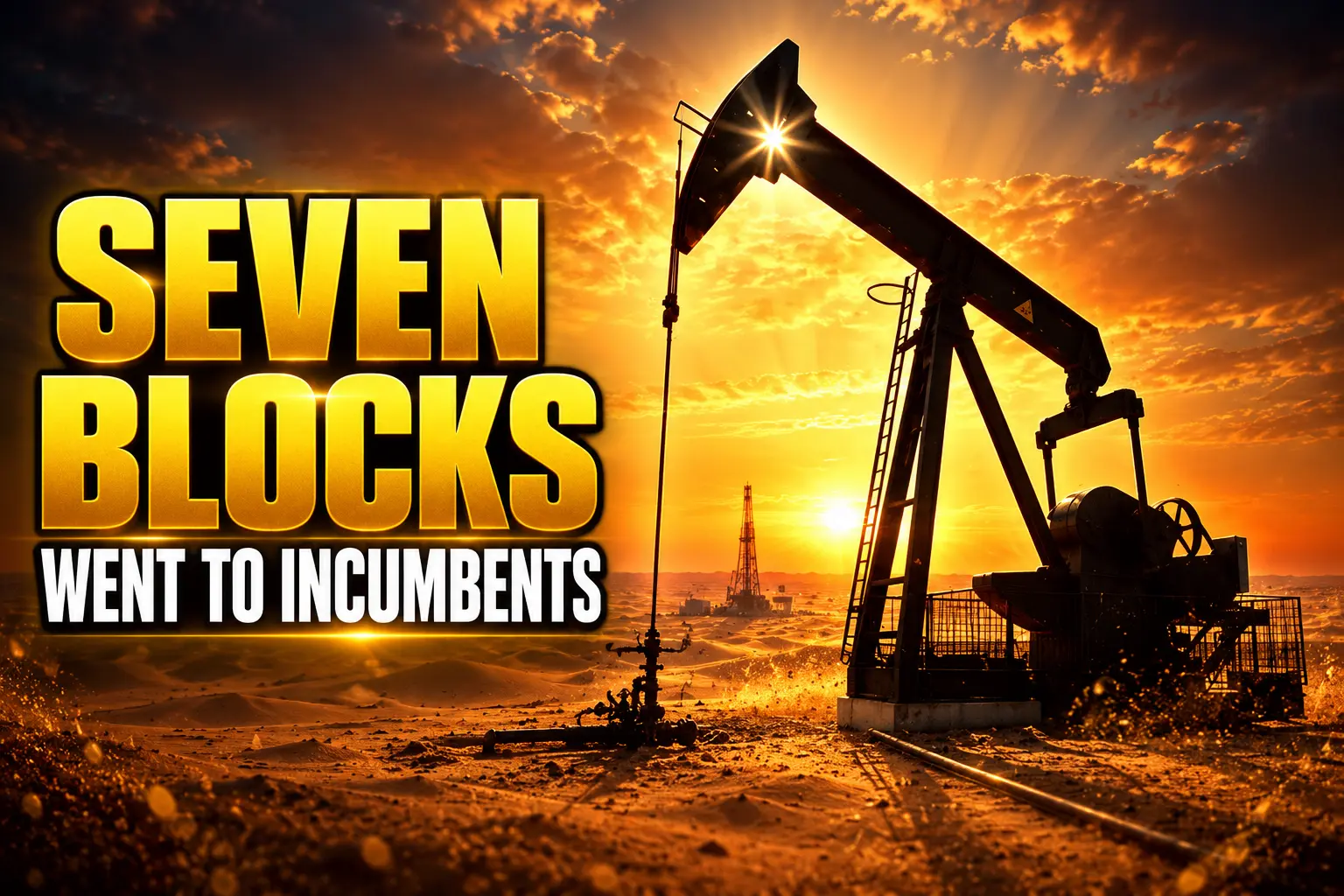
Incumbents Took Egypt’s Seven EGPC Blocks
The June 19 award notice named Cheiron Petroleum Corporation, Apache Corporation, Pharos Fayoum Company, IPR Energy Group, and a consortium of NPC and GHP. None of those names was a first-time visitor. Cheiron is an Egypt-focused producer with fields in the Western Desert, the Eastern Desert, the Nile Delta, and the Gulf of Suez. Apache has run the Khalda joint venture with EGPC in the Western Desert for more than 30 years. Pharos and IPR were already in the Fayoum trend.
The ministry framed the round as a way to pull in new exploration money and lift output. What the list actually shows is more acreage for the operators who already knew the rocks, the pipelines, and the EGPC paperwork. Apache’s West Kanayis K award was even written as development support under a merged Western Desert agreement, not as a wildcat campaign by a newcomer.
THE SEVEN EGPC AWARDS
| Block | Operator | Wells | Type |
|---|---|---|---|
| North Sitra and East Sidi Barrani | Cheiron Petroleum | 4 exploratory | Onshore acreage |
| West Kanayis K | Apache | Several development | Merged Western Desert deal |
| South Abu Senan | Pharos Fayoum | 3 exploratory | Onshore acreage |
| South Wadi El Rayan | IPR Energy Group | 3 exploratory | Onshore acreage |
| G and HNW | NPC and GHP | 7 wells | GPC brownfields |
Cheiron’s four, Pharos’s three, IPR’s three, and the consortium’s seven add up to the 17-well exploratory floor. Apache’s extra development wells sit on top of that count and were never given a public number.
Seven Wells on GPC Brownfields
The largest single work program did not go to Apache or Cheiron. NPC and GHP took the G and HNW tracts in mature fields of the General Petroleum Company and committed to seven wells, the same number as Cheiron, Pharos, and IPR combined. Those are brownfield wells aimed at lifting rates from old GPC stock, not a deepwater wildcat.
That split is the part of the round the investment-confidence language skipped. The ministry highlighted Apache and Cheiron as proof that international operators still wanted Egyptian barrels. The heaviest drill schedule went to a consortium whose job is to squeeze more oil from fields GPC already knows. Brownfield work is cheaper and faster than opening a new basin, and it uses plants and lines that are already in the ground.
It is also a bet with a ceiling. Mature reservoirs decline even when new wells land. Seven holes on G and HNW can slow that decline. They cannot replace a giant gas field in the Mediterranean, and they were never written as if they could.
A Mediterranean Award Six Days Later
The June 19 notice said four Mediterranean blocks would be awarded next through the Egyptian Natural Gas Holding Company. EGAS posted six awards on June 25, six days later: four offshore and two onshore. The ministry put exploration spend at about $245 million and a floor of 13 wells.
THE EGAS SIX
- North Samian and Northwest Atoll: Chevron Egypt and BG (Shell) committed to two exploratory wells on each block.
- North Ras El Tin: Eni’s IEOC Production committed to three exploratory wells offshore.
- East Alexandria: Cheiron Egypt committed to three exploratory wells, adding a gas leg to its June onshore haul.
- North Tanta: IPR took this Nile Delta onshore block with two wells, stacking it on South Wadi El Rayan.
- El Fayrouz: Perenco took the North Sinai onshore block for a 3D seismic survey and one exploratory well.
This was the round that brought Chevron, Shell, and Eni onto the June score sheet. The EGPC seven were mostly oil-leaning onshore positions for firms already in the Western Desert and Fayoum. The EGAS six were the gas bid, and they still added Cheiron and IPR rather than a clean sweep of new names. Dalia El-Gabry, Shell Egypt’s country chair, told an American Chamber of Commerce meeting on April 8, 2026, that the Stena IceMAX had arrived as the first rig in Egypt that year to drill West Mina on the West Delta Deep Marine trend.
Enerdata, the energy data firm, put Egypt’s gas output at 45 bcm in 2024, down from 71 bcm in 2021, and said the country became a net importer in 2023, with imports rising to 13 bcm in 2024 as Zohr slipped. A 13-well EGAS work program is real activity. It is not a volume that closes a drop of that size on its own.
What Cairo Settled Before the Rigs Moved
Karim Badawi, the petroleum minister, has been blunt about why drilling slowed. Partner arrears hit $6.1 billion at the end of June 2024 after a hard currency squeeze. Companies held back wells when invoices stacked up. The paydown, not the June 2025 acreage list, is the switch he now cites for the rebound in activity.
THE ARREARS PAYDOWN
- End of June 2024: Outstanding dues to foreign oil and gas partners stand at $6.1 billion.
- December 2025: The balance is down to $1.3 billion after monthly settlements with the Ministry of Finance.
- April 2026: Badawi puts remaining arrears at $770 million and repeats a June zero target.
- May 2026: The stock falls to $440 million.
- June 10, 2026: The ministry says the balance is zero.
Badawi recorded the close of the file in a June 10 statement that treated the payment as the condition for new work, not a side note.
By paying the full arrears, Egypt opens a new chapter, one defined by investments, growth, and increased production.
Karim Badawi, Minister of Petroleum and Mineral Resources, recorded statement, June 10, 2026
He had already told the same chamber meeting in April that dues had crushed investment and output, and that Apache’s Western Desert gas had responded once incentives and payments improved. Greg McDaniel, Apache’s senior vice president for international assets and Egypt general manager, said the firm had been in the country more than 30 years and put Apache’s five-year Egypt investment at about $5 billion. That historical spend is separate from a later three-year pledge sheet the ministry published with the arrears close: more than $19 billion of partner commitments, including $8 billion from Eni, $5 billion from bp, $2 billion from Arcius Energy, and $4 billion from Apache.
Egypt has also offered fields with arrears tied to new production, so cash and barrels move together instead of stacking as unpaid invoices. The June 2025 blocks did not create that leverage. Paying what was owed did.
Khalda Added More Than 10,000 Barrels
The first clean production print after the arrears close came from the Western Desert, where Apache already lives. The ministry said crude and condensate there rose by about 12,000 barrels a day over two weeks in early June 2026, and it tied the jump to drilling that followed the settlement of partner dues.
KHALDA’S JUNE JUMP
- Khalda oil: Output rose from 113,300 barrels a day on May 26, 2026, to 123,500 barrels a day on June 8, a gain of 10,200 barrels.
- Well mix: Five new Khalda wells, three development and two exploratory, went on stream in that window.
- GPC total: State-run GPC reached about 74,500 barrels of oil equivalent a day, its highest since October 2024, including about 61,000 barrels of crude.
- GPF-1X: The Abu Senan exploratory well added about 1,500 barrels of crude a day and 1 million cubic feet of gas a day.
Khalda is the EGPC-Apache joint venture, so the 10,200-barrel step is Apache’s operating machine, not a new company walking in from the June bid list. West Kanayis K was awarded to Apache to back that same merged Western Desert system. The ministry did not publish a well-by-well map that ties those five Khalda holes to West Kanayis K, and that link should not be invented. What the figures do show is that the operator which already held the desert put barrels on the line once cash started clearing.
A 10,200-barrel oil gain and a 1,500-barrel GPC well are useful against an import bill. They do not refill a gas system that lost tens of billions of cubic metres from the 2021 peak. Fast Western Desert tie-ins are the near-term patch. They are not a substitute for Mediterranean gas.
Pharos Spudded Again Once Cash Started Flowing
Pharos Fayoum took South Abu Senan with three exploratory wells in the June 2025 round. The wells Pharos actually spudded in 2026 were not advertised as those three. The company went back to work on El Fayum and North Beni Suef, the concessions it already held, after EGPC paid down receivables.
Katherine Roe’s team reported in its lowest Egypt receivables since 2021 that a $20 million EGPC payment in December 2025 doubled year-end cash and cut the Egypt receivable to $6.1 million. A June 8, 2026 company update said further 2026 receipts of $12.6 million, including $3.8 million that month, had brought Egypt receivables current for the first time since Pharos bought the assets in April 2019. Silah 8-2, the first well of a six-well 2026 program, spudded on June 4, 2026, four days after Khalda’s published June 8 production print sat on the board.
That sequence is the second-order of the 2025 awards in miniature. Pharos still holds a three-well South Abu Senan commitment. The wells it could staff and fund first were on acreage already in production, once the state paid. IPR, which took South Wadi El Rayan from EGPC and North Tanta from EGAS in the same June window, is the other incumbent that used the dual round to thicken a position it already understood.
Fourteen Blocks Are Open on the Gateway
The Egypt Upstream Gateway, launched at EGYPES 2020 with EGPC and SLB and live since 2021, is still the shop window. Badawi opened the next international round on August 11, 2026, with 14 exploration areas in the 2026 round split between the two state holders. EGPC is offering six blocks in the Gulf of Suez, Sinai, and the Western Desert, with bids due at noon Cairo time on November 11, 2026. EGAS is offering eight in the Mediterranean, the Nile Delta, and North Sinai, with bids due at noon on December 14, 2026.
EUG has been posting deepwater teasers into the close, including West El King, a 2,523 square kilometre Mediterranean tract about 70 kilometres north of El Dabaa in 1,675 to 2,675 metres of water. That is a different class of risk from GPC brownfields and West Kanayis development wells. It is also where Egypt has to find gas if Western Desert oil gains are going to be more than a rounding item on the import bill.
The companies that collected the seven EGPC blocks in June 2025 are the same type of bidder the gateway will see again: Apache, Cheiron, Pharos, IPR, and local groups that already have crews in the desert. Chevron, Shell, and Eni already have the EGAS paper from the week after. The 17-well floor from that EGPC list is still a work program, not a published completion tally. The barrels Egypt can count so far came after it paid the $6.1 billion, from fields the winners were already running.

Christa Pike Survived the Execution Tennessee Would Not Pause

Musk’s Oligarch Charge Hits a Queue of Three

Circle Puts USDC and EURC Into SAP Pay Workflows

Ring’s First Smart Lock Skips Home Wi-Fi for Sidewalk

GTA 6 Puts Cash Back on the Story Path

Salah Captained Egypt to Their First World Cup Win

Aramco Crash Kills 14 Two Days After Oil Restart

Apple Labor Day Deals Hide June’s Memory Price Hike

Zelda’s 40th Switch 2 Ships Without a Zelda Game

Palworld 1.0.4 Adds Palpedia Search After the 1.0 Launch
-
 NEWS5 months ago
Salah Captained Egypt to Their First World Cup Win
-
 BUSINESS4 months ago
Aramco Crash Kills 14 Two Days After Oil Restart
-
 NEWS2 months ago
Apple Labor Day Deals Hide June’s Memory Price Hike
-
 GAMING1 month ago
Zelda’s 40th Switch 2 Ships Without a Zelda Game
-
 GAMING1 month ago
Palworld 1.0.4 Adds Palpedia Search After the 1.0 Launch
-

 NEWS3 months ago
El Niño Puts Israel’s Needed Winter Rain on a Flood Clock
-

 ENTERTAINMENT1 month ago
King Charles Letter Keeps Harry and Meghan as Private Citizens
-

 ENTERTAINMENT4 months ago
A Thousand and One Drops Off Riyadh’s October Calendar