
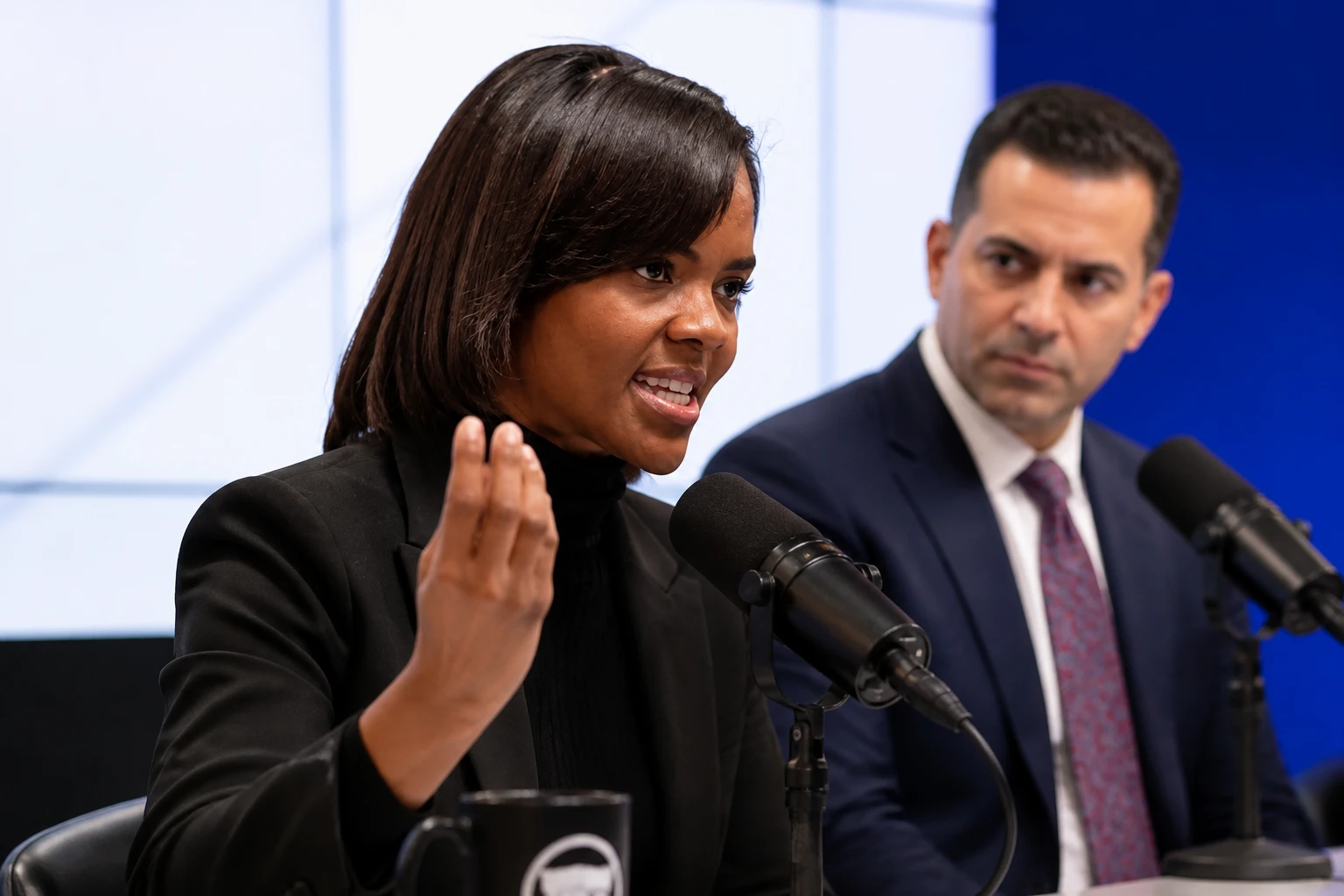
Candace Owens told online debater Andrew Wilson she has no direct evidence Israel killed Charlie Kirk, saying she “couldn’t say Israel was on the ground and shot and killed Charlie Kirk” during a nationally streamed debate on August 14, 2026.
The exchange, moderated by Patrick Bet-David, capped nearly a year of public sparring over whether the official account of the Turning Point USA founder’s death is complete. Owens still pressed a motive and an unconfirmed cellphone claim.
What Happened on the Debate Stage
Wilson, host of “The Crucible,” had offered Owens as much as $300,000 to defend her claims in public. He pressed her repeatedly for positive evidence of Israeli involvement.
Well, I couldn’t say Israel was on the ground and shot and killed Charlie Kirk.
Owens said she was establishing motive instead. She pointed to Kirk’s private complaints about pro-Israel donors in the weeks before his death and what she called unusual behavior by Israeli officials afterward. When Wilson asked if she had “any positive evidence whatsoever that Israel killed Charlie Kirk,” she repeated a claim first made in November 2025: that 12 Israeli-registered cellphones were detected near the shooting scene at Utah Valley University. She called the chain of events “a conspiracy building.”
No law enforcement agency has confirmed the phone claim. It did not originate with any named investigator. Owens has attributed her broader suspicions to unnamed sources and Turning Point USA insiders.
The stage exchange distilled a year of assertion into a single demand: produce positive proof or concede its absence. Owens chose motive and pattern. Wilson treated that choice as a failure to meet the burden she had invited by taking the offer.
What remained after the concession was not silence. It was a narrower set of claims still circulating without institutional backing.
- Direct operational role for Israel: Owens said she could not assert it.
- Donor-pressure motive drawn from Kirk’s private complaints: still advanced.
- Twelve Israeli-registered cellphones near the UVU scene: repeated, still unconfirmed.
- Broader “conspiracy building” framing: retained as interpretation, not proof.
The Sole Suspect and the Evidence So Far
Tyler Robinson, 23, remains the only person charged in Kirk’s September 10, 2025, killing at Utah Valley University. Prosecutors are seeking the death penalty. No agency or prosecutor has presented evidence of foreign involvement.
A five-day preliminary hearing in July 2026 laid out the state’s core case. Judge Tony Graf is expected to rule on probable cause after oral arguments in early September, near the anniversary of the shooting.
| Charge or Item | Detail from Hearing |
|---|---|
| Aggravated murder | Primary charge; death penalty sought |
| Surveillance video | Robinson on campus four times that day, including rooftop prone position around 12:22 p.m. |
| Rifle | Mauser Model 98.30-06 found wrapped in towel; DNA at least 1 trillion times more likely Robinson’s |
| Texts and note | Roommate Lance Twiggs received note and messages prosecutors call a confession |
| Other charges | Felony firearm use, obstruction, witness tampering, violent act near a child |
Twiggs, Robinson’s former roommate and romantic partner, told prosecutors in a recorded interview that Robinson expressed regret the next day: he “wishes he hadn’t done it.” Texts shown in court included Robinson directing Twiggs to a note that said, in part, “I had the opportunity to take out Charlie Kirk, and I took it,” followed by an alleged admission “I am, I’m sorry.”
An ATF analysis linked cartridge casings and a Dremel tool from Robinson’s home to the recovered rifle. DNA on the towel and a rooftop screwdriver showed strong support for contributions from Robinson and Twiggs. A bullet jacket fragment from Kirk’s body was inconclusive. The defense questioned forensic handling and discarded leads, including an empty pistol holster found near the scene.
Robinson turned himself in the day after the shooting. He has not entered a plea. Full details of the arrest and early charges appear in the detailed arrest and charging timeline.
Taken together, the hearing record is physical and digital rather than geopolitical. Campus video, ballistics links, DNA statistics, and the roommate messages form the spine of the state’s presentation. The defense focus on handling gaps and the inconclusive fragment does not, on the public record so far, supply a competing foreign actor.
How the Israel Angle Took Shape
The theory first surfaced publicly in September 2025. Owens claimed hedge fund manager Bill Ackman staged an “intervention” pressuring Kirk over his Israel stance at a Hamptons gathering weeks earlier. Ackman and other attendees disputed the account. Owens later suggested possible roles for France, Israel and Egypt and said she did not believe the charged suspect acted alone.
Erika Kirk, the widow, publicly urged Owens to stop. In a December 10, 2025, Fox News appearance she said, “Stop. That’s it. That’s all I have to say.” The two met privately five days later for a four-and-a-half-hour conversation both called productive. Owens continued the theories on her podcast afterward.
She has also advanced an earlier Egyptian planes theory linking Erika Kirk and other threads. Those claims sit inside a broader wave of Israel conspiracy claims that have circulated in conservative media and online.
- September 10, 2025, Kirk fatally shot at UVU Turning Point USA event before roughly 3,000 people.
- September 11-16, 2025, Robinson surrenders; charged with aggravated murder and related felonies; prosecutors signal death penalty.
- September 2025, Owens airs Ackman “intervention” claim; Ackman disputes it.
- November 2025, Owens first promotes 12 Israeli-registered cellphones claim.
- December 10-15, 2025, Erika Kirk public plea; private four-and-a-half-hour meeting.
- March 2026, Former National Counterterrorism Center Director Joe Kent tells Tucker Carlson the death deserved further scrutiny: “It’s a data point that we need to look into.” Kent, who resigned amid an Iran-war dispute, is under FBI investigation for alleged classified leaks that predate the resignation.
- July 2026, Five-day preliminary hearing presents surveillance, DNA, texts and ballistics.
- August 14, 2026, Owens-Wilson debate; concession on direct proof.
Kent did not confirm the phone claim or name a country. No official has validated foreign involvement.
The sequence shows how quickly motive talk and unconfirmed technical claims fused into a durable online narrative. Public pushback from Erika Kirk and the disputed Ackman account slowed the story in mainstream channels without ending it on podcasts or social platforms.
Crowd Reaction and the Fracture on the Right
On X, high-engagement clips framed the debate as Owens collapsing under the evidence demand. One widely viewed post said she “had nothing” after nearly a year of daily discussion and could not stand by many of her own prior claims. Another large account posted simply that she admitted zero evidence and “only thinks it.”
Other voices pushed back. Some argued Wilson spent too much time on Owens’ character and under-delivered on proving the official case “overwhelming,” leaving questions about Erika Kirk’s public statements and timeline details unresolved for skeptics. A portion of the audience still treats the phone claim, early Netanyahu statements, and Google Trends clusters as data points worth scrutiny even while granting the absence of direct proof.
- Wilson pressed the burden of proof on the person advancing alternative positive claims of foreign involvement or a patsy.
- Owens treated some prosecution materials as hearsay and emphasized degraded DNA and blurry footage interpretations.
- Split audience takeaway: technical win for Wilson on the Israel accusation; lingering gut-level doubt among some who reject a lone-gunman close.
- Critics warned the unproven accusations normalize hostility toward Jews; supporters said silence from agencies keeps questions alive.
The debate clarified the evidentiary gap on the Israel charge without resolving the deeper fracture. Owens still says she believes Robinson was set up. Wilson put his confidence that Robinson killed Kirk in the 75-85 percent range based on current evidence, a figure some critics treated as admitting room for doubt under a criminal standard.
That percentage range became its own flashpoint. Supporters of the official case heard practical certainty short of absolute proof. Skeptics heard an opening. Neither reading added new forensic material; both showed how the same public record can feed opposite conclusions once trust in institutions splits.
What the Court Calendar Holds
Judge Graf will hear oral arguments in early September and rule on whether probable cause supports the charges. If the case proceeds, Robinson will be arraigned and enter pleas. Cameras have been allowed. The defense has already challenged death-penalty eligibility and media comments by prosecutors; one prosecutor was held in civil contempt earlier.
The preliminary hearing evidence presentation remains the fullest public look at the state’s case. It includes campus video of Robinson’s movements, the rooftop sequence timed to the shot, the recovered rifle with engraved rounds, DNA statistics, and the roommate’s interview and messages. Defense experts highlighted the inconclusive bullet fragment and investigative choices.
Owens’ concession does not bind investigators or end online discussion. The phone claim, donor-pressure motive, and Kent’s earlier comments continue to circulate among those who want more federal scrutiny. At the same time, the only charged suspect faces a death-eligible aggravated-murder case built on physical and digital evidence that has survived preliminary testing.
| Track | Where matters stand |
|---|---|
| Criminal case | Single defendant; probable-cause ruling due after early September arguments |
| Foreign-involvement claim | No agency confirmation; Owens declined to assert direct Israeli action on stage |
| Phone claim | Unconfirmed; not tied to a named investigator |
| Public argument | Motive and setup theories still aired; direct-proof demand unmet |
How Motive Talk Differs From Court Proof
Owens framed donor pressure and post-shooting official behavior as reasons to keep asking who benefited. Wilson treated those points as background that never crosses into attribution without a chain of custody, a named source, or forensic placement of another actor at the scene.
Motive can explain why a hypothesis feels urgent to its holders. It does not replace the materials the preliminary hearing actually tested: video of movements on campus, DNA ratios on the towel and screwdriver, ATF links from casings and a Dremel tool to the Mauser, and the roommate note and texts prosecutors call a confession.
The phone claim sits in a third category. It is specific enough to sound technical, yet it still lacks confirmation from any law enforcement agency and did not originate with any named investigator. Repeating it keeps the hypothesis visible. It does not convert it into admitted evidence.
That is why the debate landed as a clarification rather than a full settlement. One side left with an intact motive story. The other left with the only charged suspect and a public record that has not, so far, named a foreign hand.
What the Concession Leaves Unsettled Online
Owens’ refusal to place Israel “on the ground” did not retire the wider set of threads she has aired since September 2025. The Ackman dispute, the Egyptian planes theory, Kent’s call for further scrutiny, and the setup belief about Robinson all continue in the same information space that produced the debate.
Wilson’s 75-85 percent confidence range, offered from the evidence now public, functions the same way for the opposite camp. It is high enough to reject a sweeping foreign plot on present facts. It is low enough for critics to say a criminal jury standard still leaves room to argue.
Agencies have not closed every online question by validating the phone claim or by charging additional defendants. They also have not adopted the foreign-involvement frame. The result is parallel tracks: a death-eligible state case moving on a calendar, and a media argument that treats every gap in that case as unfinished business.
Kirk was 31. The shooting became one of the most documented acts of political violence in recent years, with graphic video spreading within minutes. Nearly a year later the legal process moves forward on a single defendant while the public argument over what else, if anything, remains unfinished.
The reckoning on stage did not erase the theories. It simply made the absence of direct proof impossible to ignore.
