
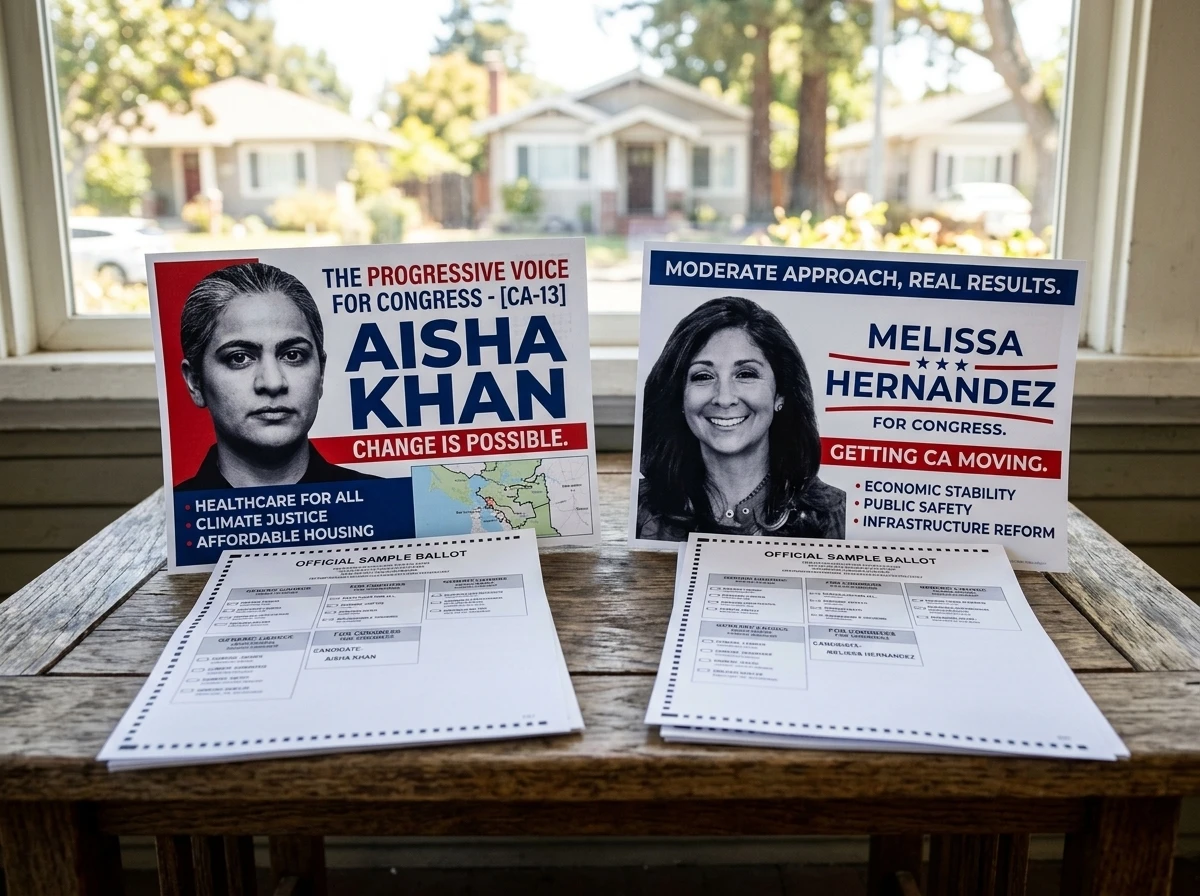
AIPAC-linked super PACs have poured close to $4 million into California’s 14th Congressional District special runoff, backing moderate Melissa Hernandez against progressive state Sen. Aisha Wahab in the race to finish Eric Swalwell’s term. Wahab remains the clear favorite after taking 42.8 percent in the June primary to Hernandez’s 16.8 percent.
The two Democrats face voters again in November for the full term. The late money has turned a local East Bay contest into a national test of whether the pro-Israel lobby can close a double-digit deficit after its costly loss in Michigan.
Two Democrats, two records on Israel and costs
Wahab, 39, is the child of Afghan refugees and the first Muslim woman elected to the California Senate. She has centered her campaign on affordability, civil rights and an end to endless wars. Her site states “We cannot bomb our way to lasting peace,” citing civilian tolls in Afghanistan, Iraq, Syria and Libya. It does not single out Israel.
In an April debate she answered “yes” when asked if Israel’s war in Gaza constituted a genocide. On a livestream with Hasan Piker she said she would have voted for the Stop the Bombs Act and supported ending all U.S. military aid to Israel while keeping humanitarian aid. She co-authored a September 2025 California resolution on Gaza hostages with Jewish state Sen. Scott Wiener that also drew signatures from the Legislative Jewish Caucus.
I work well with the Jewish community. I’m very proud to support them. They’re my constituents. As an Afghan, you know, I really deeply want to ensure that all people feel welcomed and safe and secure in this nation. And we know that there’s a rise in antisemitism. We know all of that. But that doesn’t mean you can’t criticize a foreign nation. You can’t criticize their leadership.
Wahab said that on the livestream. She has also worked with local Jewish leaders on Afghan refugee resettlement after the 2021 U.S. pullout. She attributed the volume of outside spending against her to “pure racism and prejudice,” adding that her Jewish Senate colleagues were “literally confused.”
Hernandez, 51, is president of the Bay Area Rapid Transit board and former mayor of Dublin. She has focused on lowering costs, fighting crime and public safety. At the same debate she declined a yes-or-no on genocide, saying Israel had a right to defend itself after October 7, 2023, but that “the destruction into Gaza has gone too far.” She has said of the outside money: “I have no say over independent expenditures. That is the law, and I see them when you do.” And: “I have thousands of donors and not one of them sets my agenda.”
The money arrived after voters already chose
United Democracy Project, AIPAC’s main super PAC, has spent close to $2.5 million boosting Hernandez and attacking Wahab. Bold America, which has received funding from UDP and was started by former Congressional Hispanic Caucus figures, has spent roughly $1.8 million. ABC7 tallied about $3.7 million benefiting Hernandez versus under $400,000 for Wahab since mid-July. American Priorities, a pro-Palestinian PAC, put in $200,000 for Wahab. J Street Action Fund added $100,000.
| Group or campaign | Approximate spend or raised | Side |
|---|---|---|
| United Democracy Project | $2.5 million | Hernandez |
| Bold America | $1.8 million | Hernandez |
| Total outside pro-Hernandez | ~$3.7-4.1 million | Hernandez |
| American Priorities + J Street | ~$300,000 | Wahab |
| Hernandez campaign (through July 29) | $1.53 million raised | Hernandez |
| Wahab campaign (through July 29) | $632,000 raised | Wahab |
The influx followed Wahab’s strong June showing. FEC filings and reporting from The Hill and others show the bulk arrived in the final weeks. A national Democratic strategist who has worked with UDP told The Hill the group has become “a flashpoint” and “less helpful not just to themselves, but unfortunately to the cause itself.” Longtime California operative Garry South said AIPAC risks becoming the issue that hurts the candidate it tries to help.
Primary margins and the dual ballot
California’s top-two system sent the leading pair to the August 18 special general regardless of party. The official June primary canvass totals gave Wahab 52,961 votes (42.8 percent) and Hernandez 20,731 (16.8 percent). In the June 2 regular primary for the full term Wahab took 38 percent to Hernandez’s roughly 17 percent. No one cleared 50 percent, forcing the runoff.
- June 16 special primary: Wahab 42.8%, Hernandez 16.8%, total votes 123,677
- June 2 full-term primary: Wahab ~38%, Hernandez ~17%
- August 18 special general: short-term seat through January 2027
- November general: full two-year term, same two candidates again
Governor Gavin Newsom’s Newsom proclamation setting the special election followed Swalwell’s April 14 resignation amid sexual misconduct allegations he has denied. An early Democratic effort to clear the field for a caretaker former senator collapsed when Wahab refused to stand down.
Local issues still run the district
Israel has not been the dominant topic on the ground. Wahab’s campaign and Hernandez’s both lead with costs, housing, transit and safety in Alameda County suburbs and the Tri-Valley. The district is solidly Democratic. Swalwell was a reliable Israel supporter; the seat stays blue either way. Hernandez has argued her opponent wants to nationalize a race that should stay about East Bay service. Wahab has the California Democratic Party endorsement and labor unions. Hernandez has police and fire unions plus Democratic Jewish Reps. Lois Frankel and Brad Schneider.
Crowd reaction on X treated the spending as an attempt to buy a seat voters had already sized up. Rep. Pramila Jayapal urged voters to “STOP AIPAC from buying this congressional seat.” J Street contrasted its transparent $100,000 with AIPAC’s funneling through outside groups and said it expected the attempt to fail, as others had this cycle. Prediction markets put Wahab near 85-89 percent before polls closed.
Endorsements and the party split
- Wahab: California Democratic Party, Our Revolution, multiple labor unions, Bob Wieckowski
- Hernandez: Alameda County Firefighters, Fremont Firefighters, Livermore-Pleasanton Firefighters, Teamsters Joint Council 7, Fiona Ma, Adam Gray, Sam Liccardo, Zoe Lofgren
- Outside counter: J Street Action Fund and American Priorities for Wahab
The pattern matches other 2026 fights. In Michigan, progressive Abdul El-Sayed defeated AIPAC-backed Rep. Haley Stevens in the Democratic Senate primary despite $60-70 million in mostly pro-Israel outside spending. That result landed two weeks before the CA-14 money surge. Similar flashpoints appeared in Florida and New Hampshire primaries.
A related Democratic primary shift on Israel arms has already shown progressives testing limits on unconditional aid inside the party. CA-14 is smaller dollars but the same test in a deep-blue seat.
What the short-term seat still decides
Whoever wins serves only until January. Both candidates remain on the November ballot for the full term in a slightly redrawn district. The special therefore functions as a high-visibility stress test: can multi-million independent expenditures reverse a 20-plus-point primary verdict when the progressive holds the state party, labor and a clear local lead on kitchen-table issues?
UDP spokesman Patrick Dorton called Wahab’s racism charge “100 percent ridiculous,” noting endorsements of Black and Hispanic Caucus members. An AIPAC spokesperson said the community of 7 million Americans focuses on helping pro-Israel Democrats and Republicans win in November and pointed to more than 250 primary wins. Hernandez has kept her focus on district service. Wahab has kept hers on rejecting the money’s premise.
Results were still being tabulated after polls closed. The November rematch will tell whether any shift sticks.
