
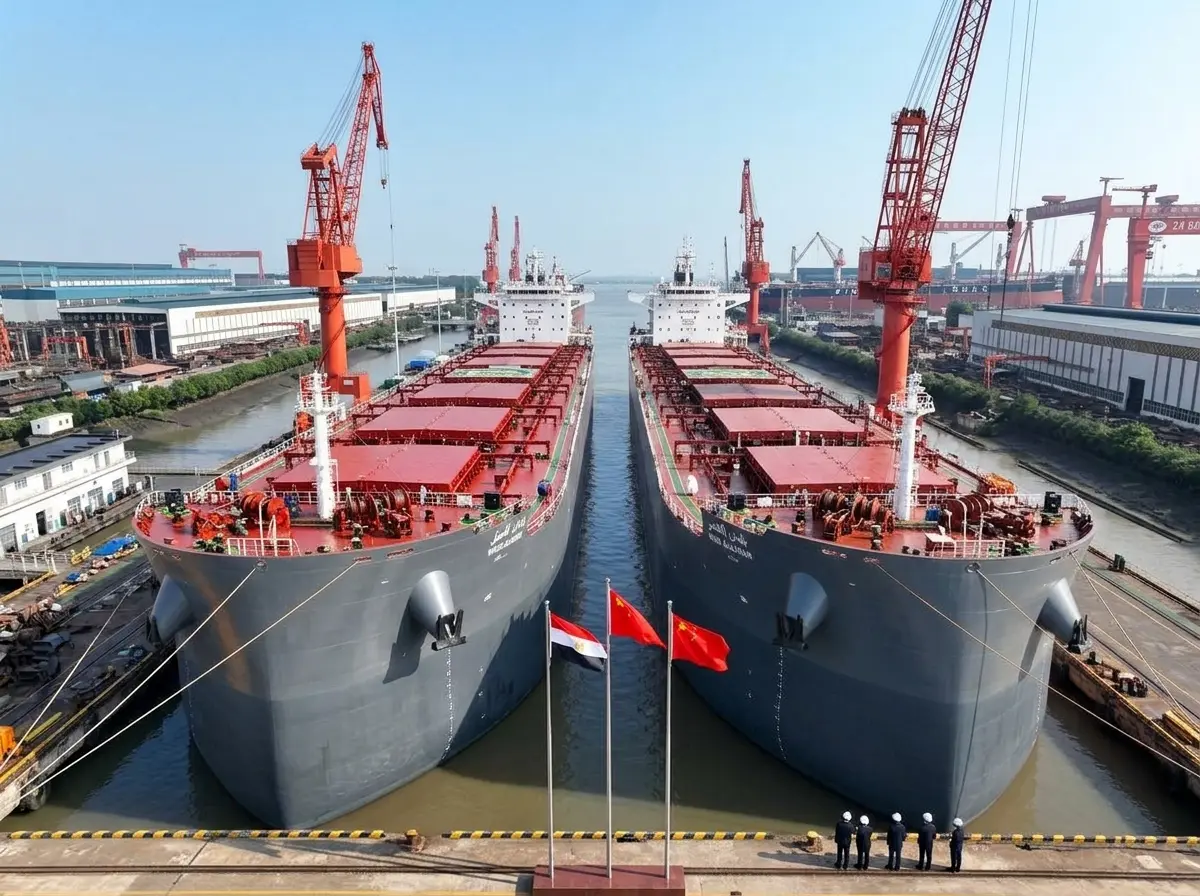
Egypt’s National Navigation Company took delivery of two identical 82,000-tonne Kamsarmax dry-bulk carriers, Wadi Al-Nil and Wadi Al-Qamar, from China’s New Hantong Shipyard on 14 August 2026. Transport Minister Kamel El-Wazir attended the handover. The next day the ministry reported Wadi Al-Nil had already left for Egypt while Wadi Al-Qamar prepared to sail.
The pair lifts NNC’s owned fleet to 16 vessels and forms part of a five-ship programme with the same Chinese yard that now stretches to 2028.
Identical Kamsarmax sisters join the Egyptian flag
Both ships measure 229 metres long, 32.26 metres in beam and 14.5 metres in draft. Each carries a MAN B&W main engine rated at 7,490 kilowatts and is fitted with a Selective Catalytic Reduction system plus a Ballast Water Management System. The ministry said the ships meet current international environmental conventions and use modern hull and systems design for better fuel efficiency.
| Specification | Wadi Al-Nil / Wadi Al-Qamar |
|---|---|
| Deadweight | 82,000 tonnes |
| Length overall | 229 m |
| Beam | 32.26 m |
| Draft | 14.5 m |
| Main engine | MAN B&W 7,490 kW |
| Fuel capacity | 2,054 m³ (up to 90 days) |
| Fresh water | Desalination plant, 20 tonnes/day |
Daily News Egypt reported the vessels also carry integrated navigation, communication and engine-monitoring packages. The 90-day endurance without bunkering suits long-haul dry-bulk trades that dominate Egypt’s grain, coal and mineral movements.
Fleet climbs to 16 and modernisation hits 54 percent
With the two new ships NNC now operates 16 vessels. Two further 82,000-tonne Kamsarmaxes ordered in June 2025 are due by the end of 2028. Once they arrive the company says the modernisation rate of its owned fleet will reach approximately 54 percent.
Earlier data on the company’s site showed a prior fleet of roughly 14 Egyptian-flagged ships, mostly bulk carriers totalling about one million tonnes plus one 3,013-TEU container vessel. The new deliveries therefore represent a clear step-change in both unit size and age profile.
- January 2024, Wadi Al-Arish, first Kamsarmax from New Hantong, delivered and entered service.
- April 2024, Contract signed for Wadi Al-Nil and Wadi Al-Qamar.
- June 2025, Contract signed for two more 82,000-tonne sisters (Wadi Al-Natrun and Wadi Al-Alaki) for 2028 delivery.
- 14 August 2026, Handover of Wadi Al-Nil and Wadi Al-Qamar witnessed by the transport minister.
- End-2027 target (accelerated), Minister asked the yard to bring the final pair forward from 2028.
Managing Director Mohamed Soliman Metwally called the latest delivery “a milestone in the company’s fleet modernisation programme” and said it reflected efforts to meet international standards.
Five-ship China programme and a repair-yard idea
Cooperation with New Hantong began with Wadi Al-Arish. The April 2024 and June 2025 contracts bring the total ordered from the yard to five vessels. El-Wazir used the ceremony to press for earlier delivery of the last two ships and floated a further proposal: joint work to establish a specialised commercial-vessel repair yard in Egypt modelled on New Hantong itself.
He framed the relationship as part of wider Egyptian-Chinese transport cooperation that already covers ports, logistics, railways, green transit, digital systems and smart ports. The yard idea would keep more maintenance spend and skills inside Egypt rather than sending ships abroad for docking.
The 40-vessel goal and 30-million-tonne ambition
El-Wazir repeated Egypt’s target of a 40-vessel commercial fleet by 2030, fully owned by Ministry of Transport affiliates. The stated purpose is to raise the share of Egypt’s foreign trade carried on Egyptian-flagged ships and to put more Egyptian tonnage on international routes.
- Current NNC fleet after delivery: 16 vessels
- Additional on order from same yard: 2 (targeted end-2027)
- National commercial fleet goal 2030: 40 vessels
- Annual carrying capacity goal: up to 30 million tonnes
Earlier ministry figures had put the existing commercial fleet near 20 ships with only 9 million tonnes of annual capacity. Reaching 30 million tonnes would more than triple that volume. UNCTAD 2024 Egypt maritime fleet figures show the national-flag fleet at roughly 1.84 million DWT (bulk carriers about 902,000 DWT) and ownership at just over 4 million DWT, confirming the gap that the newbuilding drive is meant to close.
Who gains when national ships carry more Egyptian cargo
Every extra Egyptian-owned bulk carrier that loads Egyptian grain, fertiliser, coal or minerals keeps freight revenue and control inside the country. Foreign operators currently move a large fraction of that trade; a larger national fleet reduces that exposure and improves bargaining power on rates and schedules.
The same ships can feed longer logistics chains. Egypt is advancing the Lake Victoria-Mediterranean corridor (VICMED), a planned 3,800 km navigable and multimodal link from East Africa to the Mediterranean via the Nile. Lake Victoria-Mediterranean corridor project details show the route is intended to give land-locked states sea access and to create new cargo flows that Egyptian-flag tonnage could capture. A modern bulk fleet is a natural feeder for that corridor once inland legs mature.
- Higher share of Egypt’s own import and export cargoes on national bottoms
- More Egyptian-flag presence on Red Sea, Mediterranean and longer-haul routes
- Potential cargo base for VICMED inland-to-sea traffic
- Domestic repair and training demand if the proposed yard materialises
- Stronger negotiating position versus global bulk operators
Parallel trade initiatives, such as the Finland-Egypt trade partnership headroom highlighted at recent expos, show Cairo looking for diversified cargo partners that a larger national fleet can serve directly.
Green kit and long-range design choices
SCR systems cut NOx emissions to meet current IMO tiers. Ballast-water treatment limits the transfer of invasive organisms, a requirement under the Ballast Water Management Convention. The 2,054 cubic-metre fuel tanks and 20-tonne-per-day desalination plants are sized for extended voyages without intermediate calls, useful on routes where bunkering options are limited or expensive.
These features also future-proof the ships against tightening port-state and charterer environmental scoring. Charterers increasingly prefer newer, lower-emission tonnage; NNC’s newest units should therefore command better employment and rates than older sisters.
The NNC company history and vision page ties the programme explicitly to Egypt’s Sustainable Development Strategy 2030 and to the goal of a modern, safe, eco-friendly merchant fleet that secures foreign trade.
Next hulls and the open question of pace
El-Wazir’s request to advance Wadi Al-Natrun and Wadi Al-Alaki to end-2027 would bring the full five-ship China series into service a year earlier than contracted. Whether the yard can compress the schedule remains open, but the political signal is clear: Cairo wants the modernisation rate to climb faster.
Financing the remaining climb from 16-plus-two toward 40 vessels, plus the cost of crewing, docking and competing against the world’s largest bulk operators, will test the plan. Ecofin Agency noted those exact pressures. Yet the pattern of serial ordering at one yard, the acceleration request and the repair-yard proposal together show a government treating the merchant fleet as strategic infrastructure rather than a residual commercial activity.
Wadi Al-Nil is already at sea. Wadi Al-Qamar will follow. Two more hulls are on the books. The arithmetic of 40 ships and 30 million tonnes by 2030 is now a matter of execution.
