
Saudi Arabia lifted its disposal rate of ozone-depleting substances to 69 percent in the first half of 2026 and cleared more than 8,000 metric tons of ODS and HFCs year to date, the National Center for Environmental Compliance reported. The numbers land months after the Kingdom brought the Kigali Amendment into force and show a permit machine already running at scale.
Arab News put the cleared volume above 8,500 tonnes and framed the 69 percent as a five-year phaseout measured to mid-2026. Either reading points past the headline percentage to the system that produced it.
The 69 Percent and the Tonnes Cleared
NCEC data show the disposal rate of ozone-depleting substances reached 69 percent during H1 2026 while the phase-out project regulated import and circulation under Montreal Protocol rules. More than 8,000 metric tons of ODS and HFCs moved through clearance since the start of the year.
Spokesperson Saad Al-Matrafi tied the gains to tighter oversight through the environmental clearance system. Since 2023 the center has issued more than 3,200 clearance permits for substances covered by the Protocol, keeping importers inside national quotas.
- 69% disposal / phaseout rate reported for H1 2026 (five-year frame in some accounts)
- >8,000 t ODS and HFCs cleared in 2026 to date (Arab News: >8,500 t)
- >3,200 Montreal-related clearance permits issued since 2023
- Kigali accepted 10 September 2025, in force for Saudi Arabia from 9 December 2025
Those permits and electronic links to customs are the load-bearing parts of the story. They turn paper commitments into daily gatekeeping at the border.
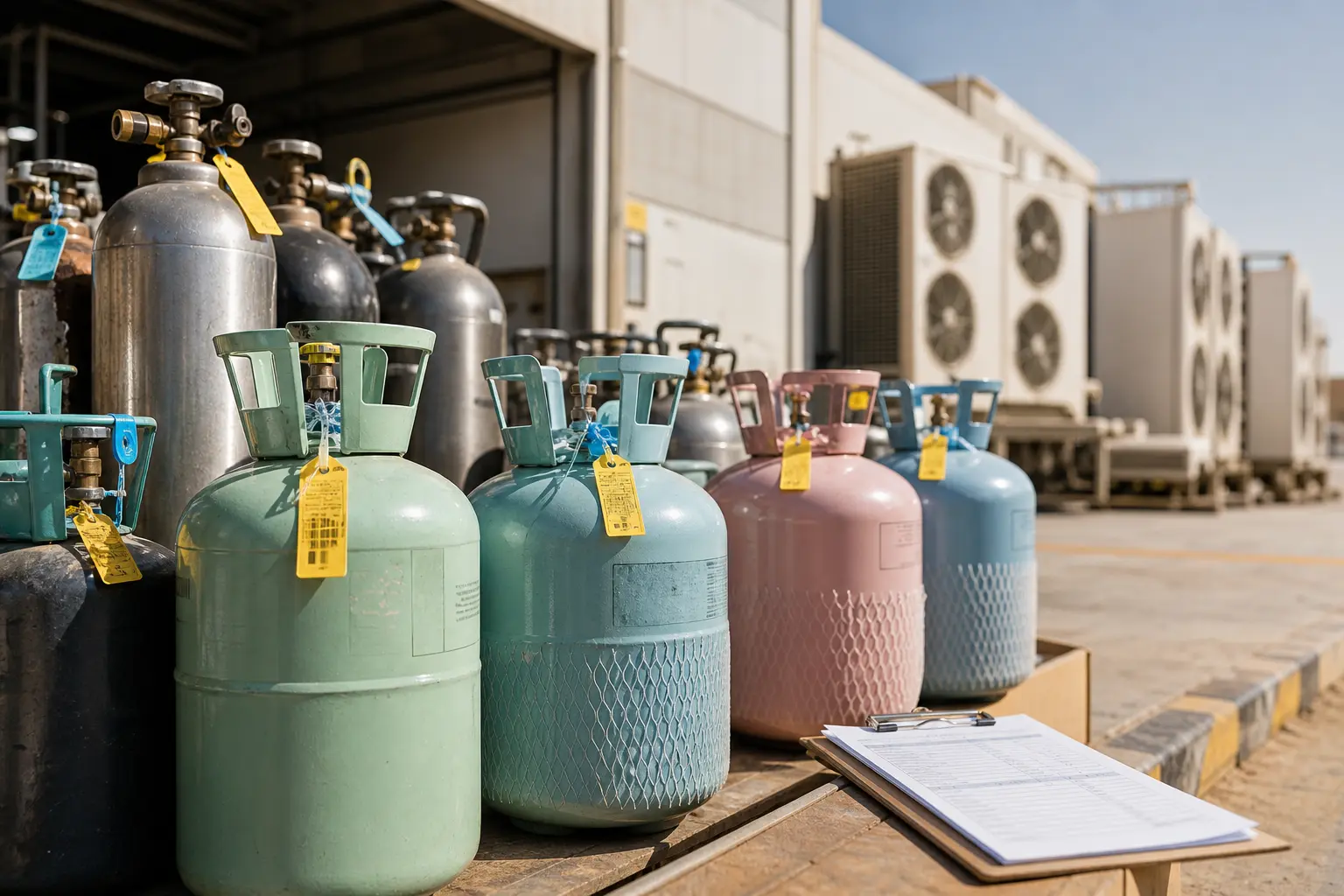
How the Clearance System Works
Al-Matrafi said electronic integration between NCEC and the Zakat, Tax and Customs Authority sped shipment clearance while holding environmental standards. The same platform now reaches financial collection tools through links to the Ministry of Finance and the customs platform.
The system governs import, export and domestic trade of controlled substances. It issues the permits that match allowed quantities, then clears the physical cargo only when the paperwork and the goods align. Processing times fell, investors moved goods faster, and the center kept a live view of what entered the market.
That architecture matters more than any single percentage. HCFC phase-out for Article 5 parties ends in 2030 with a small servicing tail. HFC controls under Kigali are just beginning. A working licensing and quota engine is the difference between targets on a chart and tonnes that never reach the atmosphere.
Kigali Lands in a High-Ambient Market
Saudi Arabia ratified the Kigali Amendment on 10 September 2025 as the 166th party; the amendment entered into force for the Kingdom on 9 December 2025. The Saudi Arabia country profile at the Ozone Secretariat records acceptance of Kigali, an established ODS licensing system, and an HFC licensing system reported on 18 November 2025.
Under the Amendment, Saudi Arabia sits in Group 2, the high-ambient-temperature (HAT) cohort that also includes Bahrain, Kuwait, Oman, Qatar, the UAE, Iraq, Iran, India and Pakistan. These countries receive a later freeze and reduction path because extreme heat drives heavier air-conditioning loads and makes some low-GWP alternatives harder to deploy at scale.
| Milestone | A5 Group 1 | A5 Group 2 (HAT, incl. Saudi) |
|---|---|---|
| Baseline | Avg HFC 2020-22 + 65% HCFC baseline | Avg HFC 2024-26 + 65% HCFC baseline |
| Freeze | 2024 | 2028 |
| First cut | 2029 (-10%) | 2032 (-10%) |
| Later steps | 2035 (-30%), further cuts to late 2040s | 2037 (-20%), further cuts to late 2040s |
The Group 2 high-ambient-temperature HFC schedule gives Saudi Arabia breathing room on the freeze date, yet the 2024-2026 baseline window is already open. Consumption recorded now will set the reference line for every later cut. Clearance data collected in 2026 therefore feed directly into the HFC accounting that starts binding in 2028.
What the May Meetings Put on the Table
In early May 2026 the National Ozone Unit at NCEC and UNEP OzonAction’s West Asia programme held two national consultation meetings in Riyadh. More than 30 officials from ministries and agencies examined updates to ozone-protection rules and a unified licensing framework for refrigeration and air-conditioning technicians.
The first session covered technical regulations on leakage prevention, recovery, recycling, reclamation and destruction, plus licensing for workshops that handle refrigerants. Participants also discussed an integrated national data system for refrigerant trade and use, professional licensing upgrades, bringing the informal sector into the rules, and stronger monitoring of substances controlled under the Protocol and its amendments.
The second session focused on proposed regulations that would create one national standard for RAC technician competence, environmental compliance and safe handling. The package is meant to support ODS and HFC obligations while cutting leakage and improving energy efficiency across the cooling sector. The May 2026 national consultation meetings on refrigerants put the servicing sector, where most HCFC-22 still lives, at the center of the next compliance push.
Saudi Arabia’s ratification of the Kigali Amendment to the Montreal Protocol in September 2025 marked a significant step toward reducing gases with a high climate impact, reflecting the Kingdom’s commitment to supporting international efforts to address climate change.
Al-Matrafi made that point while stressing Gulf cooperation on ozone protection. The technician and recovery rules under discussion are how that commitment becomes daily practice in a market heavy with installed HCFC equipment.
Ozone Recovery Timeline the Kingdom Is Joining
The wider Montreal system has already removed the bulk of the original threat. Parties have phased out 98 to 99 percent of ODS production and consumption relative to 1990 levels. The ozone layer is healing; the 2024 Antarctic hole was smaller than in recent years, according to the World Meteorological Organization.
If policies hold, recovery to 1980 values is projected around 2040 for most of the world, 2045 over the Arctic, and 2066 over the Antarctic. The same controls delivered large climate co-benefits because many ODS are also potent greenhouse gases. Kigali’s HFC phase-down is projected to avoid up to 0.5 °C of warming by 2100.
- 1987, Montreal Protocol adopted; later achieves universal ratification.
- 2007, Parties accelerate HCFC phase-out; Article 5 countries target full phase-out by 2030.
- 2016, Kigali Amendment adds HFCs with differentiated schedules.
- 2025, Saudi Arabia accepts Kigali (10 September); entry into force 9 December.
- 2026, NCEC reports 69% ODS disposal rate and multi-thousand-tonne clearances; RAC licensing consultations held.
- 2028-2030, Group 2 HFC freeze (2028); HCFC phase-out completion for Article 5 parties (2030).
The Montreal Protocol phase-out and Kigali phase-down rules remain the template. Saudi Arabia’s recent numbers place it inside that long arc rather than outside it.
Permits, Quotas and the Servicing Tail
Earlier Multilateral Fund work shows where the remaining HCFC load sits. Stage I of Saudi Arabia’s HCFC Phase-out Management Plan, approved in 2012, targeted a 40 percent cut from baseline by 2020 and financed foam conversions and servicing support. Foam manufacturing largely exited controlled substances; RAC servicing consumption of HCFC-22 stayed stubborn because the installed base kept growing and installation practices leaked refrigerant.
Total Multilateral Fund approvals for Saudi Arabia stand at roughly US$20.7 million as of late 2025, with ongoing HPMP and institutional-strengthening projects still active. An early ban on HCFC equipment imports and manufacturing was adopted to shrink future servicing demand. The 3,200-plus permits issued since 2023 are the live enforcement layer on top of those older policy choices.
Gulf coordination adds another layer. Shared climate, shared equipment markets and shared HAT status under Kigali give the six GCC states reason to align licensing and recovery standards. Al-Matrafi presented that cooperation as part of the Kingdom’s regional role.
The second-order effect is straightforward. A clearance system that already moves thousands of tonnes under quota, paired with technician licensing and recovery rules still being written, becomes the operating system for the HFC baseline years and the 2028 freeze. In a desert economy that runs on cooling, those institutional details decide how much high-GWP gas is avoided.
Frequently Asked Questions
What is the Montreal Protocol and why does it still matter?
Adopted in 1987 and universally ratified, the Montreal Protocol controls production and consumption of nearly 100 ozone-depleting substances through binding, timed cuts that differ for developed and developing countries; it has eliminated 98-99 percent of those chemicals and put the ozone layer on a recovery path while also cutting large volumes of greenhouse-gas emissions.
When did Saudi Arabia join the Kigali Amendment?
Saudi Arabia accepted the Kigali Amendment on 10 September 2025; the amendment entered into force for the Kingdom on 9 December 2025, adding HFCs to the list of controlled substances with a later freeze date because the country is classified in the high-ambient-temperature group.
Why does Saudi Arabia follow a different HFC schedule?
As a Group 2 high-ambient-temperature party, Saudi Arabia’s HFC baseline uses average consumption in 2024-2026 plus 65 percent of its HCFC baseline, freezes in 2028, and takes its first 10 percent cut in 2032, giving extra time for cooling technologies that must perform in extreme heat.
What are HCFCs and HFCs used for in Saudi Arabia?
HCFCs (especially HCFC-22) and HFCs are the main refrigerants in air-conditioning, commercial refrigeration and some foam applications; after foam manufacturing largely converted, the largest remaining HCFC load sits in the RAC servicing sector that maintains the existing equipment stock.
How much Multilateral Fund support has Saudi Arabia received?
The Ozone Secretariat records Multilateral Fund approvals totaling about US$20.7 million as of the end of 2025, covering HCFC phase-out management plans, institutional strengthening and related projects implemented with UNEP and UNIDO.
The 69 percent figure is a progress marker. The clearance permits, customs link and technician rules under design are the capacity that will decide whether the next decade of HFC cuts actually arrives on schedule in one of the world’s most cooling-intensive economies.
