
Iran’s military warned Sunday that its war with the United States could widen even further if Washington resumes air strikes, hours after Omani diplomats wrapped two days of direct talks with Tehran over safe passage through the Strait of Hormuz, the waterway that carries roughly a fifth of the world’s oil. Iranian army spokesman Mohammad Akraminia told state television that the “geography of war” already stretches from the Bab al-Mandeb Strait to United States military positions in Jordan and the Gulf.
The louder story this weekend was Tehran’s threat. The one that may decide what happens next is playing out quietly in Muscat and Doha, where Gulf mediators are working phones and conference tables while a shaky pause in US strikes holds together on little more than mutual suspicion.
Iran’s Military Widens the Map of the War
Akraminia’s warning came after 13 consecutive nights of escalating US strikes gave way, without explanation, to a sudden pause. The US military said Saturday that its naval blockade against Iran “remains in full effect,” but offered no reason for halting the streak. Axios, citing two people familiar with the matter, reported that President Donald Trump had directed the military on Friday to hold off on new strikes.
“It was previously announced that if the Americans insist on their aggression, the geography of war will expand, and now this warning has been realised in the field,” Akraminia said. He described the expansion as a direct result of Washington’s insistence on continuing what he called “aggressive actions” against Iran, adding that operations now reach “from US bases in Jordan to the countries bordering the Gulf.”
| Flashpoint | Parties Involved | Latest Development |
|---|---|---|
| Bab al-Mandeb Strait | Yemen’s Houthi rebels, Saudi Arabia | Missile strikes hit Saudi oil installations along the Red Sea coast over the weekend |
| Strait of Hormuz | Iran, Oman | Deputy foreign ministers met in Tehran Friday and Saturday; daily crossings still far below normal |
| Caspian Sea | Iran, Ukraine | Iranian commercial vessel struck, one sailor killed; Tehran summoned Kyiv’s charge d’affaires |
| Arabian Gulf and Jordan | Iran, United States | Akraminia says operations now reach US bases in Jordan and Gulf-bordering states |
The Red Sea front turned violent again as Houthi missiles struck Saudi oil installations along the Red Sea coast, reopening a front that had briefly gone quiet. In the Caspian, Iran’s foreign ministry lodged a protest after a strike that killed one sailor aboard an Iranian commercial vessel and wounded another; Kyiv’s charge d’affaires in Tehran was summoned over what the state news agency Irna called a “hostile and criminal” act, part of the dispute now surrounding a sailor’s death in the Caspian Sea. Ukraine’s President Volodymyr Zelenskyy said separately that Ukrainian forces had struck a Russian warship and vessels used to move Iran-linked military cargo. Bab al-Mandeb and Hormuz both rank among the world’s busiest maritime chokepoints, which is precisely why Akraminia chose to name them.
Why Oman Is the Broker Both Sides Still Trust
Gulf capitals that talk toughest about Iran, Saudi Arabia and the United Arab Emirates among them, are not the ones Tehran picks up the phone for. Oman is. The channel dates to 2013, when Omani officials carried the first quiet messages between Washington and Tehran that eventually produced the 2015 nuclear deal, a process former US deputy secretary of state William Burns later detailed in his own memoir of the negotiations.
Oman’s trust with Iran runs deeper than diplomacy. In the 1970s, Iran under the shah sent troops that helped Sultan Qaboos bin Said put down an uprising in Oman’s Dhofar region, a debt Omani officials still cite when explaining why Muscat, alone among Gulf states, has never treated Tehran as an adversary. Oman’s foreign minister, Badr Albusaidi, has led that broader mediator role in recent years, though the Hormuz shipping talks that wrapped in Tehran on Saturday were run at the deputy foreign minister level, according to Iran’s Foreign Ministry spokesman Esmaeil Baghaei.
The two sides exchanged views on shared principles and operational mechanisms for managing safe shipping through the strait, while respecting Iran and Oman’s sovereign rights as its two coastal states, Baghaei said. The Omani delegation left Tehran on Saturday evening. Technical and political consultations, Iran said Sunday, are continuing.
A Fifth of the World’s Oil Runs Through This Strait
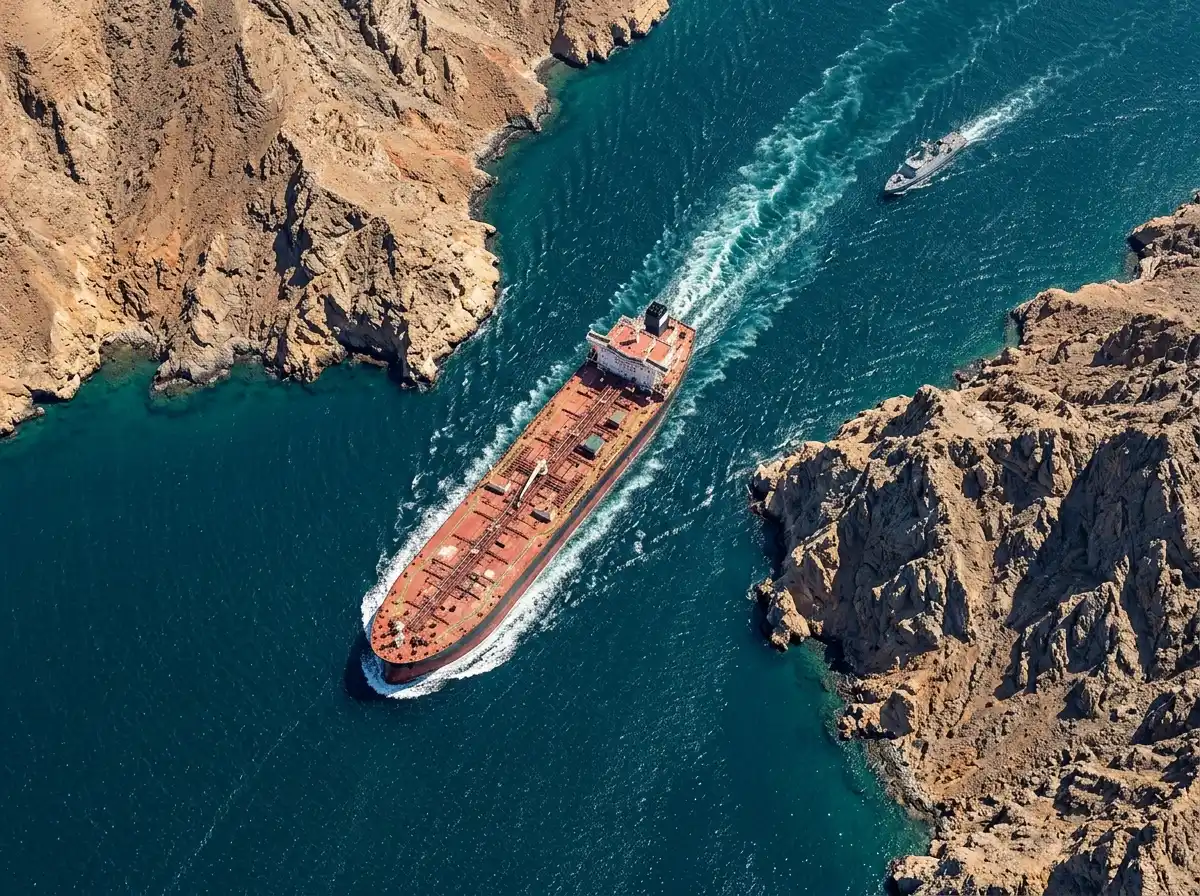
The reason Muscat’s conversation with Tehran carries more weight than another round of threats sits in the numbers. The US Energy Information Administration’s own tracking shows the strait carries about 20% of the world’s daily oil use, a share unmatched by any other waterway on earth.
- 20% of global oil consumption normally moves through the strait on an average day, per the EIA.
- 14.6 million barrels a day passed through Hormuz in the first quarter of 2026. A subsequent review of the agency’s figures found Hormuz throughput down almost 30% in early 2026 from a year earlier.
- 13 ships a day were crossing the strait as of July 23, according to brokers tracking traffic, down from a truce-era average of 45.
- 84% of Hormuz crude was headed to Asia in 2024, before this year’s escalation, with China, India, Japan and South Korea taking most of it.
Traffic has not recovered. Iran’s Mehr news agency reported Sunday that shipping patterns through the strait remained unchanged even as the Omani delegation departed Tehran.
One Confirmed Splash, One Unconfirmed Blast
Sunday brought two separate tanker scares, and only one of them has been verified.
What We Know
- A tanker in the southern Red Sea reported an unknown projectile splashing into the water close to the vessel, according to the UK Maritime Trade Operations (UKMTO), the British navy office that tracks shipping threats in the region.
- Crew and vessel were reported safe, UKMTO said, though any environmental impact has not been confirmed.
What’s Unconfirmed
- A separate claim from Iran’s Mehr news agency that a tanker exploded in the Strait of Hormuz after deviating from a shipping route designated by Tehran.
- Responsibility and casualties from that reported Hormuz incident, which Western monitors had not confirmed as of Sunday.
Iranian authorities have warned repeatedly that vessels straying from routes Tehran designates will bear responsibility for whatever follows, a warning Mehr’s report repeated again on Sunday.
Qatar Works Its Own Line to Riyadh
Qatar opened a second channel. Prime Minister and Foreign Minister Sheikh Mohammed bin Abdulrahman called Saudi Foreign Minister Prince Faisal bin Farhan on Sunday to discuss the broader conflict, with both ministers stressing dialogue and the “implementation of commitments” contained in a memorandum of understanding between Washington and Tehran, according to Qatar’s Foreign Ministry.
By Sunday afternoon, at least three separate diplomatic tracks were running at once, none of them a direct Washington-Tehran line:
- Oman’s deputy foreign minister and his Iranian counterpart, working through the technical details of safe passage through the Strait of Hormuz.
- Qatar’s prime minister and Saudi Arabia’s foreign minister, coordinating on de-escalation and the US-Iran memorandum’s commitments.
- A senior Iranian source, delivering Tehran’s position to Washington through Reuters rather than through any direct channel.
Each track is moving on its own clock, and none of the three has produced a public document beyond a shared description of “principles.”
Will This Pause Hold?
Probably not for long unless Washington makes the halt explicit. Iran has told US officials it will match the pause exactly, strike for strike, but Tehran remains more doubtful than hopeful, and a similar halt in March collapsed within weeks under the same suspicion.
A senior Iranian source described Tehran’s position to Reuters on Sunday as ‘attack for attack.’ “If the attacks stop, Iran will also halt its operations. That message has already been conveyed to the United States,” the source said.
There is more scepticism than optimism about the halt in attacks. The prevailing view is that the pause is tactical rather than genuine.
The same source made that assessment to Reuters, a day after Washington paused its own strikes.
US officials described the pause differently. “He’s giving talks some space, he’s giving it a little bit of room,” Mike Waltz, the US ambassador to the United Nations, told Fox News.
Washington has paused before and struck again. Axios reported in March that Trump had ordered a five-day halt on new strikes tied to a nuclear framework under discussion at the time. Iranian officials dismissed that pause as “psychological warfare,” and US Central Command kept striking Iranian military targets throughout the window. Four months on, Tehran is making the same argument again.
For now, the exchange of fire between Iran and its Gulf neighbours has paused too. No strikes on Arabian Gulf states were reported Saturday, the first quiet day there in more than two weeks. Iran’s consultations with Oman, Baghaei said Sunday, continue.
