
Egypt’s Financial Regulatory Authority expects to close out the permanent stock exchange listing of four state-owned companies before 2026 ends. Islam Azzam, chairman of Egypt’s Financial Regulatory Authority (FRA), described the milestone to Bloomberg as the next step for firms already trading among 20 state companies under temporary registration on the Egyptian Exchange (EGX).
Azzam also said roughly 700 pension funds, public and private, now hold Egyptian equities. He would not say how much of that money belongs to the state’s own social insurance fund, the one detail that determines how much ownership is actually leaving government hands.
Four Firms Near the Listing Finish Line
The four firms fall under Egypt’s State Ownership Policy and government offerings program, the mechanism the cabinet uses to sell stakes in public-sector companies either through the stock market or directly to strategic investors. Azzam did not name the four companies still finishing the paperwork, only that they rank furthest along among the 20 firms already trading under temporary registration.
The listings are one piece of a reform program backed by the International Monetary Fund (IMF), which has pushed Cairo for years to shrink the state’s footprint in commercial activity. That program now runs alongside Egypt’s $1.6 billion IMF staff-level agreement, reached in late June, which ties fresh financing to progress on state divestment.
Who Is Buying These Shares?
Roughly 700 pension funds, spanning public and private schemes, currently invest in EGX-listed stocks, Azzam told Bloomberg. He declined to disclose how much comes from Egypt’s National Organization for Social Insurance (NOSI), the state’s dominant social insurer, leaving the single largest pool of domestic capital in this story unmeasured in public view.
NOSI is not a name most market watchers would recognize, but data compiled by the Sovereign Wealth Fund Institute puts NOSI’s EGP 732 billion investment portfolio among the region’s largest, with about EGP 124 billion in annual investment returns spread across more than ten million beneficiaries. The fund runs through two arms, one covering government workers and one covering the wider public and private sectors.
Egyptian officials have separately floated creating a dedicated wealth fund to channel pension money into EGX-listed projects. That would give the state a larger direct stake in the very shares it is trying to sell off, at the same time Azzam is declining to say how large that stake already is.
A 2022 Promise Still Finding Its Footing
The push traces back to a State Ownership Policy Egypt’s cabinet approved in December 2022, which named 32 companies for sale within a year, spanning banking, energy, transport and electricity. Three banks and two army-run firms made the original list.
That one-year clock expired long ago. By July 2026, only 20 of those companies had reached even temporary EGX registration, and Azzam’s four are the first cohort now completing the paperwork for permanent status. An earlier 30-company privatization push put the first firms on temporary registration before this year-end batch arrived.
| Milestone | Figure | Timing |
|---|---|---|
| State Ownership Policy adopted | 32 companies named | December 2022 |
| Original sale window promised | Within about one year | 2023 to 2024 |
| Firms under temporary EGX registration | 20 companies | As of July 2026 |
| Firms completing permanent listing | 4 companies | By year-end 2026 |
| Pension funds invested in EGX | About 700 funds | As of July 2026 |
The gap between the 2022 promise and the 2026 reality is where the story actually sits. Here is a checkpoint on what is settled and what still is not.
- Confirmed: the FRA has set a year-end deadline for four firms to complete permanent EGX listing, drawn from the 20 companies already under temporary registration.
- Confirmed: about 700 pension funds hold Egyptian equities, and a $1.6 billion IMF tranche awaits a final board vote.
- Unconfirmed: which four companies are closing out their listings first.
- Unconfirmed: how much of NOSI’s EGP 732 billion in assets sits inside EGX shares.
- Unconfirmed: a firm launch date for the market maker mechanism, or the name of the construction firm eyed for a future IPO.
Ghazl El Mahalla Splits Into Old and New
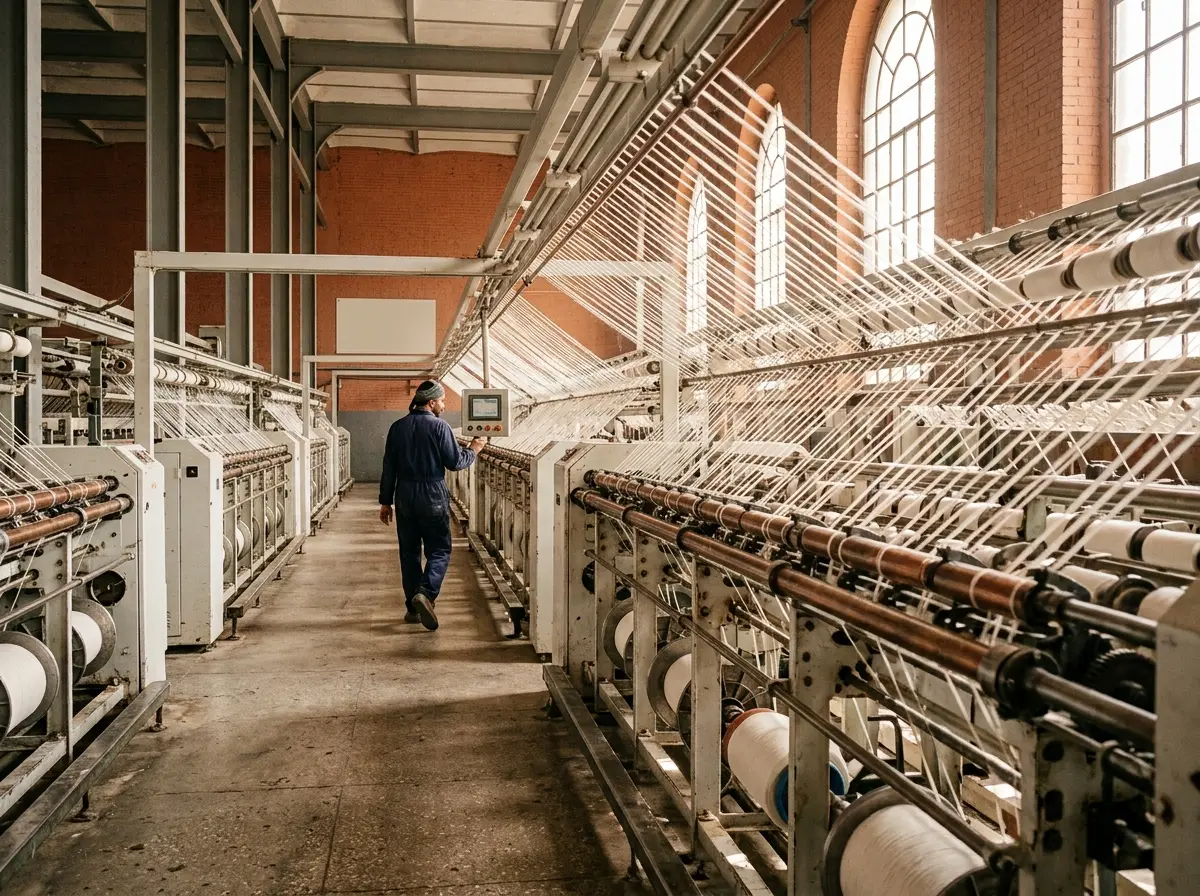
Hashem El-Sayed, assistant to Egypt’s prime minister and chief executive of the State-Owned Enterprises Unit, confirmed a parallel restructuring at Misr Spinning and Weaving Company, known locally as Ghazl El Mahalla. The government is splitting it into two entities: a legacy company carrying older liabilities, and a new one holding the factory’s modernized industrial assets.
That new entity, branded New Ghazl El Mahalla, will act as the group’s investment arm. Misr Spinning and Weaving keeps almost all of the new company’s shares, except two distributed to the Holding Company for Cotton, Spinning, Weaving and Garments and to Misr Shebin El Kom Spinning and Weaving. The parent company is now targeting a temporary EGX listing between July and September 2026, according to Egyptian financial media tracking the plan.
Egypt’s deputy prime minister inspected the complex on July 21, when officials toured the Mahalla complex’s final redevelopment stage alongside the Damietta Spinning and Weaving Company. The Mahalla site alone accounts for about 40% of the total investment in Egypt’s textile modernization program.
IMF Money Is Riding on the Same Deadline
Last month, IMF staff and Egyptian authorities reached a staff-level agreement on the seventh review of the Extended Fund Facility (EFF), the fund’s standard multi-year lending arrangement, and the second review of the Resilience and Sustainability Facility (RSF), a newer IMF tool for longer-term structural reforms. In its seventh review staff-level statement, the fund said completion would release about $1.5 billion under the EFF and $136 million under the RSF, a combined tranche near $1.6 billion once its Executive Board signs off. That would bring total disbursements under Egypt’s arrangements to about $7.2 billion since the programs began.
The statement credits strong policy responses for helping Egypt absorb an external shock from the war in the Middle East, language that echoes the government’s own line that its privatization timetable remains on track despite recent geopolitical tensions. Earlier this year, El-Sayed said the state offerings program had not been affected by regional developments.
That resilience claim faces a live test. Wall Street’s unraveling Iran peace bet has already sent oil prices and bond yields swinging again, the kind of shock that can widen an import bill and complicate debt service for a government counting on share sales to help fund itself. Beyond the divestment sales, the fund’s conditions reach into fiscal and social policy as well, another sign of how tightly Egypt’s market timetable is bound to its lending program.
The Exchange Still Needs a Market Maker
Azzam said the FRA is also working on the machinery that will let all this trade smoothly once it lists. Egypt’s markets still lack some basic plumbing that more developed exchanges take for granted.
- Expanding the pool of brokers licensed to trade EGX futures contracts
- Finalizing a market maker mechanism to keep newly listed shares liquid
- Building a specialized program to prepare temporarily listed firms for permanent status
- Vetting future listing candidates, including one company in the construction sector
Those tools did not exist when the State Ownership Policy launched in 2022. Azzam’s four listings now have five months to clear the requirements he did not spell out company by company, with the IMF’s Executive Board still to vote on the $1.6 billion tied to the same reform track.
Frequently Asked Questions
What Is the Difference Between Temporary and Permanent Listing on the EGX?
Temporary registration lets a state company’s shares trade on the Egyptian Exchange while it finishes disclosure, governance and compliance requirements. Permanent listing follows once the FRA confirms the company has met the exchange’s full ongoing reporting standards, the step Azzam expects four companies to clear by December.
Which Companies Make Up Egypt’s 32-Firm Divestment List?
The December 2022 State Ownership Policy named 32 companies across 18 sectors, including banking, energy, transport and electricity. The list includes Banque du Caire, Arab African International Bank and United Bank of Egypt, plus two army-run firms, Safi bottled water and Wataniya Petroleum.
What Does Egypt’s IMF Program Require Beyond Selling State Firms?
The Extended Fund Facility and Resilience and Sustainability Facility also tie financing to strengthening debt management, reducing inflation, protecting vulnerable groups through social spending and improving the business environment for private investors.
Why Does the IMF Support Egypt’s Privatization Drive?
The IMF has welcomed Egypt’s efforts to strengthen domestic revenue mobilization alongside its state asset divestment program. The fund argues a smaller state footprint in commercial markets frees room for private investment and more efficient use of capital.
What Is a Market Maker and Why Does the EGX Need One?
A market maker is a licensed firm that commits to continuously quote buy and sell prices for a stock, keeping trading active even when other investors are quiet. The FRA is still preparing this mechanism, meant to help absorb newly listed state shares without prices swinging on thin trading.
