
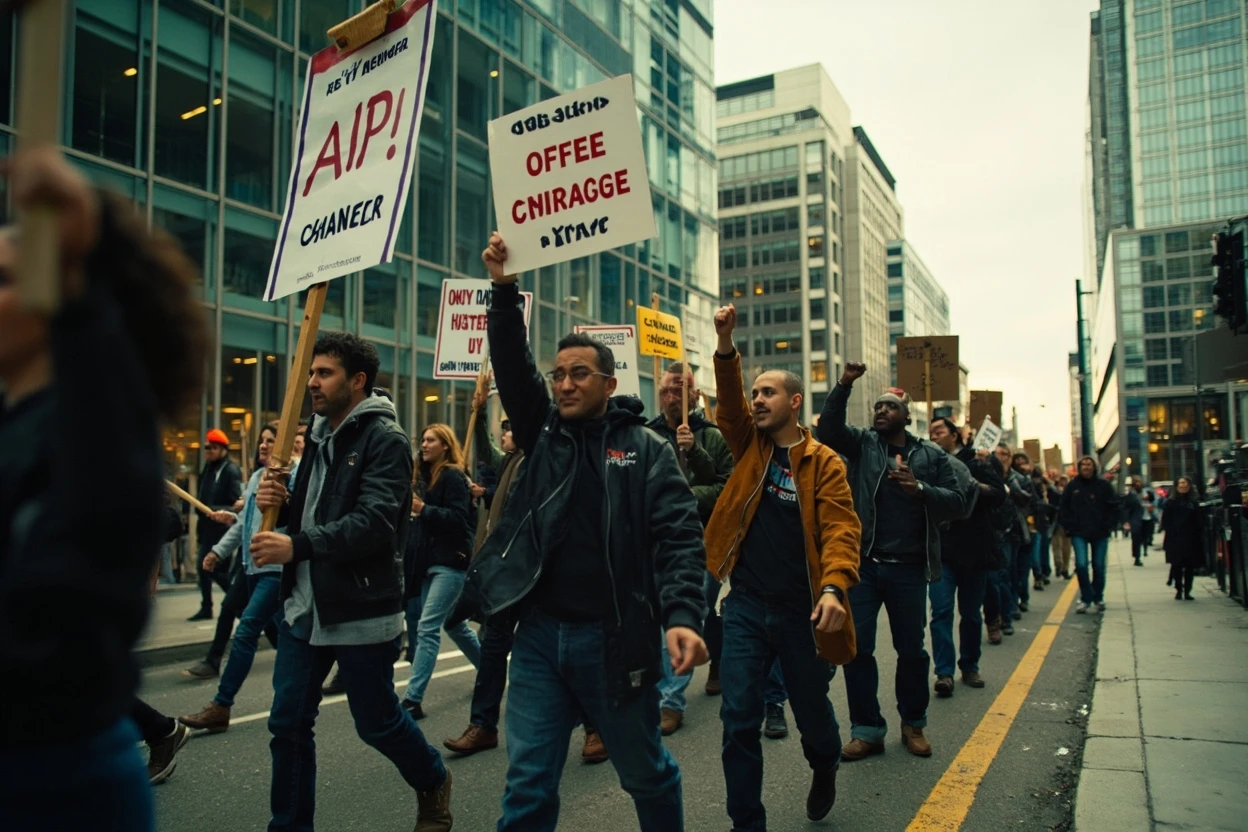
The Bethesda Game Studios union will hold simultaneous Save Our Devs demonstrations at four studio locations on Wednesday, July 15, beginning at 12:30 PM ET. The coordinated marches at ZeniMax offices in Rockville, Maryland; Austin, Texas; Dallas, Texas; and Montreal, Canada are aimed at one target: forcing Microsoft back to the bargaining table over the 440 union-represented positions eliminated in the Xbox restructuring announced July 6. Asha Sharma, who became Xbox’s chief executive in February 2026, framed the cuts as “the most significant restructure in Xbox history” in a memo to employees the same day.
Under Section 8(d) of the National Labor Relations Act, an employer that makes a unilateral decision such as a studio restructuring cannot skip the second step, which is a separate negotiation with the certified union over the consequences of that decision. Severance, healthcare continuation, recall rights, and preferential placement at open roles across Microsoft are all on the table for that negotiation, known as Effects Bargaining. OneBGS, the Communications Workers of America-affiliated union representing workers behind Fallout, Starfield, and The Elder Scrolls, says Microsoft has been slow-walking that process. Wednesday’s march is the union’s public-pressure campaign to restart it.
What’s Actually on the Table
What the Save Our Devs march is really for is a federal labor right, not a severance check. An employer that makes a unilateral decision such as a studio restructuring cannot skip the second step, which is a separate negotiation with the union over the consequences of that decision. Microsoft had the legal right to make the decision to eliminate 440 positions. It is the negotiation over what happens to those positions afterward that OneBGS is demanding at the table.
The “entrepreneurial change in the scope of business” framework Microsoft is invoking, internally described by the company as a shift from a “studio-based business model to a franchise-based model,” is a doctrine that, if accepted, would scope bargaining to effects only and remove the decision itself from the table. OneBGS rejected the framing in an email to members this week, obtained by Game Developer: “Changing a title on a PowerPoint slide does not erase our legal right to a say in our working conditions.” The union calls this “corporate wordplay.”
OneBGS has set three specific demands for the Effects Bargaining session. The first is stronger severance and extended healthcare coverage for affected workers. The second is preferential transfers, meaning laid-off union members get first consideration for open roles across Xbox and Microsoft before any external hiring. The third is recall rights that return members to Bethesda’s payroll first when the studio expands again. Refusing to engage on those demands in good faith, in the National Labor Relations Board’s framing, would constitute an unfair labor practice.
The First-Contract Gap
OneBGS was certified as a union in August 2024, almost two years ago, and Bethesda Game Studios Montreal was certified the same month. In the time since, neither unit has ratified a first contract with Microsoft. That delay matters because the protections the march is asking for live in the contract, not in certification. Written notice periods, severance floors, and recall rights exist only in a ratified agreement.
Three other CWA-organized units at Microsoft did ratify: ZeniMax Workers United QA, Raven Software QA, and Blizzard Quality Assurance, at different points across 2025 and early 2026. Those workers had written notice requirements and recall rights in enforceable form before July 6. OneBGS workers did not. The window between certification and ratification is the window in which a union member holds a card but not a contract. CWA president Claude Cummings Jr. addressed the gap directly in a the union’s July 7 statement on the layoff cuts: “Although our union signed neutrality agreements with Microsoft, we have been extremely disappointed by a company that has slow-walked our members at the bargaining table.” Montreal-based union members received their terminations in three-minute video calls with no opportunity to ask questions, an outcome the union described as psychological warfare.
Who Got Cut, by Studio
WARN Act filings provide the most specific public accounting of who lost their jobs on July 6. The notices, required by federal law for mass layoffs, name the affected studio and headcount. The numbers come from Texas and Maryland filings reported by Game Developer and TechTimes, plus figures from CWA Canada.
The Texas notice, filed with the Texas Workforce Commission, identifies 158 layoffs at ZeniMax Media locations in the state. Of those, 136 were at id Software’s Richardson office, the team credited with shipping Doom: The Dark Ages and a related DLC in the same week the cuts were announced. The remaining 22 were at Bethesda Game Studios’ Austin office. Of the 158 Texas layoffs, 146 are represented by the Communications Workers of America. Cross-state, the data tell the same story at a larger scale.
The Maryland filings name 379 ZeniMax workers across two offices. That total includes 213 employees on the team behind The Elder Scrolls Online, a still-active live-service game, with 166 layoffs at the ZeniMax Media address that also covers Bethesda Game Studios’ Rockville workforce. OneBGS additionally reported 35 positions eliminated at Bethesda Game Studios’ US offices and at least 12 in Montreal.
- id Software, Richardson, Texas: 136 layoffs (Texas WARN notice)
- Bethesda Game Studios, Austin, Texas: 22 layoffs (same filing)
- ZeniMax Media, Texas total: 158 layoffs, 146 union-represented
- ZeniMax, two Maryland offices: 379 layoffs, including 213 at ZeniMax Online Studios
- OneBGS US positions (Bethesda Game Studios proper): 35
- Bethesda Game Studios, Montreal: at least 12, every union-represented worker at that studio per CWA Canada
The cuts at id Software, where 136 jobs were eliminated in Texas, hit a team that shipped a Doom: The Dark Ages DLC in the same week. The 35 OneBGS US positions sit inside the union’s 440 national total, the headline figure carried into the Effects Bargaining demand. The 12 Montreal cuts represent every union-represented worker at that studio, as Carmel Smyth of CWA Canada confirmed, with the terminations carried out in three-minute video calls. The pattern across the four cities is consistent with what happens when a union has members but not yet a contract: layoffs proceed at the statutory minimum, and what comes next depends on whether Microsoft comes to the table.
Microsoft’s Case, and the Union’s Response
Microsoft’s case for the restructuring rests on a candid set of numbers in Asha Sharma’s July 6 memo. The memo, the July 6 memo outlining 3,200 job eliminations published in full on Xbox Wire, describes Xbox as “not healthy” and operating at margins “3-10x lower” than comparable platform businesses. The division entered the current console generation with a smaller install base and a higher cost structure. In a typical year, the company’s first-party studios lost 64 cents for every dollar invested. None of Microsoft’s first-party publicly announced games or projects are being cancelled as part of these reductions, Sharma wrote.
The internal restructuring cuts just as deep. Management layers, as many as 14 in some parts of the company, will be reduced to no more than 5, and where possible, 3. Helen Chiang, a nearly two-decade Xbox veteran who helped build Xbox Live and led Mojang and the Minecraft franchise, has been promoted to the newly created Chief Operating Officer role. Four studios will leave Xbox for new management: Ninja Theory, Undead Labs, Compulsion Games, and Double Fine Productions.
The labor fight is not over the layoffs themselves but over whether Microsoft’s chosen legal classification for them is correct. The “entrepreneurial change in the scope of business” doctrine limits any union response to bargaining over consequences rather than over the decision itself. The union’s framing, “corporate wordplay” that amounts to changing a title on a PowerPoint slide, contests whether that classification survives NLRB scrutiny. The contested category, applied correctly or not, will determine whether the consequences of the cuts are negotiable at all.
What Happens If Microsoft Stalls
The Effects Bargaining obligation is enforceable by the same body that issues the doctrine: the National Labor Relations Board. OneBGS can file an unfair labor practice charge if Microsoft participates in name only. The legal term is “surface bargaining,” meaning appearing to negotiate without genuine good-faith effort, and the Board has long treated empty exchanges as bad-faith bargaining. The historical remedy has a name. A finding against Microsoft could trigger the Transmarine remedy, a back-pay order requiring the employer to pay laid-off employees their normal wages from the point when bargaining should have begun until a good-faith offer is made. The remedy sits on the books as a defined consequence, not a discretionary one. Wednesday’s march is the public-pressure complement to that legal track, not a substitute for it.
For all its reach, the legal path runs through a Board whose recent composition, under Trump administration appointees, has been less aggressive on union enforcement than its recent predecessors. That is not a reason to abandon the legal fight, but it is a reason to understand that the march’s most durable pressure sits in plain view rather than in regulatory filings. CWA’s Mike Davis put the difference plainly in his statement:
Workers without a union are left to accept whatever cards they are dealt by management for any given decision.
Why Wednesday Matters Outside Bethesda
The march will be watched by an industry already leaning toward organized labor by self-reported margins. The survey of 2,300 game professionals on union support conducted by GDC Festival of Gaming found that 82 percent of US-based respondents support the unionization of game industry workers. Only 5 percent said they are outright opposed. Another 13 percent said they are unsure. Support was higher among workers earning less than $200,000 a year and those who had been laid off in the prior two years. Among game developers not already in a union, 62 percent reported being interested in joining one.
The structural fact behind the Bethesda walkout is a multi-year trend. More than 3,500 workers have joined CWA-affiliated unions at Xbox since 2022, following a labor neutrality framework Microsoft agreed to in part to smooth regulatory approval of the Activision Blizzard acquisition. The neutrality clause set no timeline for first contracts. The Bethesda cuts make the gap quantifiable: severance, healthcare, and recall rights negotiated in the open, or a termination carried out in a three-minute video call.
The Asha Sharma memo closes with “History is full of companies that mistake longevity for inevitability. We will not be one of them” and a pledge to “return to growth in 2027.” The union’s Wednesday demand is smaller and more concrete: a process at the table, in writing, with enforceable terms. For all its delays, the legal track carries a defined remedy in the Transmarine back-pay order. The reputational and recruiting track is harder to quantify, sharpened by the GDC finding that 62 percent of non-union developers have said they are interested in joining one. Wednesday’s walkout puts the demand on the street in four cities simultaneously, in front of cameras Microsoft cannot route through its own press team.
Frequently Asked Questions
What is Effects Bargaining, and what can OneBGS actually win through it?
Effects Bargaining is a legal requirement under the National Labor Relations Act that compels Microsoft to negotiate with OneBGS over the consequences of the July 6 layoffs: severance, healthcare continuation, recall rights, and whether laid-off members get first consideration for open roles across Xbox and Microsoft. It does not require Microsoft to undo the layoffs or justify the decision. The union is separately contesting whether Microsoft’s franchise-based model framing correctly classifies the cuts as an entrepreneurial decision under the core-entrepreneurial-control doctrine, a question that would land at the National Labor Relations Board.
Why didn’t all 440 affected union members have stronger protections when the layoffs hit?
OneBGS was certified in August 2024 and has not yet ratified a first contract. Bethesda Game Studios Montreal, certified the same month, is in the same position. Three other CWA-organized units at Microsoft, ZeniMax Workers United QA, Raven Software QA, and Blizzard Quality Assurance, ratified contracts at various points across 2025 and early 2026 and had written protections in enforceable form before July 6. OneBGS workers’ protections in this round were limited to the federal statutory floor plus whatever the union can now extract at the Effects Bargaining table.
What does Microsoft gain by framing the cuts as “entrepreneurial change in the scope of business”?
The core-entrepreneurial-control doctrine from the Supreme Court’s First National Maintenance Corp. v. NLRB decision allows an employer to change the fundamental direction of its enterprise without bargaining over the decision itself, even when that change eliminates union jobs. By invoking that framing, Microsoft narrows the legal scope of any union response to the effects only: severance tiers, healthcare details, recall procedures. The union is contesting whether the Xbox cuts properly fit that doctrine. The classification is the difference between negotiating the decision and negotiating only what follows from it.
What is the Transmarine remedy, and could it apply here?
The Transmarine remedy is a back-pay order designed to make whole workers laid off while an employer stalled bargaining in bad faith. Where the National Labor Relations Board finds that an employer engaged in surface bargaining or refused to bargain, the Board can order the employer to pay the affected workers their normal wages from the date bargaining should have begun until the date a genuine good-faith offer is made. Filing for that remedy requires OneBGS to pursue an unfair labor practice charge alleging Microsoft’s bad-faith conduct.
How large is Xbox’s unionized workforce, and what is at stake beyond Bethesda?
More than 3,500 workers at Xbox have chosen to join CWA-affiliated unions since 2022, across more than a dozen recognized bargaining units covering franchises including The Elder Scrolls, Diablo, Overwatch, and Doom. The 3,200 cuts announced July 6 represent about 20 percent of the full Xbox workforce before the restructuring. Of those cuts, 440-plus were union-represented positions. The outcome of the OneBGS Effects Bargaining round will be observable across other units still negotiating their first contracts.
