
Egypt is on course to keep its place as Africa’s largest sugar producer through 2035. The OECD-FAO outlook, published June 29, projects sugar beet output up 4.8 million tonnes above the report’s baseline period.
Three forces drive the projection. Egypt has been pivoting from cane to beet, a single foreign-backed factory in the western desert processes most of the additional capacity, and public incentives across the sector continue to expand. The OECD-FAO Agricultural Outlook 2026-2035 ties all three together as the path to 4.8 million tonnes of additional sugar beet output by 2035. The Outlook covers sugar alongside cereals, meat, fish and biofuels across more than 40 countries, and is now in its 22nd edition.
Egypt Set to Hold Africa’s Sugar Crown Through 2035
The OECD-FAO Outlook is unusually direct about Egypt’s role. Its sugar chapter calls the country “the continent’s largest sugar producer” and identifies it as one of the principal contributors to growth in African sugar output through the decade. Egypt accounts for the largest single national increment in the report’s African sugar analysis. The report covers sugar alongside cereals, meat, fish and biofuels across more than 40 countries.
Egypt’s specific line in the forecast is a sugar beet production increase of approximately 4.8 million tonnes above the baseline period by 2035. The Outlook attributes the rise to public incentives, foreign investment and the expansion of industrial capacity across the sector, not to a single bumper harvest. Egypt’s pivot reflects how heavily the country has leaned on state-backed programmes to expand domestic agricultural output.
Worldwide sugar output is projected to grow from 181 Mt during the base period to 203 Mt by 2035, with 60% of the growth coming from Asia and 30% from Africa. Sugarcane continues to provide more than 85% of total sugar crop output. Egypt’s beet-led rise is a regional exception within that global pattern, where cane still dominates.
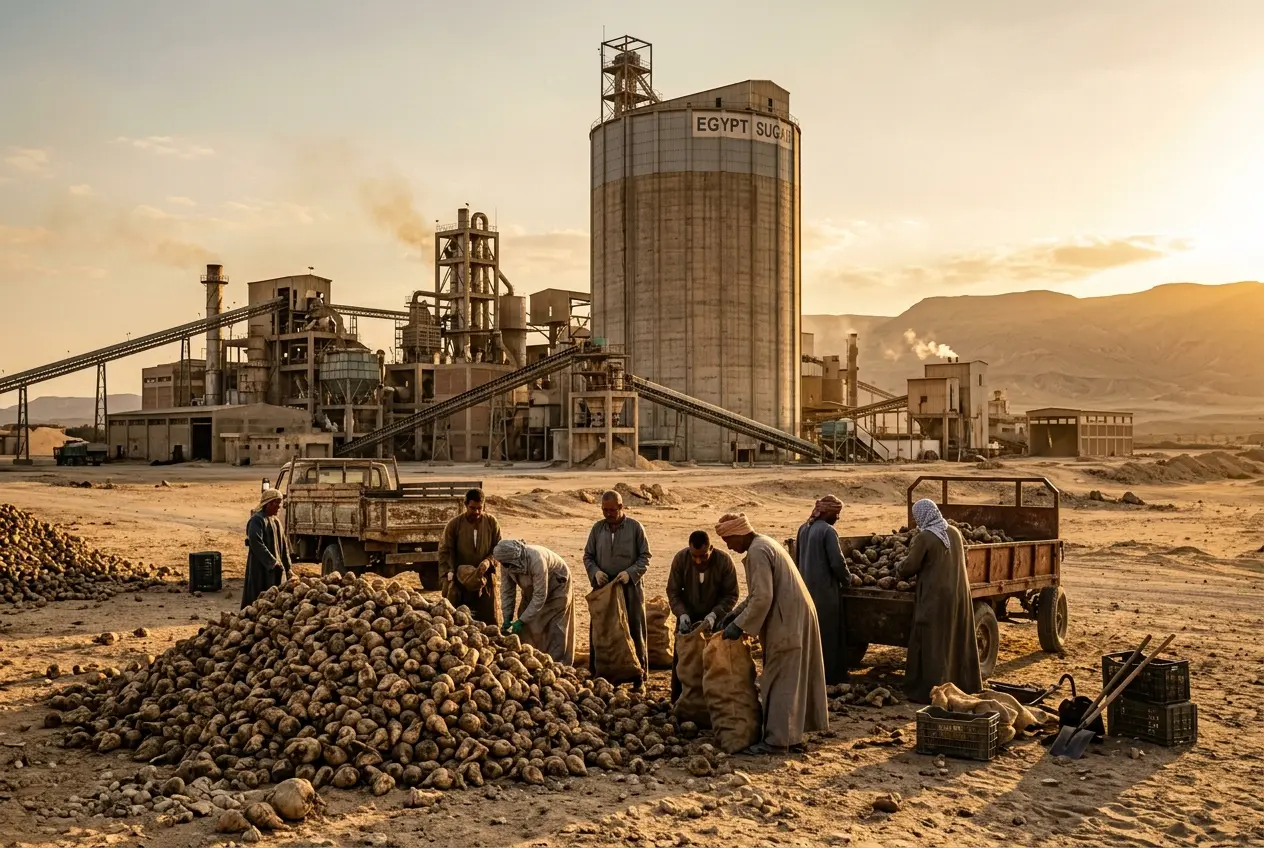
Sugar Beet, Not Cane, Powers the Forecast
Egypt’s bet on beet is the most concrete change behind the headline. Sugar beet tolerates the country’s hotter, drier conditions better than sugarcane, and beet factories can be built inland rather than clustered around Nile Delta cane fields. Egypt’s sugar beet cultivation area expanded from 600,000 feddans in 2023/24 to 750,000 feddans in 2024/25, a 25% jump in a single season, the country’s cabinet reported.
Output has followed the acreage. Egypt produced 2.6 million tonnes of sugar in 2025, the highest figure on record, with the bulk of the gain coming from beet. The same cabinet forecast sugar output of 2.9 million tonnes in 2026. Industry forecasts put 2025/26 production at 3.18 million tonnes, of which 2.47 million tonnes comes from beet and 0.71 million tonnes from cane. Sugar beet’s share of total output has been climbing since the early 2020s, and the OECD-FAO expects that share to keep rising into 2035.
The OECD-FAO Outlook identifies three specific drivers for the decade ahead:
- Farmer-friendly pricing policies that make beet cultivation more attractive than competing crops.
- Wider adoption of improved seed varieties, lifting yields per feddan.
- Investments to expand the production capacity of sugar mills, including new industrial projects.
Canal Sugar and the Beet Plant at the Centre of the Boom
The single project most identified with Egypt’s rise is Canal Sugar, described in the OECD-FAO Outlook as the world’s largest sugar beet processing facility. The plant sits in West Minya, about 245 km south of Cairo, and was built at a reported cost of $1 billion. Canal Sugar’s own corporate filings describe the company as a national food security investment designed to ensure Egypt’s self-sufficiency in sugar. The factory started commercial operations in 2021 and runs a single processing line described by the company as the largest of its kind anywhere.
The plant draws on a beet area of 181,000 feddans of reclaimed desert, irrigated with groundwater, and processes up to 900,000 tonnes of beet sugar a year at full capacity, per the OECD-FAO Outlook. The factory is owned 70% by Emirati investors, split between Al Ghurair (37%) and Murban Energy (33%), with the remaining 30% held by Al Ahly Capital Holding, a subsidiary of the National Bank of Egypt. The Egyptian cabinet estimated the plant alone bridges 75% of the country’s sugar production-consumption gap.
The project’s footprint extends well beyond sugar output. Canal Sugar’s site includes what the company describes as the world’s largest sugar storage silo, with a stated capacity of about 417,000 tonnes. The project has reported roughly 1,500 direct jobs alongside some 50,000 farmers tied to its beet supply, and it produces 216,000 tonnes of beet pulp and 243,000 tonnes of molasses a year, both exported. The Egyptian government counts the plant as a core piece of its national food security strategy, alongside investments in wheat and other staples.
The key numbers behind the projection:
- 900,000 tonnes: Canal Sugar’s annual beet sugar capacity, per the OECD-FAO Outlook.
- $1 billion: Total investment in Canal Sugar, per the company.
- 181,000 feddans: Desert land Canal Sugar has brought into beet cultivation.
- 750,000 feddans: Egypt’s total sugar beet area in 2024/25, per the Egypt cabinet.
- 81%: Egypt’s sugar self-sufficiency by March 2025, per the Egypt cabinet.
Africa’s Sugar Boom Carries an Import Caveat
Sub-Saharan Africa will account for 15.6% of global agricultural production growth by 2035, up from 11.2% in the previous decade, according to the OECD-FAO Outlook. Within that expansion, sugar features as one of the categories where African output will rise fastest.
The catch sits in the import line of the report. Sub-Saharan Africa’s net food imports are projected to increase by 55% by 2035, leaving imports at 22% of total food consumption by 2035, up from 20% during the 2023-2025 period. Africa’s share of global rice imports alone is forecast to climb from 35% to 45% by 2035.
Africa is also expected to contribute more to global sugar supply, with its share of production increasing, mainly thanks to Sub-Saharan African countries and the growing contribution of Egypt, the continent’s largest sugar producer. Public support measures and foreign investment should help increase sugar production.
The OECD-FAO expects Eastern and Southern African producers, which it calls “among the world’s most competitive,” to expand sugarcane output. It separately expects Egypt, working through beet, to add the largest single national increment. The Outlook does not project the net effect of those two trends together on Africa’s overall import bill. The two regional expansions are modelled separately in the Outlook’s country-level analysis.
Sugar is one of several commodities where Africa’s output growth trails rising demand. Africa’s total meat consumption is projected to rise 32% by 2035 and aquatic food consumption 20%, the fastest growth globally for both. Both categories are growing faster than sugar over the decade. Egypt’s beet-driven surplus will arrive into a regional market where staples drive the bigger import pressure. Across the broader food basket, regional output is rising in absolute terms while regional demand grows faster.
Who Loses as Egypt Extends Its Lead
The clearest loser is the set of African countries that import sugar they could not grow cheaply at home. Egypt is set to stop importing sugar in 2026, the Egyptian cabinet said, after raw sugar imports fell 54.5% in the first quarter of 2025 compared with a year earlier. Neighbouring importers have no analogue to Canal Sugar, no comparable beet expansion plan in the OECD-FAO base case, and Egypt is on track to become a net exporter.
A second pressure point sits inside Europe. EU beet sugar output is forecast to fall to 16.1 million tonnes in 2025/26, from 16.6 million tonnes the prior season, as beet area contracts under regulatory and environmental pressure, per global sugar market forecasts for 2025/26. Egypt’s beet-driven growth adds another large beet producer to the Mediterranean rim while Europe’s declines. Long-term EU consumption is also expected to keep declining under sugar taxes and reformulation policies.
The two giants of the world market, Brazil and India, are untouched by the Egyptian story. The OECD-FAO expects Brazil’s export share to hold at around 55% in 2035, with India close behind. Together the two will account for 42% of global output. Egypt’s decade adds regional primacy and 4.8 million tonnes of beet to the world balance sheet. The country still sits below Brazil and India on global export rankings.
Frequently Asked Questions
Is Egypt the largest sugar producer in Africa?
Yes. The OECD-FAO Agricultural Outlook 2026-2035 calls Egypt “the continent’s largest sugar producer” and lists it as the largest single national contributor to African sugar growth through 2035.
What is Canal Sugar’s production capacity?
Roughly 900,000 tonnes of beet sugar a year, per the OECD-FAO Outlook, which describes Canal Sugar as the world’s largest sugar beet processing facility, with a $1 billion investment and a 2021 start of commercial operations at West Minya.
Has Egypt reached sugar self-sufficiency?
Close to it. Egypt’s cabinet reported 81% sugar self-sufficiency by March 2025, with raw sugar imports down 54.5% in the first quarter of 2025 compared with a year earlier. The cabinet forecast 2.9 million tonnes of sugar output in 2026 and a target of eliminating imports by that year.
Which drivers does the OECD-FAO identify for Egypt’s sugar growth?
Farmer-friendly pricing policies for beet, wider uptake of improved seed varieties, and investment in new sugar mill capacity, including the launch of new industrial projects such as Canal Sugar.
