
Iran’s Islamic Revolutionary Guard Corps fired on a commercial container ship in the Strait of Hormuz on Saturday evening, drawing a third round of US airstrikes within a week and missile fire across the Gulf. The IRGC attacked the M/V GFS Galaxy, a Cyprus-flagged vessel crossing the waterway, then declared the corridor closed “until further notice.” One civilian crew member remained missing on Sunday, the US military said, with the ship unable to continue after fire and engine-room damage.
The IRGC’s move pulled Washington and Tehran back toward open war and put mediators who brokered June’s ceasefire on the defensive. The June framework deal paused major combat but did not resolve who decides which ships pass through the strait on which route. That unresolved clause now sits at the center of a weekend that has closed a global oil chokepoint and opened a wider regional fight.
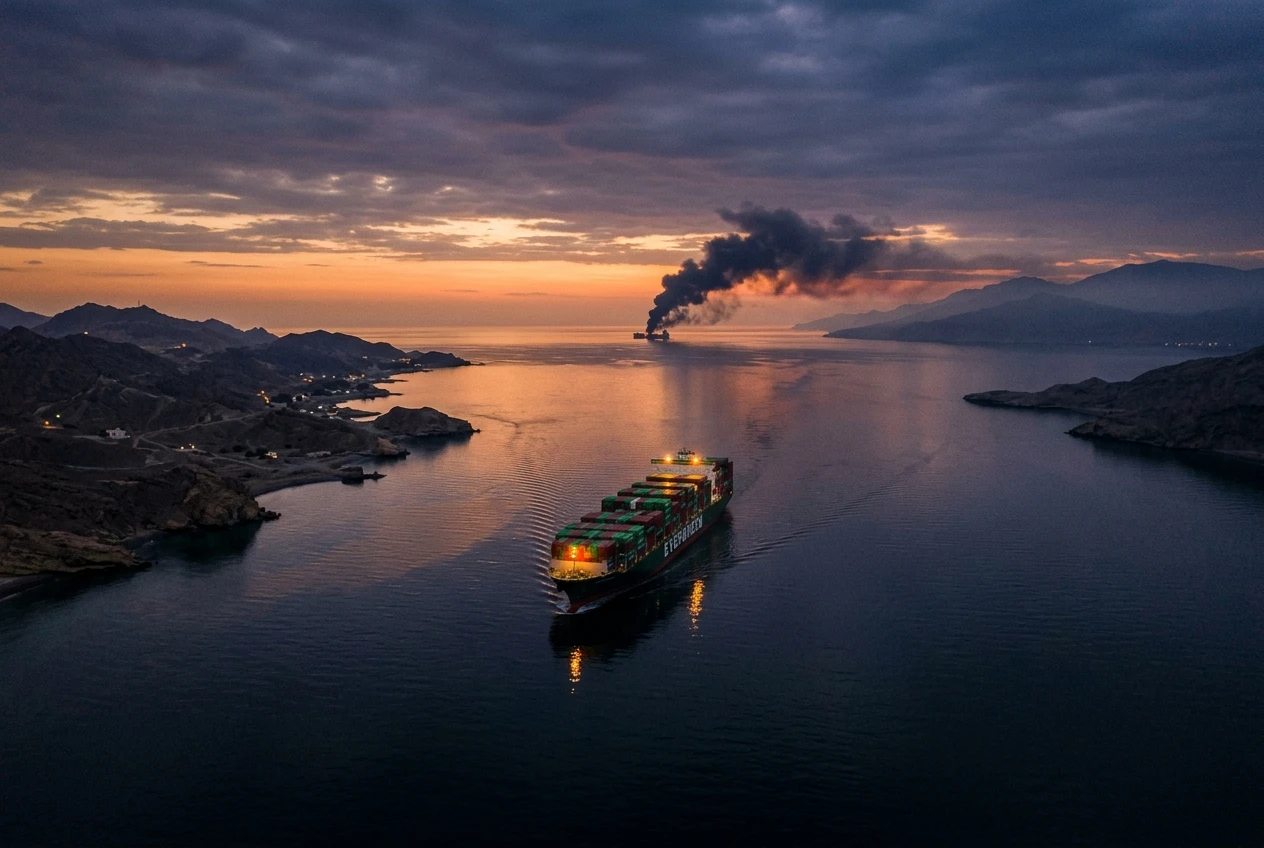
A Container Ship Burns at the Mouth of the Gulf
US Central Command said the attack on the M/V GFS Galaxy began at 7:15 p.m. ET on Saturday. The command’s CENTCOM’s update from its official account called the strike by IRGC forces “blatant” and described the ship as “unable to continue the journey due to an onboard fire and significant engineroom damage.” A civilian crew member from the GFS Galaxy was reported missing.
The US struck back within hours, hitting approximately 140 Iranian military targets with precision munitions launched by land- and sea-based fighter aircraft, drones and naval vessels. Targets included Iranian missile and drone sites, naval capabilities, ammunition storage facilities, communication networks and coastal surveillance locations, according to a CENTCOM’s written account of the strike campaign issued from Tampa, Florida. Operations were carried out at the direction of the President, the command said. Commercial vessel transits through the waterway “continue” despite the Iranian order, CENTCOM added in the same release.
CENTCOM said Iran had been “provided yet another opportunity to demonstrate adherence to the Memorandum of Understanding after being held accountable for earlier attacks on commercial vessels but has again failed.” The IRGC earlier claimed it had fired only a warning shot at the GFS Galaxy, which it said was on an unauthorized route. The US response was authorized at the President’s direction and framed, in the words of the Defense Secretary, as a price for Tehran’s choice.
The Corridor Goes Dark
Within hours of the strike, the IRGC announced that the Strait of Hormuz was off-limits to commercial shipping. Its statement, carried by Iranian state media, framed the closure as retaliation for US air operations along Iran’s coast. The strait connects the Persian Gulf to the Gulf of Oman and carries about one-fifth of global petroleum shipments according to US Energy Information Administration figures, a number now at the center of every oil trader’s risk model. Iran left the order open-ended and tied it explicitly to the cessation of US military operations in the area.
Following this incident … the Strait of Hormuz will be closed until further notice and until the end of the American interventions in this area, and no vessels will be allowed to pass through it.
Iran’s framing implied the closure could lift if Washington halted the strikes; the language offered no timetable. The IRGC tied the GFS Galaxy strike to vessels traversing unauthorized routes, a category that appears to extend beyond Iranian-controlled waters. CENTCOM, for its part, said commercial vessel transits through the waterway “continue” despite the Iranian order. The command added that “Iran does not control the Strait of Hormuz. It remains an international waterway. US forces are positioned and prepared to keep it that way.” The closure, in short, is a unilateral Iranian declaration that the US military does not recognize as binding.
Trump Tells Iran the Truce Is Over
Hours before Saturday’s strikes began, President Trump used Truth Social to tell Iran that the June ceasefire “is OVER.” The Friday post, written after Iran asked the US to keep talking, said the United States had agreed to do so but had stated “in no uncertain terms, that the Cease Fire is OVER!” The statement sidestepped whether the US would join a fresh round of diplomacy that Oman’s representatives had been hosting in Muscat.
The June deal, a Memorandum of Understanding, paused major combat and committed both sides to reopen the strait to commercial shipping. Iran’s foreign ministry said on Sunday that “only 25 days” had passed since that agreement and accused Washington of having “violated nearly all aspects” of it by striking Iranian infrastructure and shipping. Iran characterized its own attacks on commercial ships in the strait as enforcement of an “unauthorized routes” rule rather than as ceasefire violations. The two accounts, both stated publicly, leave no agreed narrative of who broke what and when.
Saturday’s meeting in Muscat had been an attempt to add a structured shipping plan to the June framework. Oman’s draft, reported by regional outlets, would have split the strait into two corridors, one under Iranian control and one through Omani territorial waters, to allow traffic to resume. Iranian negotiators were still in the Omani capital when news of the latest US strikes came through. Whether Tehran’s eventual answer to Oman’s plan could now be retrieved by negotiators was unclear. Iran’s foreign ministry added a demand that the US halt strikes within hours, or face consequences it did not detail, a posture at odds with the Muscat track.
Iran’s Missiles Reach Across the Gulf
Iran widened the fight overnight, striking US-allied Gulf states with missiles and drones. The UAE’s Defense Ministry posted on Saturday that its air defenses were engaging Iranian missiles and drones. Qatari air defenses intercepted a missile attack, and three people, including a child, were injured by shrapnel. Alarm sirens sounded in Bahrain, and Jordan’s Prince Hassan Air Force base absorbed Iranian ballistic missile fire, according to state media.
- United Arab Emirates: missile and drone attacks intercepted by air defenses
- Qatar: missile attack intercepted; three people injured, including a child
- Jordan: ballistic missile strikes on the Prince Hassan Air Force base
- Bahrain: alarm sirens sounded; drones intercepted
- Kuwait: three border centres and an offshore oil platform attacked; one worker injured
- Oman: missiles and drones launched despite hosting Saturday’s mediation talks
Iran’s strikes drew immediate condemnation from across the Gulf and threatened the diplomatic track built by Qatar and Oman. Doha has told mediators for months that it would not host talks while under Iranian attack and said Sunday it reserves the right “to respond” to the strikes. The Iranian Foreign Ministry warned countries on the southern shore of the Gulf not to allow their territory to be used for strikes on Iran, saying origin points would be treated as legitimate targets.
The pattern was not new; Iranian forces have hit the UAE, Qatar, Kuwait, Bahrain and Jordan at various points in the war. Sunday’s round, however, came within hours of Tehran declaring the strait closed and of Iran’s foreign ministry issuing an ultimatum on US operations. Together, the three moves compressed a long-running dispute into a single weekend of declared escalation. Oman hosted mediators and Iran’s negotiating team in Muscat on Saturday morning; by Sunday those same Iranian actors were firing on Gulf capitals. The June framework’s mediators are now listed among Iran’s declared targets.
Qatar’s air defense intercepts were described as successful and the regime said it reserved the right to respond to further strikes. Kuwait confirmed that three of its border centres and an offshore oil platform had been hit, the most concrete damage reported. The widening of the fight drew no public comment from US Central Command beyond its strike update. Iran’s foreign ministry, in its Sunday statement, characterized its strikes on Gulf states as enforcement of its own rules, not as a violation of the June framework.
Inside Washington’s Three-Night Strike Push
US Central Command wrapped up a third consecutive night of strikes on July 11, its Tampa-based press office said. The strikes are aimed at degrading Iran’s ability to attack civilian mariners in the strait. Targets selected over the three nights ran to more than 300 sites across Iran, the command said.
Iran made a poor choice. Now they pay.
The latest 140 targets were struck with precision munitions launched from land- and sea-based fighter aircraft, drones, and naval vessels, the command said. The Defense Secretary’s post on X, paired with a the Defense Secretary’s post on the retaliation and a CENTCOM statement, said the strikes would “impose a heavy cost by continuing to degrade Iran’s ability to attack civilian mariners and commercial ships freely transiting the strait.” CENTCOM dates the unraveling of the ceasefire to July 6, when Iran launched missiles at commercial ships in the strait. Iran’s foreign ministry rejects that framing, saying US strikes on Iranian infrastructure, shipping, and aviation facilities since June amount to a violation of nearly every clause of the memorandum. Hegseth’s reaction to the latest IRGC strike sat in plain language on Saturday night.
Pete Hegseth, the Defense Secretary, posted the two sentences on X within hours of CENTCOM’s strike announcement. As CENTCOM reports the cumulative campaign:
- 140 Iranian military targets struck on July 11
- More than 300 targets struck across three nights
- 800+ commercial vessels escorted through the strait since early May
- 400 million barrels of crude oil moved under US protection since early May
- One US military strike round per night for three consecutive nights
The arithmetic on the Iranian side: one cargo ship hit, a fifth of global oil trade at risk, six Gulf states reporting incoming fire. Each side’s tally ends at a different number, and the difference between them is now the entire distance back to a settlement.
Oil Markets Register the Risk
Oil markets moved sharply on the news. Brent crude futures rose $2.67, or 3.51 percent, to settle around $78.68 a barrel in Sunday trading. The move came even though, in CENTCOM’s telling, the strait remained operationally open to commercial traffic. Traders responded to the IRGC’s declaration, not to confirmed physical disruption. Higher gasoline prices in the United States remain sensitive politics for the President ahead of midterm elections.
The Strait of Hormuz was a corridor for roughly one-fifth of global petroleum before the war began in late February, by US Energy Information Administration figures. Saudi Arabia, Iraq, Kuwait, the UAE, Iran and Qatar together send most of their seaborne crude through the strait. Iranian threats to close it have moved the price of crude before in 2026. Sunday’s move was smaller than the spike during the war’s first weeks but came on top of an already nervous market.
Why the Ceasefire Broke at the Waterway
The waterway was the open question the June framework did not settle. Strip the Strait of Hormuz clause out of the Memorandum of Understanding’s text and the rest of the deal, including a halt to major strikes, an end to nuclear escalation, and limited sanctions relief, has held in form if not in spirit.
Iran first opened fire on commercial shipping in the strait on July 6, according to CENTCOM’s published timeline. Washington answered with a first round of strikes the next day. A second round followed within days. The IRGC’s Saturday strike on the GFS Galaxy and the closure declaration that followed pulled the trigger on the third round, the most intense of the week.
Tehran’s political temperature is also a variable. Ayatollah Mojtaba Khamenei, Iran’s Supreme Leader since his father was killed at the outset of Operation Epic Fury on February 28, issued a written statement on Saturday vowing revenge. His language was uncompromising: the “criminal, disgraceful murderers of the martyred leader” will pay, “this vengeance is what our nation is demanding, and this must definitely be done.”
The grudge at the top of the Iranian state is not new, but the operations that grudge now shapes have widened. Iran fired across the Gulf on Sunday and warned neighboring governments not to host US forces. The mediators who brokered June’s framework are themselves now under attack from Tehran. Oman, which hosted Saturday’s Muscat meeting, was among the countries struck at by Iranian missiles. A routing of any return to talks, including who speaks first, where, and on what terms, was, by Sunday evening, undefined.
Frequently Asked Questions
Why did Iran close the Strait of Hormuz?
Iran’s Islamic Revolutionary Guard Corps declared the Strait of Hormuz closed after firing on the M/V GFS Galaxy, a Cyprus-flagged container ship, on Saturday evening. The IRGC’s statement, released after the strike, kept the closure in force indefinitely and pinned it to US military activity in the area.
How much oil passes through the Strait of Hormuz?
About one-fifth of global petroleum transited the Strait of Hormuz before the war began in late February 2026, according to the US Energy Information Administration. Saudi Arabia, Iraq, Kuwait, the UAE, Iran and Qatar together route most of their seaborne crude through the corridor.
Who is mediating between the US and Iran?
The June 2026 framework deal between the United States and Iran paused major combat. Oman hosted follow-on talks in Muscat on Saturday. Iran’s missile and drone strikes on Qatar and Oman on Sunday put both mediators in the firing line and threatened their role in any future talks.
What triggered the latest US strikes on Iran?
US Central Command started the third round of strikes in a week after the IRGC attacked the M/V GFS Galaxy on Saturday evening. CENTCOM’s stated goal is to continue degrading Tehran’s ability to disrupt shipping in the corridor.
