
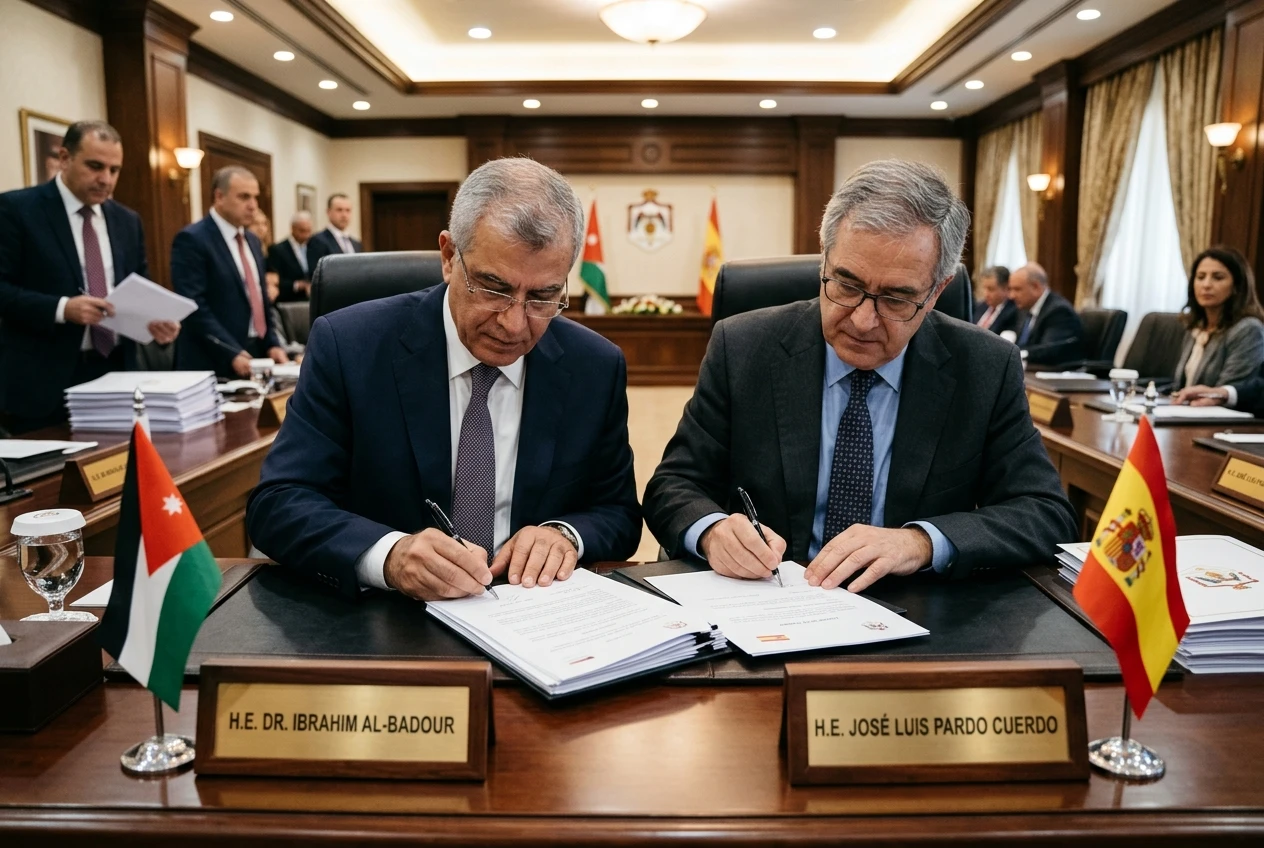
Spain committed €5.5 million on Tuesday to fund “Ri’aya 2,” a Jordanian-Spanish project aimed at expanding primary healthcare in Zarqa Governorate and curbing the country’s dominant chronic disease burden. Health Minister Ibrahim Al-Badour and Spanish Ambassador José Luis Pardo Cuerdo signed a letter of intent in Amman to launch the initiative, which the Spanish Agency for International Development Cooperation (AECID) will implement alongside the Ministry of Health. The grant is the second phase of a partnership that began under European Union funding, and it lands in a country where nearly 78% of deaths are tied to non-communicable diseases.
The signing extends a relationship AECID has built with the Ministry of Health since the first phase of Ri’aya launched under EU money. It also lands inside a broader push by Amman to upgrade its primary care network, which the Ministry describes as the cornerstone of the national health system because of its role in disease prevention and chronic disease management.
What the €5.5 Million Funds
The grant was confirmed through a letter of intent between Jordan’s Minister of Health Dr. Ibrahim Al-Badour and Spanish Ambassador José Luis Pardo Cuerdo, as detailed in the Ri’aya 2 grant scope and focus areas. Implementation will run jointly through the Ministry of Health and AECID, with the Spanish agency handling external coordination, training pipelines and technical exchange that defined the first phase of Ri’aya. The agreement also commits both sides to deepen the bilateral technical cooperation built during the first phase.
The project targets three concrete levers, per the agreement. It expands access to primary healthcare for all residents, including refugees and host communities. It raises service quality across that primary care network. And it sharpens the system around the prevention, early detection and management of non-communicable diseases, the chronic conditions that drive most of Jordan’s deaths.
Spain is firmly committed to supporting Jordan in strengthening its public health system and ensuring equitable access to high-quality health services for all. Reducing the burden of non-communicable diseases through prevention, early detection, and the promotion of primary healthcare remains one of the strategic pillars of the partnership between Spain and Jordan.
The ambassador’s remarks at the signing in Amman tied the work to the strategic pillars of Spain-Jordan cooperation. The project description treats Ri’aya 2 as an extension of the first phase, building on the achievements of the EU-funded original. Both sides will run implementation at the facility level through the Ministry’s primary healthcare network in Zarqa.
Why Zarqa Governorate Anchors the Project
Inside Zarqa Governorate, Ri’aya 2’s capacity-building work will run through three channels, per the agreement: institutional strengthening, healthcare worker skills, and service quality upgrades. The decision fixes the geographic focus inside Jordan’s second-largest governorate. That governorate is a dense urban area that absorbs a steady flow of refugees alongside its long-standing population, and its clinics carry a heavy chronic disease load.
That lever set maps onto a Zarqa primary care network already on the front line for diabetes, hypertension and cardiovascular disease management. Non-communicable diseases drive most of the country’s deaths, and the governorate’s clinics are where early detection and routine follow-up have to land for the largest patient load. The Ministry’s wider NCD strategy runs through these primary care centres, and the governorate is one of the heaviest users of that network. The grant pays for the clinical training, tighter protocols and stronger specialist links that the new phase is meant to scale up.
On the ground, that means new investment in the staff and equipment that routine NCD care depends on. AECID will handle the external coordination and technical exchange, with the Ministry running implementation through its primary healthcare centres in Zarqa.
Minister Al-Badour described the Zarqa focus as a way to ‘improve service quality to meet citizens’ needs,’ per the Ammon News report. He framed the broader investment as ‘an investment in community health and a more sustainable future.’ That framing aligns the project with the Ministry’s national strategy for primary healthcare, which the minister has called the cornerstone of the health system.
The NCD Crisis Behind the Signing
For a country that has been building a chronic-disease response for the better part of a decade, the numbers behind Ri’aya 2 still carry weight. Nearly 78% of deaths in Jordan are caused by non-communicable diseases, with cardiovascular disease and cancer alone accounting for more than half, a September 2025 update on Jordan’s NCD mortality reports. Almost half of those deaths occur before the age of 70.
The risk profile behind those deaths is heavy. WHO data shows that eight in 10 men use tobacco or nicotine products, that overweight and obesity affect 60% of adults and surpass 80% in older women, and that nearly a third of children aged 6 to 12 are overweight or obese. Smoking among women continues to rise. Diets rich in salt, sugar and fat, hypertension and raised blood sugar all appear on the WHO list of risk factors.
- 78% of all deaths in Jordan are caused by non-communicable diseases
- 29% of deaths are from cardiovascular disease; 26% from cancer
- Smoking cessation clinics grew from 5 in 2019 to 29 nationwide in 2025
- 60% of adults are overweight or obese, rising above 80% in older women
Jordan has been building the response over the past decade, with the Ministry of Health folding NCD services into its essential primary healthcare package and running WHO’s HEARTS technical package for cardiovascular prevention. Smoking cessation clinics have grown from 5 in 2019 to 29 nationwide in 2025, and the Ministry conducted national surveys on NCD risk factors and school health in 2025 to guide the next round of policies. National strategies on tobacco control, nutrition and mental health now run through 2030 in some cases.
Where Phase One Left Off
Phase two is sized at €5.5 million, smaller than the EU-funded first phase, and the new project description points its spending at staff skills, clinical protocols and institutional capacity. Ri’aya 2 is the direct continuation of the original “Ri’aya” project, which was funded by the European Union and run through AECID. The same implementing partners, the same bilateral cooperation model, and the same primary healthcare focus carry through into the new phase.
AECID has a multi-year track record in Jordanian primary care that the new grant now extends. The Spanish agency will continue the technical cooperation and knowledge exchange that the first phase set up, per the agreement. The project description treats Ri’aya 2 as an extension of that working pipeline rather than a stand-alone initiative. Both sides have committed to deepening the bilateral technical cooperation that the first phase established.
How This Connects to Jordan’s Health Reform Roadmap
Minister Al-Badour tied the project to the Economic Modernization Vision, the government’s 10-year reform blueprint, framing investing in primary healthcare as ‘an investment in community health and a more sustainable future.’ The roadmap treats healthcare as one of its ten priority sectors. That framing shapes how the Ministry is positioning external grants inside the wider reform push.
Inside the Ministry, primary healthcare is treated as the cornerstone of the national health system because of its role in disease prevention and chronic disease management. The Ministry spends external grants on training budgets, equipment, clinical protocols and patient outreach at the primary level, rather than tertiary hospital expansion. The approach favours upstream intervention over downstream hospital capacity. The minister has framed the deal as part of a ‘comprehensive vision’ for the sector that lines up with national priorities.
Spain and Jordan’s health partnership now stretches across both phases of Ri’aya, with AECID as the common thread. The new grant gives the Ministry of Health a Spanish-funded pipeline for the same kind of work the EU funded in phase one. Implementation focuses on training staff, upgrading protocols, and reaching patients where they first encounter the health system.
In Zarqa, the work lands at the governorate where the patient load for chronic disease runs highest. €5.5 million now funds the Ministry’s primary care response in that governorate, with AECID coordinating the technical exchange that the agreement commits both sides to deepen.
Frequently Asked Questions
What is Ri’aya 2?
Ri’aya 2 is the second phase of a Jordanian-Spanish primary healthcare project. It runs through the Ministry of Health and the Spanish Agency for International Development Cooperation, focuses on preventing and managing non-communicable diseases, and centres its work in Zarqa Governorate.
How much is Spain contributing?
Spain is committing €5.5 million to fund Ri’aya 2, paid through AECID. The grant was confirmed by a letter of intent between Health Minister Ibrahim Al-Badour and Spanish Ambassador José Luis Pardo Cuerdo.
Why is Zarqa Governorate the focus?
Zarqa concentrates a large share of the Ministry of Health’s primary care workload for chronic disease, and absorbs a steady flow of refugees alongside its existing population. The project’s training, capacity-building and clinical work are concentrated there.
Who implements the project on the ground?
The Spanish Agency for International Development Cooperation (AECID) handles external coordination and technical exchange. The Ministry of Health runs implementation at the facility level through its network of primary healthcare centres in Zarqa Governorate.
