
Georgia will keep full ownership of the Anaklia deep-sea port. On Monday the Economy Minister, Mariam Kvrivishvili, confirmed that international operators would be invited to run the port’s terminals under a Landlord model, ending two years of planning tied to a single Chinese-led consortium.
The shift lands at Anaklia’s third restart in a decade. A 2016 contract with a Georgian-American consortium was cancelled in 2020. A 2024 deal with the Chinese-Singaporean China Communications Construction Company quietly unwound over the past year. Kvrivishvili framed the new model as the country’s final answer to a project that has outlasted three governments.
A Landlord Model, No Shares Sold
The Landlord structure, described by the minister as “the most widely tested in the world” for port ownership, splits the project cleanly in two. The Georgian state will own, finance and manage the core maritime infrastructure: berths, breakwaters, dredging, communications and the road and rail connections to the site. International operators and private investors will finance, equip and run the container and bulk cargo terminals.
Shares in the port itself are not for sale, Kvrivishvili stressed. The state will remain the sole owner, with foreign companies brought in only to manage terminal operations, a role she said carries no ownership rights. Under the previous concession plan, a 49 percent stake had been earmarked for CCCC and its Singapore-registered subsidiary China Harbour Investment, with the state holding 51 percent and the first phase priced at $600 million from the consortium. That inflow is now gone, OC Media reported.
In its place, the state must find an additional $200 million on top of what it had already committed for breakwater, dredging and access links, Kvrivishvili said. The money will come from the budget and from international financial institutions, with negotiations already under way. She named no lender, only that interest is strong.
The decision is based on our main objective: with the participation of partner countries and consideration of their interests, Anaklia port should become a centre for international interests, capital and cargo flows.
Mariam Kvrivishvili, Minister of Economy and Sustainable Development of Georgia, delivered the line at the July 6, 2026 government briefing in Tbilisi. Georgia’s Landlord-model announcement details the mechanics of the new structure.
Three Deals That Fell Apart Before This One
Anaklia is the third attempt at a Georgian deep-sea port after the failed Lazika project of the 2000s, a Black Sea city envisioned after the 2004 Rose Revolution and never built. The current site has been contested since at least 2016, when a Georgian-American consortium won the original tender. Three different arrangements have ended without a port standing at the site.
| Year | Lead investor | Stake offered | Outcome |
|---|---|---|---|
| 2016 | TBC Holding (Georgia) and Conti International (US) | Operator concession | Cancelled in 2020 after corruption charges against consortium-linked figures and the withdrawal of US investors |
| 2024 | China Communications Construction Company and China Harbour Investment (China-Singaporean) | 49% equity | Negotiations ended in late 2025 over issues Kvrivishvili linked to national interests; tender collapses |
| 2026 | State-led, with multiple international terminal operators | 0% shares sold; leases on terminals | Landlord model announced July 2026; first vessel still planned for 2029 |
The 2016 contract was awarded to the Anaklia Development Consortium, a joint venture of Georgian bank TBC Holding and US-based Conti International, after a competitive tender (the original Anaklia Development Consortium award was reported by Reuters). The agreement was cancelled in 2020 after corruption charges were brought against the consortium’s founders, Mamuka Khazaradze and Badri Japaridze, and US investors exited. The two men pursued arbitration at the World Bank’s ICSID in Washington and lost in early 2026; the government said the ruling vindicated its position. A 2024 tender selected CCCC and China Harbour Investment as the sole bidder, triggering concern in Washington and Brussels because of CCCC’s role in China’s Belt and Road Initiative and US Treasury sanctions on the company since 2021 over ties to China’s military-industrial complex.
Cargo Is Already Arriving, Just Not at Anaklia
The case for Anaklia rests on cargo already straining the country’s two existing deepwater ports, Poti and Batumi. Georgian seaports and terminals handled 5,949,115 tons of cargo in the first four months of 2026, up 21 percent from the same period a year earlier, according to data cited by the Economy Ministry. Container throughput reached 258,583 TEU in the same window, up 8 percent year on year.
Total cargo volumes have risen 46 percent over the past four years, and Kvrivishvili said Georgia’s existing port infrastructure is now operating at maximum capacity. The minister tied the growth to the Middle Corridor, the trade route that links Europe and Asia while bypassing Russia, with every major cargo category recording gains. Ferry cargo was up 34 percent, general cargo up 33 percent, containerised cargo up 10 percent and bulk cargo up 8 percent. The cargo demand on the corridor is the single clearest reason Georgia is pushing Anaklia forward.
To support the trajectory, the government has committed $7 billion to transport infrastructure by 2032, covering Anaklia, the modernisation of Georgian Railway and the completion of the country’s motorway network. The minister highlighted interest in Anaklia from China, Central Asian states, Azerbaijan, Gulf countries and unnamed Western companies, with the state “particularly welcoming” investment from Middle Corridor participants (the full text of the July 6 government briefing lists every welcome partner). She did not name which Western companies had expressed interest.
A Geopolitical Balance Sheet No One Will Balance
The Landlord model is also a foreign-policy balance sheet, and Tbilisi is keeping every line open at once. Kvrivishvili named China, Central Asian states and Azerbaijan as the most welcome partners, and said the Chinese-Singaporean consortium is “no longer the sole anchor investor” but China remains welcome. Western companies have also expressed interest, and in March 2026 the Anaklia plan was presented to Peter Andreoli, a representative of the Bureau of European and Eurasian Affairs of the US State Department, visiting Tbilisi.
Washington is putting its money closer to home. In June 2026, the US International Development Finance Corporation signed a second $25 million loan agreement with PACE Group to support the expansion of Poti, Georgia’s other major Black Sea port (how the Poti port expansion is being funded is detailed here). That brings DFC’s exposure at Poti to $75 million, following a 2020 loan to the same company. The Chinese-Singaporean consortium’s exit was foreseeable, given CCCC’s US Treasury sanctions since 2021 over ties to China’s military-industrial complex and an eight-year World Bank debarment that began in 2009 over corruption in the Philippines.
The Bill the State Is Now Picking Up
The shift from a foreign concession to a state-built port moves three risks onto the government’s ledger at once. Under the previous arrangement, construction cost overruns, delays and demand shortfalls were the consortium’s problem, disciplined by performance obligations and penalties. Under the Landlord model, every overrun and every year of delay lands directly on the state budget, with no external party contractually accountable for delivery.
The second is operator expertise. A strategic port investor brings shipping-line relationships, terminal operating experience and volume guarantees. The Georgian state has never built or operated a deep-sea container port, and no party has now underwritten the cargo flows that would make Anaklia commercially sustainable (Civic IDEA’s full assessment of the Anaklia pivot raises exactly this concern).
The third is transparency. Cancelling the tender removes competitive discipline from the procurement of dredging, breakwater, berth and access works. Contracts can now be awarded through direct state procurement, where the real beneficiaries often sit in subcontracting chains.
Until international financial institutions are named, the claim that donor interest is strong cannot be verified, Civic IDEA added. Roman Gotsiridze, an economist and former governor of the National Bank of Georgia, told OC Media the Anaklia project is “effectively dead” under the government’s handling and called the outcome a betrayal of the Georgian public. The government rejects both characterisations. The model now rests on a buyer for the terminals that has not yet been signed and a donor for the new state ask that has not yet been named.
Whether 2029 Still Holds
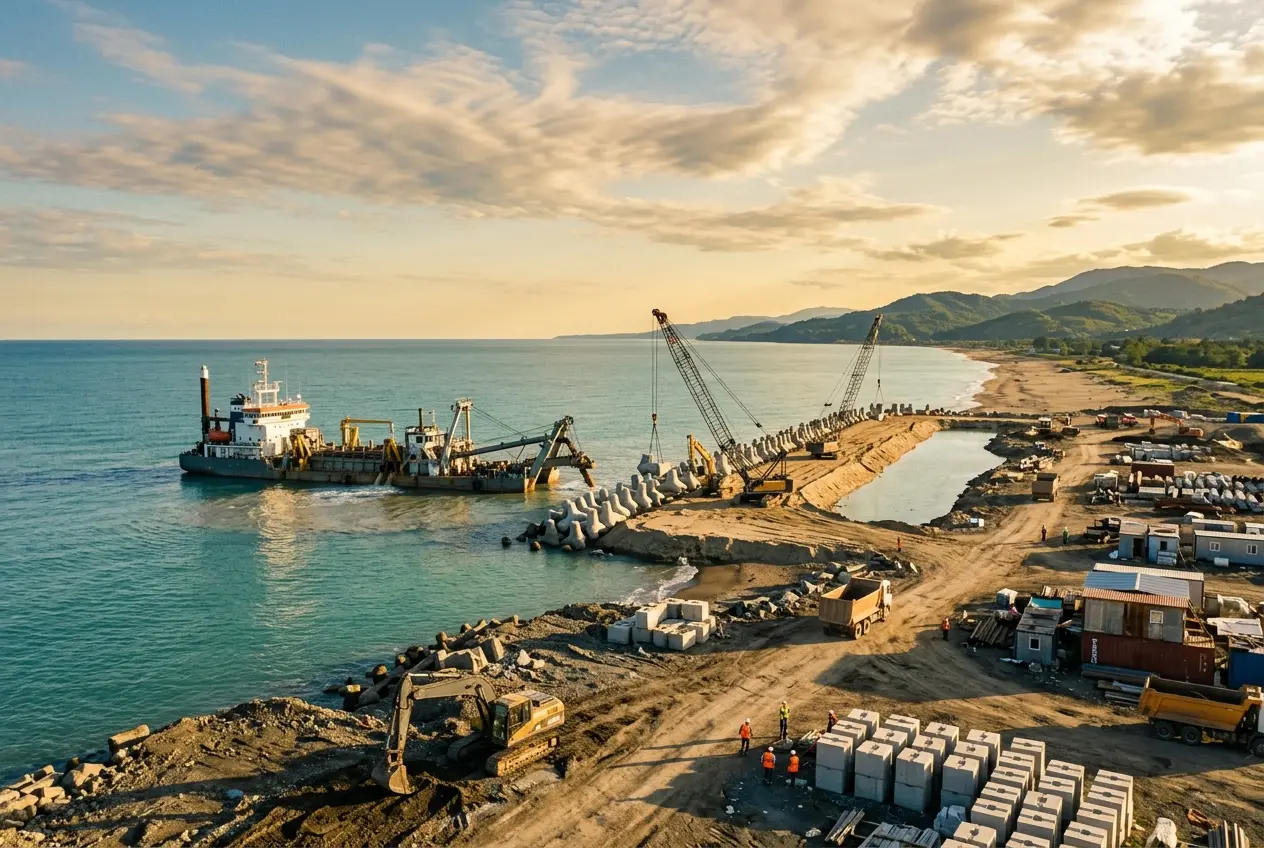
The construction clock is already running. Dredging and breakwater works are under way at the site, Kvrivishvili said, inviting sceptics to visit. Prime Minister Irakli Kobakhidze said the first phase of the port is expected to be completed by 2029, with the access road and railway under construction in parallel.
Whether that timetable survives the financing reset is the open question. A separate $250 million of pre-existing state works is being optimised by $50-52 million, the minister said, leaving the new state ask at $200 million. The total project cost remains approximately $1.1 billion, unchanged in headline terms. Without a named lender or a signed agreement with any terminal operator, the project moves into its fourth decade of planning without a contract in place for the part of the deal that was supposed to bring private cargo and capital.
Frequently Asked Questions
Will foreign companies own shares in the Anaklia port?
No. Kvrivishvili said shares in the port itself will not be sold. Foreign companies will be brought in only to lease and operate individual terminals, not to take equity in the port.
Why did China leave the Anaklia project?
The Chinese-Singaporean consortium led by China Communications Construction Company and China Harbour Investment was selected in May 2024 as the sole bidder for a 49 percent stake. Negotiations ended in late 2025 over issues the minister linked to national interests. The government describes the parting as a joint and friendly decision; Civic IDEA argues the relationship collapsed.
When will the first ship call at Anaklia?
The first vessel is still planned for 2029, Prime Minister Irakli Kobakhidze said. Construction of the access road and railway is running in parallel with the dredging and breakwater works at the site.
What is the total cost of the Anaklia project?
Approximately $1.1 billion, the minister said, unchanged in headline terms. The financing mix has shifted: a planned $600 million first-phase contribution from the CCCC consortium has been replaced by an additional $200 million from the state budget and from international financial institutions.
How does the Landlord model work?
The state owns the core port and its connecting transport links; private operators finance and run the terminals. Kvrivishvili described it as “the most widely tested in the world” for port ownership.
