
Egypt’s archaeologists announced two major finds on Saturday: 18 sealed Greco-Roman tombs on the Mediterranean coast and a planned 4th-century Byzantine city in the western desert. The tombs sit at Marina El-Alamein, about 100 kilometres west of Alexandria, and the city lies further inland at Ain al-Sabil in the Dakhla Oasis.
The two discoveries, announced a day apart, span roughly 2,000 years of Egyptian history. Inside the tombs, archaeologists recovered a sealed 2.5-metre granite sarcophagus and 24 gold “tongue” pieces placed in the mouths of the deceased. At the desert site, a planned street grid, a basilica church, and ~200 inscribed pottery fragments are now reshaping what researchers knew of 4th-century urban life far from the Nile.
Eighteen Sealed Tombs Open on the Mediterranean Coast
Egypt’s Ministry of Tourism and Antiquities said the coastal discovery was made at Marina El-Alamein, an archaeological site roughly 100 kilometres west of Alexandria. The latest excavations uncovered 18 Greco-Roman tombs, several of which still had their original stone blocking slabs in place. The finds lift the total number of excavated tombs at the site to 44 since it was first identified in 1986.
Of those 18, 11 are rock-cut hypogea reaching depths of around eight metres, and seven are limestone-built surface tombs, according to the ministry’s statement. Several burial chambers remained sealed by their original slabs, untouched since antiquity, with skeletons and grave goods preserved inside. Mission chief Eman Abdel Khalek said the team also uncovered a 2.5-metre-long granite sarcophagus with its lid still sealed in place, a level of preservation confirmed in the detailed inventory of the Marina El-Alamein excavation. Human remains inside are now undergoing scientific examination.
Marina El-Alamein is widely believed to be the ancient city of Leukaspis, a Mediterranean port mentioned by the Greek geographer Strabo. The settlement flourished from the Hellenistic through the Byzantine periods, reaching its height between the first and third centuries AD as a commercial and maritime hub. Marble statues, Greek gods, and Egyptian funerary motifs in the new finds highlight that mixed cultural layer, and Egyptian funerary traditions remain a live field of study, from the pyramids to the Greco-Roman tombs.
| Tomb type | Number | Average depth |
|---|---|---|
| Rock-cut hypogea | 11 | ~8 metres |
| Limestone surface tombs | 7 | Surface level |
The Goods Sealed in Each Chamber
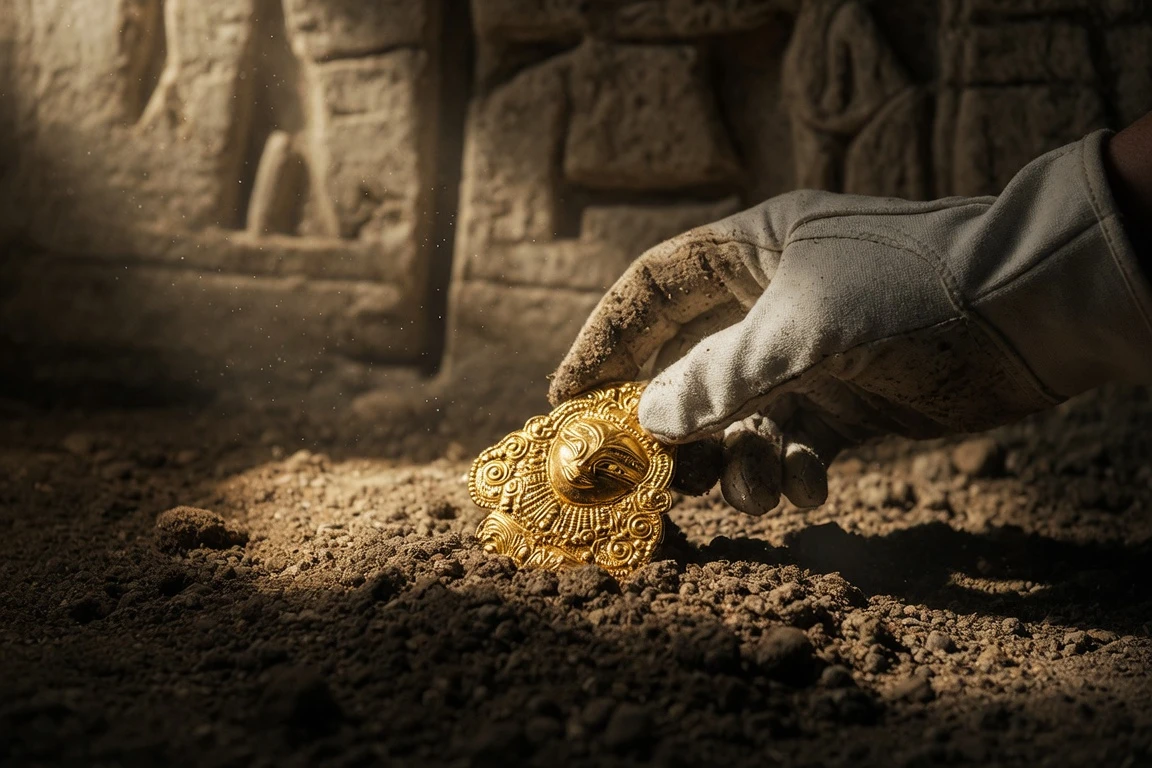
Near the granite sarcophagus, archaeologists found fragments of a plaster sphinx, evidence of the lasting Egyptian religious and artistic traditions inside the city during the Hellenistic and Roman eras. The team also recovered 24 gold funerary pieces placed in the mouths of several deceased, a ritual known as the “golden tongue” and thought to help the dead speak in the afterlife. Among the smaller finds was a rare gold Eye of Horus amulet, one of the most enduring protective symbols in ancient Egyptian belief. Mission director Eman Abdel Khalek called the golden-tongue recovery one of the most remarkable discoveries of the season.
The excavation produced a broader assemblage: complete and nearly complete pottery vessels, amphorae, oil lamps, plates, limestone altars and basins, and architectural elements associated with the tombs. A limestone offering altar carved in the form of an Egyptian “false door” came out of the rubble, alongside a funerary stela showing a seated man holding a bird and a collection of glass lacrimaria. An unfinished marble statue believed to depict the goddess Aphrodite was also recovered. Archaeologists also found a water well that had been converted into a burial shaft, another sign of how Ptolemaic and Roman funerary traditions persisted at the site. Surface burials surrounding the cemetery hinted at the city’s social diversity.
A Planned City Surfaces in the Dakhla Oasis
The second discovery was announced a day earlier, on Friday, at Ain al-Sabil in the Dakhla Oasis, in Egypt’s western desert. The settlement is dated to around the 4th century AD, when Egypt sat inside the Byzantine Empire.
The excavation revealed a planned city of mudbrick with broad north-south streets intersected by east-west roads forming open public squares, according to the ministry. A basilica church dating to the mid-fourth century stands at the settlement’s head, overlooking its main streets. Two watchtowers sit at the outskirts, alongside a heavily fortified structure with thick defensive walls, according to mission head Mahmoud Massoud.
The houses carry their own weight: many contain reception halls and vaulted roofs. One is identified as the house of Tisous, a church deacon dating to the second half of the fourth century. Another, the residence of Tabibos, dates to the early fourth century and is believed to have served as a house church before the basilica was built. The site also yielded bread ovens, kitchens, and stone grinding tools that appeared to have been used to produce food. Diaa Zahran, who heads the Islamic, Coptic and Jewish Antiquities department, described the find as a detailed picture of everyday domestic life.
The Dakhla Oasis lies in the New Valley Governorate, deep inside Egypt’s western desert, and is already on UNESCO’s Tentative List, the agency’s penultimate step before World Heritage inscription, a status documented in the official photographic record of the Dakhla excavation. The ministry’s two announcements came wrapped in a broader pitch to visitors, the same pitch that has driven a record tourism year.
- Planned street grid: north-south and east-west
- Mid-4th-century basilica church at the settlement’s head
- Two watchtowers at the outskirts
- Heavily fortified structure with thick defensive walls
- Mudbrick houses with reception halls and vaulted roofs
- House of Tisous, a church deacon, used as a house church
- ~200 ostraca inscribed in Coptic and Greek
A 4th-Century Economy Inscribed in Pottery
The finds that may tell the most are ~200 ostraca, pottery fragments inscribed in Coptic and Greek. They carry commercial contracts, business transactions, and personal correspondence. Diaa Zahran said the texts provide rare evidence of how the oasis settlement organized its economy and social life. The texts offer an exceptional documentary record of the city’s inhabitants.
The coin finds anchor the chronology. Archaeologists recovered well-preserved bronze coins bearing portraits of Byzantine emperors, alongside Latin inscriptions and Christian symbols. A separate group of gold coins dates to the reign of Roman emperor Constantius II, who ruled between 337 and 361. The coin mix fixes the city squarely in the mid-fourth century. Heritage Daily’s reporting confirms the settlement sits on UNESCO’s Tentative List, the agency’s penultimate step before World Heritage inscription.
The unearthed quarters included north-south thoroughfares intersected by east-west streets, forming open squares and public spaces.
That was Hisham el-Leithy, secretary general of the Supreme Council of Antiquities, speaking about the Ain al-Sabil excavation. The settlement, excavated at the Ain Al-Sabil archaeological site in the New Valley Governorate by a mission from Egypt’s Supreme Council of Antiquities, has a well-organized street network, a Christian basilica, two watchtowers, a fortified structure, and numerous mud-brick houses, Heritage Daily reports.
Why Both Finds Headline Egypt’s Tourism Pitch
The pair of discoveries lands inside a wider economic pitch. Tourism is a major source of foreign currency alongside Suez Canal revenues and remittances from Egyptians working abroad. A record 19 million tourists visited Egypt last year, a 21% increase from 2024. The first four months of 2026 saw 6.1 million tourists, up from 5.7 million over the same period in 2025.
Minister of Tourism and Antiquities Sherif Fathy called the Marina El-Alamein find a significant scientific addition that deepens understanding of the cultural identity of the ancient inhabitants and helps redefine the city’s role as a major Mediterranean crossroads. SCA Secretary General Hisham el-Leithy said the ministry is supporting excavations at the site alongside a development project that will include a visitor centre, electric shuttle routes, pedestrian walkways, a museum storage facility, an administrative headquarters, and an open-air theatre. The project is expected to be completed during the first half of next year, transforming Marina El-Alamein into a fully integrated archaeological destination.
Egypt’s tourism has started to recover after years of political turmoil following the 2011 uprising and the coronavirus pandemic. The ministry’s announcements of high-profile finds are part of a long-running push to bring international visitors back.
- 19 million: tourists who visited Egypt in 2025, a record
- 21%: increase over 2024
- 6.1 million: tourists in the first four months of 2026
- 44: total tombs identified at Marina El-Alamein since 1986
- ~200: inscribed ostraca at Ain al-Sabil
Frequently Asked Questions
How old are the finds at Marina El-Alamein?
The 18 tombs are nearly 2,000 years old, dating to the Greco-Roman period between roughly the first and third centuries AD, when the ancient port of Leukaspis reached its height. The site was first identified in 1986 during construction work, and the latest excavations bring the running total of excavated tombs there to 44.
What is the golden tongue ritual?
The golden tongue is a funerary practice in which small gold pieces are placed inside the mouth of the deceased, a ritual believed to help the dead speak in the afterlife. Egyptian archaeologists recovered 24 such pieces from the Marina El-Alamein tombs, along with a rare gold Eye of Horus amulet.
When was the Byzantine city at Dakhla Oasis built?
The settlement at Ain al-Sabil is dated to around the 4th century AD, with the basilica at its centre dating to the mid-fourth century. Gold coins link the occupation to the reign of the Roman emperor Constantius II, who ruled between 337 and 361, anchoring the city firmly in that century.
Can visitors tour either site?
Marina El-Alamein is part of a Ministry of Tourism and Antiquities development project that includes a visitor centre, electric shuttle routes, and pedestrian walkways, expected to be completed in the first half of next year. The Dakhla Oasis is on UNESCO’s Tentative List for World Heritage status, but tourist access arrangements were not detailed in the ministry’s announcements.
