
The Lebanese and Israeli governments signed a framework agreement in Washington on June 26, 2026, under the sponsorship of the Trump administration. The public text commits both sides to “a complete and lasting peace,” with the Lebanese Armed Forces (LAF) to take over from the Israeli army across southern Lebanon. The prerequisite sits on Beirut: full disarmament of Hezbollah and every other non-state armed group across Lebanese territory must be verified before any IDF “progressive redeploy[ment],” in stages from two initial “pilot zones” south of the Litani. A “military coordination group, with U.S. support and participation” will supervise the process, and Israel defines when a “threat” has been eliminated. Two days after the signing, Defense Minister Israel Katz said Israeli forces would not move “one millimetre” until Hezbollah surrenders its weapons and that the Israeli presence would be “long-term.”
The framework was the product of direct negotiations between Beirut and Tel Aviv brokered by Washington over four days. Hezbollah rejected it the day it was signed. Druze leader Walid Jumblatt, the Free Patriotic Movement, and the Lebanese Communist Party followed with their own rejections. Street protests drew Hezbollah and Amal supporters to central Beirut on Saturday. The bloc that backed it is the same one that had spent the past year working to cut Lebanon off from the Iran-U.S. channel.
What the Framework Paper Actually Says
The agreement is a 14-paragraph text released by the U.S. State Department on June 26, 2026. Its core paragraph commits Lebanon to rebuild the state’s “monopoly on the use of force” and to “achieve the complete and verified disarmament of all non-state armed groups,” ensuring those groups “will have no military or security role and no armed capabilities anywhere in Lebanon.” That covers Hezbollah and any other armed formation, across Lebanese territory, not just south of the Litani.
| What the text sets | What Israeli officials are saying |
|---|---|
| “Verified disarmament of non-state armed groups” is the precondition for any redeploy | “Not one millimetre” until Hezbollah disarms, with no deadline attached |
| Two initial pilot zones south of the Litani; future zones “by mutual consent” | “Long-term” presence, “defendable borders,” and an Israeli right to assess the threat |
| Israel declares “no territorial ambitions” in Lebanon | Israeli forces remain “until the threat is eliminated” |
| “Military coordination group, with U.S. support and participation” | Israel and the U.S. sit on the group that defines “non-state armed group” |
| Lebanon commits to stop “all hostile or adverse actions” in international fora | No mention of any Israeli limit on prosecution of those who resist the disarming |
The same paragraph conditions any IDF pullback. “The LAF will restore effective sovereign authority over all Lebanese territory,” the text reads, “pending the verified disarmament of non-state armed groups and dismantlement of associated infrastructure, enabling the [IDF] to progressively redeploy out of the Lebanese territory.” Two “pilot zones” are named as the first stage; only after the disarmament in those zones is verified will the LAF take responsibility and “internationally supported reconstruction efforts” begin.
Israel declares in the same text that it “has no territorial ambitions in Lebanon,” and pins all of its military actions there “solely” on Hezbollah. The Government of Lebanon, in turn, commits to “the cessation of all hostile or adverse actions in international political or legal fora.” Opponents in Beirut read that line as a renunciation of suits at the International Court of Justice or the International Criminal Court. The framework does not name a deadline by which the redeployment sequence has to begin.
What Netanyahu and Katz Say Out Loud
The text sets the framework. The ministers are drawing the map.
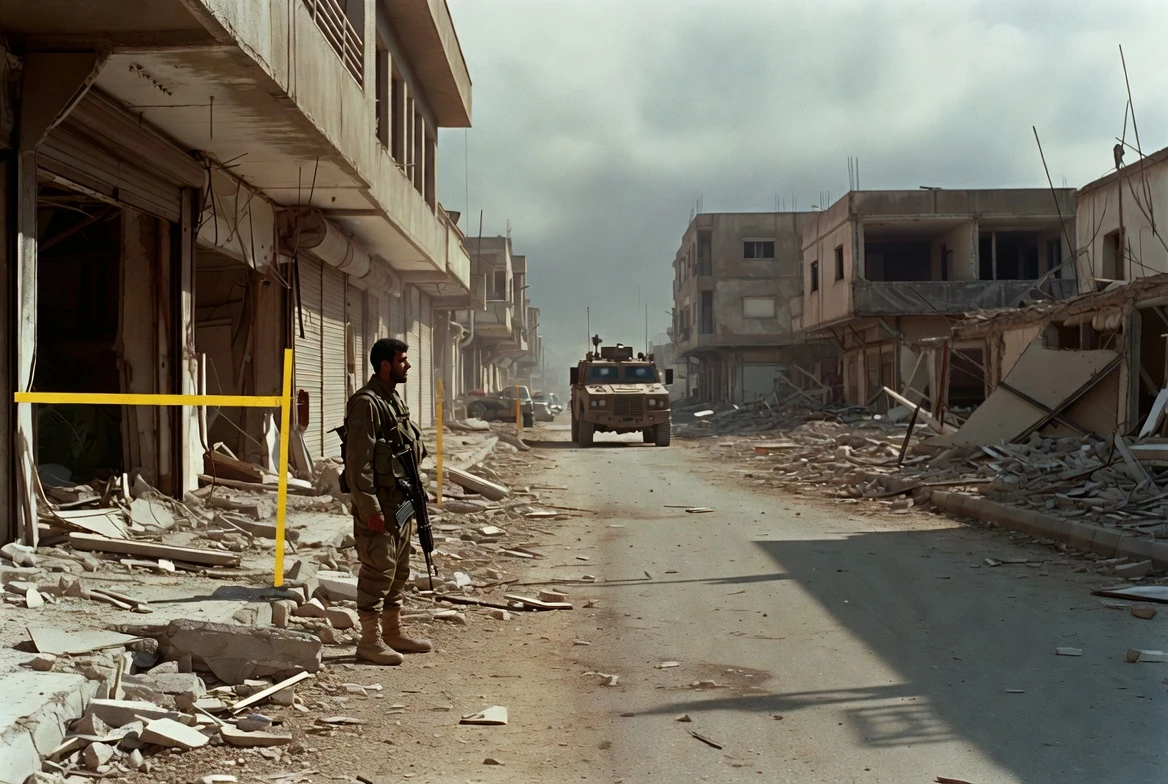
On June 30, 2026, four days after the signing, Prime Minister Benjamin Netanyahu toured a security zone inside southern Lebanon reported by the International Viewpoint to span more than 600 square kilometers. The zone extends up to ten kilometers inside Lebanese territory. He addressed Israeli troops there. The text had been signed in Washington four days earlier.
Our insistence is that we will not leave southern Lebanon until the threat is removed.
Netanyahu told the troops, inside what the Israeli military calls the yellow-line buffer zone, that the operative reading of “no territorial ambitions” is that the IDF stays. A day before the tour, Defense Minister Israel Katz had said Israeli forces would not move “one millimetre” until Hezbollah surrendered its weapons. The yellow line was drawn by Tel Aviv without Lebanese signoff, per the International Viewpoint account.
Katz also said the Israeli army’s presence would be “long-term,” and that the LAF would not “suddenly become composed of lions charging at Hezbollah.” He added, according to the same account, that Shia villages in the border strip “must go.” Finance Minister Bezalel Smotrich gave Al Jazeera a longer horizon still: “We are there until Hezbollah disarms, and I think also beyond that, because we need defendable borders.”
A Ruling Class Split Against Itself
Inside Lebanon, the agreement did not split public opinion. It split the elite that signed it.
President Joseph Aoun, in office since January 2025, called the framework “the first step on the path towards Lebanon restoring its sovereignty over all its territory.” Prime Minister Nawaf Salam wrote on social media that the agreement “aims to achieve Israel’s withdrawal from all Lebanese territories.” Samir Geagea, who leads the Lebanese Forces, hailed it as the “most important political initiative of the Lebanese state in half a century,” reading it as the path to Israeli withdrawal and the end of armed groups outside state control. The Kataeb party has backed the text.
The base of that bloc is the traditional Maronite-right parties, and the regional gravity behind it is Gulf-U.S.-Israeli. The United Arab Emirates has welcomed the framework; the Gulf Cooperation Council issued a statement a day before the signing welcoming the talks without naming an explicit endorsement. Saudi Arabia, the heaviest GCC player, has not stated a position. The Lebanese government had also worked separately, in the run-up to the framework, to keep its Israel track outside the Iran-U.S.-Lebanon ceasefire task force created separately, which had put Iran, the United States, and Lebanon at one table. The framework is the instrument that choice produced.
The Rejection
Hezbollah Secretary-General Naim Qassem accused the Lebanese government of “legitimizing” Israel, calling the agreement a “humiliating, shameful” surrender of sovereignty, per Al Jazeera. The party’s position going in had been that Israel cannot be trusted and that Hezbollah needs to keep its weapons to defend Lebanon.
This agreement is null and void.
Qassem, the Hezbollah secretary-general, said the agreement crossed “all red lines and makes Lebanon a plaything in the hands of the Israeli enemy,” according to the International Viewpoint translation. Parliament Speaker Nabih Berri, who heads the Amal movement, told L’Orient Le Jour the agreement was “contradictory and impossible to implement,” warning it was “contrary to all logic and out of step with Arab and international positions.” Mahmoud Comati, deputy chairman of Hezbollah’s political bureau, said the party “will not allow its implementation” and would deal with it “by all possible means and methods.”
Non-Hezbollah figures joined the rejection. Druze leader Walid Jumblatt called the framework “a capitulation to Israel” and pointed to what he characterized as the total omission of the 1949 Lebanese-Israeli armistice agreement from the text, calling for “a front of political opposition to this agreement” before later qualifying his position. Hassan Fadlallah, a Hezbollah member of parliament, told Al Jazeera that any attempt by the LAF to enforce a Washington-brokered agreement would lead to “civil war.” The Lebanese Communist Party, in a statement titled “Uniting efforts to bring down the shameful Lebanese-Israeli agreement,” called the text “a dangerous precedent of submission and capitulation.”
Street protests drew Hezbollah and Amal supporters to central Beirut on Saturday, with demonstrators waving Hezbollah flags and rejecting the deal, Al Jazeera reported. Resident Ali Zaytoun of Beirut’s southern suburbs, displaced multiple times by Israeli attacks, told the outlet: “It is incredibly difficult for me to accept an agreement with the same state that carried out the military actions that devastated our communities.” A separate demonstration torched government-aligned signs on the airport road, per the International Viewpoint.
Paying for Disarmament
The framework makes reconstruction contingent on compliance. Lebanon and the United States commit to “preventing funds from flowing to any entity, organization, or individual affiliated with non-state armed groups,” and to taking “available legal measures to proscribe” their activity. The text reserves “internationally supported reconstruction efforts” until verified disarmament in each pilot zone.
On June 30, 2026, four days after signing, the U.S.-GCC Terrorist Financing Targeting Center (TFTC) sanctioned Al-Qard al-Hassan and Bayt al-Mal, two Hezbollah-linked financial institutions, alongside several individuals. The Treasury Department described Al-Qard al-Hassan as a microcredit organization that “masquerades as a non-governmental organization” while operating banking-like services beyond its stated mandate. Bayt al-Mal had been under U.S. sanctions since 2007. The framework’s money-laundering provisions now anchor those designations inside a state-to-state text. Any future Lebanese reconstruction assistance will be tied to the disarmament sequence the agreement lays out.
The text also requires both governments to “take good faith measures that demonstrate positive intent, including the cessation of all hostile or adverse actions in international political or legal fora.” Inside Beirut, that line is being read as a closure of the war-crimes suits non-state actors and Lebanese plaintiffs have pursued at the ICC and the ICJ. A second channel, Lebanon’s separate deconfliction cell that excludes Israel, sits in the background of the wider architecture.
The Damage This Agreement Works Against
The agreement is signed over the wreckage of a war that has not formally ended.
- More than 4,000 killed in Lebanon since March 2026 (Al Jazeera, June 26, 2026)
- More than 4,200 killed and hundreds of thousands displaced since early March (Al Jazeera, June 28, 2026)
- $1.38 billion direct building damage in South Lebanon as of April 29, 2026 (UNDP rapid damage assessment from June 2026)
- More than 11,000 buildings completely destroyed in South Lebanon (UNDP, June 2026)
- Roughly one-fifth of Lebanon still under Israeli occupation (Al Jazeera, June 26, 2026)
Those figures sit on top of the 2024 war, in which more than 4,000 civilians were killed and direct damage was estimated at more than $7 billion, with economic losses of $13 billion on top. Al Jazeera reported that Israel continues to occupy roughly one-fifth of Lebanon today. Lebanese government figures, drawn on by the International Viewpoint, put the 2026 toll above 4,200 dead and displacement above one million.
A Long-Term Occupation in Framework Language
Inside Lebanon, many politicians have compared the agreement to two earlier deals. A May 17, 1983 agreement between the Lebanese government of President Amine Gemayel and Israel was meant to end the state of belligerency between the two countries. It was never implemented.
It was cancelled in February 1984, with the Israeli occupation of the south continuing. The Oslo Accords of 1993 drew the Palestinian Authority into a security role inside the occupied territories.
That role legitimized Israeli colonization rather than ending it, deepening Palestinian divisions the occupation has continued to exploit. Beirut’s framework assigns the LAF an analogous role. The framework agreement is dated June 26, 2026; on June 30, Netanyahu was inside southern Lebanon, telling troops the IDF would not leave “until the threat is removed.” The text names no other date.
Frequently Asked Questions
What does the Lebanon-Israel framework agreement signed June 26, 2026, actually do?
It commits Lebanon to the complete and verified disarmament of all non-state armed groups across Lebanese territory, beginning with two initial pilot zones south of the Litani. The Israeli army will redeploy only after that disarmament is verified. A trilateral military coordination group with U.S. support and participation supervises the process.
Does the framework require Israel to withdraw from southern Lebanon?
Not on a fixed timetable. Any Israeli redeployment is conditional on verified Lebanese disarmament. Prime Minister Netanyahu and Defense Minister Israel Katz have stated publicly that Israeli forces will not leave until Hezbollah is disarmed and that the presence will be “long-term.”
Who supports the agreement inside Lebanon?
President Joseph Aoun, Prime Minister Nawaf Salam, the Lebanese Forces under Samir Geagea, and the Kataeb party have publicly backed or welcomed it. The United Arab Emirates has welcomed the framework; the GCC issued a statement a day before the signing welcoming the talks without naming an explicit endorsement. Saudi Arabia has not stated a position.
Who opposes the agreement?
Hezbollah Secretary-General Naim Qassem has called the agreement “null and void” and “a grave error.” Parliament Speaker Nabih Berri has called it “contradictory and impossible to implement.” Druze leader Walid Jumblatt has called it “a capitulation to Israel,” later qualified. Hassan Fadlallah, a Hezbollah lawmaker, has warned of “civil war.” The Lebanese Communist Party has called it “a dangerous precedent of submission and capitulation.”
What are the sanctions on Al-Qard al-Hassan?
The U.S.-GCC Terrorist Financing Targeting Center sanctioned Al-Qard al-Hassan and Bayt al-Mal on June 30, 2026, alongside several individuals tied to the institutions. The Treasury Department described Al-Qard al-Hassan as a microcredit organization that “masquerades as a non-governmental organization” while operating banking-like services beyond its stated mandate. The framework requires Lebanon to prevent funds from flowing to entities affiliated with non-state armed groups.
