
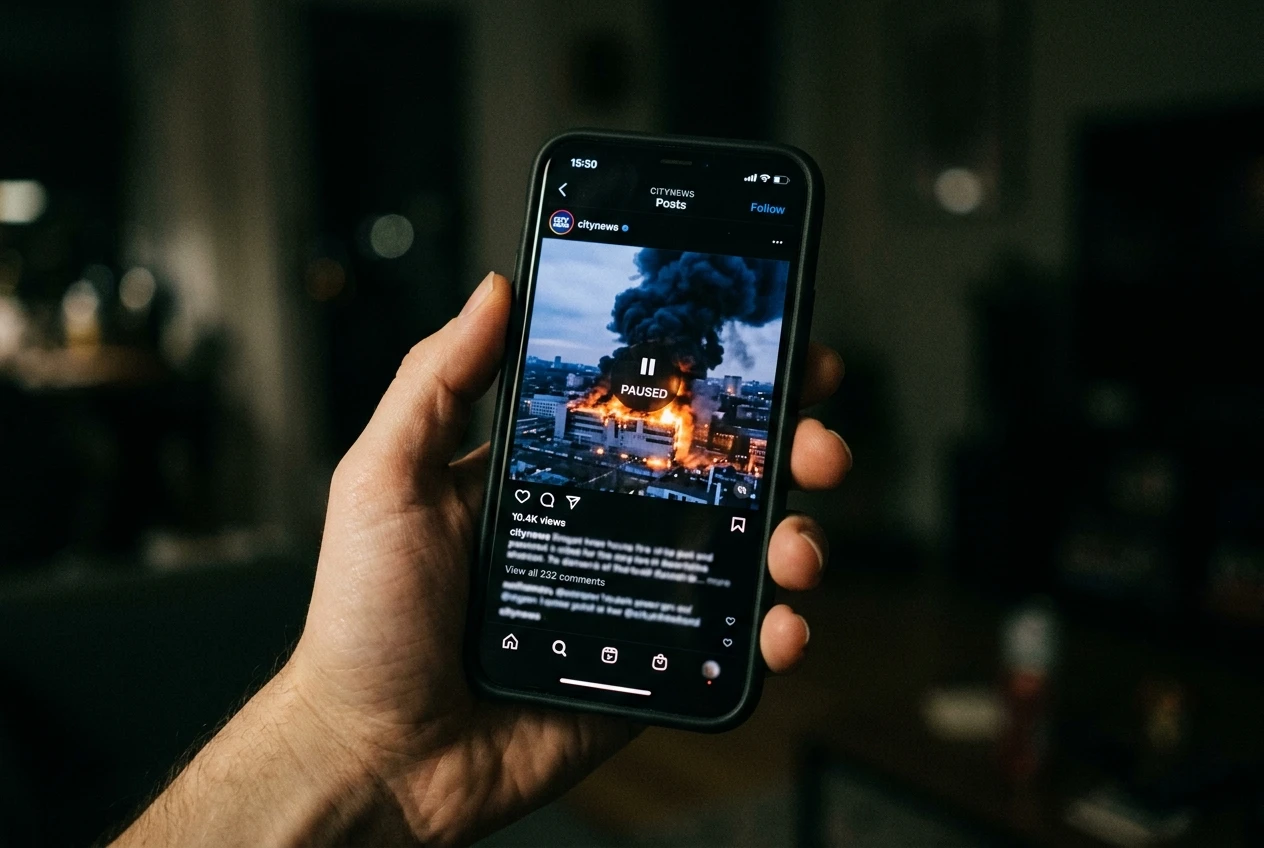
A video of a 2020 fire at a public market in Ajman, a city in the United Arab Emirates, has been shared on social media as footage of a recent Iranian attack on Tel Aviv. The UK fact-checking charity Full Fact has ruled the claim false. Iran did fire missiles at Israel on 7 June 2026, the day before the posts went up, but the barrage struck northern Israel, not Tel Aviv energy infrastructure.
The 22-second clip, filmed from a passing vehicle, was posted to X and Facebook on 8 June 2026 with the caption “Iran today attacked and destroyed energy infrastructure in Tel Aviv.” Full Fact traced the footage to a Nepali-language Facebook post from August 2020 describing a blaze in Ajman, and matched the road in the moving shot to Google Street View imagery of a street in the same city.
The Claim and the Verdict
The video was uploaded a day after Iran fired missiles at northern Israel, on 7 June 2026. The post asserted that energy infrastructure in Tel Aviv had been hit. Full Fact’s verdict labelling the 8 June claim false was published on 15 June 2026 and rests on three independent lines of evidence.
The first is a 2020 Facebook upload credited to a user named Sujan Gaire, posted in Nepali to describe a market fire in Ajman. The second is the road in the moving shot, which corresponds to Google Street View imagery of a street in the city.
The third is AFP’s separate fact check, which corroborated the same 2020 origin and timeline. All three converged on the same conclusion: the video is from 2020, and Iran did not hit Tel Aviv energy infrastructure on 7 June 2026. The fact check also draws a line between the 7 June missile barrage on northern Israel and the absence of any reported damage to Tel Aviv energy infrastructure.
The video is old and actually shows a fire that broke out at a market in Ajman in the UAE in August 2020.
Full Fact, the UK fact-checking charity, published the verdict on 15 June 2026.
What the Footage Actually Shows
The fire broke out on 5 August 2020 at a public market in Ajman’s industrial area, according to a Gulf News report cited by AFP. The market was closed at the time under Covid-19 safety measures, and no casualties were reported, but 125 shops were destroyed. Other clips filmed from passing vehicles circulated online alongside the original footage, showing the same black smoke and the same road layout.
Ajman police posted their own version of the fire in Arabic, with a caption saying parts of the building had collapsed. The Nepali caption on the earliest verifiable upload, by the Facebook user Sujan Gaire, read in English: “Massive fire breaks out in Ajman, Dubai.” That same 22-second clip is the video now circulating as evidence of an Iranian strike on Tel Aviv.
The Trail Back to August 2020
Full Fact’s investigators began with a reverse image search on the circulating video. That search returned the August 2020 Facebook post, written in Nepali, that described a market fire in the same city.
They then compared the road in the moving shot to Google Street View imagery of a street in the area. The match was enough to place the original footage in Ajman’s industrial area, where the 2020 fire had happened. Other clips filmed from passing vehicles had circulated online in early August 2020, with the same black smoke and the same road layout. A third source, an Arabic-language post by Ajman police, named the location and said parts of the building had collapsed.
The path from a 2020 fire to a 2026 claim runs through at least four distinct social media posts. The video has now been recaptioned for three different wars, none of which it shows.
- 5 August 2020 – A fire engulfs the public market in Ajman’s industrial area. The market is closed for Covid-19, and 125 shops are destroyed.
- 6 August 2020 – Sujan Gaire posts the now-circulating video to Facebook in Nepali, captioned in translation: “Massive fire breaks out in Ajman, Dubai.”
- 5 May 2026 – The same clip resurfaces on X with a Thai-language caption claiming a gas separation station in Dubai had been destroyed in an Iranian drone attack.
- 8 June 2026 – A new false caption attaches itself to the same video, asserting Iran had attacked and destroyed energy infrastructure in Tel Aviv.
- 15 June 2026 – Full Fact publishes its verdict, rating the claim false.
What Iran Did on 7 June
Iran did fire missiles at Israel on 7 June 2026, the day before the false posts went up, Full Fact reported. The barrage hit northern Israel, framed by Tehran as a response to what Iran called a Beirut attack that “crossed all red lines.” Israel responded with strikes on Iranian military targets. None of the reporting Full Fact reviewed described damage to energy infrastructure in Tel Aviv.
The fact check’s own statement is the cleanest summary: “Iran fired missiles at northern Israel on 7 June, but we’ve not seen any reports of energy infrastructure in Tel Aviv being hit.” The verdict treats the two findings as separate: the real 7 June attack on one hand, and the absence of any reported damage in Tel Aviv on the other.
The Same Clip, Two Different Wars
This is not the first time the 2020 fire has been repackaged. Full Fact says it has fact-checked the same clip before, when it was shared with claims that it depicted a fire at Dubai’s international airport. AFP addressed a Thai-language post that labelled the video as a strike on a Dubai gas separation station, in a fact check of the same clip from May 2026.
The pattern is consistent: a single fire, six years old, and at least three different false captions, each attached to a different moment in an active conflict. In May 2026, the clip carried a caption claiming a Dubai gas separation station had been destroyed in an Iranian drone attack. By June 2026, the same clip carried a different caption, this one asserting Iran had hit Tel Aviv energy infrastructure. The 22-second footage, with no edits, has now appeared in at least three Middle East stories it had nothing to do with. Each false claim had no connection to the original footage, beyond the moving car and the black smoke.
The 22-second video is the same one uploaded to Facebook in August 2020. The false captions are not.
Reading a War Video Before You Share It
The Ajman case has become a textbook study in how conflict footage is recycled. Full Fact’s own guidance points to three questions worth asking of any video claiming to show an active war: where the clip was first posted, whether the road or sky matches the claimed location, and whether the same footage has been linked to an earlier false claim. The same checklist exposed the 8 June post, the May 2026 caption, and the earlier Dubai airport story.
The Ajman clip is one of several recent cases where war footage turned out to be old, AI-made, or filmed somewhere else. A fact check clearing other Tel Aviv strike videos traced several viral posts to footage from earlier conflicts. A viral video claiming an Iranian strike on Mossad HQ was exposed as AI-generated within days of the 7 June attack. All three followed the same arc: a dramatic claim, fast shares, then a fact check that arrived after the post had already done its work. Reading a war video before sharing it takes a minute; unsharing a false one is harder.
Frequently Asked Questions
Was an Iranian attack on Tel Aviv energy infrastructure reported in June 2026?
No. Iran fired missiles at northern Israel on 7 June 2026, and Israel struck Iranian military targets in response. Full Fact’s verdict on the 8 June claim states that the fact checkers had not seen any reports of energy infrastructure in Tel Aviv being hit.
When did the Ajman market fire actually happen?
The fire broke out on 5 August 2020 at a public market in Ajman’s industrial area in the UAE, according to a Gulf News report cited by AFP. The market was closed at the time under Covid-19 safety measures, and 125 shops were destroyed.
Has this same video been falsely shared before?
Yes. Full Fact says it has fact-checked the clip previously, when it was shared as a fire at Dubai’s international airport. AFP also addressed a Thai-language version of the same footage that claimed a Dubai gas separation station had been destroyed.
How was the Ajman fire video verified as old?
Investigators ran a reverse image search on keyframes from the circulating clip and matched the result to a Nepali-language Facebook post by Sujan Gaire dated 6 August 2020. The road in the moving shot was then compared to Google Street View imagery of a street in Ajman, and the two matched.
What did Iran actually do on 7 June 2026?
Iran launched a barrage of missiles at northern Israel on 7 June 2026, Full Fact reported, framing the attack as a response to what Tehran called a Beirut attack that “crossed all red lines.” Israel responded with strikes on Iranian military targets.
