
Saudi Arabia and Yemen signed a $150 million petroleum deal in Riyadh on Tuesday to supply diesel and mazut to more than 70 Yemeni power plants, with a separate agreement signed the same day to prop up Yemen’s state oil company PetroMasila. The two deals, announced on May 27 and formally signed on June 9, extend a years-long pattern of Saudi fuel grants that has not ended Yemen’s chronic electricity crisis.
The Saudi Development and Reconstruction Program for Yemen (SDRPY), the Riyadh body funding both deals, said the $150 million in petroleum derivatives had been directed by King Salman bin Abdulaziz Al Saud and Crown Prince Mohammed bin Salman bin Abdulaziz Al Saud, with follow-up from Minister of Defense Prince Khalid bin Salman.
The $150 Million Riyadh Signing
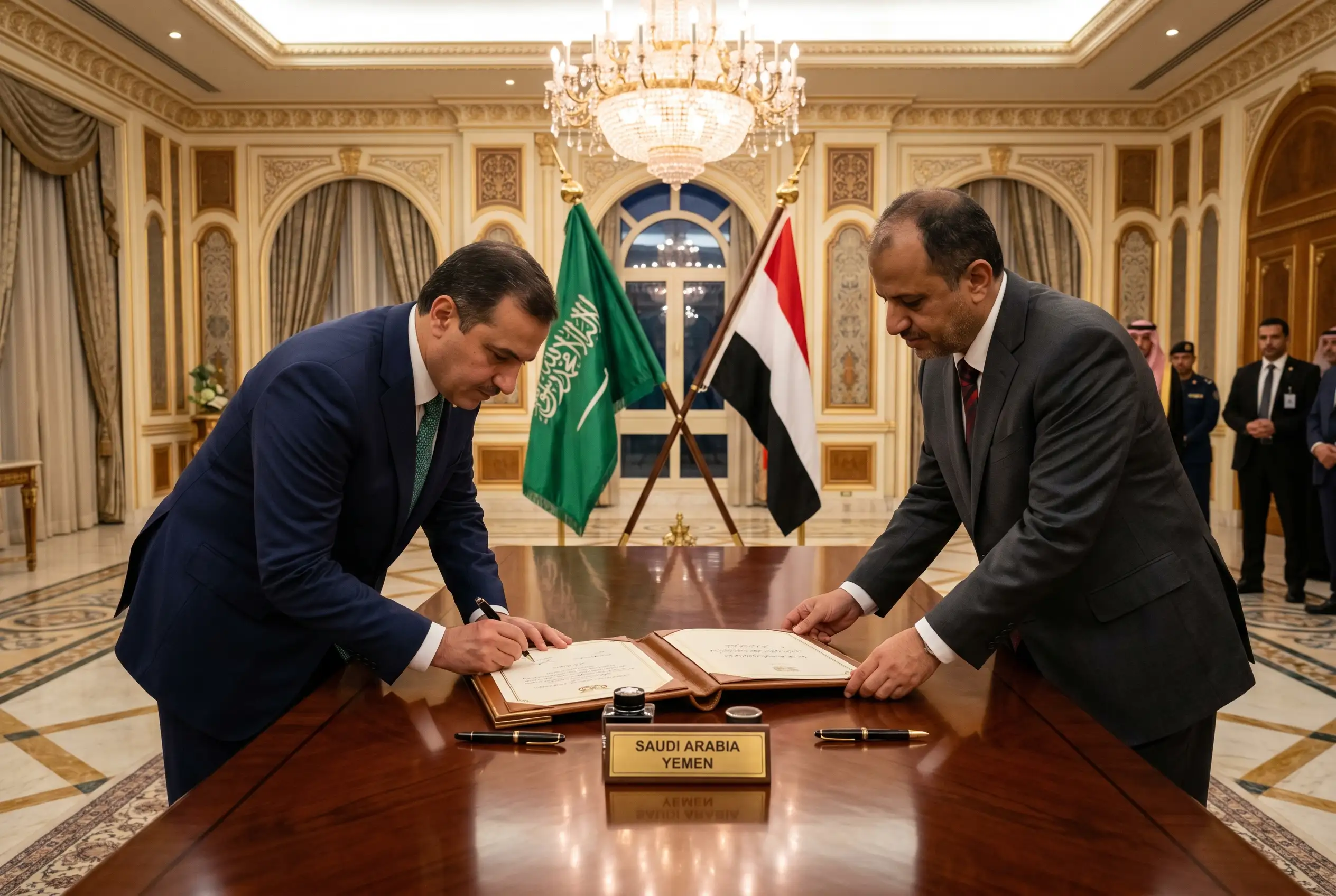
Yemeni Minister of Electricity and Energy Eng. Adnan Al-Kaf and Saudi Ambassador to Yemen and SDRPY General Supervisor Mohammed bin Saeed Al Jaber signed the main agreement under the patronage of Yemeni Prime Minister Dr. Shaya Mohsin Zindani, the official June 9 dispatch on the signing said. The fuel, a mix of diesel and mazut, will be routed to more than 70 electricity generation plants across various Yemeni governorates.
SDRPY framed the package as urgent relief. The grant was announced in late May as rising summer temperatures pushed Yemen’s power demand higher, and the formal signing a day later was timed to move the fuel quickly. The state news agency dispatch said the cash is meant to “enhance the stability and continuity of electricity services” and to “support vital sectors linked to electrical energy.”
Saudi framing leaned on development language. The SDRPY press release said the package “contributes to the stability and continuity of electricity services, supports vital and service sectors linked to electric power, and strengthens the foundations of development and stability in Yemen.” It also said the fuel would help “stimulating commercial activity, creating job opportunities, and promoting economic growth.” A separate dispatch on the same day said the deal “reflects the Kingdom of Saudi Arabia’s longstanding commitment to supporting the Yemeni people and alleviating their humanitarian suffering, particularly amid rising temperatures.”
Saudi Arabia, through the Saudi Development and Reconstruction Program for Yemen (SDRPY), provided urgent fuel derivatives support worth $150 million to Yemen. The support will cover the operational needs of electricity power plants with diesel and mazut across various Yemeni governorates.
The framing came from the May 27 announcement of the fuel grant, which said the package was directed by King Salman and Crown Prince Mohammed bin Salman, with the Ministry of Defense’s Prince Khalid bin Salman overseeing follow-up.
The PetroMasila Lifeline
A second agreement, signed on June 9 and tied to the same SDRPY funding line, runs alongside the fuel grant. It binds the Yemeni Ministry of Electricity and Energy, Yemeni state oil company PetroMasila, and SDRPY to “support the sustainability of PetroMasila’s operations as a state-owned company, strengthening its capabilities, improving operational efficiency, and ensuring continuity of services in support of the Yemeni government,” the state news agency dispatch said. Saudi cash is now underwriting both the supply of fuel and the Yemeni entity that sells it.
The arrangement turns a one-off grant into a recurring commercial relationship between SDRPY and PetroMasila, the state producer of the diesel and mazut flowing to the power plants. The same three parties had signed a similar tripartite deal on January 21, when SDRPY committed $81.2 million to purchase 339 million liters of diesel and mazut from PetroMasila for the same network of power plants. The June 9 deal embeds the same commercial flow as a recurring feature of SDRPY’s Yemen work, not a one-time purchase. The January deal set the template; the June 9 agreement extends it.
How the Fuel Will Reach the Plants
Both June 9 deals run through a governance structure Riyadh is building inside the Yemeni government. The fuel will be distributed under a “comprehensive governance framework” managed by a supreme committee linked to the Yemeni prime minister, with several Yemeni entities sitting on the body.
The framework is meant to lock in accountability. SDRPY said the committee will “oversee and monitor the distribution of petroleum derivatives to power plants based on the identified needs of electricity generation facilities across Yemeni governorates.” The structure puts the prime minister’s office on the hook for delivery.
SDRPY is also pairing the fuel grant with a wider development portfolio. The program has implemented 287 development projects and initiatives across eight vital sectors, including education, health, energy, water, transportation, agriculture, fisheries, and development programs, per the May 27 release. SDRPY’s January 2026 work included a memorandum with the General Authority of Foreign Trade and a $40 million education partnership with the Global Partnership for Education. The June 9 deal doesn’t specify a volume of fuel, a duration for the supply contract, or a breakdown between diesel and mazut, even though the January grant was sized at 339 million liters.
A Pattern of Fuel Grants Since 2018
The $150 million package is the fifth major Saudi fuel grant to Yemen since 2018. SDRPY’s own press releases list the same sequence: $180 million in 2018, $422 million in 2021, $200 million in 2022, and $81.2 million in early 2026.
The cadence has quickened this year. The January 21 grant was the first 2026 entry, and SDRPY had announced a $506 million aid package a week earlier for Yemen’s education, health, government, and infrastructure sectors. The table below captures the full fuel-grant series.
| Year | Grant Value | Notes |
|---|---|---|
| 2018 | $180 million | Petroleum derivatives grant |
| 2021 | $422 million | Petroleum derivatives grant |
| 2022 | $200 million | Petroleum derivatives grant |
| January 2026 | $81.2 million | 339 million liters of diesel and mazut |
| June 2026 | $150 million | Diesel and mazut for more than 70 power plants |
The SDRPY series includes five separate fuel grants to Yemen since 2018. Each has been triggered by a discrete need, and each has been followed by another. The June 9 signing landed a day after SDRPY’s late-May announcement and on the same day as the formal PetroMasila arrangement. The May 27 release describes the cumulative impact as a contribution to the “stability and continuity of electricity services” across Yemeni governorates.
The fuel grants sit alongside other Saudi-Yemen coordination efforts, including a separate push for peace between Saudi and Yemeni commanders in the Saudi capital. SDRPY has also run development projects across energy, education, health, water, transportation, agriculture, fisheries, and government institutional support, the program says.
Saudi Support to Yemen in 2026
Fuel is one slice of a wider 2026 package. The January 21 grant followed SDRPY’s announcement, a week earlier, of a $506 million aid package for Yemen’s education, health, government, and infrastructure sectors. Three days before that, on January 18, SDRPY had announced a SAR1.9 billion development package alongside a new fuel grant.
Together with the June 9 deal, Yemen has received three discrete Saudi fuel grants in the first half of 2026, and the broader aid portfolio has expanded across at least five other sectors. SDRPY’s May 27 release describes the wider effort as covering eight sectors:
- education
- health
- energy
- water
- transportation
- agriculture
- fisheries
- support for the Yemeni government’s institutional capacities
The grants are also being layered on top of a broader regional realignment, as Oman’s quiet shift from Yemen mediator to quiet Saudi ally reshapes the diplomatic backdrop. The number of moving pieces is high.
The combined picture is one of recurring Saudi cash, a working tripartite fuel relationship, and a governance committee inside the Yemeni government now being asked to absorb all of it. The committee’s first test is whether Yemeni power plants stay lit this summer.
- $150 million: the new fuel derivatives grant, June 2026
- more than 70: Yemeni power plants the grant targets
- 287: SDRPY development projects and initiatives across Yemen
- $506 million: the wider SDRPY aid package announced in January 2026
- 339 million liters: the diesel and mazut covered by the January 2026 grant
Frequently Asked Questions
What is the $150 million Saudi-Yemen petroleum deal signed in June 2026?
A $150 million Saudi-funded petroleum grant, signed in Riyadh on June 9, 2026, to supply diesel and mazut to more than 70 Yemeni power plants. It is the fifth major SDRPY fuel grant to Yemen since 2018, the Saudi state news agency dispatch says, and was signed by Yemeni Minister of Electricity and Energy Eng. Adnan Al-Kaf and Saudi Ambassador to Yemen and SDRPY General Supervisor Mohammed bin Saeed Al Jaber.
What is the PetroMasila agreement signed the same day?
A separate tripartite deal between Yemeni state oil company PetroMasila, the Yemeni Ministry of Electricity and Energy, and SDRPY, signed on June 9, 2026. It supports PetroMasila’s operations as a state-owned company, with the goal of strengthening capabilities, improving operational efficiency, and ensuring service continuity, per the Saudi state news agency dispatch.
How is the fuel being distributed to power plants?
Under a comprehensive governance framework managed by a supreme committee linked to the Yemeni prime minister. The committee comprises several Yemeni entities and is responsible for overseeing and monitoring the distribution of petroleum derivatives to power plants based on the identified needs of electricity generation facilities across Yemeni governorates, per the Saudi state news agency dispatch.
What is SDRPY?
The Saudi Development and Reconstruction Program for Yemen, the Saudi government body funding both June 9 deals. It has implemented 287 development projects and initiatives across eight vital sectors, per the May 27 announcement, and is also running a $40 million partnership with the Global Partnership for Education signed in late 2025.
How does this deal fit Saudi Arabia’s wider aid to Yemen since 2018?
It is the fifth major fuel grant SDRPY has provided since 2018. Previous grants include $180 million in 2018, $422 million in 2021, $200 million in 2022, and $81.2 million in January 2026, the Saudi state news agency dispatch says.
