
Israel’s military issued an evacuation order for the Lebanese city of Tyre on Tuesday, and for the first time the order also covers Al Hara, the historic Christian quarter of a city that has stood on the Mediterranean for more than 4,700 years. The widening of the order pulled in residents who had stayed through months of Israeli bombardment, including older Christians and families whose businesses sit in the shadow of Tyre’s port. Lebanon’s Health Ministry said an Israeli airstrike earlier in the day killed at least eight people in Tyre, and the army struck several more locations across southern Lebanon after issuing the warning. Reporting from Zouk Mosbeh and New York, NBC News journalists Zoya Awky and Corky Siemaszko gathered the accounts that residents of Al Hara gave them as the evacuation deadline took hold.
A Christian Quarter Added to the Order
Tyre’s Christian quarter, Al Hara, joined the evacuation order for the first time since Israel began its latest push into southern Lebanon to root out Hezbollah, according to the Israel orders Tyre residents to evacuate ancient Lebanese city dispatch from Zouk Mosbeh. Israel says Hezbollah, a Shia Muslim militant group allied with Iran, is using Al Hara as cover to fire rockets and drones into Israeli territory. A Lebanese security source told The National that the Lebanese Army, sent to Al Hara last week to check the Israeli claim, “conducted patrols and didn’t find anything suspicious.”
The Israeli military’s Arabic-language spokesman, Lt Col Avichay Adraee, posted the order on X and told Tyre residents to “move north of the Zahrani River“, about 25 kilometres away. He accused Hezbollah of operating in the Christian neighbourhood but did not provide evidence, The National reported. The full evacuation map covers Shabriha, Hamdieh, Jal Al Bahr, Zkouk Al Mafdi, Al Bass, Maashouq, Burj Al Shemali, Nabaa, Hosh, Rashidieh and Ain Baal. The Israeli army last month declared all areas south of the Zahrani “combat zones.”
Lebanon’s state-run National News Agency reported “a heavy air strike on the city of Tyre” shortly after the warning went out. The Health Ministry said the pre-warning strike killed at least eight people and wounded 32, with rescuers still searching rubble for survivors. The NNA also reported Israeli raids on more than a dozen other locations across southern Lebanon.
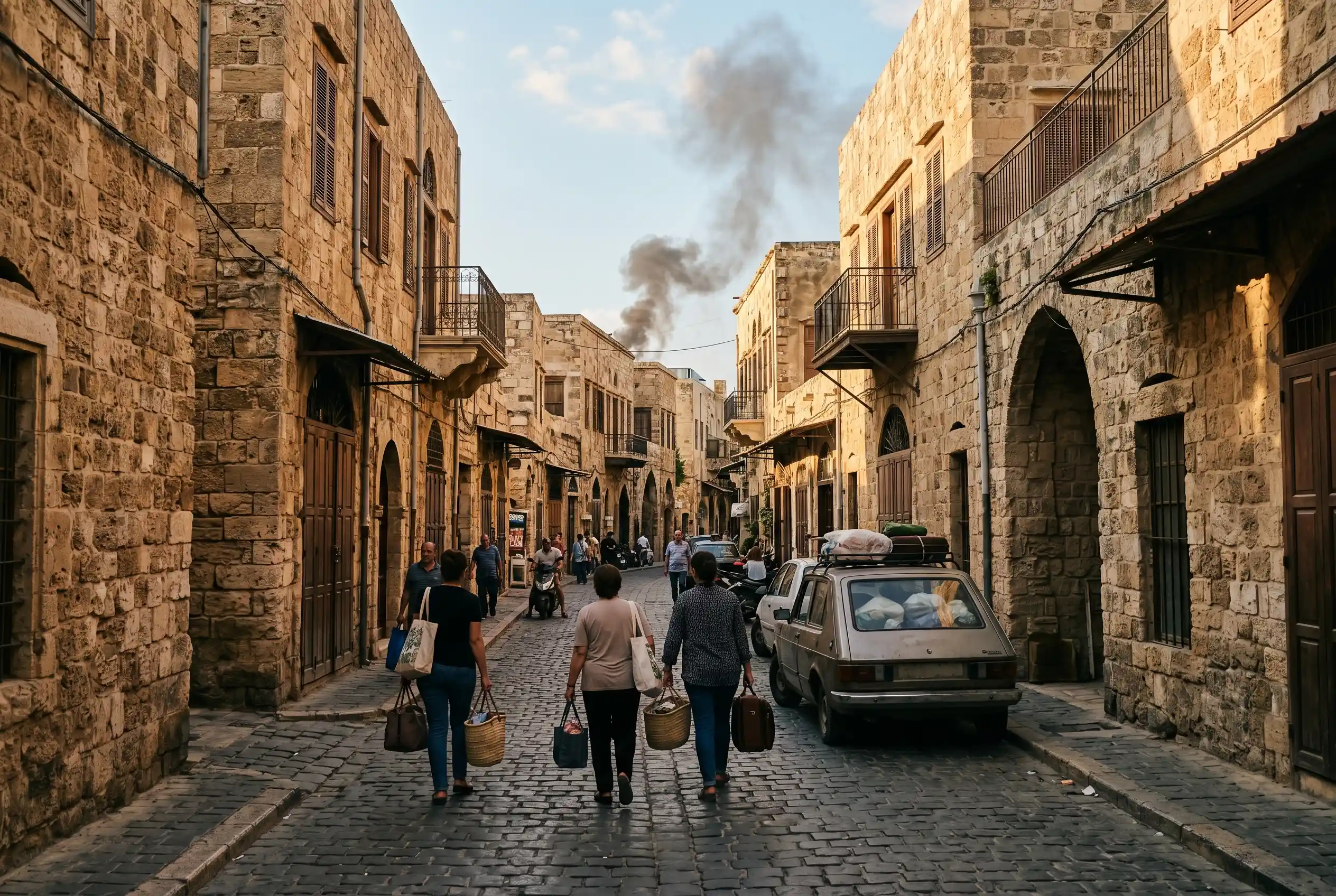
The ‘Neutral Area’ That Stopped Feeling Safe
Janette Barbour, a married mother of three grown children, lives in Al Hara and runs a family business there. Her son operates a café in Tyre, and her husband runs a restaurant in Tyre port, which is also part of Al Hara. On Tuesday morning, she packed a bag and drove north to Beirut with her daughter.
Al Hara is a neutral area, no political parties, no arms, so we’re hoping that it doesn’t get attacked.
That was Janette Barbour, a Tyre resident, speaking to NBC News on Tuesday. She had called the quarter a “safe area” earlier in the day and told the network, “I never imagined leaving Al Hara.” Her husband and son stayed behind in the quarter because they could not leave the family businesses, she added, and her fear was for those still inside. “Of course I am afraid, especially because part of my family is still there,” Barbour said.
A worker at an Al Hara hotel, who asked not to be named for fear of an Israeli strike, said most of the hotel’s guests had already fled. “I have around 10 people in the hotel,” the worker said. “Most of them don’t want to leave Tyre, and the others don’t know where to go.” The worker said he is staying put, even though most of his neighbours have left.
Lily Hawila, a 29-year-old English teacher, lives a few miles from Al Hara in a Tyre neighbourhood called Al Houch. She has rented an apartment in the Chouf Mountains for her mother and has already fled the city with her own belongings.
A 4,700-Year-Old City Under Siege
Tyre is one of the oldest continuously inhabited cities on Earth, founded by Phoenician traders more than 4,700 years old on a Mediterranean promontory that has been fought over ever since. The Israeli bombardments that began in 1978 are only the latest in a long list of military campaigns aimed at the city. The same stretch of coast has survived sieges laid by Alexander the Great, the Crusaders, and a string of regional powers across nearly five millennia.
A section of Tyre, including the area where Al Hara sits, was added to the UNESCO World Heritage list in 1984. The old quarter is famed for its Phoenician ruins, a Roman hippodrome, and what travel writers describe as some of the best sandy beaches on the eastern Mediterranean. Between military operations, Al Hara has been overrun by waves of tourists coming to admire the ancient architecture and dine at the seafood restaurants around the fishing port. Barbour described the area to NBC News as a “safe area” whose residents are “not armed,” and she and other residents consider the quarter a “neutral area” with no political parties and no arms, a refuge from the wider war. That refuge has now been pulled into the same evacuation order that covers the rest of the city.
A timeline of Tyre’s most consequential sieges shows how the current evacuation order fits into a pattern centuries older than the modern state of Israel. The same Phoenician promontory that held off Alexander the Great for seven months is now the launching point for a daily scramble toward Beirut.
- Founded by Phoenician traders more than 4,700 years ago
- 332 BCE: Alexander the Great’s army laid siege to Tyre during his campaign against the Persian Empire
- 12th and 13th centuries: Crusaders held Tyre as a strategic coastal fortress
- 1978 onward: Israel began repeated bombardments of southern Lebanese cities including Tyre
- June 9, 2026: An Israeli evacuation order covers Tyre’s Christian quarter for the first time
North of the Zahrani River
The Israeli military’s evacuation warning, posted in Arabic, told residents of Tyre and the Christian quarter to leave their homes immediately. “For your safety, we ask you to immediately evacuate your homes… and move north of the Zahrani River,” the army’s warning read. The Zahrani runs about 25 to 30 kilometres north of Tyre, and the Israeli army last month declared all areas south of the river “combat zones.” Residents were given no timeline for when they might be able to return.
The forced-displacement map published on Tuesday covers the following areas of greater Tyre, several of them Palestinian refugee camps and surrounding neighbourhoods. Sami Baradhi, a Christian quarter shop owner, told The National that he had finally decided to leave for Beirut. “I will come back in a few days, as soon as the situation is stable,” he said.
- Shabriha
- Hamdieh
- Jal Al Bahr
- Zkouk Al Mafdi
- Al Bass
- Maashouq
- Burj Al Shemali
- Nabaa
- Hosh
- Rashidieh
- Ain Baal
A War That Has Killed 3,637 People
Tyre’s latest chapter of displacement sits inside a wider war that began on March 2, 2026, when Hezbollah fired rockets into northern Israel in response to the killing of Iran’s supreme leader in US-Israeli strikes. That Iranian trigger is part of the broader pattern of Iran and Israel trading strikes across the Middle East since the spring. Israel responded with airstrikes across Lebanon, including in Beirut, and on March 16 began ground operations in southern Lebanon. The Israeli army eventually deployed five divisions, and Israel has been striking what it calls Hezbollah targets across the country almost daily since.
Lebanon’s Health Ministry says Israeli attacks since March 2 have killed at least 3,637 people and wounded 11,188. The conflict has displaced about 1.2 million people, more than 20% of Lebanon’s population, and damaged civilian infrastructure including schools, healthcare centres, mosques and churches. The wider ground push into southern Lebanon, documented in Israel’s renewed ground operation in southern Lebanon, has now extended to Tyre and shows no sign of slowing.
On the Israeli side, the army says 29 soldiers and one civilian contractor have been killed in Lebanon. The two sides have agreed to four ceasefires, the most recent on June 3, and negotiations are scheduled to resume on June 22. None of the ceasefires has held. On Monday, the day before Tyre’s evacuation order, the Health Ministry said Israeli strikes on south Lebanon killed at least 14 people, including five in a strike near a Red Cross centre in Tyre. The Lebanese government has publicly condemned Hezbollah’s renewed strikes against Israel for endangering the Lebanese state, while also condemning Israel’s planned occupation and attacks on civilians.
- 3,637 people killed in Lebanon since March 2, 2026
- 11,188 wounded in Lebanon
- 1.2 million displaced in Lebanon, more than 20% of the population
- 29 Israeli soldiers and 1 civilian contractor killed in Lebanon
- Four ceasefires agreed; none holding; next talks June 22
Those Who Refuse to Leave
Inside Al Hara, the order is colliding with residents’ attachment to the only home many have ever known. Many older Tyre residents told NBC News they would rather stay in their houses than flee, despite the bombardment. The Al Hara hotel worker who has decided to stay said, “We are afraid, it’s only human, but we decided to stay.”
Sana Abou Zeid, a 50-year-old mother of three grown children, lives in a densely populated section of Tyre called Al-Masaken. Her eldest son is serving in the Lebanese army and her youngest is in high school, and she said they cannot imagine living anywhere else. “I cannot leave Tyre because my children don’t want to,” she told NBC News. As she spoke to a reporter, she received word that her street had been bombed and that eight people were killed.
