
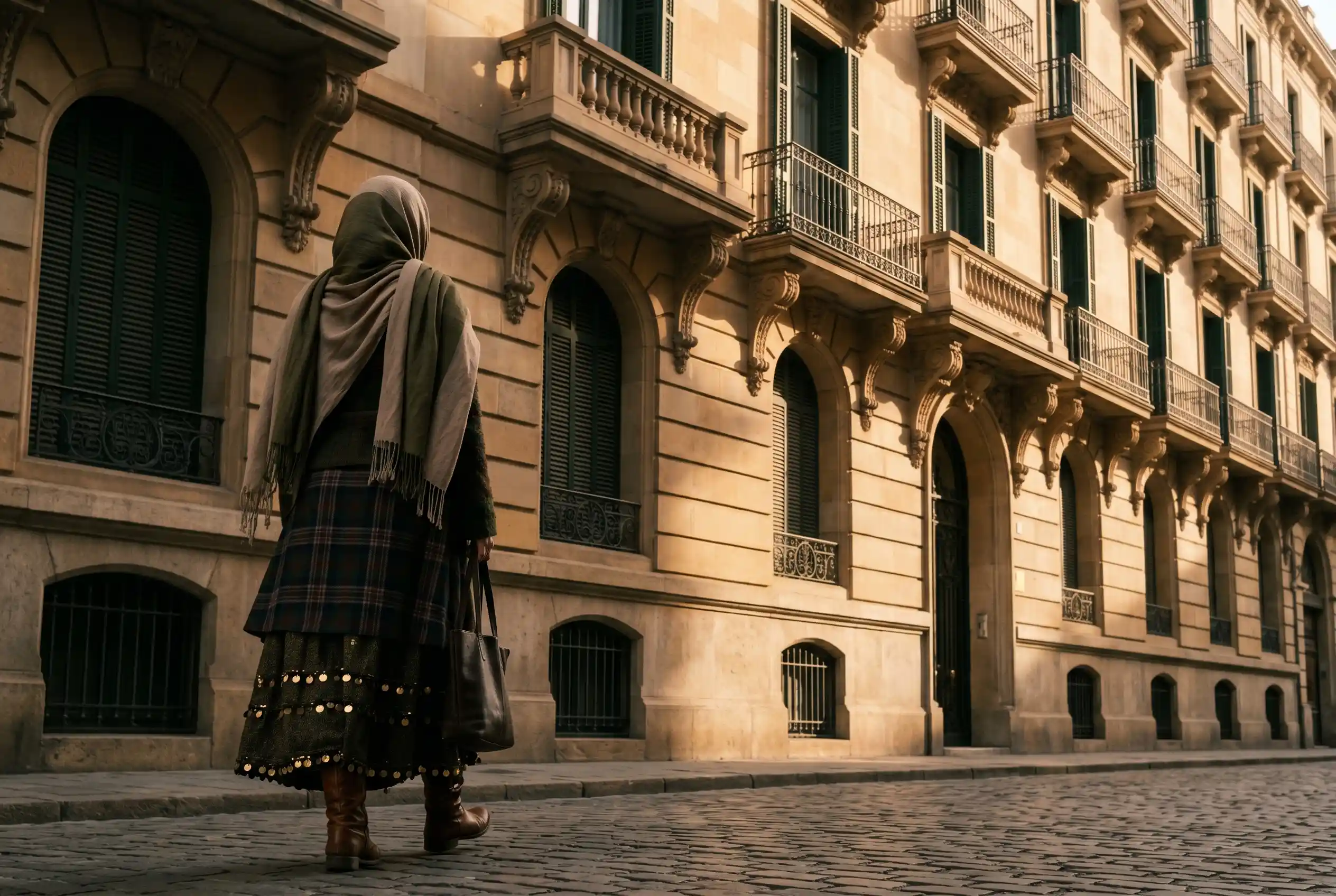
Nadine El is a Scottish-Egyptian fashion creator raised in Kilmarnock by Egyptian parents, and for the Cairo Scene SELECTS feature she styled three outfits against the documented Belle Époque facades of Zamalek that only make sense once you know her full biography. Tartan layered over a coin skirt from a Marrakesh souq. A thrifted jacket over multiple waistbands on a Nile-island street with its own idea of old money. An ankh necklace from Khan el-Khalili market paired with an H&M t-shirt and platform boots. The wardrobe is the argument.
She started wearing the hijab around 2020, found the dominant modest fashion imagery online had nothing to do with her, and built her own aesthetic from whatever pieces her two cultures had left in her hands.
A Very Niche Childhood in Kilmarnock
Kilmarnock is a small town in East Ayrshire, about 22 miles southwest of Glasgow. The Egyptian community there was, in Nadine El’s own telling, nearly nonexistent. At school, she recalls, it was just her, her sister, two Iraqi sisters, and two Pakistani sisters among around a thousand students. East Ayrshire’s 2022 census on religion and ethnic identity records the area’s Muslim population at just 0.6% of residents, against Glasgow’s 7.9%. The Egyptian community, a subset of that already small number, was genuinely rare in the town.
“The identity crisis was so real growing up,” she said. “But character building.”
Home was conservative. School was overwhelmingly white and Scottish. For a girl growing up at that intersection, belonging required negotiation at every level: which parts of herself to lead with at any given moment, which to keep quieter, how to explain the combination to people who had encountered nothing like it. The accent she carries is distinctly Scottish. Everything else the accent doesn’t cover, she had to account for herself.
Other British cities have Muslim student communities large enough to form their own cultural gravity: south Asian high-street fashion lines, Islamic student societies, halal markets as social hubs. Kilmarnock had essentially none of that. There was no visible template for what a Scottish-Egyptian-Muslim young woman could look like, because the combination had no presence in the town to look at growing up.
Fashion wasn’t there yet as a language for her. She needed, first, to find people who understood the question she was carrying around.
Chronically Online, Long Before It Paid
The community she found was online. Twitter, Tumblr, fan pages, group chats. She describes herself as “an internet kid” who had been “chronically online” for as long as she can remember. In one of the better footnotes to this period, Justin Bieber once followed her fan account. “A little bit of a flex,” she says.
The laugh she gives when she says it is the point. The fan account was real teenage labour and it was also building something. Online, she found Egyptians, Muslims, and people from other compound-identity backgrounds who understood the small daily negotiations of living between two cultures that had virtually no overlap in Kilmarnock. She absorbed aesthetic references from these communities, built audience fluency, and developed a practical tolerance for commentary that disagreed with her.
The creator who now makes outfits designed to prompt a double take ran that game first in the fan-account years, where finding your specific community mattered more than pleasing a general one. When the comment sections later had opinions about modesty or ethnicity or aesthetic, she already knew how to keep going.
The Headscarf Changed the Terms
Around 2020, Nadine El started wearing the hijab. And immediately ran into a problem.
The modest fashion imagery online didn’t look anything like her. It ran toward soft pastels and hyper-feminine silhouettes, coordinated and gentle and genuinely popular with its intended audience. The dominant creator profile was GCC-based or London-based, working in a visual tradition tied to abayas, pastel sets, and a broadly feminine color palette. As NSS Magazine’s survey of modest fashion and diaspora identity notes, the second-generation creators who reshaped the space were “staying true to their religion, culture, and the aesthetic codes these entail, adding a touch of the West.” For Nadine El, the touch of the West was tartan, a Glaswegian accent, and references nobody else in the modest fashion feed was pulling from.
I felt like if I wore the headscarf, I would lose a bit of my personality.
Nadine El, fashion creator, speaking to Cairo Scene for the SELECTS series. She built differently: tartan for Scotland, coin belts and layered souq jewelry for Egypt, enough texture and proportion play to make a Glaswegian winter look deliberate. The headscarf became the starting point for working out, in public, what the overlap between two very specific cultures actually produces on a body. “I really just see my identity through my clothes,” she says.
Three Looks in Zamalek
Zamalek, the affluent Nile island district that carries a century of diplomatic and social layering alongside its Belle Époque facades, gave the SELECTS shoot its structure. The neighborhood’s tree-lined streets and Art Deco villas maintain what Al-Ahram describes as “a collective sense of maintaining a historic identity” even as Cairo transforms around it. Each of the three looks used that architectural character as a deliberate counterpoint to the garments in front of it.
| Look | Stated Inspiration | Cultural Anchors | Key Pieces |
|---|---|---|---|
| Look 1 | Cairo’s layered chaos | Androgynous balance, comfort-led | Zidouri zipper, Free People balloon trousers, Marrakesh souq necklace |
| Look 2 | Zamalek’s old-money elegance | Classic tailoring with a modern edge | Vinted jacket, Mise En Place bag, Maadi chain belt |
| Look 3 | Egyptian-Scottish identity | Coin belt and tartan in dialogue | Marrakesh coin skirt, Cairo vintage tartan, Khan el-Khalili ankh |
Cairo’s Layered Chaos
“I was inspired by Cairo’s layered chaos,” she said of the first look, “the mix of textures, prints, and energy translating it into an androgynous balance of feminine and masculine, while still holding onto a sense of comfort that feels familiar.”
The pieces span several price points without drawing attention to the gap: a zipper from London-based brand Zidouri, a lace dress and vest from ASOS, and the Free People Lotus balloon trousers that give the proportions their androgynous volume. Necklace and bag thrifted from souqs in Marrakesh, shoes from the secondhand platform Vinted. Cairo’s chaos, filtered through a budget any viewer could replicate.
Zamalek’s Quiet Register
“In Zamalek, there’s an understated old-world elegance, refined, and timeless,” she said. “I wanted to reflect that ‘old money’ feel through classic tailoring, while introducing a modern edge through accessories to make it feel current and personal.”
A Vinted jacket. Weekday trousers. An ASOS skirt. Two belts, one black from a Marrakesh souq and one chain-linked and thrifted from a market in Maadi, Cairo. Boots from a Cairo vintage store. The one piece from an actual label: a bag from Egyptian brand Mise En Place. Everything else secondhand or high-street. The aesthetic, as it always is with Nadine El, has nothing to do with a budget.
Tartan and Coin Belt
The third outfit is the clearest statement of the shoot’s argument. A thrifted headscarf. An H&M t-shirt. A coin skirt from a Marrakesh souq, a layered black skirt from Vinted, a tartan skirt pulled from a Cairo vintage store, and an ankh necklace from Khan el-Khalili market.
“This look explores my Egyptian-Scottish identity,” she said, “pairing tartan details with a traditional coin belt, and grounding it with a simple base to let those cultural elements take the lead.”
Two cultural materials in front, everything else held as close to neutral as a thrifted wardrobe can manage.
The Women Who Kept the Headscarf On
The online feedback she describes is specific. Women write to tell her they’ve stayed with the hijab because they found an aesthetic that felt like their own personality rather than one they’d been handed.
“The only reason I continue to do what I do,” she has said, “is seeing the feedback and seeing girls say to me, ‘I’ve kept the headscarf on because I found a way that can also fit myself.'”
This is the part of the equation that follower counts don’t fully capture. The modest fashion creator landscape is well-populated, particularly among GCC and London-based figures. Harper’s Bazaar Arabia’s 2026 mapping of 25 modest fashion creators to follow covers Dubai, Saudi Arabia, the UAE, and the Netherlands. Nothing from Scotland. Nothing from the specific intersection of Egyptian heritage and post-industrial Scottish upbringing. For a girl in a small Scottish town with an Egyptian family and no interest in the dominant pastel aesthetic, the options were adapt or be under-served. That gap is the actual product.
She’s also deliberate about the difficulty level of the work. “I want people to do a double take and say, ‘I don’t know if I like this.'” She’s not dressing to please. “If you’re pleasing everyone, you’re not being true to yourself.” The comment sections have had opinions in every direction; she keeps going.
Her thick skin came partly from the chronically online years in Kilmarnock, where the identity questions arrived long before the fashion ones did, and from deciding that the only audience she needed to satisfy was the one with no other version of itself to look at. That community is real, and it’s in her comment sections telling her so.
One Good Accessory
The current version of her practice is quieter than the layering-heavy work that built her following. The emphasis now runs toward silhouette, proportion, and what she calls the “power of one good accessory.” Less stacking, more structure. A clear shape, a specific cultural touch, and space for the viewer to do more of the interpretive work.
The reference points she keeps returning to:
- Japan
- Copenhagen
- Korea
- Scotland
- Egypt
Copenhagen and Japan have both become shorthand for a kind of dressing where one considered piece carries the whole outfit. Korea’s fashion vocabulary skews structural and androgynous, which aligns with where her silhouettes are heading. Scotland and Egypt stay in the folder for the reasons this shoot established.
Her early work needed the full stack because the aesthetic was still finding its shape. Japan, Copenhagen, and Korea now sit as clearly in the reference folder as Scotland and Egypt do. The layering is getting quieter.
