
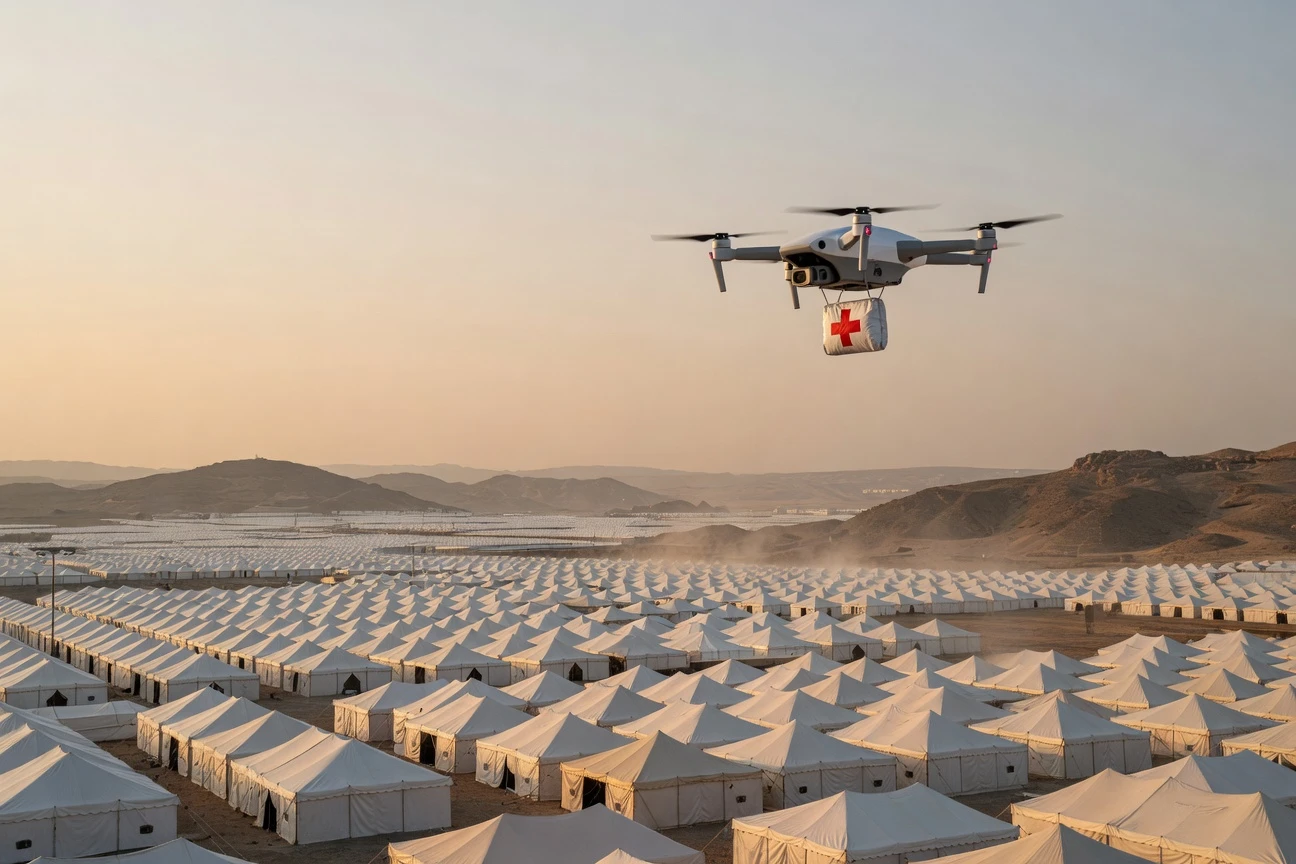
Saudi Arabia’s General Authority of Civil Aviation issued the country’s first operational permit for drone-based medicine delivery inside the Hajj holy sites on May 25, granting it to Terra Drone Arabia for limited operations during the 2026 pilgrimage. The clearance lands in the same week more than 1.5 million pilgrims moved into the Mina tent city, with temperatures across Makkah forecast to climb toward the high forties.
Saudi Health Minister Fahad AlJalajel has said the system moves medicines to camp clinics in six minutes against 90 by road. That single figure anchors a wider bet on aerial logistics inside one of the densest crowd events on earth, the sort of operating environment most aviation regulators still treat as off-limits to commercial payloads.
The Permit and What It Covers
The General Authority of Civil Aviation, known by its initials GACA, framed the document as a “limited” clearance, restricted to medicine and medical-supply movement within the boundaries of the holy sites at Makkah for the current Hajj season. The wording matters. This is not a blanket beyond-visual-line-of-sight authorisation across the kingdom, but a sealed corridor inside Mina, Muzdalifah and Arafat for a defined window. Operations sit under direct regulator oversight, with logged flight data and pre-cleared corridors.
The recipient, Terra Drone Arabia, is the Saudi arm of Japan’s Terra Drone group, with offices in Riyadh and inside the Techno Valley business park in Dhahran. Outside the pilgrimage, it runs industrial surveying, laser scanning and AI-powered analytics work for energy and infrastructure clients across the Gulf. The medical-payload mandate is its largest crowd-facing assignment to date, and its first widely publicised civil-logistics deployment in the kingdom.
The regulator aligned the move with the Aviation Program under Saudi Vision 2030’s localisation targets for air mobility, which list domestic drone services among priority sectors. The Saudi Ministry of Health, on a separate track, has called the deployment of drones for urgent medical supplies the first such programme worldwide aimed at very-large-crowd healthcare.
- 1.5 million pilgrims gathered in Mina this week, with foreign arrivals running higher than last year’s count
- 127 clinics across Makkah, Mina and Arafat need daily resupply through the climax days
- 50,000 medical staff and 3,000 ambulances support the network on the ground
From Pilot Phase to Operational Clearance
Last year’s trials gave the permit its evidence base. During Hajj 1446 in mid-2025, the aircraft ran experimental flights that the Health Ministry has since cited as the technical proof points. One delivery sent ice packs to Mina Emergency Hospital, supplies used to treat the heat exhaustion and sunstroke that spike at Arafat. Other runs tested cooling rigs onboard the airframes, verifying that medications stayed within thermal limits despite ambient heat near 50 degrees.
AlJalajel told local reporters in June 2025 that the programme had taken two years of intensive studies and field experiments to reach pilot stage. He attached the 90-to-6-minute figure to the system at that point, citing it as the operational target. The 2026 permit is the step that turns those drills into a chargeable, accountable operation under regulator oversight with formal risk reporting.
The shape of the trials also explains the permit’s narrow scope. Aviation regulators rarely move from sandbox to commercial in a single jump, and the “limited” framing reads as standard regulatory practice: prove safety inside one constrained airspace, generate incident data, then widen. The 2027 pilgrimage is where the file gets reread.
What the trials did not test is just as relevant. Last year’s flights focused on point-to-point medical runs between fixed nodes, not on swarm operations or extended autonomous routing. The current permit therefore reads as a single-aircraft, single-corridor authorisation rather than a fleet-wide green light, with each route logged and signed off ahead of departure.
Six Minutes Against Ninety
The headline contrast is between road and air. Mina sits inside a vehicle-restricted zone with permit gates at every entry, and security checkpoints throttle access during pilgrim movements. Service traffic, including medical logistics, negotiates the same throttle points as buses and ambulances.
| Metric | Ground delivery | Drone delivery |
|---|---|---|
| Typical clinic resupply time | About 90 minutes | About 6 minutes |
| Main constraint | Permit checkpoints, traffic peaks | Approved corridor, weather, payload weight |
| Cooling control | Vehicle climate control | Onboard cooling rig |
| Coverage | Full clinic network | Supplemental under “limited” permit |
Drone routes bypass the checkpoint network. They also bypass a structural pinch in pilgrimage logistics: the clinics deep inside the tent grid that sit furthest from supply depots are precisely the ones serving the most heat-stressed pilgrims at midday. Cutting their resupply cycle to a few minutes changes how a duty doctor plans dosing for a sunstroke patient.
The permit does not replace the ground network. The regulator’s language frames the clearance as supplemental, meaning the aircraft layer on top of trucks rather than taking their place. That keeps the failure modes contained. If a unit grounds for weather or technical reasons, the trucks still move and the clinic still gets stocked, just at the slower pace.
The use-case mix on the air side leans toward time-critical medication. IV fluids, electrolyte drips, cardiac kits, antiemetics and ice packs all lose their value with delay. Bulk consumables such as bandages, masks and saline volumes stay on the road, where weight makes economic sense and the time penalty does not bite as hard.
Why 47°C Forces the Aerial Option
Mid-Hajj temperatures in Makkah touched 47 degrees Celsius this week, and Saudi Ministry of Health teams had treated 144 cases of heatstroke before the climax day at Arafat. The medical demand curve in those conditions is steep and non-linear. A single afternoon hour can produce dozens of heat-exhaustion presentations across a small cluster of camps, exhausting on-site stocks before the next ground delivery arrives.
The Health Ministry pushed several heat-protection measures into the field this season:
- Umbrellas distributed to pilgrims, said to drop the ambient temperature around the user by up to 10°C
- Cooling stations and giant fans positioned along pilgrim corridors
- Specialised clinics inside accommodation blocks with diagnostic and emergency kit
- Round-the-clock pharmacy-level cover at camp clinics
The aircraft plug into that posture as a logistics layer rather than a clinical one. They carry IV fluids, ice packs, electrolyte solutions, cardiac supplies and other items whose value drops sharply with each minute of delay. King Abdullah Medical City, separately, has reported nine cardiac interventions inside a 72-hour window this pilgrimage, the kind of clinical pace that punishes any supply gap. The CDC’s pre-travel heat-illness guidance for Hajj travellers flags the same risk profile for foreign pilgrims.
Terra Drone Arabia and the GACA Rule Stack
The Saudi drone regime, codified across what the regulator calls GACAR Parts 48 and 107, runs on four pillars. Operators have to clear each one before any commercial flight, and the new medical programme had to clear all of them under the heaviest crowd density in the calendar.
- Coordinate drone imports with the regulator and the Ministry of Interior, meeting national-security technical standards
- Hold a GACA Remote Pilot Certificate, passed against Saudi Air Law, meteorology and human-factors exams
- Register every airframe with a unique HZ-UAS-XXXX mark linked to the operator’s portal profile
- Carry third-party liability insurance compliant with Saudi Central Bank rules
The medical-delivery mandate sits inside the regulator’s “Specific Category” of operational authorisation, which covers complex missions involving formal risk assessments and direct sign-off. The Hajj corridor adds two heavyweight risk vectors that the open category cannot accommodate: persistent high-density crowds underneath the flight path and ambient temperatures that stress airframe, battery and payload alike. Local sourcing also plays into the choice, since the Aviation Program flags the four-pillar permit framework as written by the Saudi operator as a route to localised drone services.
The operator’s parent context matters here too. Terra Drone’s wider group has built industrial drone projects across Asia, Europe and Latin America, with most revenue coming from oil and gas inspection rather than civilian logistics. The Saudi medical mandate is one of the group’s most public crossovers into a healthcare workflow, and the operating data it produces over the coming days will feed back into the parent’s pitch to other regulators.
A Template Other Regulators Will Read
The Health Ministry has called this programme the first of its kind globally for managing healthcare across very large crowds. That is not a marketing line so much as a regulatory artifact. The permit is the document that other aviation authorities will pull when they consider whether to authorise drone medical logistics over their own dense events, from European football tournaments to South Asian religious gatherings and African mass-vaccination campaigns.
Several near-term tests will set how readable that template becomes. Incident data is the first. If the operator closes out this pilgrimage without a payload loss or controlled-airspace breach, the regulator’s case file becomes a workable reference. Scope creep is the second, meaning whether the authority extends similar permits to non-medical payloads such as documentation, lost-property recovery or low-mass essentials. Regional uptake is the third, with the Dubai Civil Aviation Authority and Qatar’s regulator both running their own urban-drone pilots, and Terra Drone’s wider regional operations across Asia positioned to chase any opening.
If the permit holds through the peak temperature window without a major incident, the authority will likely widen the operational envelope in time for next year’s pilgrimage, and the framework moves from one-event clearance toward a class authorisation. If a serious incident grounds the fleet, the rollback is also predictable: a tightening of payload categories and a longer pilot phase before any commercial extension. Either way, the document that started it carries May 25 as its issue date.
