
Eid Al-Adha prayers begin across Saudi Arabia this morning inside a tight 50-minute window, opening in the Eastern Province around 5:03am and closing on the Red Sea coast near 6:01am. Each congregation lifts roughly 15 to 20 minutes after the local sunrise, the schedule rotating westward as the sun moves from Dhahran to Yanbu.
The Kingdom’s Supreme Court fixed Wednesday, May 27 as 10 Dhul-Hijjah 1447, locking the holiday to the same morning Hajj pilgrims complete their first stoning at Mina. For residents and visitors, the synchronized window leaves a compressed pre-dawn schedule: wake, dress, takbir on the walk to the mosque, two rak’ahs, a short sermon, then home for the first family visits.
City-by-City Prayer Times Across the Kingdom
Saudi Arabia spans roughly 12 degrees of longitude, enough to spread sunrise across nearly an hour from the Gulf to the Red Sea. The Eid prayer follows that drift. Pending final ministry confirmation on the evening of Arafah Day, the indicative window for the ten most-populous cities runs as follows.
| City | Sunrise | Eid Prayer (indicative) |
|---|---|---|
| Khobar | 4:48am | 5:03am to 5:08am |
| Dammam | 4:48am | 5:03am to 5:08am |
| Dhahran | 4:48am | 5:03am to 5:08am |
| Al-Ahsa | 5:00am | 5:15am to 5:20am |
| Riyadh | 5:05am | 5:20am to 5:25am |
| Madinah | 5:34am | 5:49am to 5:54am |
| Taif | 5:37am | 5:52am to 5:57am |
| Makkah | 5:39am | 5:54am to 5:59am |
| Jeddah | 5:41am | 5:55am to 6:00am |
| Yanbu | 5:41am | 5:56am to 6:01am |
The 15-to-20-minute lag is the classical rule cited in the Islam Question & Answer reference on Eid prayer timing, which sets the earliest valid time at the point the sun has cleared the horizon by roughly the height of a spear, around two metres. Larger mosques in central Riyadh, Jeddah, and the Haramain typically schedule on the later side of the window to allow worshippers to settle. Neighbourhood prayer grounds tend to start at the earlier mark.
How the Eid Prayer Differs From Daily Salah
The Eid prayer is two rak’ahs, the same unit count as the dawn Fajr prayer, but the structure carries additional declarations of Allahu Akbar, known as takbeerat, that mark it apart from any other congregational salah on the calendar.
The Seven and Five Takbeerat
In the first rak’ah, the imam recites seven extra takbeerat after the opening takbeer of consecration and before Surah Al-Fatiha. In the second rak’ah, five additional takbeerat follow the rise from sujood, again before the recitation. The pattern is documented in the classical hadith collections indexed on Sunnah.com and is the methodology followed by mosques across the Kingdom.
No Adhan, No Iqamah
Unlike the five daily prayers, the Eid congregation begins without an adhan and without an iqamah. Worshippers gather to the sound of takbir recited collectively, often from loudspeakers atop the mosque, until the imam steps forward. The takbir formula is the long version familiar from the days of Tashreeq.
The Khutbah After, Not Before
The sermon comes after the prayer, reversing the order used for Friday Jumu’ah. Saudi khateebs traditionally focus the Eid Al-Adha sermon on the story of Prophet Ibrahim, the meaning of sacrifice, family duties, and communal harmony. Worshippers may leave once the prayer ends, though staying for the khutbah is the strongly recommended practice.
The Morning Ritual Before and After Prayer
Eid morning in Saudi households begins long before sunrise. Many families rise for Fajr, eat a light date or laban, then change into thobes and abayas reserved for the day. Children put on new clothes laid out the night before.
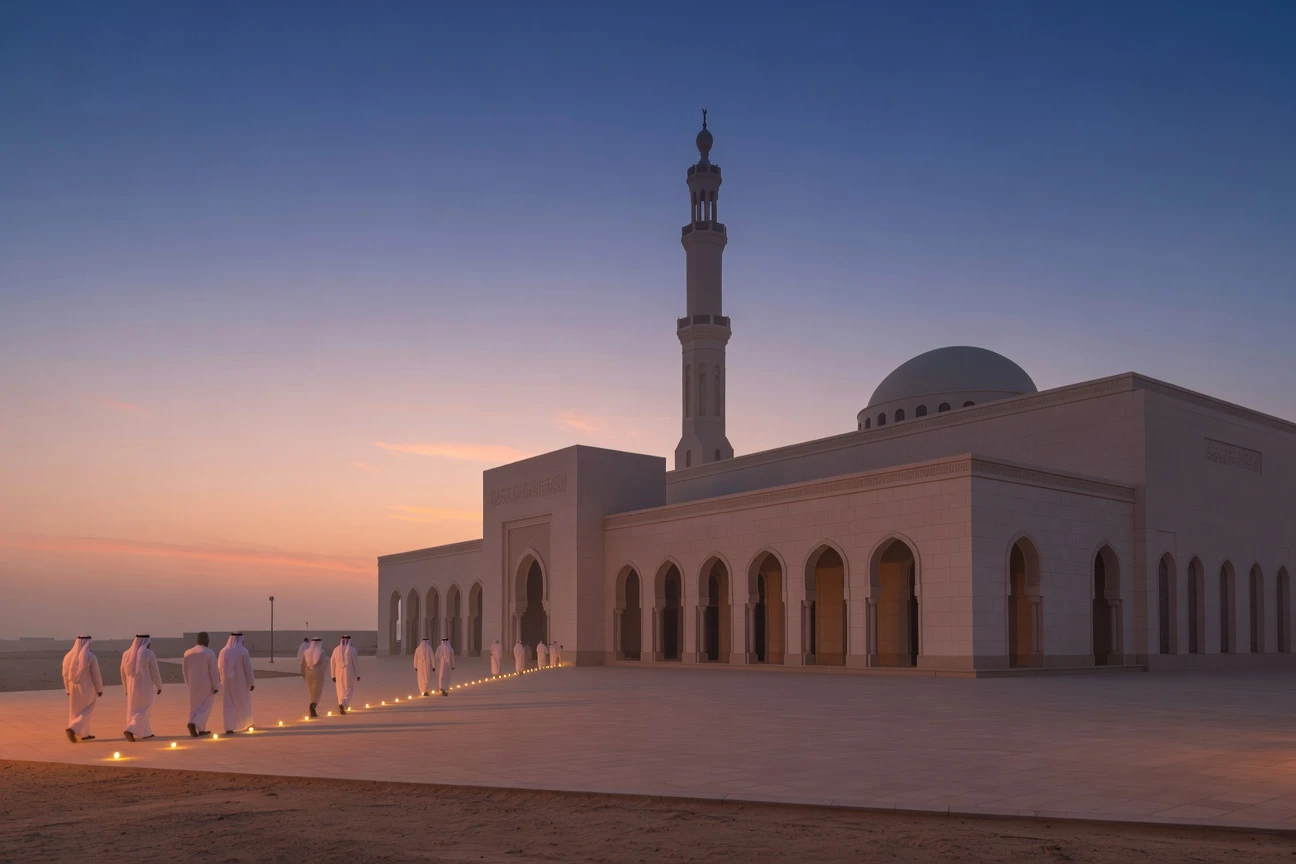
The walk to the mosque is itself part of the observance. The Sunnah encourages taking one route to the prayer ground and a different route home, a small geographic act meant to spread the takbir and widen the circle of those who hear the morning’s recitation. In dense Riyadh neighbourhoods and Jeddah corniche districts, the practice produces visible loops of worshippers moving in two directions before the sun fully rises.
After the khutbah, families return for the first round of visits. Coffee, dates, and ma’amoul biscuits arrive almost immediately. The udhiya, the ritual sacrifice of a sheep, goat, cow, or camel, follows for those performing it themselves; most urban families delegate the slaughter to licensed abattoirs or charity programs, with meat divided into thirds for the household, for relatives, and for the needy.
Hajj at Mina and the Wider Eid Coordination
The Kingdom’s mosque schedule on Wednesday runs alongside the busiest day of the Hajj. More than 1.6 million pilgrims are gathered at the holy sites this year, with over 1.5 million arriving from outside Saudi Arabia, according to the Hajj arrival figures published this week.
While urban congregations form in Khobar, Riyadh, and Jeddah, pilgrims at Mina perform the first stoning of the Jamarat at dawn, then move to the slaughter sites and shave or shorten their hair before changing out of ihram. The Eid prayer is not required of pilgrims observing Hajj rites that morning, though many still join smaller congregations near the camps.
The state has built the largest cooling and shading footprint in Hajj history for this season. Shaded zones at Arafat were expanded to more than 272,000 square metres, roughly five times the 2024 area, with 34 medical units stationed along the holy-site routes. Drone-based medicine deliveries received their first operational permit for the season, a logistics test that Saudi authorities have flagged as a template for future pilgrimages.
Saudi Arabia is fully prepared for this Hajj season and has put in place all the precautionary, preventive and treatment measures to protect the health of the pilgrims.
That assurance came from Saudi Health Minister Fahad Al-Jalajel, speaking to The National ahead of Arafah Day on May 22. His ministry is overseeing roughly 50,000 medical and support staff across Mina, Muzdalifah, and Arafat.
The Four-Day Holiday Window and What’s Open
The Ministry of Human Resources and Social Development has confirmed a four-day Eid Al-Adha holiday for private and non-profit sector workers, running from the Day of Arafah on Tuesday through Friday, May 29. Public-sector staff observe the same window. Schools have been on summer break since mid-May.
The Friday at the back of the holiday overlaps with the standard weekly rest day, and Saudi Labour Law treats that overlap as compensable. In practice, employees in covered roles are entitled to a substitute day, often taken on the following Sunday, which can extend the break to six consecutive days. It is one of the longest holiday windows on the Kingdom’s 2026 calendar, comparable to the recently confirmed six-day Egyptian Eid Al-Adha break for all formal employees.
Services pattern around the prayer. Most malls and supermarkets stay closed for the morning, reopening mid-afternoon. Restaurants in tourist districts open early for breakfast trade with returning families. Government counters, including the Absher and Tawakkalna service centres, are shut for the full four days; emergency, healthcare, and security services run normal rotations.
- Closed for the morning of May 27: shopping malls, banks, most government counters, schools, large office complexes
- Open through the holiday: hospitals and clinics, fuel stations, hotels, airports, the Haramain High Speed Railway, the Riyadh Metro
- Open on a reduced schedule: pharmacies, convenience stores, fast-food outlets in major districts, public-park gates
Travellers using the Haramain rail line between Makkah, Jeddah, and Madinah have been advised to book in advance; demand on Eid morning and the day after typically pushes the early services to capacity.
Heat Safety as Temperatures Climb Toward 47°C
Forecasters expect Makkah and the surrounding holy sites to touch 47°C later this week, the kind of reading that turned the 2024 Hajj into a public-health emergency. The Saudi Ministry of Health is repeating the umbrella guidance issued earlier this month: a personal umbrella can lower the ambient temperature around a pilgrim by up to 10°C, more than any single piece of clothing.
For residents attending neighbourhood Eid prayers, the morning is comparatively cool. Dawn temperatures in Riyadh sit in the high twenties this week. The risk shifts later, during family visits, livestock markets, and the meat-distribution rounds that stretch into the afternoon heat.
The Ministry’s published advice for the broader holiday window covers hydration breaks every 20 to 30 minutes outdoors, avoidance of strenuous activity between 11am and 4pm, and immediate cooling for anyone showing signs of confusion, dry skin, or rapid pulse. Misting fans and water-distribution points are running across the holy-site routes; in other cities, civil-defence teams will be visible at major prayer grounds. Visitors heading to the Kingdom this week may want to check the visa-free Eid travel windows for GCC residents before finalising any cross-border plans.
Frequently Asked Questions
What time does Eid Al-Adha prayer start in Riyadh on May 27, 2026?
The indicative Eid prayer time in Riyadh is approximately 5:20am to 5:25am, beginning roughly 15 to 20 minutes after the local sunrise at 5:05am. Larger central mosques tend to schedule at the later end of that window; neighbourhood musallas may begin slightly earlier.
Is the Eid prayer time the same in Makkah and Jeddah?
No. Makkah’s indicative prayer time is 5:54am to 5:59am, while Jeddah falls slightly later at 5:55am to 6:00am, tracking the marginally later sunrise on the Red Sea coast. The two cities sit only about 80 kilometres apart but their congregations stagger by a couple of minutes.
Do I need to perform wudu before the Eid prayer?
Yes. The Eid prayer requires the same ritual purity as any of the five daily prayers. Worshippers are also encouraged to perform a full ghusl, wear their best clothes, and apply perfume before leaving for the mosque, all considered confirmed sunnah practices for the day.
Can women attend the Eid prayer in Saudi mosques?
Yes. Saudi mosques and open prayer grounds maintain designated areas for women at the Eid congregation, and the Prophet’s guidance specifically encouraged women, including those not praying, to attend and witness the gathering. Many of the larger Riyadh and Jeddah prayer grounds run dedicated transport and accessibility arrangements.
What is the difference between Eid Al-Fitr and Eid Al-Adha prayers?
The prayer structure is identical: two rak’ahs with seven extra takbeerat in the first and five in the second, followed by a sermon. The difference lies outside the prayer itself. Eid Al-Adha is followed by the udhiya sacrifice across three days, and it falls on 10 Dhul-Hijjah at the climax of the Hajj, while Eid Al-Fitr marks the end of Ramadan on 1 Shawwal.
Are shops and restaurants open on Eid morning?
Most malls, banks, and supermarkets stay shut through the morning prayer and the first round of family visits, typically reopening from mid-afternoon. Hospitals, pharmacies, fuel stations, airports, and major rail and metro services keep running. Government counters are closed for the full four-day holiday from May 26 through May 29.
By 7am, the loudspeakers will fall quiet, the streets will fill with returning families, and the Kingdom’s longest holiday of the year will be properly underway.
