
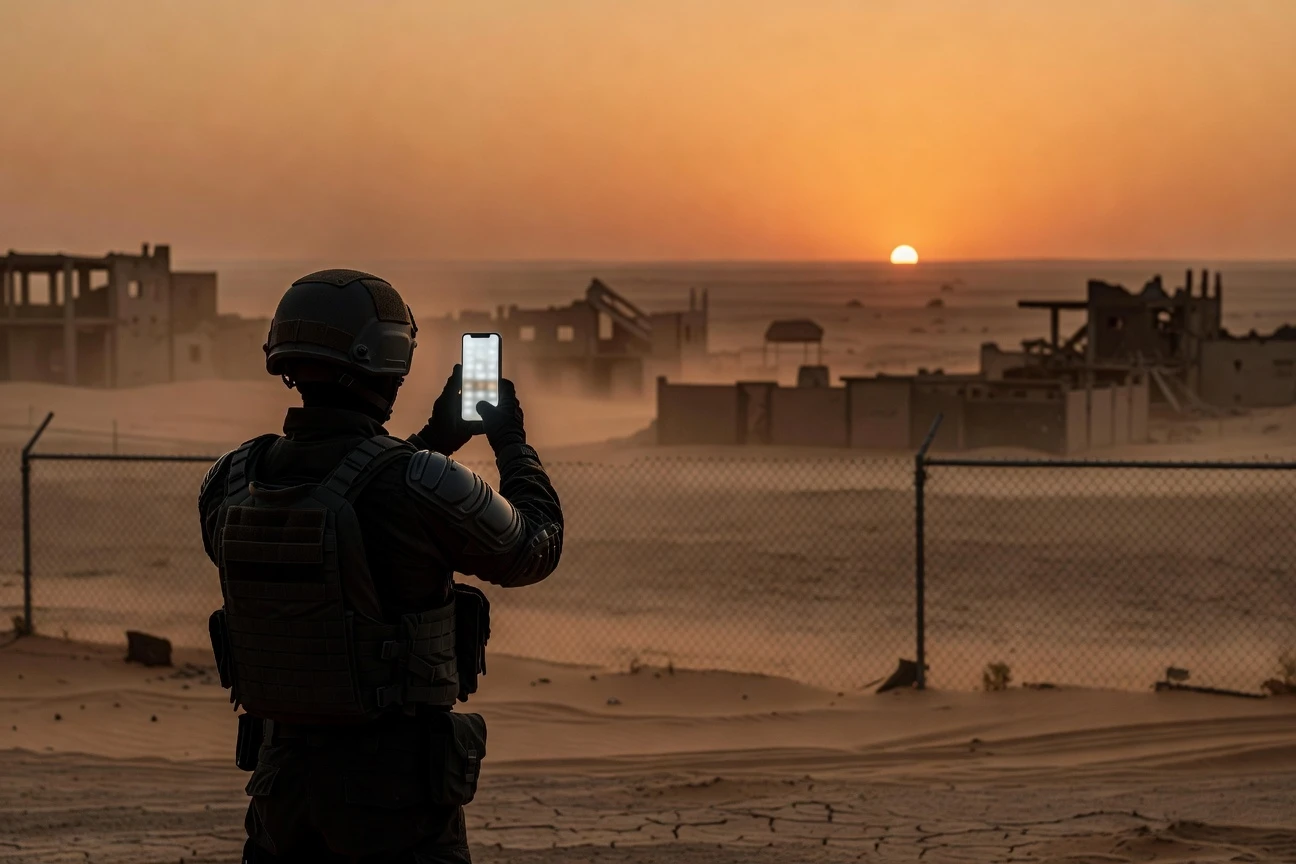
A French-Israeli soldier turns his camera on a Palestinian detainee in one of the clips catalogued by Al Jazeera’s Investigative Unit Gaza archive, a database that now covers more than 2,500 social media accounts run by Israeli troops. “Look, he pissed himself,” the soldier tells whoever will watch. “You’re going to laugh.” The promise that the audience will laugh is the affective frame Israeli soldiers now bring to videos of torture, demolition, and killing they upload for friends, family, and a domestic public that rewards them with views.
For decades, Israeli propaganda packaged the country’s violence against Palestinians as tragic necessity, “shooting and crying” in Hebrew shorthand. That register has been replaced. The 84 Palestinian prisoners B’Tselem counted dead in Israeli custody since October 2023, the collapse of the Sde Teiman rape prosecution this March, and the $14.7 billion in Israeli defence exports during 2024 all describe a single condition: settler colonial violence that no longer pretends to mourn itself.
From Shooting and Crying to Filming and Laughing
Golda Meir, the Israeli prime minister most associated with the country’s 1970s self-image, is credited with the sentence that anchored a generation of state propaganda: “We can forgive the Arabs for killing our sons. But we can never forgive them for forcing us to kill their sons.” That sentence was the moral architecture of “shooting and crying”: violence committed reluctantly, processed with public grief, framed as a tax on Israeli innocence.
The frame began to crack with the second Intifada and the 2007 siege of Gaza. Arnon Soffer, the Haifa University demographer who advised Ariel Sharon on unilateral disengagement, told an interviewer in 2004 that the policy would require Israelis to “kill and kill and kill. All day, every day.” Soffer added one caveat about the psychological toll on the soldiers doing the killing. By the time the ground invasion of Gaza began in late October 2023, that caveat had dropped out of the public conversation.
What remains is a discourse that has stopped accounting for the cost of violence on the Israeli psyche. Mainstream Hebrew media celebrate body counts. Soldiers film themselves smiling next to confiscated property and burning homes. Settler attacks have spread into the West Bank with the same affect, captured most recently in the CCTV-contradicted military account of a 16-year-old killed at close range.
The civil-society organisations documenting these patterns no longer describe an aberration. They describe a settled culture, one whose affective register flipped while the world was still arguing about whether the previous register was sincere.
What the January Living Hell Report Counted
B’Tselem’s January 2026 update, “Living Hell: The Israeli Prison System as a Network of Torture Camps,” catalogued conditions across the Israel Prison Service and military detention sites operating after the October 2023 ground invasion. The headline figure: 84 Palestinian prisoners and detainees, including one minor, died in custody between October 2023 and January 2026. Fifty came from Gaza, 31 from the West Bank, three were citizens of Israel.
The update draws on testimony from 21 Palestinians released under ceasefire arrangements, alongside whistleblower accounts from Israeli prison staff and military medical personnel. Documented methods include electric shocks, the burning of detainees with extinguished cigarettes, the pouring of boiling liquid on skin, prolonged shackling, sexual violence carried out by both male and female guards, and the deliberate withholding of medical care to the point of amputations and permanent loss of sight or hearing. Approximately 9,200 Palestinians remained in Israeli prisons as of January 2026, after partial releases tied to hostage-deal arrangements.
The new findings build on B’Tselem’s August 2024 report “Welcome to Hell,” which had already characterised the prison system as an instrument of state violence rather than incarceration. Read in sequence, the two documents trace a system institutionalising what it once tolerated.
| Indicator | “Welcome to Hell” (Aug 2024) | “Living Hell” (Jan 2026) |
|---|---|---|
| Detainee deaths counted since Oct 2023 | 60 | 84 |
| Released-detainee testimonies in report | smaller cohort | 21 |
| Sexual violence pattern | documented incidents | systematic, male and female guards |
| Medical-withholding outcomes | severe injuries | amputations, permanent sight or hearing loss |
The 2,500-Account Database Nobody Wanted to Build
Al Jazeera’s Investigative Unit (AJIU, the network’s long-form documentary division) spent more than a year compiling its archive of Israeli soldier social-media output from Gaza and southern Lebanon. The collection draws on posts to Instagram, Facebook, TikTok, and YouTube from over 2,500 verified accounts, with troops identified in the frame where possible. The catalogued material clusters into a few repeating categories:
- Wanton destruction of civilian homes and entire neighbourhoods, often with detonation sound effects added in editing
- Looting of jewellery, currency, and personal possessions from evacuated or destroyed properties
- Humiliation rituals performed on bound detainees, including forced stripping
- Live-fire footage of strikes on unarmed civilians and children
- “Trophy” posing with confiscated keffiyehs, family photographs, and Palestinian women’s underwear
What unites the clips is not what the camera frames but who the camera assumes is watching: a domestic audience that will reward each post with views, shares, and stitched reaction content. Israel Defense Forces (IDF, Israel’s military) chief of staff Eyal Zamir issued a memo on 18 May 2026 calling soldier social-media activity “a red line that must not be crossed.” The clips kept coming.
The Settler Colonial Logic Patrick Wolfe Named
The structure of feeling visible in those videos is not an Israeli or Jewish peculiarity. It is the predictable output of a settler colonial state operating without external constraint.
Invasion as Structure
Patrick Wolfe, the Australian historian whose 2006 essay on the elimination of the native became foundational to the field, defined the system in a single line that has anchored two decades of subsequent scholarship.
Settler colonizers come to stay: invasion is a structure not an event.
The frame travelled. Palestinian and Israeli scholars including Lana Tatour, Rashid Khalidi, and Nadera Shalhoub-Kevorkian have applied the category to Israel and the Occupied Territories, treating Zionism as a settler project organised around a logic of elimination of Indigenous Palestinian presence from the land.
Dehumanisation and Supra-Humanisation
What the framework explains is why glee, rather than grief, has become the affective payoff a working settler system produces. Two psychological conditions follow once the structure operates without check. First, dehumanisation of the Indigenous population to the point where violence against them registers no moral cost. Second, supra-humanisation of the settler, a sense of exemption from law, custom, and ordinary decency that other societies still observe.
The two together produce the soldier who films himself laughing because he believes, correctly within his own audience, that the audience will laugh back. Each rewarded post deepens the loop; each unprosecuted act confirms the exemption.
Charges Dropped, Cases Closed, Cameras Rolling
The Sde Teiman prosecution became the test of how far Israeli institutions would go in policing documented soldier violence. Five reservists faced charges in 2024 after closed-circuit footage from the desert detention site near Beersheba showed the sexual assault of a Palestinian detainee who was hospitalised with serious injuries including a punctured rectum.
On 12 March 2026, the IDF military advocate general announced the charges had been dropped. The stated reason: the leak of the surveillance video to Israeli television had compromised the defendants’ right to a fair trial, and the underlying conduct did not, in the prosecutor’s view, rise to criminal abuse. Erika Guevara-Rosas, Amnesty International’s senior director for research and advocacy, called the decision a chapter in Israel’s long-standing impunity record, describing it as “yet another unconscionable chapter in the Israeli legal system’s long-standing history of granting impunity to perpetrators of grave crimes against Palestinians.”
The case had originally fractured the country in the opposite direction. When military police arrested the reservists in July 2024, far-right protesters including sitting members of the Knesset broke into the facility to defend them. The political signal was absorbed. Cameras kept rolling because costs kept disappearing.
$15 Billion in Sales and the EU Vote That Wasn’t
The international reward structure has not shifted. Israeli weapons sales reached $14.7 billion in 2024, more than double the figure five years earlier, according to the Stockholm International Peace Research Institute (SIPRI, the Swedish defence-data clearinghouse). In its March 2026 release, SIPRI ranked Israel the seventh-largest major-arms exporter in the world for the 2021 to 2025 period, overtaking the United Kingdom for the first time.
- $14.7 billion in Israeli defence exports during 2024, with the full-year 2025 figure expected to clear $15 billion
- 7th largest major-arms exporter globally on the 2021 to 2025 SIPRI ranking
- 28.8% share of Israeli total exports flowing to the European Union in 2024
- 1 million+ signatures collected in roughly three months on the European Citizens’ Initiative to suspend the EU-Israel Association Agreement
The European Commission proposed in September 2025 to suspend trade-related provisions of the EU-Israel Association Agreement, the 2000 treaty granting Israeli exporters preferential access to the bloc’s single market. The proposal required qualified-majority backing from member states. Germany and Italy declined to support it; foreign-policy chief Kaja Kallas conceded in late April 2026 that “I have seen no change in positions around the table.” Member-state pressure has, however, started to push settlement procurement into corporate legal-risk territory for European firms.
The pattern would be familiar to any reader of Wolfe. A settler state continues to receive material rewards. Its violence continues to escalate. Civil society in donor and trading-partner countries can organise, petition, and propose; without state-level enforcement, the underlying incentive structure remains intact. If Berlin and Rome shift before the next Council vote, the cost equation begins to change. If they do not, the next B’Tselem update will count higher numbers, and the soldiers will keep filming.
