
Eight months after Chinese J-10C fighter jets touched down at an Egyptian airbase for joint drills, and three months after Cairo deployed Chinese HQ-9B long-range air defense batteries near the Israeli border, Benjamin Netanyahu used a closed Knesset committee meeting on February 5 to tell legislators what satellite imagery had already made plain. The Egyptian army, the Israeli prime minister said, was “getting stronger,” and Israel had to “prevent it from becoming too strong.”
That warning maps a slow-motion failure. The strategic toolkit Washington and Jerusalem built across four decades to ration what Cairo could buy, blocked F-15 sales, withheld AIM-120 air-to-air missiles, vetoed F-35 access, downgraded Rafale armament packages, has lost most of its grip in the time it took Egypt to sign one Chinese fighter contract.
Netanyahu’s Closed-Door Warning Lands Differently This Year
Netanyahu’s February remarks to the Knesset Foreign Affairs and Defense Committee marked a clear shift from his earlier flags about Egypt’s military buildup. The language sounded preemptive this time rather than reassuring. Seven months earlier, in September 2025, the prime minister had asked US Secretary of State Marco Rubio to press Cairo over what Israeli intelligence described as new fighter-jet runways and underground sites suitable for missile storage.
Set those statements next to a 1999 Netanyahu, then in his first term, who waved off a possible American Patriot air defense sale to Egypt as “nothing particularly new.” Or against Major General Amir Eshel, then Israel’s air force commander, dismissing reports in 2015 that Cairo was buying the Russian S-300 system.
Are you kidding me? We’re at peace with them.
Eshel’s offhand reply has not aged well. A May 9 op-ed in an Israeli daily by David Ben-Basat, citing intelligence sources and international reports, warned that “the Egyptian presence is moving closer and closer to the border with Israel,” describing a “quiet process, almost imperceptible, but one with deep strategic significance.” Residents of Israeli border communities have publicly compared the live-fire drills they hear from Sinai to the operational tempo that preceded the Hamas attacks of October 2023.
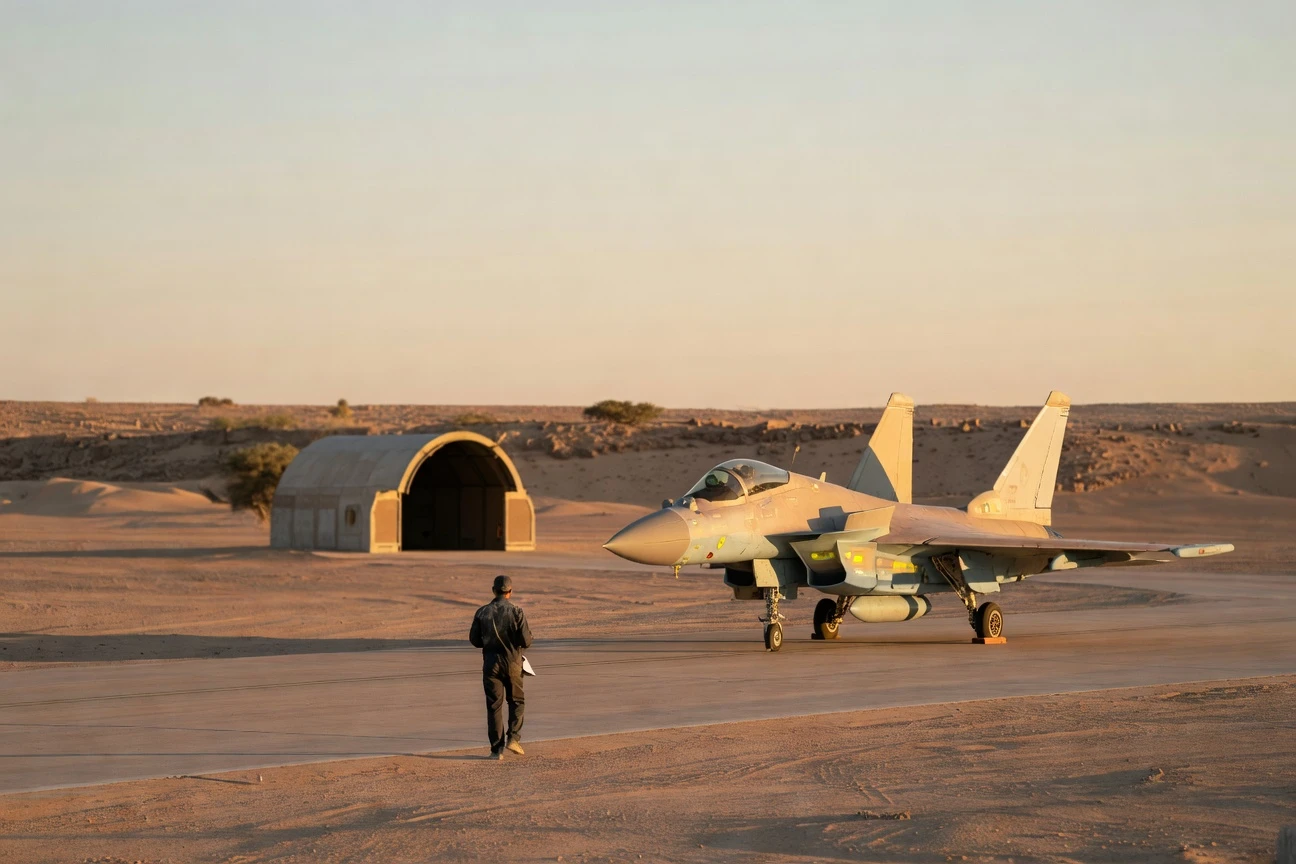
The 1979 Treaty’s Sinai Math Has Quietly Shifted
The Egypt-Israel peace treaty signed in March 1979 divided the Sinai Peninsula into zones with descending Egyptian troop allowances as one moves east toward the Israeli border. Zone A on the western side permits up to 22,000 Egyptian personnel with hundreds of tanks and artillery pieces. Zones C and D, hugging the international line, are heavily demilitarized; permanent or temporary changes require mutual coordination, supervised by the 1,165-strong Multinational Force and Observers mission.
That math began drifting during the 2010s, when Cairo faced an entrenched Islamist insurgency in the peninsula’s northern reaches that included a local Islamic State affiliate. Israel acceded to Egyptian deployments well beyond treaty limits to combat the shared threat, and even ran covert airstrikes against militants with Egyptian authorization for at least two years. Satellite imagery during the same window showed Egypt refurbishing old airbases in the peninsula and building hardened shelters that could house F-16s.
What started as a counterterrorism workaround has not been rolled back. The table below sketches the gap.
| Element | 1979 treaty limit (Areas C and D) | Observed presence today |
|---|---|---|
| Permanent Egyptian combat troops | Sharply restricted; only civilian police and MFO peacekeepers | Multi-brigade ground force per Israeli intelligence reporting to Rubio in September 2025 |
| Combat aircraft | No fixed fighter basing near the border | Refurbished airbases with hardened shelters; new runways under construction per the September 2025 brief to Rubio |
| Long-range surface-to-air missiles | Not contemplated | HQ-9B batteries operational since September 2025 |
| Reconnaissance and armed drones | Not contemplated | Egyptian drones in service since the 2010s counterterrorism phase |
Every row started as a narrowly justified exception. None has been reversed. That is the pattern the prime minister flagged.
The China Pivot That Changes the Air Calculus
The Sinai posture is the visible layer. The procurement story underneath it carries the larger strategic shift, because nearly every major new system Cairo has bought in the last eighteen months traces back to Beijing rather than Washington or Paris.
J-10C Fighters and the PL-15 Demonstration
Egypt placed its first order for the Chinese fighter on August 19, 2024, with deliveries reported in February 2025. The aircraft carries the PL-15 long-range air-to-air missile, which in May 2025 marked its first known combat use when a Pakistan Air Force pilot flying the same airframe downed at least one Indian Rafale at roughly 200 kilometers, well beyond the export-variant range Indian intelligence had assumed. That single engagement rewrote the cost-benefit math on Beijing’s mid-tier fighter export.
Two months earlier, Cairo had hosted the inaugural Egyptian-Chinese air exercise codenamed Eagles of Civilization 2025 from April 19 to May 4. Beijing dispatched five Y-20 transports, a YY-20 aerial-refueling tanker and more than a dozen fighters and trainers, according to the Chinese Ministry of National Defense readout. It was the first time the People’s Liberation Army Air Force had projected a mixed-fleet detachment to Africa for systematic joint training.
HQ-9B Batteries in the Sinai
In September 2025, days after Israel struck Hamas political leadership in Doha, Egyptian general officers confirmed the HQ-9B deployment inside the demilitarized peninsula. The system is China’s flagship long-range surface-to-air platform, with an engagement range out to roughly 200 kilometers against aircraft, drones and cruise missiles, plus published capability against certain ballistic-missile classes. It is the system most often compared to Russia’s S-400 and America’s Patriot PAC-3.
The battery placement matters because it sits inside the framework set in 1979. The system’s radar envelope reaches deep into Israeli airspace.
FC-31 Interest in the Pentagon’s China Report
The Pentagon’s 2025 unclassified report to Congress on China’s military and security developments lists Egypt among the countries that have expressed interest in the fifth-generation Shenyang FC-31 stealth fighter, alongside Saudi Arabia and the UAE. Egyptian officials reportedly explored a J-35 (the same airframe in PLA service) purchase during a May 2025 event marking forty-five years of Egypt-China military ties. No order has been confirmed. The signal is the listing itself.
Why the Vetoes That Worked for Decades Stopped Working
Washington’s playbook on Egyptian airpower ran precise for forty-five years. The Pentagon refused to sell Cairo the AIM-120 advanced medium-range air-to-air missile, leaving Egyptian F-16s with shorter-range air-defense ordnance. The Defense Department repeatedly declined Egyptian requests for the F-15, raised since at least 1980. When Egypt turned to France in 2015 for the Dassault Rafale, Israeli and American pressure persuaded Paris not to bundle the Meteor missile, leaving the new Rafales with much the same air-to-air handicap as the F-16s before them.
David Witty, a retired US Army Special Forces colonel who served in Egypt, has described Egyptian F-16s without the AIM-120 as “civilian aircraft.” The phrasing captured a working logic: so long as Cairo accepted the menu Washington offered, Israel kept its qualitative military edge codified in Section 36(h) of the Arms Export Control Act without firing a shot.
Two specific denials tell the rest of the story. In 2018, during Donald Trump’s first presidency, Cairo formally sought 20 F-35As; the Defense Department and Israel pushed the request off the table.
A separate Egyptian effort to buy Russian Su-35 fighters ran into US sanctions under CAATSA (the Countering America’s Adversaries Through Sanctions Act, the 2017 law that punishes major arms deals with Moscow) and never delivered an airframe.
Cairo absorbed both denials. The Chinese fighter order and the FC-31 inquiry are what happens when those denials lose their cost.
Turkish Drones, Egyptian Factories, a Second Procurement Front
Beijing is not the only supplier Cairo is courting outside the American column. On August 27, 2025, Egypt’s Arab Organization for Industrialization signed an agreement with Turkey’s Havelsan to co-produce the BAHA vertical-takeoff drone inside Egypt, a platform already operational with Turkish forces for reconnaissance and surveillance. Earlier talks between Cairo and Baykar covered the Bayraktar Akinci heavy combat drone and technology transfer for the TB2.
The shift cuts two ways for Israel. Turkish drones are the leading non-Israeli competitor on the global drone export market, combat-proven across Ukraine, Libya, Karabakh and Ethiopia. Local production in Egypt builds an export-grade drone industry on Israel’s southern flank using Turkish intellectual property, just as Ankara and Jerusalem trade public threats over Gaza and post-Assad Syria.
- United States: F-16 fleet (Egypt operates the fourth-largest globally), M1 Abrams tanks, Patriot batteries.
- France: 24 Dassault Rafale fighters delivered without the Meteor missile, FREMM frigate.
- Russia: MiG-29M/M2 fighters, Ka-52 attack helicopters.
- China: Chinese fighters delivered in early 2025, long-range air defense batteries operational since September, stealth-fighter interest formally noted by the Pentagon.
- Turkey: Havelsan BAHA co-production signed August 2025, Baykar Akinci and TB2 talks ongoing.
Cold War style multi-supplier hedging is back in the Middle East, and Cairo is one of the first US partners to operationalize it as Gulf capitals build out their own cross-region mutual defense arrangements. The roster Cairo now runs is not the portfolio of a country expecting Washington’s lever to keep working.
The Two Procurement Decisions That Settle This
Two pending decisions will determine whether the February warning becomes a managed irritant or a strategic rupture, and they belong to different capitals.
Washington’s choice involves Israel’s 100 fifth-generation F-35 Lightning II stealth fighters now on order, the qualitative gap that historically argued against any Egyptian F-15 sale. With that gap secured, the original Israeli objection to Cairo buying older heavyweight American jets weakens. A future US administration could release older American heavies, or even a downscaled fifth-generation variant, to keep Egypt inside the American supply chain. The bet is unlovely but rational: better an American jet flown by Cairo than a Chinese one. The Washington Institute’s analysis of the Egyptian Su-35 episode argued that exact point years before Beijing made it urgent.
Egypt’s path runs in the opposite direction. Confirmation of a Chinese stealth-fighter order, or a follow-on tranche of the J-10 family, would lock in a procurement track that takes years to unwind. Egyptian President Abdel Fattah el-Sisi already used a September 2025 emergency summit to publicly call Israel an “enemy,” the first such formal characterization of his tenure. A signed contract would match that rhetoric with hardware.
If Washington moves to release older heavyweights or a downscaled variant before Cairo signs the next Chinese tranche, the framework Camp David built keeps the strategic shape it has held since 1979. If the next contract Cairo signs is a Chinese stealth-fighter deal, the Egyptian air force four years from now is no longer the air force Israel’s edge calculations were built to outclass.
