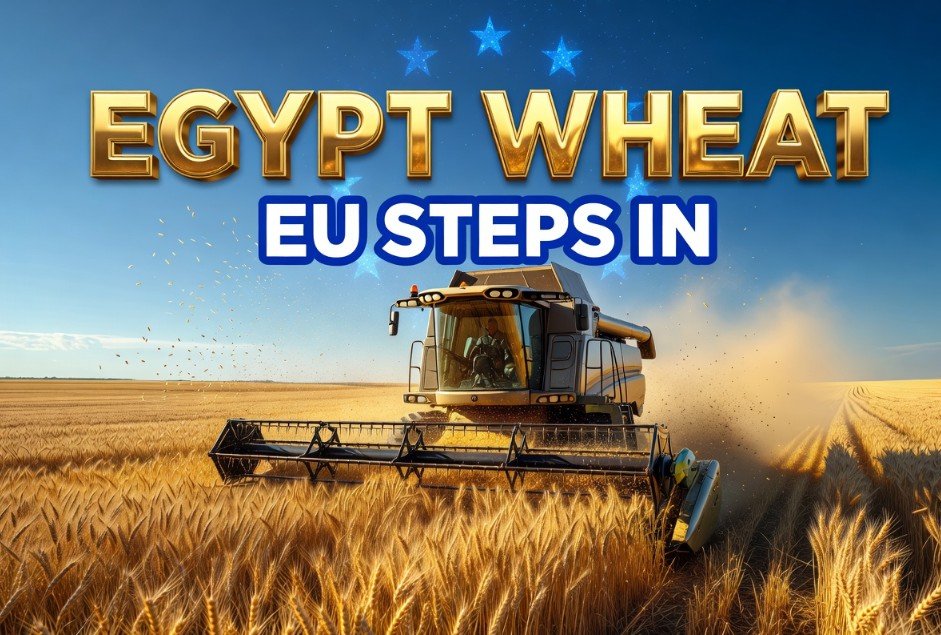
Egypt feeds nearly 109 million people on subsidised bread. But it still imports more wheat than any other country on earth. Now the European Union is stepping in with machinery, training, and millions in funding to help Egypt grow more of its own grain before global supply shocks hit harder. The numbers coming out of Damanhour this week paint a picture that is both urgent and quietly hopeful.
Egypt’s Agricultural Heartland Gets a Big Boost
On Monday, May 11, 2026, the Agricultural Research Center’s Rental Service Station in Damanhour became the site of a landmark moment for Egyptian farming. EU Ambassador to Egypt Angelina Eichhorst stood before smallholder farmers, government officials, and development partners to officially hand over modern harvesting machinery to the Ministry of Agriculture and Land Reclamation.
The event, held under the theme “Wheat Harvest Mechanization Event,” marked the formal launch of mechanised wheat harvesting under the EU-funded CAFY program. It brought together high-level representatives from the EU, the Italian Agency for Development Cooperation (AICS), and Egypt’s Ministry of Agriculture. Crucially, the farmers themselves were in the room too.
During a tour of the mechanised agriculture station, officials also handed over 44 maize shellers directly to smallholder farmers to cut post-harvest waste. Beheira Governor Jacqueline Azer described the harvest season as one of “work, giving, and achievement,” noting that Beheira remains one of Egypt’s most critical agricultural hubs.
What the KAFIEU Program Is Delivering on the Ground
The event is part of the EU-funded Good Agricultural Practices project, known as KAFIEU, implemented in partnership with Italy’s AICS. It is a programme built to do one thing: help Egypt grow more grain and lose less of what it already grows.
Egypt’s Agriculture Minister Alaa Farouk put the loss problem bluntly. Without modern harvesting machinery, crop losses during harvest can climb to between 20 and 30 percent. A pilot field run under this programme, using modern practices alongside certified seeds and technical recommendations, successfully yielded 24 ardebs per feddan.
The scope of KAFIEU’s work on the ground is broad:
- Tractors, harvesters, and planting machinery covering approximately 4,000 hectares of wheat cultivation
- Training for 50 agricultural extensionists as Trainers of Trainers in Good Agricultural Practices
- Dissemination of modern farming practices to more than 80,000 small and medium-scale farmers in Beheira alone
- Training programmes targeting 400,000 wheat farmers across five Nile Delta governorates
- Upgrades to seed sorting and processing facilities in Sakha, Gemmeiza, Sids, and Shandweel
The broader EU-KAFI framework funds this work through a €100 million grant. Of this, €25 million supports agricultural mechanisation and access to certified seeds. Another €15 million goes toward building field silos and establishing a digital information system to track wheat movement across the country. EU Ambassador Eichhorst noted that the EU currently runs more than 15 projects in Egypt’s agricultural sector, with the total ongoing development portfolio between the two partners reaching approximately €1.3 billion.
Egypt’s Wheat Problem Is Bigger Than It Looks
Egypt holds an uncomfortable title: the world’s largest wheat importer. The country consumes around 20.3 million tonnes of wheat every year. Domestic production, even in a strong season, covers roughly half of that demand.
Wheat is not just a crop in Egypt. It is the foundation of the baladi bread subsidy that keeps food on the table for tens of millions of low-income Egyptians. The government needs around 8.6 million tonnes annually just to supply that subsidised bread programme. Bread prices are not just an economic issue here. They are a social stability issue.
Before the Russia-Ukraine war disrupted global grain markets, Russia and Ukraine together covered more than 80 percent of Egypt’s wheat import needs. That dependency exposed a painful vulnerability. When global prices spiked and supply chains fractured, Egypt felt it immediately.
The losses problem compounds the import dependency further. Studies estimate that around 20.62 percent of Egypt’s total wheat supply is lost or wasted across the production and distribution chain. Eliminating even a significant portion of that waste could, according to analysts, reduce Egypt’s wheat import dependency by up to 37 percent and save over a billion US dollars annually.
The Road to 70%: Ambition Meets Hard Reality
Egypt has now set a target: 70 percent wheat self-sufficiency by 2030. This season alone, production is nearing 9.8 million tonnes, which would be the second-highest output on record. Cultivated wheat areas expanded by 600,000 feddans this year, reaching 3.7 million feddans nationwide.
The government is backing local farmers with higher procurement prices and large-scale certified seed distribution. Egypt’s strategic wheat reserve now stands at approximately 4.5 million tonnes, covering roughly four months of domestic consumption. A decade ago, that buffer was barely five weeks.
But the challenges standing between Egypt and genuine self-sufficiency are real. More than 90 percent of Egyptian land is desert. The country loses around 2 percent of its remaining arable land each year to urbanisation. Climate change is intensifying heat stress on crops, with temperatures approaching extreme highs in southern governorates. Land fragmentation and limited access to mechanisation continue to squeeze smallholder yields.
| Indicator | Current Status (2026) |
|---|---|
| Projected wheat production | 9.8 million tonnes |
| Annual wheat consumption | 20.3 million tonnes |
| Cultivated wheat area | 3.7 million feddans |
| Strategic wheat reserve | 4.5 million tonnes (4 months) |
| Harvest loss rate (without mechanisation) | 20% to 30% |
| Self-sufficiency target by 2030 | 70% |
The EU-KAFI programme is directly addressing several of these bottlenecks at once. Beyond machinery, it is running field schools, improving irrigation practices, promoting raised-bed sowing, and introducing high-performing climate-adapted wheat varieties. The Training of Trainers model means the knowledge does not stop at government offices. It reaches the farmer in the field.
Minister Farouk was direct at the Damanhour event. He stated that the state views wheat production as a matter of national security. That framing says everything about how seriously Egypt is taking this push.
Every loaf of baladi bread in Egypt carries the weight of a nation’s social contract. When a farmer in Beheira loses a third of his harvest to outdated equipment, that loss ripples all the way to a family’s table in Cairo. The EU’s investment in modern machinery, certified seeds, and farmer training is not just agricultural development. It is a quiet act of food diplomacy at a moment when global grain markets remain dangerously volatile. Whether Egypt can close the gap to 70 percent self-sufficiency by 2030 will depend on whether these field-level changes can scale fast enough to outrun a growing population and a warming climate. What do you think about Egypt’s push to cut wheat import dependency? Share your thoughts in the comments below.