
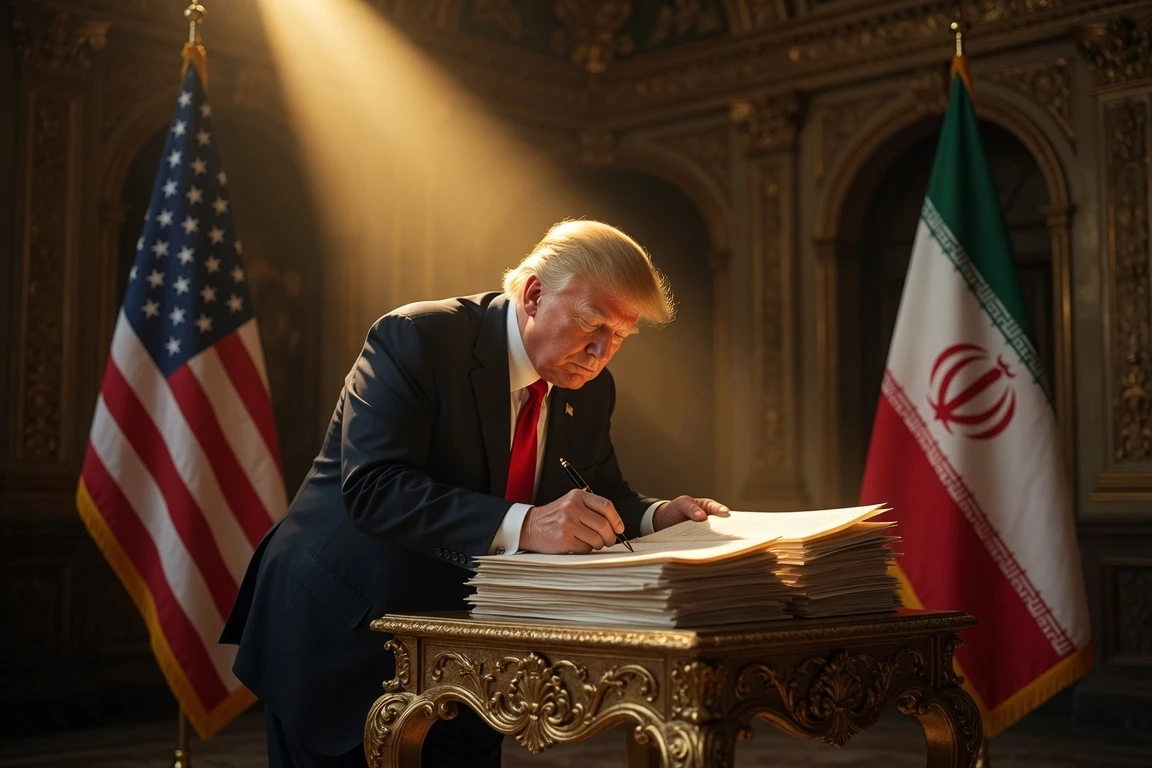
President Donald Trump and Iranian President Masoud Pezeshkian signed the 14-point Islamabad Memorandum of Understanding on June 17, calling for the “immediate and permanent termination of military operations on all fronts, including in Lebanon.” Israel was not a signatory. By the time Israeli and Lebanese negotiators were set to sit down for the next round of Washington talks opening Tuesday, Hezbollah had fired 147 rockets, 20 explosive drones and nine anti-tank missiles at Israel in 24 hours, and four IDF soldiers were dead in Kfar Tebnit.
The deal, signed remotely from the Palace of Versailles during a dinner on the sidelines of the G7 summit, is the clearest US diplomatic move on Lebanon in months. Its first clause, read out to reporters by a US official, commits Washington and Tehran to ending the fighting in Lebanon, even though Iran is the patron of the group doing the firing, and Israel is the country absorbing the strikes.
A Deal Israel Did Not Sign
The 14-point MoU, called the Islamabad Memorandum of Understanding for the venue of the original US-Iran talks, was signed in two ceremonies: Trump at the Palace of Versailles, Pezeshkian in Tehran. The first clause states the US and Iran have agreed to the “immediate and permanent termination of military operations on all fronts, including in Lebanon.” A second clause commits both sides to the “territorial integrity and sovereignty of Lebanon,” per the 14-point deal that names Lebanon in its first clause.
Israel was not at the table. The agreement “makes no mention of Israel,” Al Jazeera reported, even though Israel “currently occupies one-fifth of the country and has subjected Lebanon to near-daily strikes since early March.” Israeli officials have publicly attacked the MoU for restricting Israel’s Lebanon campaign while offering Iran economic relief. The Israeli ambassador to the US, Yechiel Leiter, wrote on Saturday that “Hezbollah broke the ceasefire, not Israel,” accusing Iran of “using its proxy to extract concessions.”
Hezbollah’s 24 Hours: 147 Rockets, 20 Drones, Nine Anti-Tank Missiles
The deal’s first test came almost as soon as it was signed. Leiter said on Saturday that Hezbollah had launched 147 rockets, 20 explosive drones and nine anti-tank missiles at Israeli troops and northern Israeli towns in the previous 24 hours, per the Israeli ambassador’s account of Hezbollah’s 24-hour fire. “Hezbollah are terrorists. Hezbollah lies. Hezbollah is Iran’s long arm and they don’t want a cease fire,” Leiter said.
The strike that killed four IDF soldiers overnight into Friday hit the tank of Lt. Col. Dor Gedalia Ben Simhon, commander of the 401st Armored Brigade’s 52nd Battalion, in the southern Lebanese village of Kfar Tebnit. A suspected drone or anti-tank missile destroyed the vehicle, killing all four crew members, the IDF said, per the Kfar Tebnit strike that killed four IDF soldiers. Hours later, a Hezbollah explosive drone wounded five more soldiers in Kfar Tebnit, one of them seriously.
Lebanon’s health ministry reported at least 18 people killed and 33 wounded by Israeli strikes since midnight on Friday, in at least 10 southern Lebanese localities. Israeli strikes in Lebanon since early March have killed at least 3,000 people and displaced more than one million from their homes, per Al Jazeera.
By the numbers
- 147 rockets fired at Israel in 24 hours
- 20 explosive drones fired at Israel in 24 hours
- 9 anti-tank missiles fired at Israel in 24 hours
- 4 IDF soldiers killed in Kfar Tebnit
- 3,000-plus Lebanese killed since early March
Trump’s G7 Verdict on Israel
Trump used his closing news conference at the G7 summit in Evian-les-Bains, France, on Wednesday to press Israel directly on the conduct of the war. “Israel’s fighting Hezbollah too long, and too many people are being killed,” Trump said, per Trump’s G7 news conference where he rebuked Israel. He added, “I’m not happy with the way Israel has handled themselves with Lebanon and with Hezbollah. They should have been able to do the job faster.”
On Sunday, Trump told Fox News that he is “disappointed Israel can’t put Hezbollah away.” “They can’t do anything without knocking buildings down,” he said, adding, “I’m close to giving it over to Syria.” In a Truth Social post that roiled the US-Iran talks in Switzerland, he wrote, “Iran must immediately stop their highly paid PROXIES in Lebanon from causing trouble. If they don’t, we’ll hit Iran very hard again, just like we did last week, only harder!” The post did not place blame on Israel.
Israel is fighting Hezbollah too long, and too many people are being killed. You don’t have to knock down an apartment house every time you’re looking for somebody. Because there are a lot of people in those apartment houses. And they’re not all Hezbollah, that I can tell you.
Trump made the remarks at the G7 conference of global leaders, per the Associated Press.
Syria Says No
Trump’s “give it over to Syria” remark was not a throwaway line. “I suggested to Israel to let Syria take care of Hezbollah, because I think they would do a better job of doing it,” Trump told reporters at the G7. The comment put a spotlight on Syria’s new ruler, Ahmed al-Sharaa, the former jihadi commander who has been in power since his forces ousted Bashar al-Assad in late 2024.
Sharaa rejected the idea within days. “The crisis in Lebanon is very serious and there is a deadlock in political solutions,” Sharaa told the Arab outlet Al Mashhad. “Syria offers a different approach to solving it, but the most important thing is first of all to stop the war,” per the Sharaa interview that rejected Trump’s Syria plan.
Sharaa said Trump’s “words were misunderstood” and insisted that Syria was “looking for economic channels between Lebanon and Syria, not military ones.” He framed Syria’s role as rebuilding Lebanese state institutions. Asked if he would sit at the table with Hezbollah, Sharaa said, “If this serves Lebanon’s interests and safeguards Syria’s interests, why not?”
We are looking for economic channels between Lebanon and Syria, not military ones. Our vision is based on restoring support for the Lebanese state, strengthening its institutions, and seeking a solution that everyone can believe in. Stopping what is happening in Lebanon now requires creative solutions, not traditional and outdated ones.
Ahmed al-Sharaa made the remarks in an interview with the Arab outlet Al Mashhad, after Trump had publicly floated the Syria idea on Fox News.
The Buffer Zone Netanyahu Won’t Give Up
Israeli Prime Minister Benjamin Netanyahu spent the same Sunday defending the security zone in southern Lebanon that the MoU implicitly puts on the table. “As long as we need to protect our people, we will remain in the security zone in south Lebanon,” Netanyahu said at the Jewish News Syndicate International Policy Summit in Jerusalem. “No country would be asked to do otherwise.” A separate report on the Israeli flag hoisted at Beaufort Castle, from 2024, traced a similar arc of occupation and exit, with Israel back in the same hilltop fortress it left in 2000.
A senior Israeli security official, quoted by Channel 12, was blunter about the squeeze. “We need to be cautious about our moves in Lebanon so that it doesn’t get us in trouble,” the official said.
Defence Minister Israel Katz had set the line earlier in the week. “Prime Minister Benjamin Netanyahu and I are pursuing a clear policy under which the [military] will remain in the security zones in Lebanon, Syria and Gaza for an unlimited period of time in order to protect the border and Israeli communities from there against jihadist elements,” Katz said in a statement on Monday. Netanyahu, in his own remarks, said Israel was targeting terrorists with a one-to-five civilian-to-combatant ratio, calling it an “unheard of” achievement.
Israeli officials have railed against the MoU for restricting Israel in Lebanon and for providing Iran with economic relief without any concrete concessions from Tehran on its nuclear program. The IDF is currently insisting on two specific aims in Lebanon: preserving a buffer zone in the country’s south and destroying a major underground Hezbollah facility underneath the Ali Taher ridge, near Nabatieh. Hezbollah firing on Israeli jets 48 hours into the ceasefire shows how thin the latest truce is, even when the sides sit down in Washington.
Tuesday in Washington
Israeli and Lebanese negotiators are scheduled to hold their next round of direct talks in Washington, DC, from Tuesday to Thursday, the US State Department has announced. The two sides are set to discuss enforcement of the existing ceasefire and security arrangements along the border. As that meeting approaches, the IDF is reportedly urging Israel’s political echelon to intensify the negotiations amid fears that ongoing US-Iran talks will hamper the military’s offensive against Hezbollah.
Hezbollah’s 13 southern Lebanese launch sites in the 24 hours leading into Saturday, named by Israeli Ambassador Yechiel Leiter:
- Kfar Sir
- Al-Zaharani
- Khirbat a-Dwir
- Tufakhta
- Mazraat a-Daudia
- Tul
- Kharouf
- Jouaiyya
- Kfar Riman
- Kfar Fila
- Joubaa
- Mazraat a-Kamata
- Kharet a-Nabbaa
What the MoU Does Not Cover
The deal, according to Al Jazeera, leaves the central question open. “Given that the agreement is solely between the US and Iran, Israel and the Lebanese group Hezbollah it is at war with are not signatories, it is unclear how a ceasefire in Lebanon would be implemented, or whether it means Iran must stop funding Hezbollah.” Iran’s support for proxy groups around the region “generally is not mentioned in the agreement,” Al Jazeera reported.
The first clause calls for ending military operations in Lebanon and commits both sides to Lebanon’s territorial integrity. The agreement does not call on Israel to withdraw from its buffer zone. Iran has said the deal is void if Israel remains in Lebanon. Israel has said it will remain.
For now, the war’s main fire comes from south Lebanon, where Hezbollah resumed its attacks after the February 28 start of the US-Israeli bombing campaign on Iran. According to a JNS report, the top command center of the Iran Armed Forces announced on Saturday that it is again shutting maritime transit in the Strait of Hormuz, citing hostilities in Lebanon as the driver of the measure.
Frequently Asked Questions
What is the Islamabad Memorandum of Understanding?
The Islamabad Memorandum of Understanding is a 14-point deal signed remotely on June 17, 2026 by US President Donald Trump, at the Palace of Versailles, and Iranian President Masoud Pezeshkian, in Tehran. The deal is named for the Pakistani capital where the first direct US-Iran talks since the 1979 Islamic revolution were held in April.
Why is Israel not party to the US-Iran MoU?
The agreement is signed only by the United States and Iran. Al Jazeera reported that the text makes no mention of Israel, even though Israel currently occupies one-fifth of Lebanon and has subjected the country to near-daily strikes since early March. Israeli officials have publicly attacked the deal for restricting Israel while offering Iran economic relief.
What did Trump say about Israel at the G7 summit?
At the G7 closing news conference in Evian-les-Bains, France, on June 17, Trump said, ‘Israel’s fighting Hezbollah too long, and too many people are being killed.’ He added, ‘I’m not happy with the way Israel has handled themselves with Lebanon and with Hezbollah. They should have been able to do the job faster.’
Why did Syria reject Trump’s offer to fight Hezbollah?
Syrian President Ahmed al-Sharaa told the Arab outlet Al Mashhad that Trump’s words were misunderstood and that Syria’s role would be economic channels between Lebanon and Syria, not military ones. He said the priority is to stop the war and that the solution will not come through war and the bombing of cities.
When are the next Israel-Lebanon talks?
Israeli and Lebanese negotiators are set to hold the next round of direct talks in Washington, DC, from Tuesday to Thursday, June 23-25, 2026, the US State Department has announced. The two sides last met on June 2 and 3 in Washington, and before that on May 14 and 15.
