
NEWS
Khan’s Ouster Left the Netanyahu Arrest Warrants Intact
Israel asked the ICC to bar Karim Khan and cancel the Netanyahu warrants. Member states removed Khan. The 2024 warrants remain in force.

The International Criminal Court’s member states removed Chief Prosecutor Karim Khan on 24 July 2026. The arrest warrants against Israeli Prime Minister Benjamin Netanyahu and former Defense Minister Yoav Gallant, issued on 21 November 2024, remain in force.
Israel had asked the Appeals Chamber on 17 November 2025 to do both jobs in one filing: bar Khan from the Israel files and declare those warrants of no force or effect. The personnel half is finished. The warrant half is not.
Israel Tied Khan’s Fate to the Warrants
The Foreign Ministry said it had submitted a request to disqualify Khan and cancel the warrants for Netanyahu and Gallant. It argued that Khan had acted from “improper personal motives” and had pushed “false and unfounded allegations against Israel” to pull attention from “serial sexual harassment of a subordinate employee.”
The ministry called the taint “profound and irreparable.” It asked the Appeals Chamber to bar Khan from cases relating to Israel and to declare the warrants “of no force or effect.” It added that the filing did not drop Israel’s other attacks on the warrants, including the claim that the court has no jurisdiction.
The State of Israel emphasizes that the contamination of the proceedings caused by the Prosecutor’s conduct is profound and irreparable. Therefore, Israel requests that the Court’s Appeals Chamber disqualify the Prosecutor from involvement in cases relating to Israel and to declare that the arrest warrants issued against the Prime Minister and the former Minister of Defense are of no force or effect.
Israel Ministry of Foreign Affairs, 17 November 2025
That statement treats the prosecutor and the warrants as one object. The court’s later record treats them as two.
The State of Israel submitted today a request to disqualify the ICC Prosecutor, Karim Khan, and to cancel the warrants concerning Israel
The State of Israel submitted today to the Appeals Chamber of the International Criminal Court (ICC) a request to disqualify the Court's…
— Israel Foreign Ministry (@IsraelMFA) November 17, 2025
Netanyahu had already said Khan “hatched a plan” to scapegoat Israel and shift focus from the sex claims. Israel’s written request, transmitted to the Appeals Chamber on 19 November 2025, put a date on that theory. It said a reasonable doubt arose once Khan learned of the coming claims on 2 May 2024 and then, on 20 May 2024, filed the arrest-warrant applications.
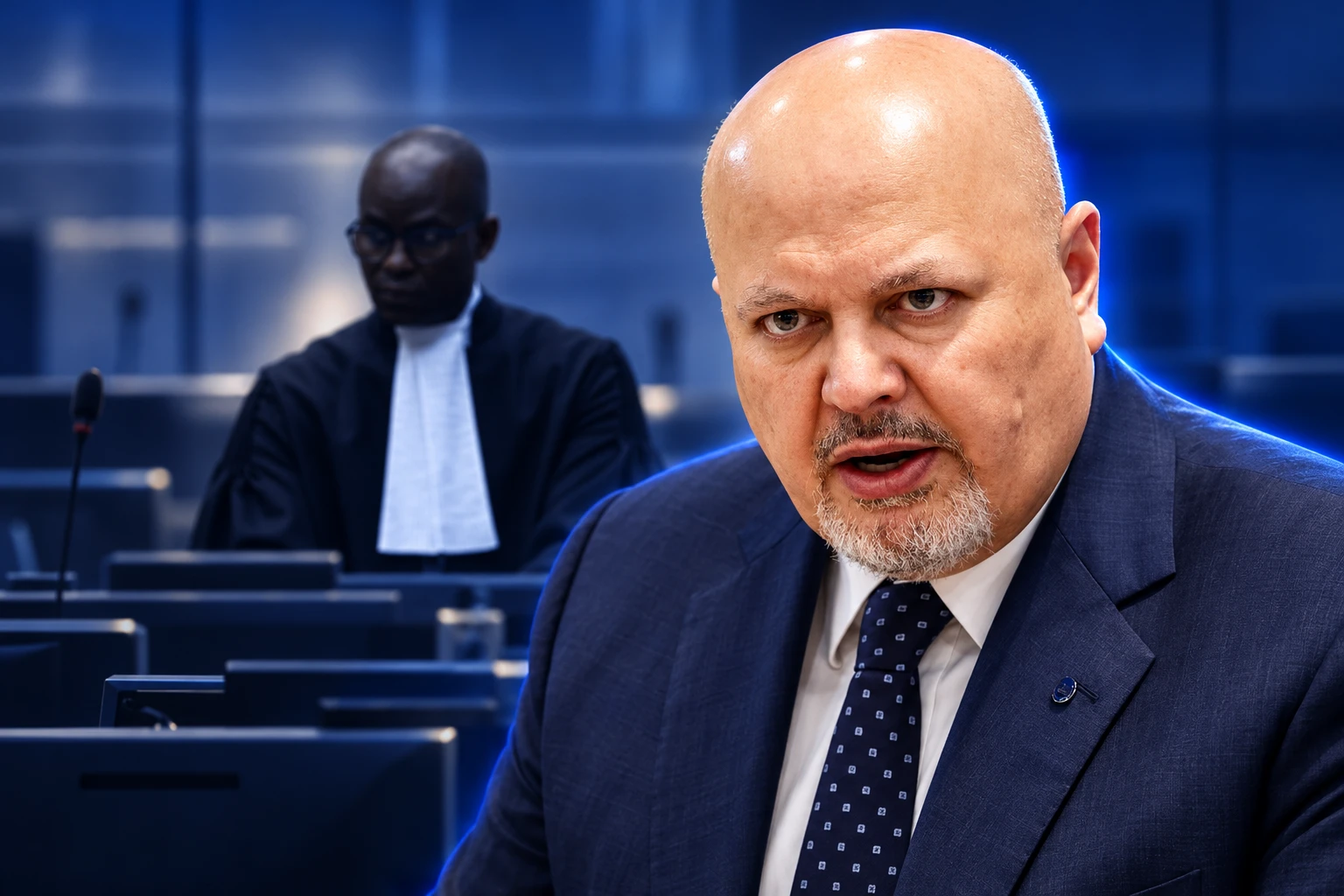
82 States Parties Removed Him in New York
By the time that request was briefed, Khan was already off the file in practice. He went on voluntary leave on 16 May 2025 while the United Nations Office of Internal Oversight Services finished a probe that ran from November 2024 to December 2025 and produced more than 5,000 pages of material.
THE ASSEMBLY VOTE
- Leave: Khan, 56, stepped aside on 16 May 2025; his deputies ran the Office of the Prosecutor.
- Suspension: The Bureau of the Assembly of States Parties suspended him on 8 June 2026 and referred the case to the full membership.
- Removal: On 24 July 2026 in New York, an absolute majority of 82 of 125 member states found serious misconduct and a serious breach of duty and removed him from office under article 46.
- Replacement: The vote opened an election that is not expected to finish before 2027.
A three-judge advisory panel had reported in March 2026 that the UN findings did not establish misconduct under the test it applied. The Bureau still found, on 8 June 2026, that Khan had engaged in an improper sexual relationship with a junior staff member given the power imbalance, and that he had tried to stop her complaint. Khan has denied any sexual relationship and any wrongdoing. His lawyer, Tayab Ali, said he would challenge “the lawfulness and fairness of the decision through all available legal mechanisms.”
The Assembly vote was a personnel decision about an elected official. It was not a ruling on Gaza, and it did not name Netanyahu or Gallant. After the result, Foreign Minister Gideon Sa’ar said the ouster was long delayed and that the warrants, issued against a country that is not an ICC member, should be revoked at once.
The Judges Who Signed the Netanyahu Warrants
The warrants did not issue from Khan’s letterhead. Under article 58 of the Rome Statute, Pre-Trial Chamber I had to find reasonable grounds and then issue the warrants itself. On 21 November 2024 the three judges did so unanimously, for conduct from at least 8 October 2023 until at least 20 May 2024, the day the applications were filed.
Khan had announced the applications on 20 May 2024. The chamber later found reasonable grounds on some counts and not on others. It accepted war crimes of starvation and of directing attacks against civilians, and crimes against humanity of murder, persecution, and other inhumane acts. It did not find all elements of extermination as a crime against humanity.
WHAT THE 2024 WARRANTS COVER
- Israeli suspects: Netanyahu and Gallant, for alleged crimes on Palestinian territory in Gaza in the window above.
- Hamas file: Khan also sought warrants against three Hamas leaders. Applications tied to Ismail Haniyeh and Yahya Sinwar were withdrawn after their deaths were confirmed. The chamber issued a warrant for Mohammed Deif.
- Who can lift them: Withdrawal is a judicial act. Removing the prosecutor does not cancel a warrant the judges have already signed.
The Office of Public Counsel for Victims made that split express on 10 December 2025. Principal Counsel Paolina Massidda told the Appeals Chamber that the warrants “remain unaffected by any ruling, as they constitute independent Pre-Trial Chamber decisions.” Even if the chamber barred Khan, she wrote, it would be acting under Part IV of the Statute, which governs the court’s administration, and would lack authority to quash the warrants as a follow-on.
The prosecution’s 1 December 2025 response, signed by Deputy Prosecutor Nazhat Shameem Khan as officer in charge, said the same thing in plainer terms. Pre-Trial Chamber I had assessed the applications and the supporting evidence on its own, and on that independent reading its three judges had issued the warrants.
Who Can Ask the Court to Disqualify a Prosecutor?
Article 42(7) of the Rome Statute says a prosecutor shall not take part in a matter in which impartiality “might reasonably be doubted on any ground.” Article 42(8) then gives a path to enforce that rule: the person being investigated or prosecuted may ask the Appeals Chamber to disqualify the prosecutor. Israel is not that person. It is a state that is not a party to the Statute, and Netanyahu and Gallant have not themselves filed the motion.
The prosecution asked the Appeals Chamber to throw the request out at the threshold for that reason. It said Israel has no standing to seek Khan’s disqualification, and that there was no basis for the chamber to raise the issue on its own. It said the extra ask, withdrawal of the warrants, should fall with the rest.
Victims’ counsel pressed a related point. Massidda noted that the November filing was, on her count, Israel’s fourth attempt to have the two warrants suspended, quashed, or declared invalid, and she questioned why a state was using a tool written for suspects.
International criminal law scholar Kevin Jon Heller called the disqualification bid thin on its own terms, in part because Khan had already stepped aside and had not been the acting prosecutor for months. The harder legal problem is the one the victims’ office flagged. A finding against a prosecutor is a finding about that person. It does not, by itself, unwind a warrant three judges have already issued.
Washington Named Khan in a Sanctions Annex
The United States, which is also not a Rome Statute party, had already moved against Khan before Israel filed. On 6 February 2025 President Donald Trump signed an order that described the ICC’s warrants as “baseless” and listed Khan, by office, in a sanctions annex naming Karim Khan. The order blocks U.S. property, bars listed people and their immediate families from entering the United States, and extends to others who help the court investigate, arrest, or prosecute U.S. or Israeli nationals without consent.
Treasury added Khan to the blocked-persons list in the days after the order. Later rounds reached the two deputy prosecutors, including Nazhat Shameem Khan, and ICC judges. On 18 December 2025 the United States designated Appeals Chamber judges Gocha Lordkipanidze of Georgia and Erdenebalsuren Damdin of Mongolia over the Israel file.
Those two judges sat, with Presiding Judge Tomoko Akane, Judge Luz del Carmen Ibáñez Carranza, and Judge Solomy Balungi Bossa, on the chamber that has been handling Israel’s disqualification request. The 24 July 2026 removal vote was held at United Nations Headquarters in New York, a city Khan could not enter under the February 2025 order.
The political fight around the sex file still runs on two tracks. One track says the claims were used to break a prosecutor who had gone after Israeli leaders. The other says the Gaza applications were rushed as cover after Khan learned a staff complaint was coming. The Assembly did not adopt either story. It voted on misconduct and left the warrants where the judges had put them.
Four Earlier Bids to Vacate the Warrants Already Failed
The November 2025 filing arrived after Israel had already tried other doors. On 21 November 2024, the same day as the warrants, Pre-Trial Chamber I rejected a jurisdiction challenge as premature. The Appeals Chamber later sent that challenge back for a ruling on the merits, and that fight is still open. A separate bid on notice and complementarity lost on 15 December 2025 by 3-2. A direct ask to withdraw, vacate, or void the warrants was refused on 16 July 2025; leave to appeal that refusal was denied on 17 October 2025.
ISRAEL’S BIDS AGAINST THE WARRANTS
| Date | What Israel asked | Forum | Result |
|---|---|---|---|
| 21 November 2024 | Jurisdiction challenge under article 19 | Pre-Trial Chamber I | Rejected as premature; later remanded |
| 9 May 2025 | Withdraw, vacate, or void the two warrants | Pre-Trial Chamber I | Rejected 16 July 2025 |
| 22 July 2025 | Leave to appeal that refusal | Pre-Trial Chamber I | Denied 17 October 2025 |
| 15 December 2025 | Complementarity and fresh-notice appeal | Appeals Chamber | Rejected 3-2; warrants stay |
| 17 November 2025 | Disqualify Khan and cancel the warrants | Appeals Chamber | No public merits ruling |
On 3 February 2026 the Appeals Chamber gave Israel a short consolidated reply, due 13 February 2026 and capped at 10 pages. On 20 February 2026 it refused, by majority, a joint victims’ request to file observations, with Judge Ibáñez Carranza and Judge Bossa dissenting. No later public decision on the merits of the disqualification request appears on the docket.
The Quash Request Did Not Travel With Khan
Khan’s removal makes the first prayer in Israel’s request look spent. He is out of office. He cannot “participate” in the Palestine situation because he is no longer the prosecutor. The second prayer is the one that still has work to do, and it is the one the victims’ office said the Appeals Chamber cannot grant as a corollary of disqualification.
THE FILE SINCE THE WARRANTS
- 20 May 2024: Khan files the arrest-warrant applications, including against Netanyahu and Gallant.
- 21 November 2024: Pre-Trial Chamber I issues the two Israeli warrants, unanimously.
- 16 May 2025: Khan goes on leave pending the UN investigation.
- 17 November 2025: Israel asks the Appeals Chamber to bar Khan and cancel the warrants.
- 15 December 2025: The complementarity appeal fails 3-2.
- 24 July 2026: The Assembly removes Khan; the warrants stay in force.
Old video of Khan’s 20 May 2024 announcement still circulates as if a new warrant had just dropped. It has not. The court has not issued a fresh warrant against the two Israelis, and it has not withdrawn the ones it issued on 21 November 2024. Travel risk in Rome Statute states still turns on those 2024 orders, not on who holds Khan’s former title.
The jurisdiction remand remains open. A new prosecutor is not expected before 2027. Until the Appeals Chamber rules on the November 2025 request, or until the Pre-Trial Chamber revisits the warrants on some other ground, Netanyahu and Gallant are still the subject of outstanding ICC arrest warrants, and Khan’s ouster is a completed personnel fact that did not rewrite them.
Disclaimer: This article is news reporting on court filings, Assembly votes, and public statements. It is informational only and is not legal advice, nor an assessment of guilt or innocence on any criminal charge. Readers who need advice on arrest-warrant exposure, travel, or related procedure should consult a qualified international criminal lawyer. Names, vote counts, docket dates, and case statuses reflect the official records and statements cited here and can change if the Appeals Chamber, the Pre-Trial Chamber, or the Assembly issues a later decision.

Christa Pike Survived the Execution Tennessee Would Not Pause

Musk’s Oligarch Charge Hits a Queue of Three

Circle Puts USDC and EURC Into SAP Pay Workflows

Ring’s First Smart Lock Skips Home Wi-Fi for Sidewalk

GTA 6 Puts Cash Back on the Story Path

Salah Captained Egypt to Their First World Cup Win

Aramco Crash Kills 14 Two Days After Oil Restart

Apple Labor Day Deals Hide June’s Memory Price Hike

Zelda’s 40th Switch 2 Ships Without a Zelda Game

Palworld 1.0.4 Adds Palpedia Search After the 1.0 Launch
-
 NEWS5 months ago
Salah Captained Egypt to Their First World Cup Win
-
 BUSINESS4 months ago
Aramco Crash Kills 14 Two Days After Oil Restart
-
 NEWS2 months ago
Apple Labor Day Deals Hide June’s Memory Price Hike
-
 GAMING1 month ago
Zelda’s 40th Switch 2 Ships Without a Zelda Game
-
 GAMING1 month ago
Palworld 1.0.4 Adds Palpedia Search After the 1.0 Launch
-

 NEWS4 months ago
El Niño Puts Israel’s Needed Winter Rain on a Flood Clock
-

 BUSINESS8 months ago
Egypt Bets EGP 638 Billion Can Open Sinai to Investors
-

 BUSINESS8 months ago
BAE’s 60-Year Saudi Franchise Now Runs Through Taif