
Egyptian paratroopers and Turkish commandos rehearsed storming a hostage compound together this month, the kind of joint drill neither army would have staged a decade ago. Egypt’s military spokesperson said in a statement carried Saturday that the exercise, called Golden Eagle, closed its final phase with helicopters descending on a mock terrorist stronghold in a residential area, freeing hostages and capturing the simulated attackers.
The choreography went off without a hitch. The politics underneath it did not: Cairo and Ankara are running hostage-rescue and drone-hunting drills together while still disputing whose waters run where off Libya, a fight that no amount of joint training has settled.
Inside the Compound Egypt and Turkey Stormed Together
Egyptian airborne and commando units trained alongside Turkish special forces for the multi-day exercise, which mixed live-fire drills with technical skills the two militaries had rarely practiced side by side. Senior Egyptian and Turkish commanders attended the closing phase, along with Türkiye’s military attaché in Cairo.
The training package covered a wide range of skills, according to the spokesperson’s statement:
- Conventional and unconventional live-fire drills
- Vertical assault training using an aircraft simulator
- Handling and disposal of improvised explosive devices
- First aid and combat lifesaving procedures
- Flying unmanned aerial vehicles and countering enemy drones
- Free-fall simulation inside a vertical wind tunnel, followed by live parachute jumps
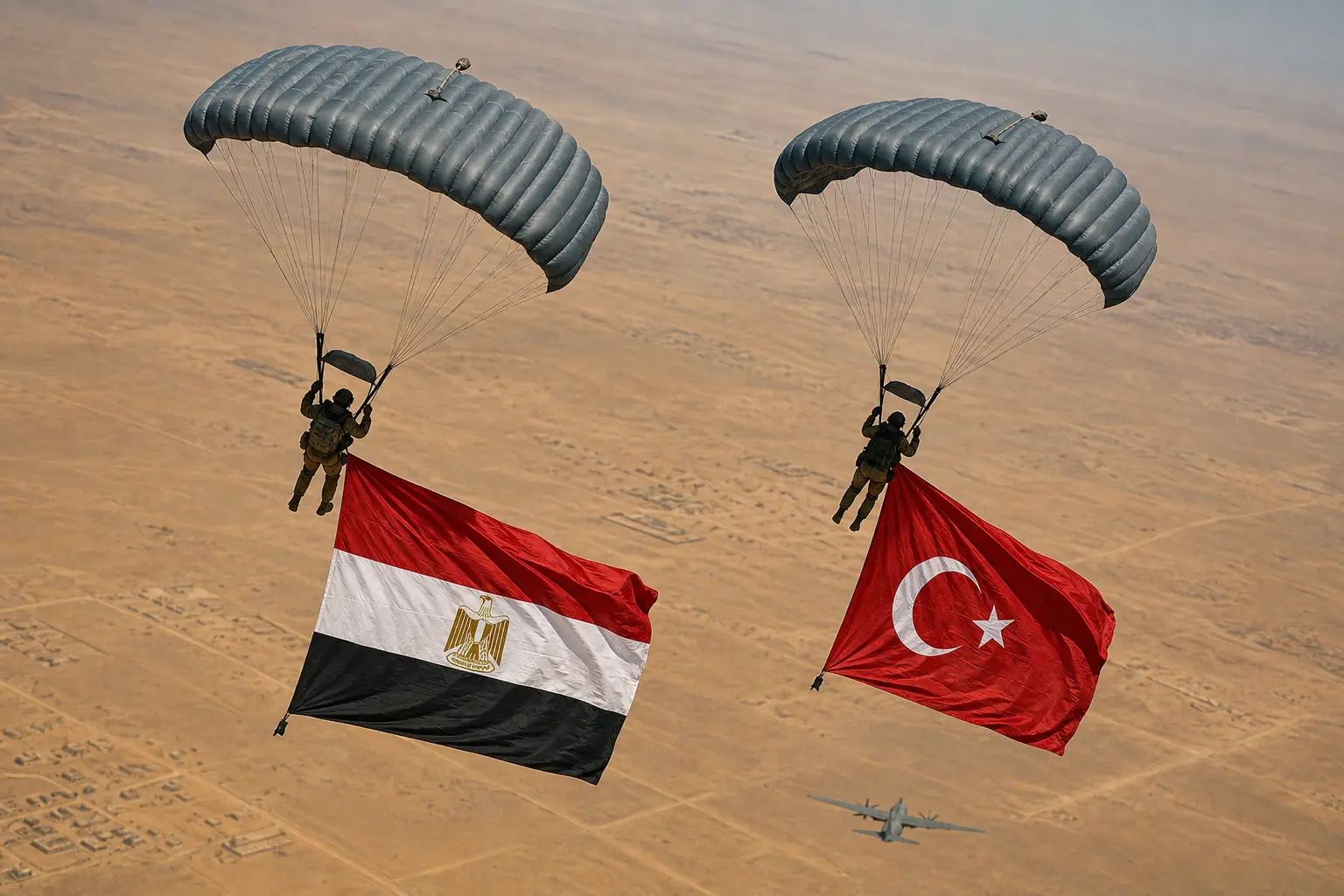
Troops closed the drill with what the spokesperson called a “friendship jump,” parachuting in tandem while carrying the flags of both countries. Egypt described the moment as proof of the participants’ “high level of proficiency and advanced technical skills.” An earlier phase featured theoretical lectures meant to standardize operating procedures between the two forces, plus a exhibition of the weapons and gear used in training.
A Decade of Cold Shoulders Thaws Into a Training Ground
Golden Eagle did not happen in a vacuum. It capped a reconciliation that took years to build after one of the coldest stretches in modern Egypt-Turkey relations.
- 2013: Egypt’s military, then led by Abdel Fattah al-Sisi, removes President Mohammed Morsi. Cairo and Ankara withdraw their ambassadors within weeks.
- November 2022: Sisi and Turkish President Recep Tayyip Erdogan shake hands on the sidelines of the World Cup in Doha after Qatari mediation.
- July 2023: The two countries exchange ambassadors for the first time in a decade.
- February 2024: Erdogan visits Cairo, his first trip to Egypt in more than 12 years, and the leaders launch a Strategic Cooperation Council.
- September 2024: Sisi travels to Turkey for the Council’s first meeting, where the sides sign energy and military memorandums.
- September 2025: The Egyptian and Turkish navies hold their first joint drill in the Eastern Mediterranean in 13 years.
- February 2026: Erdogan returns to Cairo for the Council’s second meeting, and the defense ministries sign a Military Framework Agreement.
- July 2026: Golden Eagle closes with the hostage-rescue drill described above.
One detail shows how fast the machinery has moved. The Egyptian general who signed the February framework deal, Abdel Majeed Saqr, was replaced as defense minister within a week. Lieutenant General Ashraf Salem Zaher took the oath as Egypt’s defense minister on February 11, 2026, in a wider cabinet reshuffle, and inherited the file. Zaher traveled to Türkiye last week to meet his counterpart, Yasar Guler, to discuss expanding training exchanges and technology transfers, according to Egypt’s military.
The Defense Industrial Bet Behind the Handshakes
The drills sit on top of a growing pile of hardware deals. Turkey’s defense minister has said Ankara and Cairo have finalized roughly $350 million in agreements, and the two governments are aiming to nearly double bilateral trade by the end of the decade.
| Initiative | What It Covers | Figure or Status |
|---|---|---|
| Military Framework Agreement | Signed by both defense ministries in Cairo | Feb. 4, 2026 |
| TOLGA close-in weapon system | Turkish export to Egyptian forces | Part of the $350 million package |
| 155mm ammunition plant | Joint factory in Egypt with Turkey’s MKE | Agreed, production planned |
| KAAN fighter jet program | Egyptian participation in Turkey’s fifth-generation jet | Under discussion |
| Bilateral trade | Two-way trade target | $15 billion by 2028, up from about $10 billion |
Beyond the ammunition plant, the two sides are discussing cooperation on drone manufacturing, and Cairo has signaled interest in joining Turkey’s KAAN stealth fighter development, a program Ankara is racing to field as it drifts from reliance on Western suppliers. This is not symbolic. A joint munitions line and a fighter-jet co-production talks are the kind of commitments that are expensive to reverse.
Libya Is the Line Neither Army Has Crossed
The same week Egyptian and Turkish troops were training together, Cairo was contesting Ankara’s maritime claims at the United Nations. Egypt and Turkey backed opposite sides of Libya’s civil war for years: Cairo bankrolled Khalifa Haftar’s Libyan National Army in the east, while Ankara sent troops, drones and air defense systems to save the Tripoli government in 2020. That fight never produced a settlement, and the maritime boundary Turkey drew with Tripoli in 2019 is still contested.
Egypt submitted a formal note to the United Nations on September 16, 2025, rejecting Libya’s declared continental shelf and maritime boundaries as an infringement on its own territorial waters and economic zone. Turkey, meanwhile, has spent the past year courting the family it once fought. Turkish intelligence chief Ibrahim Kalin traveled to Benghazi in August 2025 to meet Haftar directly, the first such high-level contact, and Haftar’s son and deputy commander, Saddam, visited Ankara that April to discuss training and arms cooperation. In May, Ankara went further, bringing 501 personnel from both of Libya’s rival armies into its own Efes exercises, the first time the two Libyan forces trained internationally under one flag.
This is a huge, practical pivot towards the east. It has huge implications for Libya’s stability. Turkey’s position now is that it has good relations with both sides.
Jalel Harchaoui, a Libya researcher at the Royal United Services Institute, a London defense think tank, made that assessment about Ankara’s outreach. The goal, according to analysts who track the file, is to pressure Haftar’s parliament in Tobruk into ratifying the 2019 maritime deal Turkey signed with Tripoli, something Cairo has rejected on legal grounds since it was first proposed.
Greece Watches Its Two Partners Get Closer
Egypt’s objection to the Turkey-Libya maritime map is not new. Cairo signed its own exclusive economic zone agreement with Greece on August 6, 2020, carving a partial 104-nautical-mile boundary specifically as a counterweight to Ankara’s deal with Tripoli. Turkey’s then-foreign minister, Mevlut Cavusoglu, dismissed the Greek-Egyptian pact at the time, posting that the agreement was “null and void” and vowing to defend Turkish rights on the ground.
Six years later, Egypt is friendlier with Turkey than at any point since, and that puts Cairo in an awkward spot with Athens. Greece has long treated Haftar’s eastern Libya as a check on Turkish ambitions in the Mediterranean, and it has not enjoyed watching Ankara make inroads there. Haftar, for his part, is hedging every direction at once. He hosted Greece’s foreign minister in Benghazi last July, inviting Greek firms to bid on reconstruction projects even as his son courted Ankara. Egypt has told Athens it intends to keep its own boundary settlement intact, but Cairo is unwilling to let a Libya dispute wreck a Turkish partnership it spent three years rebuilding.
Do Cairo and Ankara Actually Agree on Libya?
Not entirely. Egyptian and Turkish officials describe the drills and defense deals as counterterrorism and maritime-security cooperation aimed at no third country. Libya specialists mostly agree the exercises ease tension on the ground. Israeli commentators read the same facts as something closer to an axis.
Aya Burweila, a Libya analyst at the Athens-based Centre for Hellenic and Mediterranean Studies, has argued that joint drills involving both Libyan armies push the country toward one unified force rather than two, and that outcome, in her view, would help everyone. Officials in Cairo and Ankara make a similar case about their own bilateral drills, framing them around shared threats rather than shared enemies.
A recent opinion piece in Ynetnews, an Israeli news outlet, took the opposite view, calling the Egypt-Turkey buildup “a cold, cynical strategic alliance between two authoritarian heavyweights” that could unsettle the Eastern Mediterranean. That reading sits alongside a separate, quieter track: Egypt has joined a four-country consultative platform with Turkey, Saudi Arabia and Pakistan, meeting most recently in Cairo on June 21, largely to coordinate on fallout from the region’s wider security crises. The drills, in other words, are one piece of a bigger board, not the whole game.
Frequently Asked Questions
What is the R4 mechanism that links Egypt and Turkey?
The R4 mechanism is a consultative platform grouping Egypt, Turkey, Saudi Arabia and Pakistan. It was set up largely to help the four countries coordinate their response to regional security shocks, including fallout from the US war against Iran and Iranian strikes on Gulf states, and it held its most recent session in Cairo on June 21, 2026.
Is Egypt’s 2020 maritime deal with Greece still in effect despite the Turkey thaw?
Yes. Egypt ratified its exclusive economic zone agreement with Greece in October 2020 and has not moved to unwind it. Cairo has told Athens it wants to preserve that relationship even as it deepens defense ties with Ankara, though Egypt has stopped short of publicly backing Greece against Turkey’s separate maritime claims with Libya.
Why did Egypt and Turkey become rivals in the first place?
The rupture dates to 2013, when Egypt’s military removed President Mohammed Morsi, a figure Erdogan had backed. Erdogan spent the following years attacking Sisi’s legitimacy in public, and Cairo responded by pulling its ambassador and suspending joint naval drills that had existed before the falling out.
What happens to Khalifa Haftar’s family as Libya’s factions edge toward unity?
Haftar, 81, has placed his sons in key posts as he manages succession. Saddam Haftar serves as deputy commander of the Libyan National Army, Khaled Haftar has become its chief of staff, and Belqasem Haftar oversees reconstruction funds, positioning the family to keep influence regardless of how any eventual unification deal is structured.
What comes next for Egypt-Turkey military cooperation?
Expect more joint exercises rather than fewer. The two governments are targeting $15 billion in annual trade by 2028, continuing meetings of their Military Cooperation Committee, which has already met five times, and further talks on drone manufacturing and Egyptian involvement in Turkey’s KAAN fighter program.
