
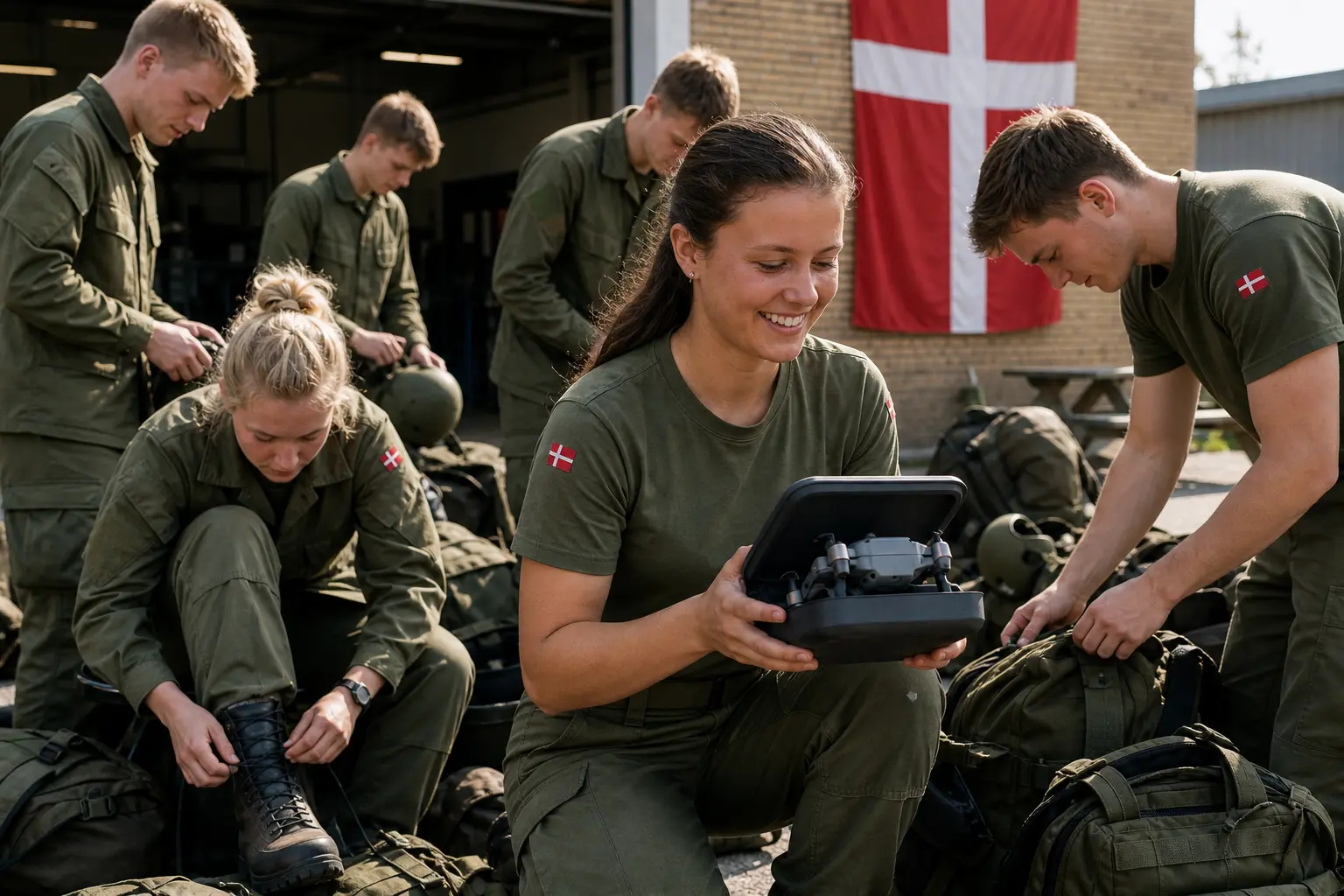
Around 1,600 young Danes reported to 14 bases on 3 August 2026 to start the country’s first full cohort under its reformed 11-month, gender-equal military service. Roughly 20 percent are women. A company of more than 100 will deploy to Greenland later this month for a one-month rotation, the first time conscripts take operational tasks there from professionals.
The intake realizes the 2024 defence agreement that lengthened service from four months, opened full lottery equality to women, and set higher annual targets. It arrives as Denmark faces pressure from Russia’s war in Ukraine and repeated U.S. interest in Greenland.
The First Cohort Steps Onto Base
All of the new arrivals are volunteers. They fill slots at army, navy, air force and Special Operations Command sites across the country. Officials from the Danish Armed Forces described them as the opening full hold under the modernized model.
Defence Chief General Michael Hyldgaard framed the day in straightforward terms.
It is a common duty to stand guard over the Kingdom and contribute to our shared security.
Hyldgaard added that the young people take responsibility that strengthens both the forces and society.
- 1,600 volunteers began on 3 August at 14 locations
- ~20% of the 2026 starters are women
- 11 months standard length (12 at select units including the Royal Life Guards)
- New tracks include drone platoons and conscript lieutenants
Silas Nohr, a 19-year-old from Varde, told reporters he welcomed the longer stretch. “Now we have 11 months, and I feel like you can really get into it, really experience it and get a lot deeper into the military,” he said on day one at Oksbøl.
Greenland Rotation Lands This Month
One company drawn from the Slesvigske Fodregiment will spend a month on the island later in August. They take over routine operational duties so professional soldiers can shift to higher-skill work. The move carries political weight because U.S. President Donald Trump has repeatedly sought control of the semi-autonomous territory on national-security grounds. Greenland and Danish governments have firmly rejected the idea.
Prime Minister Mette Frederiksen told the NATO summit in Ankara last month that Denmark stands ready to defend every inch of alliance territory, “including our own.” The same week the new recruits arrived, officials underlined continued expanded presence and exercises in Greenland with NATO partners.
- January 2026: Denmark and Greenland announce expanded military presence and allied exercises through the year
- July 2026: Frederiksen restates readiness to defend the Kingdom at NATO summit
- 3 August 2026: 1,600 begin new service model
- Late August 2026: first conscript company deploys to Greenland for one month
The rotation is short and rotational. Broader plans call for up to 1,000 combat soldiers rotating through the island across 2026.
What the Longer Service Delivers
The old four-month model produced limited skills. The new structure spends the opening three to five months on core soldiering: weapons, first aid, fitness, field movement. The remaining six months put conscripts into operational roles.
| Phase | Duration | Focus |
|---|---|---|
| Basic training | 3-5 months | Shooting, first aid, physical, terrain movement |
| Operational service | ~6 months | Guard, patrol, drones, radar, shipboard, Arctic or NATO tasks |
| Select units | 12 months | Life Guards, Hussars, cyber, royal yacht |
Conscripts can now fill drone pilot slots in the army, radar assistant posts in the air force, combat information roles at sea, and Special Operations Command patrols. Those tasks free career soldiers for work that needs deeper specialization. Deployment outside the Kingdom of Denmark remains voluntary.
Kenneth Strøm, head of the conscription programme, said the change generates combat power faster. Longer service also supports a new track that trains conscript lieutenants for a further year of tactical leadership after their initial twelve months.
Women and a Princess Share the Barracks
Full gender equality took effect for those turning 18 after 1 July 2025. Women now face the same lottery and service obligations as men when volunteers fall short. Earlier, women could only volunteer. This first large intake already shows the shift: about one in five starters are female.
- Princess Isabella, 19, daughter of King Frederik and Queen Mary, reported to Antvorskov Barracks in Slagelse for the Guard Hussar Regiment
- She becomes one of the first women under the reformed model
- Like her brother Crown Prince Christian before her, she declined the standard pay and food allowance (roughly 190,000 kroner or about $29,000 over eleven months)
- Ordinary recruits receive just over 9,000 kroner monthly plus a daily tax-free sum
The royal arrival drew cameras, yet she arrived alone in a civilian car, smiling, before changing into uniform. The symbolism is deliberate: elite families now share the same barracks and kit issue as everyone else. Public conversation on X noted the princess step as elite buy-in under pressure, while others framed the whole intake as preparation against both eastern and northern risks.
Intake Targets Climb Toward a Larger Reserve
The 11 month service and up to 7,500 yearly figures come straight from the 2024-2033 Defence Agreement and its sub-agreements. The Armed Forces currently state a climb to 6,500 over the agreement period. Separate defence planning discussed in Danish media earlier this year looks further: annual recruitment possibly reaching 13,000 by 2035 and a mobilization pool of up to 180,000 that would include trained men and women up to age 65.
| Horizon | Annual conscripts (approx.) | Notes |
|---|---|---|
| Recent past | 4,200-5,000 | Mostly volunteers, lottery fill-in |
| 2026 start | 1,600 this intake | First full new-model cohort |
| Agreement period | 6,500 | Armed Forces target |
| By 2033 | 7,500 | Reuters and agreement language |
| Longer plans | up to 13,000 | By ~2035 per earlier DR reporting |
The system remains a ballot among medically fit 18-year-olds. For years nearly all slots filled by volunteers; the lottery only topped up. Higher numbers and longer service will test how many still step forward and how often the draw must compel service.
Dual Pressures Shape the New Model
Ukraine’s war forced every Nordic and Baltic state to rebuild mass and readiness after post-Cold War cuts. Denmark kept a mixed volunteer-conscript system when many peers went all-professional, yet the short service limited what those conscripts could do. The new length and equality fix that gap.
The Arctic layer is more recent and more awkward. Trump’s public interest in annexing Greenland rattled a NATO ally. Danish and Greenlandic leaders answered with firmer presence, more allied exercises, and now citizen soldiers on the ground. On X, U.S. voices such as Rep. Don Bacon stressed support for Greenlandic sovereignty and warned that pressure on an ally damages American credibility in Europe. Danish coverage treats the dual threat as the reason ordinary 18- and 19-year-olds now train for Arctic conditions and operational duty.
The first full cohort of about 1,600 volunteers therefore does more than raise headcount. It places the next generation inside the actual defence of the Kingdom’s most remote territory while career forces concentrate on complex tasks. That structure also feeds the larger reserve pool that planners say would be needed in a major war.
A related domestic security thread appears in a recent Danish terror sentencing case involving a 2024 grenade attack, underscoring that Copenhagen is hardening across several fronts at once.
The 1,600 now in kit will spend the rest of 2026 and into 2027 proving whether the longer, mixed model produces usable combat power and whether society accepts the expanded call. Their Greenland company will be the first visible test of the second-order shift: citizens, not only professionals, holding the Arctic line.
