
Israeli AI lab Decart raised $300 million in a Series B on Monday May 18, 2026, valuing the company at roughly $4 billion. The round was led by Radical Ventures and brought in NVIDIA as an investor and Amazon as a strategic customer, according to the company and its lead investor’s post. It brings Decart’s total funding past $450 million, and it is the largest commercial signal yet for the Decart AI world model category the company has been building since 2023.
The company sells software that imagines a world frame by frame and hands it to a user in real time, a category that was a science-fiction idea a year ago and is now a product line. The $300M is the headline, but the round is also a bet that the cost of running that software has collapsed from thousands of dollars an hour to pocket change. That collapse is what makes the technology commercially interesting to Amazon, NVIDIA and the gaming, advertising and cloud customers already in the room. The bet is being made in Tel Aviv by three former Unit 8200 officers.
The Round in Numbers
Decart announced the Series B on Monday May 18, 2026, with JNS reporting the figure the same day. The raise values the Tel Aviv-based company at roughly $4 billion, per the JNS report. It is Decart’s largest round by a wide margin and brings total funding past $450 million, the company said in its announcement on the $300M Series B and DOS 2.0 announcement.
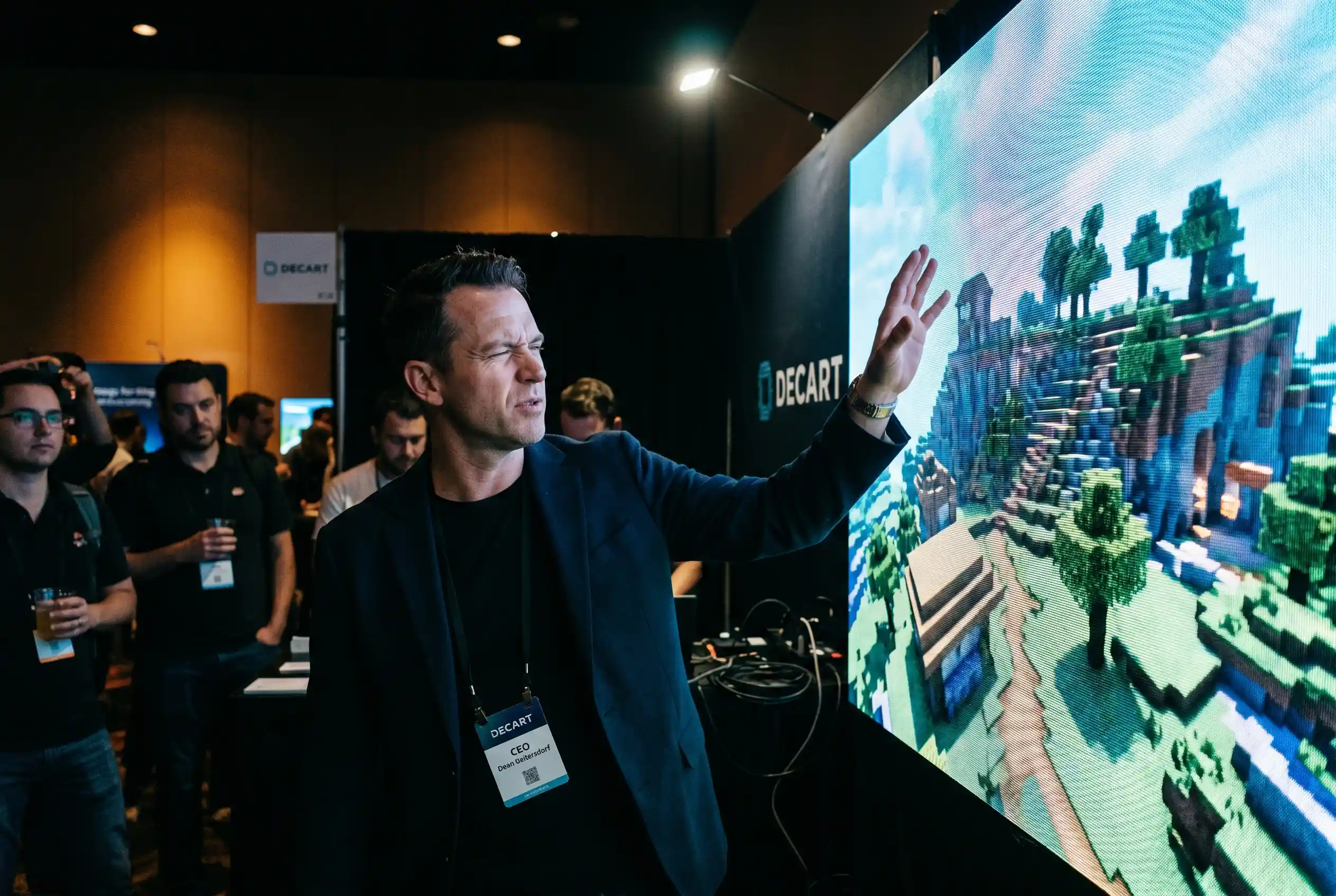
Jordan Jacobs, a partner at Radical Ventures, confirmed his firm led the round in a post on Radical’s site the same week, writing that he will join the board “alongside the founders, Sequoia and Benchmark.” Both Sequoia and Benchmark have been on the cap table since the company’s seed stage in October 2024. The full investor list, as published by Decart, runs from Adobe Ventures and Amazon to Zeev Ventures. A 30-minute video posted by the company features Decart CEO Dean Leitersdorf and gaming investor Moritz Baier-Lentz discussing what the money is for.
Who’s Writing the Checks
The cap table splits cleanly into three groups: strategic, financial and private. On the strategic side, NVIDIA invested in Decart and signed on as a business partner, and Amazon joined as a strategic customer whose cloud customers can run Decart’s technology for AI applications in media, commerce, advertising and physical AI, the company said. That AWS-facing agreement is the commercial anchor of the round. New financial investors include Adobe Ventures, eBay Ventures, Toyota Ventures, Atreides Management and Valor Equity Partners. Existing financial investors Sequoia Capital, Benchmark and Zeev Ventures all added to the round.
The private side of the cap table drew headlines. Andrej Karpathy, the OpenAI co-founder and one of the most cited AI researchers of the past decade, invested. So did former Disney CEO Michael Eisner, members of the Nintendo founding Yamauchi family, and gaming investor Moritz Baier-Lentz. The roster spans AI research, Hollywood, gaming hardware families, and gaming investment, signalling where the company wants to compete.
The Amazon deal is the most operationally significant piece of the round, and Decart framed it that way. Under the partnership, AWS customers can use Decart’s models for media, commerce, advertising and physical-AI workloads, which is the four-front go-to-market the company has been building toward. Amazon was an “early anchor API customer” across multiple product lines before the round closed, according to the case for world models as the next infrastructure layer.
NVIDIA’s role is harder to read. The chip giant is both a backer and a named infrastructure partner, a pattern in which NVIDIA takes equity in young labs whose software is built to run well on its hardware. Decart’s stack already runs on NVIDIA GPUs, Amazon Trainium and Google TPUs, and the company pitches that hardware-agnosticism as a feature. Decart’s hardware-agnostic pitch is the reason NVIDIA is comfortable on the cap table, given the software also runs on Trainium and TPUs.
The Product Stack Behind the Number
The $300M is being spent on three product lines, all announced or expanded with the round. DOS 2.0, the Decart Optimization Stack, is the inference and training platform that runs underneath everything else. Lucy is Decart’s world model for immersive experiences, the real-time video transformation product that powers live commerce, virtual try-on, dynamic advertising and gaming deployments. Oasis is the world model for physical AI, the line aimed at robotics, autonomous systems, manufacturing and drones. All three are available to customers through Decart’s API, per the company’s announcement and Decart’s current product line and roadmap. New versions of Lucy and Oasis are launching “in the coming weeks.”
DOS 2.0 is the part the company talks about in numbers, and the numbers are aggressive. Decart says the platform delivers over 1,600 tokens per second for agentic inference and over 100 frames per second for world-model generation, on the major hardware platforms it supports. Radical Ventures, in its write-up, puts the industry average for agentic inference at “roughly 200 tokens per second.” That is the gap the company is selling against.
The table below sets out the three product lines and what they actually do, as described by the company and its lead investor. The lines matter separately because they are sold separately, even though they share an underlying stack.
| Product | What kind of world | How it gets used | Availability |
|---|---|---|---|
| DOS 2.0 | Not a world model; the inference and training stack underneath the others | Runs on NVIDIA GPUs, Amazon Trainium, Google TPUs | Announced with the Series B |
| Lucy | Generated live video overlay on real footage | Commerce, virtual try-on, dynamic ads, gaming, live streaming; under 30 ms response | Live with customers; new version in coming weeks |
| Oasis | Generated interactive environment for robots and autonomous systems | Robotics training, autonomous-vehicle simulation, drones, manufacturing | New version in coming weeks |
Why the Cost Story Matters More Than the Round
The bigger story inside the $300M is the price. Decart says its infrastructure can reduce AI processing costs from “thousands of dollars” to less than 25 cents per hour in some applications. The company also says it has been profitable “almost since launch,” generating millions of dollars in revenue through contracts with cloud providers and AI laboratories. That profitability is unusual for a frontier-AI company of this size at this age.
When something expensive becomes nearly free, people stop using it carefully. The same cost collapse that put a graphics card in every gaming PC in the 2000s is the model Decart’s investors are betting on for real-time generative video. The bet is that the next decade of consumer entertainment, advertising, e-commerce and simulation will be built on top of software that costs less to run than the ad it interrupts. That is also the bet, on the record, in Radical’s announcement of the round.
World models represent this next frontier, and Decart is building both the SOTA generative video models and one-of-a-kind systems-level infrastructure required to run them in production, in real-time, at scale and at a fraction of the cost previously possible.
Jordan Jacobs, a partner at Radical Ventures, wrote that in the post announcing his firm’s lead investment. Sequoia, in its October 2024 partnership post, made the same point with a Google analogy: when Google shipped, it ran cheaper on commodity hardware than rivals did on Sun Microsystems servers, and won the next decade of search because of it. Decart’s founders, Sequoia wrote, “set out to tackle that problem, and started hacking on training and inference optimization” before applying those wins to a consumer product. The shape of the bet is identical, and the product category is different.
The category framing is also the part the company keeps repeating. Decart’s own announcement pitches the company as building on “two core pillars: ultra-optimized infrastructure for AI workloads, and realtime world models built on top of it.” Radical’s write-up extends the framing: to move AI from language into the physical world, systems need to model environments that persist and react according to real-world dynamics, and world models are how you do that. Decart is selling the inference and training layer to enterprises, and the world models themselves to everyone else.
The Israeli angle is a subplot that is hard to ignore. Unit 8200, the signals-intelligence unit where the founders met, has produced a long line of cybersecurity and chip startups that sold components into someone else’s platform. Decart’s founders are pitching a different kind of company, the kind that aims at the consumer entertainment stack itself. Israel’s official social account, after the round, said it plainly: “Decart is building the future of real-time AI and world models, another example of Israeli innovation shaping the future of technology.”
Where the Worlds Break Down
None of it is finished, and the honest reviewers all say the same thing. TechCrunch’s hands-on with Oasis at launch, in October 2024, found that the model “tends to quickly forget the level layout,” and turning the character around showed a rearranged landscape. The same demo ran at 20 frames per second, between 360p and 720p, with no in-game sound and a five-minute session cap. Reviewers called the experience a “nightmarish hallucination” and a “dream,” sometimes in the same paragraph. The technical reality is that world models keep only a short memory of where you have been, and when that memory fills, they improvise.
The limits show up the same way for the company itself. Drive a Decart-generated car around a block, and the intersection you started from may be gone when you circle back. The model has no persistent map, only a moving window. The same is true of the live-video re-skin: turn a kitchen into the deck of a ship, walk out of frame, walk back, and you may walk into a different ship. The category’s central trick, real-time generation, is also the category’s central fragility.
The numbers below are the raw figures the company and its backers have put on the table, set out together so the upside and the limits can be read against each other. The list runs from the round to the product to the prior demo, in that order. Every line carries its own sourced citation in parentheses. The figures appear verbatim from the cited reports.
- $300M raised in Decart’s Series B (JNS, May 19, 2026; Decart announcement).
- ~$4B valuation set in the Series B (JNS, May 19, 2026).
- 1,600+ tokens per second for agentic inference on DOS 2.0 (Decart announcement).
- 100+ frames per second for world-model generation on DOS 2.0 (Decart announcement).
- 1 million Oasis users within three days of the November 2024 launch (SiliconAngle, August 7, 2025; Haaretz, December 22, 2024).
The Unit 8200 Through-Line
The founders’ story starts in Unit 8200, the Israeli Defense Force’s signals-intelligence unit, and finishes in a $4B-valuation Series B in less than three years. Dr. Dean Leitersdorf, the CEO, was the youngest ever PhD graduate from the Technion at 23, per Radical’s write-up; his thesis on distributed computing won first place at the Symposium on Principles of Distributed Computing. His brother Orian Leitersdorf is Decart’s CTO and co-founder, and Radical notes Orian completed his own Technion PhD at 21, knocking his older brother off the “youngest ever” perch. Moshe Shalev, the CPO, is the third co-founder and the operations lead; Sequoia’s 2024 post, on the founders’ early work on training and inference optimization, describes him as a trusted problem-solver inside Unit 8200. The three of them had worked together in the unit for years before turning to AI infrastructure.
The funding history shows how the cap table filled in. Decart raised a $21M seed in October 2024, led by Sequoia with Oren Zeev participating. A $32M round followed within weeks, led by Benchmark. By August 2025, the company had closed $100M at a $3.1B valuation, more than a year before this latest round.
What changed between the August 2025 round and the May 2026 round is mostly a step up in commercial traction, not a step change in technology. Decart had already shipped the Oasis demo, the MirageLSD live-stream diffusion model, and the Lucy product for immersive video. The Series B came packaged with the launch of DOS 2.0 and with the AWS and NVIDIA relationships, which is what a venture-stage company sells when it wants a higher multiple. The valuation moved from $3.1B to roughly $4B, and the dollar amount moved from $100M to $300M, both figures as reported in the respective announcements.
The pattern of the story is the same as the pattern of the technology: things that looked impossible a year ago now look like a Series B. Decart is still small, still young, and still in a category the rest of the industry has barely started to map. The $300M is the price the public market is putting on the founders’ bet, based on the Series B pricing.
Frequently Asked Questions
What is a world model?
A world model is a generative AI system trained on enough video to learn how a world looks and moves, then asked to generate each new frame from the user’s last action and the frame it just produced. Unlike a traditional game engine, a world model has no instructions and no prebuilt world, so it improvises from moment to moment. The category is what Decart, Google DeepMind’s Genie, and a handful of other labs are now competing in.
What is Decart’s DOS?
Decart’s DOS is the inference and training platform that powers the company’s world-model products. The 2.0 version, launched with the Series B, delivers over 1,600 tokens per second for agentic inference and over 100 frames per second for world-model generation, running across NVIDIA GPUs, Amazon Trainium and Google TPUs. Radical Ventures puts the industry average for agentic inference at roughly 200 tokens per second.
Why is this $300M round significant?
The round takes world models from viral demo to venture-scale product category, with Amazon as a named strategic customer and NVIDIA as a named investor and partner. It also makes Decart one of the most valuable AI infrastructure companies out of Israel, and one of the few that pitches a category rather than a component.
Who are Decart’s founders?
Decart was founded in late 2023 by Dr. Dean Leitersdorf (CEO) and Moshe Shalev (CPO), both veterans of Israel’s Unit 8200 signals-intelligence unit. Orian Leitersdorf, Dean’s brother, is the CTO and co-founder. All three are Technion-trained. Dean Leitersdorf was the youngest PhD graduate in Technion history at 23, a record his younger brother subsequently broke. The three founders had worked together in Unit 8200 for years before launching the company.
What can you do with Decart’s tech right now?
Three product lines, all available via API. Lucy re-skins live video in real time for commerce, advertising and gaming. Oasis generates interactive, physically grounded worlds for training robots, drones and self-driving systems. DOS is the underlying inference and training platform that customers can also license on its own, separately from the world models.
