
AUTO
Chasseur’s Prize Interior Lost Its Glass Stairs at Sea
The Christensen Chasseur won 2017 prizes for glass stairs and spare sycamore, then a 2022 Patrick Knowles refit covered those features so the boat could be lived on.

In 2022, Patrick Knowles covered the floating glass stairs on the 160-foot Chasseur because guests would not walk them at sea. The Christensen yacht had won a 2017 design prize for that spare, light interior. New owners who bought her in 2022 called the same rooms too harsh, cold, and angular, then paid for a three-phase Fort Lauderdale refit that hid the look that made her famous.
Telecoms entrepreneur Donald Burns had commissioned that look on purpose. He wanted a boat that matched his houses, not the heavy joinery most yards still sold, and he thought glass would age better than fashion. The next people to live aboard found the glass unnerving under way and the milk-glazed sycamore turning pink at dusk.
Burns Wanted Light, Clean, and Almost No Ornament
Burns told designer Tonya Lance of Varo Interior Design that he would only return to yachting if he could have a vessel more like Christensen’s 2009 Odessa, a 48.77-metre boat with a crisper interior than the yard’s usual work. His friend and business associate Henry Luken, later the yard’s majority shareholder, had hull contracts in hand during a hard stretch for the company. Burns first took Luken’s contract on Hull 37, then gave those rights back so the yard could sell that hull as D’Natalin IV. He started again on Hull 40, which became Chasseur.
The brief was spare on purpose. Lance said the aim was a seamless flow between inside and the water, with high-gloss ceiling panels that would bounce light. Bulkheads ran in milk-glazed sycamore against teak and holly soles. Cupboards were santos rosewood. Shagreen, woven leather, and capiz shell showed up as accents, with a Hermès chair and an Armani Casa table used as statements rather than filler. Throughout, the geometry stayed rectilinear.
Burns had already told Lance to keep the sycamore in milk tones, with no pink in the species. He also hired lighting designer Nathan Orsman, a personal friend, after Lance said neither she nor the yard had deep experience with architectural light. Art was chosen to stay light too, including a Christian Liaigre wood sculpture in the foyer. Burns said he was trying to give the décor the longest life he could, and that he did not want the boat so personal it would scare off charter guests or a later buyer.
I think glass ages well and I think the natural materials will all age very well. I wanted to do it the way I wanted to do it, but I didn’t want to take it so far that it was overly personalised, because I think boats that go that way don’t do well. I think I struck a good note.
Donald Burns, original owner
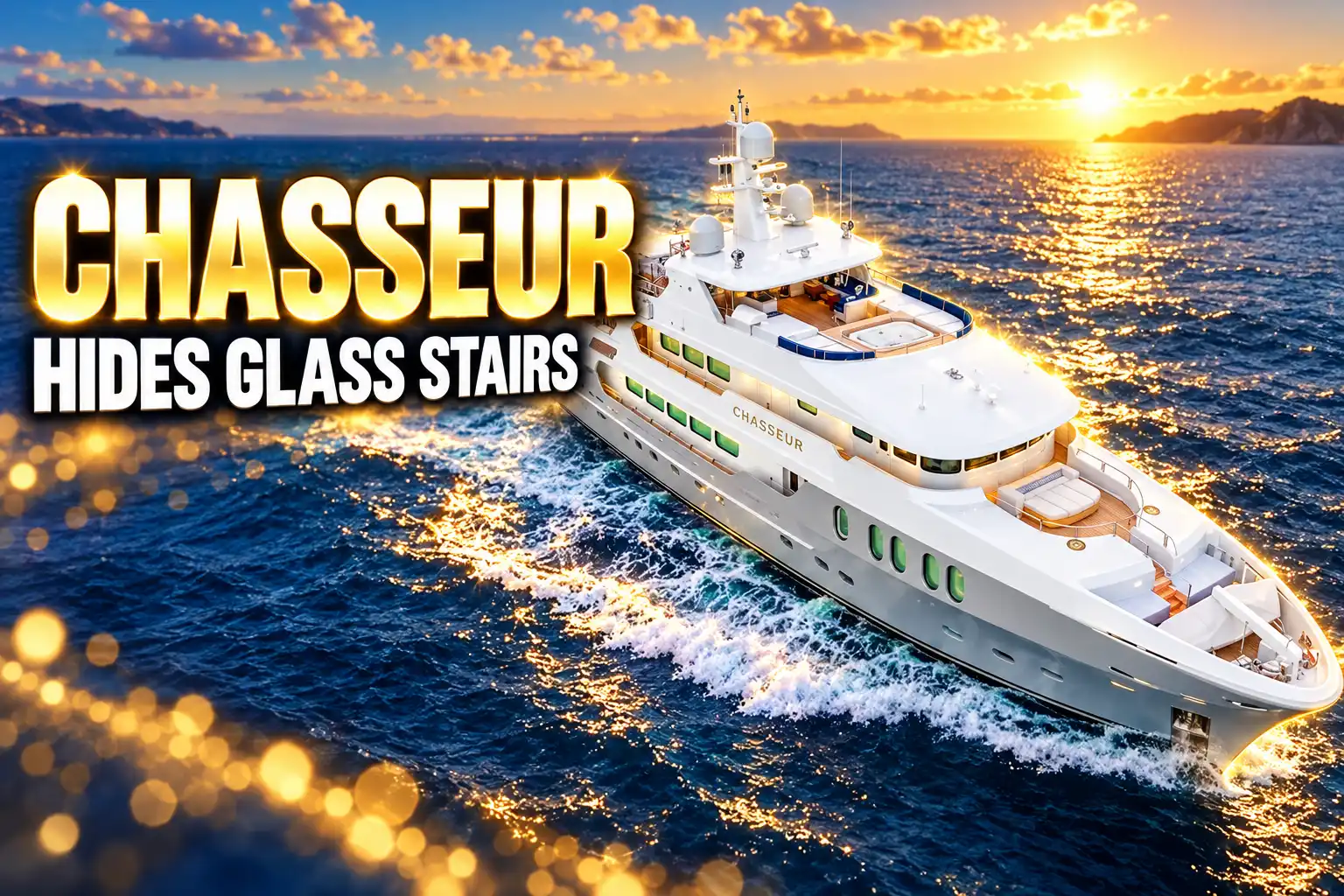
Chasseur was launched on June 25, 2016, at Christensen’s Columbia River plant in Vancouver, Washington, five days after sister ship Silver Lining, and delivered that September. She is a 499 GT tri-deck in GRP, built under 500 gross tons, with an elevator, Quantum zero-speed stabilizers, and room for 12 guests in six staterooms plus a crew of 10.
Prize Night for a Glass Stair and Milk Sycamore
The International Superyacht Society named Chasseur Best Power yacht from 40m to 65m at its 2017 Design and Leadership Awards in Fort Lauderdale. Varo Interior Design also said the boat took a Special Achievement prize at that year’s Showboats Design Awards. Trade write-ups lingered on milk-glazed figured sycamore, holly-inlaid teak, rosewood casegoods, and a sculptural main stair of floating glass treads with woven-leather walls and color-changing LEDs. Brokers later called that stair the first of its kind on a Christensen.
Lance’s studio, based in Camas, Washington, next to the yard, spent 36 months on the interior. Most owner contact ran by email, with the big presentations on the Columbia River. Burns said yards around the world still produced heavy-looking boats, and that even Odessa had felt a little dark. Chasseur was his answer: more glass, lighter wood, better light, and technology the yard had not been pressed to install on earlier hulls.
He planned to charter her after a maiden run to St. Barths, in the Mediterranean in summer and the Caribbean in winter, arguing it would be better for the crew, the boat, and the yard’s reputation. The glass stair, the sycamore, and the open sightlines were the features he expected to last.
The 2022 Owners Found the Interior Too Sharp
The owners who bought Chasseur in 2022 liked the silver hull and the clean exterior lines. They did not like living inside Burns’s brief. Knowles, hired to change the rooms without throwing away the boat, said they found the interior rectilinear and wanted something more ergonomic. They cruise the U.S. Eastern Seaboard and island-hop the Bahamas and Caribbean, and they spend most of their time in the sky lounge, not posing in a foyer.
WHAT THE NEW OWNERS REJECTED
- The corners: Sharp 90-degree edges on cabinetry and furniture ran through the boat and felt hostile in a seaway.
- The stair: Transparent railings and treads between the main deck and bridge deck pushed guests onto the exterior stairs once the boat was moving.
- The wood: English sycamore that had been milk-glazed to stay pale had taken on a pastel pink cast that deepened at dusk.
- The blinds: Venetian blinds on the windows read as austere rather than calm.
- The sightline: From the main salon, guests could look straight into the master suite.
Northrop & Johnson had already sold the boat in-house in December 2021, with Wes Sanford and Sean Doyle on the deal, after less than three months on the market. That sale is the one that lines up with the 2022 purchase Knowles described. A 2020 modernization sits in later broker notes as a separate, lighter refresh before the Knowles work.
Three Dockside Phases Softened Every Edge
The 2022 refit ran in three phases at Safe Harbor Marina in Fort Lauderdale, the yard formerly called Lauderdale Marine Center. Knowles’s studio, which sells custom megayacht and aircraft interiors from Fort Lauderdale, treated the job as a cover rather than a gut. Panels, rugs, and snap-on pieces went over the original architecture so the hardwood and the stair could stay.
ORIGINAL LOOK VERSUS THE 2022 REFIT
| Feature | 2016 Varo interior | After the Knowles refit |
|---|---|---|
| Staircase | Floating clear-glass treads and rails | Foam-backed cream panels snapped over the glass |
| Woodwork | Milk-glazed English sycamore | Stripped, tinted storm gray, satin finish |
| Furniture edges | 90-degree cabinetry throughout | Rounder pieces and stitched textile wraps |
| Windows | Venetian blinds | Roller mesh, faux Roman valances, drapery |
| Floors | Teak and holly soles | Custom rugs laid over the existing teak |
| Master privacy | Open view from the main salon | Bow-front console in fumed eucalyptus |
| Palette | High-gloss, rectilinear, pale wood | Blues, creams, leather, mohair, storm gray |
Hand-stitched fabric panels went onto bulkheads, berths, soffits, and window mullions. Knowles said the wrap gives a sense of being embraced by the interior, and it also damped noise. A full-height entertainment cabinet now splits the open-plan salon from the formal dining area, where guests sit at a custom Armani table. In the master, dark square cabinetry came out in favor of softer shapes. The bow-front console that blocks the old sightline mixes fumed eucalyptus, polished stainless steel, mirror, fabric, a cappuccino onyx top, lacquer, and overhead lights.
Hand-Stitched Panels Hid the Sharp Corners
The owners’ first complaint was tactile. Every 90-degree corner that had read as contemporary in a still photograph caught the body once the boat was moving. Knowles did not rebuild the joinery. He wrapped it. The same panels that warmed the eye also changed the acoustics, which matters on a hard, glossy boat that had been designed to bounce light. Roller mesh blinds, fixed drapery, and faux Roman valances replaced the Venetian blinds. On the main deck aft, a new bar with a natural quartzite top did the same job outdoors. A navy racing boot stripe was added to the hull as a last exterior note.
The Sycamore Went Pink, Then Storm Gray
Knowles said English sycamore needs pre-treatment that appears not to have been done, so the milk glaze failed in service. The pastel pink that Burns had banned in the original meetings came back in certain light, then went more aggressive at dusk. Rather than rip out the hardwood, the crew stripped it, tinted it storm gray, and finished it satin. On the lower deck the wood was painted cream and covered with removable upholstered panels or a fine grass cloth. Burns had asked for milk tones so the boat would not date. The pink cast is what dated it.
Why Guests Took the Outside Stairs
The stair between the main deck and the bridge deck was the feature brokers still sold as sculpture: floating glass, leather, LEDs, the Liaigre piece in the well. It was also the feature guests would not use once Chasseur left the dock. Knowles kept the structure and designed a snap-on fix, foam-backed cream panels over the suspended glass, so the stair could be walked without the view straight through the treads.
Most guests found it unnerving to negotiate a staircase of floating, clear-glass treads, particularly while at sea. It drove them to use the exterior staircases when moving between the decks, which was quite impractical.
Patrick Knowles, founder, Patrick Knowles Designs
Tranquility, Knowles said, is key for the owners. That is why the sky lounge got a games table and became the social room, opening onto a new custom dining table on the bridge deck aft. The sun deck still carries a jacuzzi. The glass that was supposed to age well had sent people outside in a seaway. The cream panels are the quiet admission that the prize object had failed its first job, which was to get 12 people from one deck to another while the boat moved.
Vancouver Built Her, Fort Lauderdale Rewrote Her
Christensen was a composite specialist in a size band where most rivals build metal. Dave Christensen, a Vancouver, Washington, home builder, founded the yard in the mid-1980s after finishing his own boat. The company delivered about 44 yachts, almost all between 120 and 160 feet, from a 180,000-square-foot plant with 12 assembly bays on the Columbia River. In 2015 the yard went into receivership. Luken bought the name and assets for $5.5 million. The Vancouver site went to Vigor in 2019 for Army landing-craft work, and the last Christensen finished there was Jackpot. The remaining fleet is finite. Interiors now get rewritten in Florida.
Knowles has done this job before. On the Westport 164 now called Maison Blanche he was hired because a previous owner had commissioned a really austere boat. On Alta he turned a 144-footer in 161 days. His about page lists Christensen among yards the studio has already worked with, alongside Burger, Delta Marine, Feadship, ISA, and Palmer Johnson. Repeat clients have come back 8, 11, and in one case 19 times. When a closed American yard’s boats change hands, the second interior is often his.
Safe Harbor Marinas closed on Lauderdale Marine Center on May 3, 2021, in a deal valued at about $340 million, and still bills the 65-acre site as the largest yacht repair facility in the country. It runs as a marketplace more than a single shipyard: space, covered sheds, a 485-ton lift, and a list of approved contractors, with owners free to bring their own teams. Chasseur’s three-phase Knowles refit sat inside that model. Vancouver could no longer take the call.
FROM LAUNCH TO THE KNOWLES BOAT
- June 25, 2016: Christensen launches Chasseur at Vancouver, Washington, five days after Silver Lining.
- September 2016: The yacht is delivered to Donald Burns as Hull 40.
- 2017: The International Superyacht Society names her Best Power yacht from 40m to 65m.
- December 2021: Northrop & Johnson announces an in-house sale after less than three months on the market.
- 2022: New owners hire Knowles for a three-phase interior refit at Safe Harbor in Fort Lauderdale.
- October 2023: Wes Sanford lists her again and takes her to the Fort Lauderdale International Boat Show.
- January 12, 2024: The ask falls by $3 million, to $29,750,000.
- April 2024: Fraser’s Stuart Larsen and Lon McCloskey introduce a buyer; Sanford represents the seller.
By the time she was listed in 2023, broker copy described the interior as Knowles’s work, elegant and chic, with a zen-like mood. Varo’s name had dropped out of the sales language. The prize interior survived as a 2017 plaque and as the thing the snap-on panels conceal.
Listed at $29.75 Million and Sold Again
A 2023 valuation tagged Chasseur around $32 million, which is how the makeover first circulated. On January 12, 2024, Northrop & Johnson had her asking $29,750,000 after a $3 million cut. The listing stressed U.S. registration, commercial charter compliance, a completed five-year ABS special survey, and a full replacement of tenders and toys in 2022. Sanford brought her to that year’s Fort Lauderdale show. In April 2024 she sold, with Fraser introducing the buyer.
CHASSEUR ON PAPER
- Length: 160-foot (48.77-metre) Christensen tri-deck, 499 GT, beam 29 feet 6 inches.
- Power: Range of 4,000 nautical miles at 12 knots, with a 16-knot top speed from the original pair of Caterpillars.
- Layout: 12 guests in six staterooms, elevator to all decks, 10-person jacuzzi, 75-inch sky-lounge screen.
- Charter: Still offered for 2026 and 2027, with winter rates from $260,000 a week and a high of $295,000.
Original specifications list two CAT 3512C series engines at 1,650 hp each and 15,500 U.S. gallons of fuel. CharterWorld was still walking the boat for clients in June 2024, two months after the sale. The public conversation around her, such as it is, is inventory: listing posts, a price cut, a sold stamp. Nobody on those threads argues for putting the glass treads back.
Burns thought he had hit a resale note by keeping the décor spare and the glass honest. The people who wrote the next listing sold a Knowles interior and a stair you can walk in a seaway. The 2017 prize still sits on the résumé. The cream panels sit on the treads.
Frequently Asked Questions
Who designed the original interior of yacht Chasseur?
Tonya Lance of Varo Interior Design in Camas, Washington, spent 36 months on the 2016 interior, with most owner contact by email and major presentations at the Vancouver yard. Lighting designer Nathan Orsman, a friend of original owner Donald Burns, was brought in on contract from stem to stern after Lance said the studio and the yard lacked that specialty.
What awards did Chasseur win in 2017?
The International Superyacht Society named her Best Power yacht from 40m to 65m at its 27th awards gala in Fort Lauderdale, with design credited to Christensen and Varo Interior Design. Varo also said Chasseur received a Special Achievement award at the Showboats Design Awards earlier that year, before the ISS night.
How fast is the Christensen Chasseur and what is her range?
As built she was specified for a 16-knot top speed and a cruising speed of 12 knots, with a range of 4,000 nautical miles at 12 knots from two Caterpillar 3512C diesels rated at 1,650 hp each and 15,500 U.S. gallons of fuel. Later broker notes sometimes quote a shorter range; the original specification is the 4,000-nautical-mile figure.
Where was Christensen Shipyards located?
The yard sat in a 180,000-square-foot plant with 12 assembly bays on the Columbia River in Vancouver, Washington, from the mid-1980s until 2019, when Vigor took the site for U.S. Army landing-craft work. After a 2015 receivership, Henry Luken bought the Christensen name and assets for $5.5 million; Jackpot was the last boat finished in Vancouver.
Was Chasseur always Hull 40 at Christensen?
Burns first assumed Luken’s contract on Hull 37, then gave up those rights so Christensen could sell that hull to the owners of D’Natalin IV. The gap between the two contracts is the period Lance used to tour other yachts and lock Burns’s brief before work began on Hull 40, which launched as Chasseur.
Charter desks still price her as a 2022 Knowles boat on Christensen bones, $260,000 to $295,000 a week depending on the season. The glass treads remain under the cream panels, which is the whole story in one fitting.

Christa Pike Survived the Execution Tennessee Would Not Pause

Musk’s Oligarch Charge Hits a Queue of Three

Circle Puts USDC and EURC Into SAP Pay Workflows

Ring’s First Smart Lock Skips Home Wi-Fi for Sidewalk

GTA 6 Puts Cash Back on the Story Path

Salah Captained Egypt to Their First World Cup Win

Aramco Crash Kills 14 Two Days After Oil Restart

Apple Labor Day Deals Hide June’s Memory Price Hike

Zelda’s 40th Switch 2 Ships Without a Zelda Game

Palworld 1.0.4 Adds Palpedia Search After the 1.0 Launch
-
 NEWS4 months ago
Salah Captained Egypt to Their First World Cup Win
-
 BUSINESS4 months ago
Aramco Crash Kills 14 Two Days After Oil Restart
-
 NEWS2 months ago
Apple Labor Day Deals Hide June’s Memory Price Hike
-
 GAMING1 month ago
Zelda’s 40th Switch 2 Ships Without a Zelda Game
-
 GAMING1 month ago
Palworld 1.0.4 Adds Palpedia Search After the 1.0 Launch
-

 NEWS3 months ago
El Niño Puts Israel’s Needed Winter Rain on a Flood Clock
-

 ENTERTAINMENT1 month ago
King Charles Letter Keeps Harry and Meghan as Private Citizens
-

 ENTERTAINMENT4 months ago
A Thousand and One Drops Off Riyadh’s October Calendar