
Greater Amman Municipality is rehabilitating pathways and adding AI-powered tools across 13 tourist trails launched in 2024, turning scattered heritage spots into one walkable network that reaches from City Hall to the Citadel and onward to Bethany Beyond the Jordan.
Executive Director for the Development of Amman’s Popular Neighborhoods and Tourist Trails Mohammad Abu Zeitoun described the approach as presenting the capital as a connected experience rather than isolated sites. Visitors and residents move step by step through history under the municipality’s 2026-2030 strategy.
Thirteen Trails Form the New Map
In 2024 GAM launched 13 trails covering historical, religious, cultural and heritage themes. The list includes the Amman Walk, Baptism Trail, Cultural Tourism Trail, Religious Trail, Quraysh Caravan Trail, Jordan-Hejaz Railway Trail, Roman Street Trail and Old Towers Trail.
Data for the routes now sits in geographic databases. Several appear in the Amman Explorer platform. Maps, brochures and guides back them up. Partnerships with the Ministry of Tourism and Antiquities, the Department of Antiquities and the Jordan Tourism Board drive the work.
- Amman Walk: downtown core from Ras Al Ain to the Citadel
- Baptism Trail: city start extended to Iraq Al Amir and Al-Maghtas
- Jordan-Hejaz Railway Trail: Ottoman-era pilgrimage and revolt route
- Roman Street Trail and Old Towers Trail: classical and defensive layers
- Quraysh Caravan Trail and Religious Trail: trade and faith themes
The goal is stronger domestic tourism and a clearer place for Amman on the visitor map. Residents gain the same access as overseas guests.
Amman Walk Turns Streets Into the Main Stage
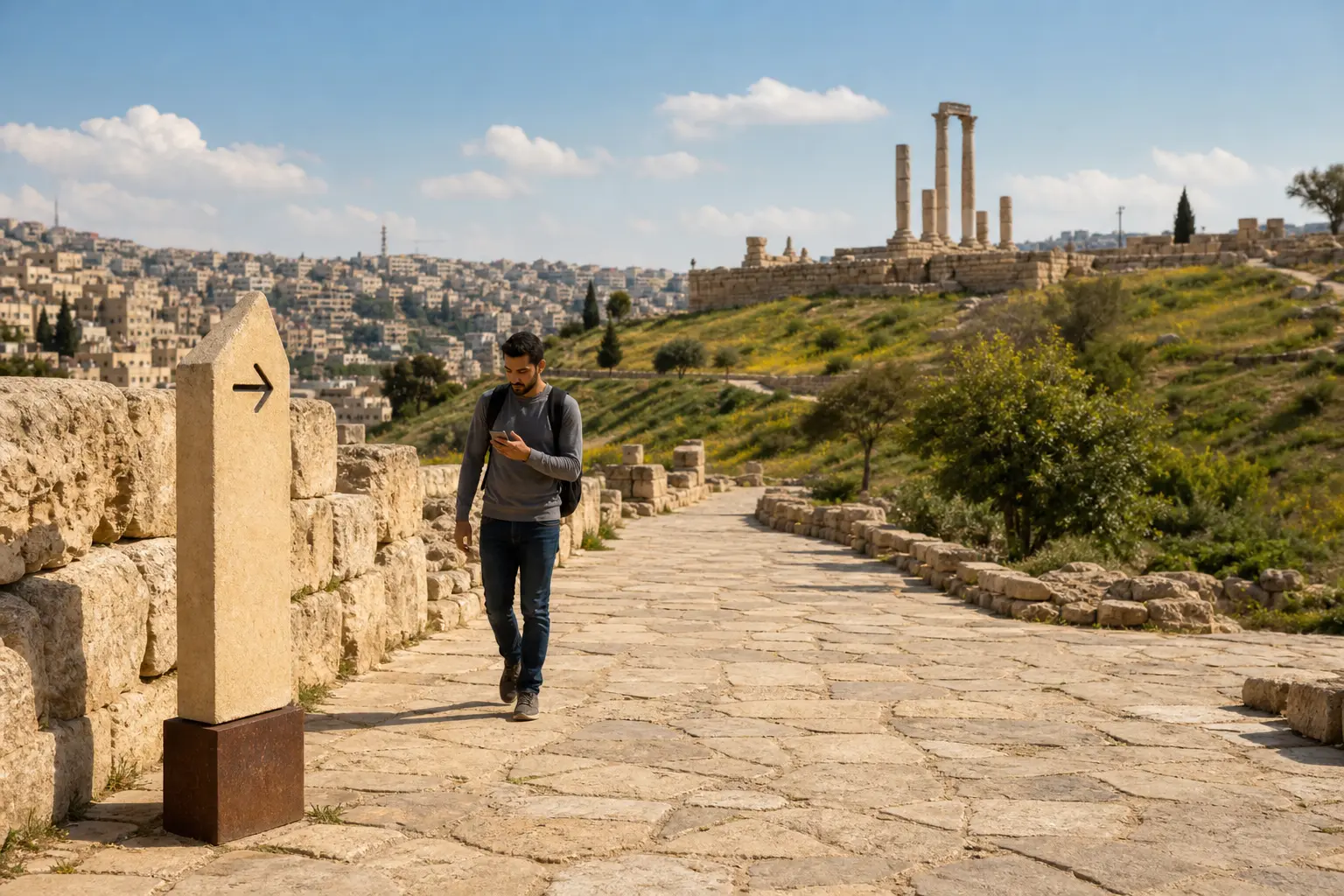
Abu Zeitoun called the Amman Walk the clearest example of the integrated model. It starts at the “See Amman” exhibition at City Hall in Ras Al Ain, moves through the Jordan Museum, then follows Quraysh and Talal streets, Faisal Square, the Nymphaeum and the Roman Theater before climbing to the Citadel.
Right now crews are clearing encroachments, fixing pathways and roads, and installing directional signage. The movement between stops becomes part of the visit itself. The same streets that once felt like ordinary downtown traffic lanes now carry the story.
Sites along the route match the official Amman attractions guide that already highlights the Citadel’s Umayyad Palace and Temple of Hercules, the Jordan Museum in Ras al-Ayn, the Nymphaeum’s second-century fountains and the Hijaz Railway Station’s steam locomotives.
AI and AR Make the Stones Speak
Development has moved past paper maps. GAM is applying artificial intelligence plus virtual and augmented reality to document urban heritage and shape the trails. Archaeological stops become interactive points that deliver historical images, digital reconstructions, audio stories, interactive maps and multilingual information.
The aim is a tighter emotional link between visitor and place. A phone or headset can overlay what a Roman street looked like or let a traveler hear a caravan account while standing on the modern asphalt. The same tools serve school groups and weekend walkers from nearby neighborhoods.
Interactive layers planned
- Digital reconstructions of vanished structures at key stops
- Audio stories tied to GPS locations along the routes
- Multilingual content for both foreign visitors and Arabic-speaking residents
- Geographic databases already feeding the Amman Explorer
Baptism Trail Points Straight at 2030
The Baptism Trail begins on the Amman Walk downtown, continues toward Iraq Al Amir and reaches Bethany Beyond the Jordan, known as Al-Maghtas. That single extension ties the capital’s daily life to one of the kingdom’s highest-profile religious sites.
Jordan is already preparing for the 2000th anniversary of the Baptism of Jesus Christ in 2030. Archbishop Christoforos Atallah, president of the Council of Church Leaders in Jordan, called the bimillenary a chance to lock the kingdom onto the global Christian pilgrimage map. Government projects on lands next to the site total about $120 million across 1,400 dunams.
| Project | Estimated Cost | Key Features |
|---|---|---|
| Jesus Christ Baptism Museum | $50 million | 5,500 sq m cultural narrative space |
| Pilgrims and Visitors Village | $40 million | Hotels, restaurants, church, visitor center |
| Infrastructure works | $27 million | Roads, water, power, solar, lighting |
| Green Corridor | $3 million | Biodiversity trails designed with RSCN |
Preliminary work on the museum and village is set for early 2027, with completion targeted for early 2029. Father Rif’at Bader of the Catholic Studies and Media Center said the kingdom is preparing to welcome millions of pilgrims. The trails give Amman a natural starting point for those journeys.
A related exhibition titled “Jordan: Dawn of Christianity” has already shown at the Vatican and Assisi and is scheduled for the Museum of the Bible in Washington in early 2027. X posts from Jordan’s embassy and church circles frame the whole effort as both spiritual and practical, highlighting Islamic-Christian harmony and new churches at the site itself.
Neighborhoods and Partners Share the Load
Abu Zeitoun’s title includes “Popular Neighborhoods.” The trails are meant to connect places with memory and local communities. Removing encroachments and improving paths also clears space for residents who live along the routes. Domestic tourism is an explicit target.
The Ministry of Tourism welcome overview already positions Amman as the commercial and cultural hub. Joint work with the Department of Antiquities keeps the archaeological standards high. The Jordan Tourism Board handles the external messaging.
A parallel 2026-2030 sustainable tourism transport roadmap endorsed by several ministries targets lower emissions from tourist buses and cleaner mobility. Walkable trails fit that direction by reducing short vehicle hops between close sites.
Hejaz Rails and World Heritage Ambitions
One of the 13 routes follows the Jordan-Hejaz Railway. The station still holds working steam locomotives and a museum that covers the Ottoman pilgrimage line and its role in the Great Arab Revolt. Full Hejaz Railway Station museum details sit on the official site for anyone who wants the mechanical side of the story.
GAM is also pushing a number of archaeological and tourist sites toward the World Heritage List and the wider global tourism map. The Citadel, Roman Theater area and Al-Maghtas already carry weight; the connected trails make the case that Amman itself functions as a living cultural landscape rather than a collection of separate tickets.
Recent tourism numbers show the stakes. Jordan recorded roughly 3.15 million incoming visitors and nearly JD 2.47 billion in revenue in the first half of 2026, according to Central Bank and media tallies, though monthly figures have swung both up and down. Petra alone saw 582,550 visitors in 2025. A smoother Amman experience can keep more of those arrivals longer and pull more Jordanians into the same circuit.
What the Paths Deliver Now
Rehabilitation work is underway. Signage is going in. Digital layers are being built. The Amman Walk already offers a full-day or multi-stop itinerary that any resident can join without a tour bus. The Baptism extension gives religious visitors a logical city-to-river sequence.
The second-order effect is simple. A better walk through downtown Amman becomes the first chapter of a larger journey that ends at a UNESCO site preparing for millions. Local shopkeepers, guides and neighborhood families sit inside that same chapter. The 2026-2030 strategy turns infrastructure into narrative, and narrative into longer stays and shared ownership of the capital’s past.
The stones have always been there. The trails now make them readable in sequence, on foot, with a screen that can show what used to stand beside them.
