
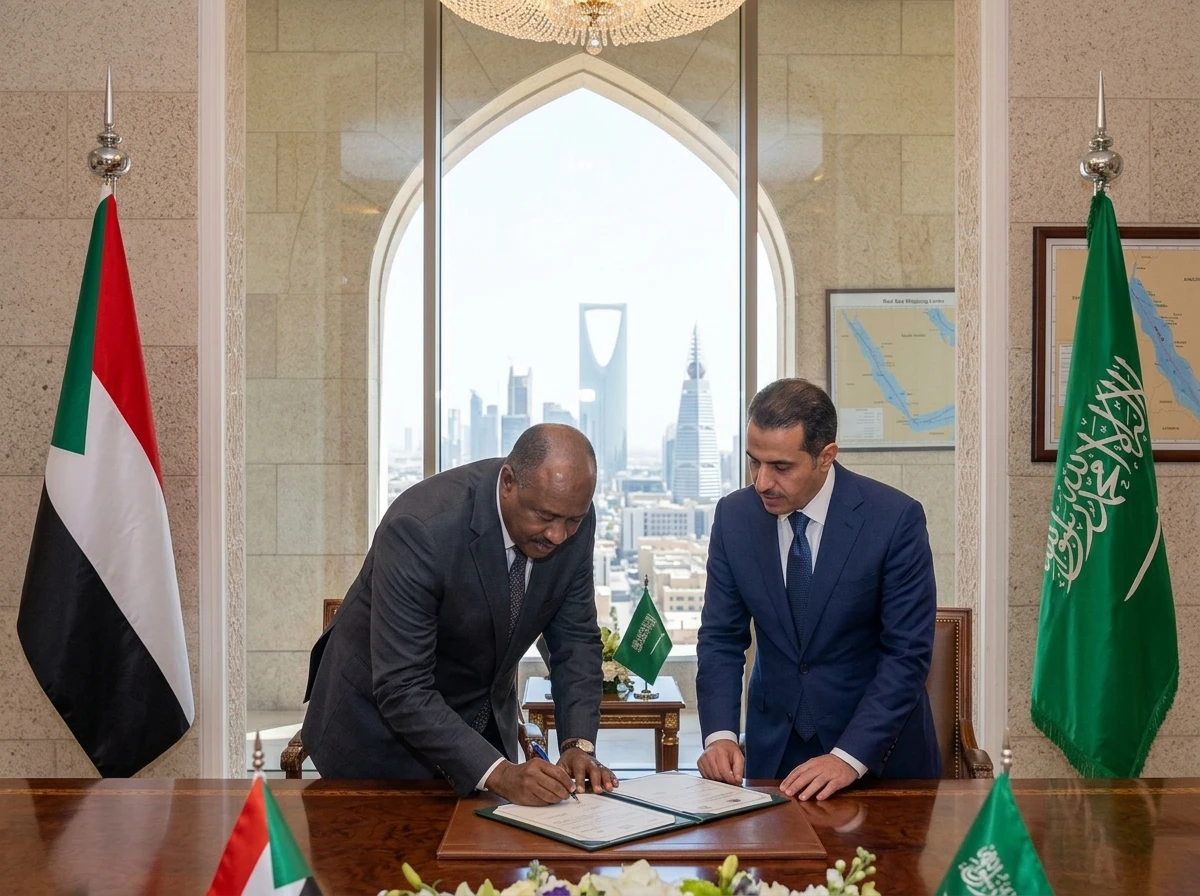
Saudi Foreign Minister Prince Faisal bin Farhan and Sudanese Foreign Minister Mohieddin Salem Ahmed Ibrahim signed a document in Riyadh on August 17 establishing the Saudi-Sudanese Coordination Council. The body creates a permanent institutional platform for joint initiatives, projects and targets across political, security, economic and social fields.
The ministers had just co-chaired a session of the bilateral Political Consultation and Follow-Up Committee. They reviewed existing ties, mapped expansion routes and swapped views on regional developments before putting pen to the new framework.
Ministers Sign the Council Into Existence
The Saudi Press Agency described the council as an effective platform that gathers relevant entities from both sides to deliver tangible results. It is meant to raise the level of cooperation and meet the aspirations of the two leaderships and peoples.
Sudanese officials said the structure covers ten main areas. Those include political coordination, economic ties, investment, trade relations and other fields of mutual interest. The council follows earlier understandings between the two countries on security, defence, the economy and Red Sea questions.
At a news conference that evening, Salem and Sudanese Ambassador to Saudi Arabia Dafallah Al-Haj said the body would open the door to further consultations, initiatives and projects aimed at deeper integration.
Saudi-Sudanese relations are strategic and I expect the new council to produce tangible results.
Salem told Asharq Al-Awsat that Red Sea security remained a top priority for both capitals. He called Saudi Arabia more than a major power or international symbol, saying Riyadh had approached the Sudanese crisis with “the sense of a neighbor, supporter and shared destiny.”
Red Sea Priority and the Makkah Opening
Salem praised the Makkah Joint Defense Agreement signed on August 7 by Saudi Arabia, Pakistan and Türkiye. He expressed optimism that Sudan could join a broader grouping with the Kingdom. Khartoum, he said, viewed potential integration positively as a way to strengthen regional security and stability.
The Makkah Al-Mukarramah Summit joint defence statement treats an armed attack on any of the three as an attack on all. It aims to deepen collective deterrence. Sudan’s interest surfaces just days after that pact and weeks after a wider Multinational Maritime Defense Alliance that already lists Sudan among participants seeking to protect navigation through the Bab al-Mandeb, the Red Sea and the Gulf of Aden.
Houthi attacks on shipping and Saudi-linked vessels have kept the waterway under pressure through 2026. Saudi Arabia has faced repeated exposure along those routes, a vulnerability documented in coverage of earlier Saudi exposure to Houthi fire. A formal coordination council with Sudan, which holds a long Red Sea coastline, gives Riyadh another institutional lever on the western shore.
Wartime Support Turns Structural
Salem credited Saudi Arabia with steady backing since the war erupted. He blamed the Rapid Support Forces and mercenaries for the conflict. He pointed to Riyadh’s hosting of the Jeddah talks, the first negotiating platform launched after fighting began in 2023, as proof of commitment to Sudan and its people.
He also highlighted aid delivered through the King Salman Humanitarian Aid and Relief Center. The war, he said, had forced Sudan to reassess its relationships with other countries. Khartoum’s foreign policy would take a different course in the future. The council, in his view, could usher in comprehensive strategic cooperation spanning political, security, economic and social affairs.
Official Saudi figures put total assistance to Sudan at $3.1 billion. KSrelief’s own dashboard shows more granular activity: 283 projects costing nearly 195 million dollars across food security, health, multi-cluster response, camp coordination, water and sanitation and other sectors.
| Sector | Projects | Cost (US $) |
|---|---|---|
| Food Security | 32 | 72,664,211 |
| Health | 208 | 55,248,442 |
| Multi Cluster | 9 | 26,689,544 |
| Camp Coordination | 11 | 21,736,424 |
| Water and Environmental Sanitation | 11 | 11,498,838 |
| Other sectors combined | 12 | 6,721,577 |
| Total | 283 | 194,559,036 |
Those numbers sit alongside broader Saudi regional humanitarian work, including a recent Saudi petroleum support deal with Yemen that keeps power plants running under similar pressure.
- $3.1 billion total Saudi aid to Sudan cited by the kingdom
- $194.6 million in tracked KSrelief projects
- 208 of those projects concentrated in health
- First post-outbreak negotiating platform hosted in Jeddah in 2023
How the Relationship Reached This Point
- May 2023: Saudi Arabia and the United States convene the first Jeddah talks between the Sudanese Armed Forces and the Rapid Support Forces, producing an early declaration on humanitarian access and ceasefire principles that later frayed.
- 2023-2025: Continuous KSrelief operations expand across food, health and shelter as the war displaces millions and fragments civilian politics.
- September 2025: Saudi Arabia and Pakistan sign a bilateral Strategic Mutual Defence Agreement that later expands.
- July 30 2026: A Multinational Maritime Defense Alliance that includes Sudan forms to protect Red Sea navigation.
- August 7 2026: Saudi Arabia, Pakistan and Türkiye sign the Makkah Joint Defense Agreement.
- August 17 2026: The Saudi-Sudanese Coordination Council is signed in Riyadh.
Each step moved the relationship from crisis response toward standing architecture. The council is the first body that locks the full spectrum of political, security and economic work into one permanent frame.
Khartoum’s Domestic Message and Foreign Reset
Salem turned to Sudan’s internal scene. He expressed hope that civilian forces could reach consensus on an overarching vision for resolving the crisis. Political divisions and fragmentation among those groups, he said, had complicated the landscape. He urged civilian and political forces to unite around national priorities and hold dialogue free from agendas that could undermine national unity.
He called for inclusive internal talks that represent Sudan’s diverse political currents and foster greater cooperation between the government and national forces. He also pressed Sudanese political groups to forge a unified national position against the challenges created by the war. He accused the militia involved of seeking demographic change inside the country.
The foreign-policy reset is already visible in public language. Sudanese officials describe the council as the outcome of two years of joint work. On X, observers noted that the new channel could open more direct Saudi investment, economic aid and diplomatic backing for the Sudanese Armed Forces side of the conflict. That reading matches Salem’s own framing of a different future course for Khartoum’s external relations.
The human cost of the war continues to spill across borders. Neighboring states face rising pressure on Sudanese refugees in Egypt, a reminder that any lasting political settlement will need regional buy-in beyond the new council.
Economic Stakes Already on the Books
Trade data give the council a concrete baseline to work from. Recent figures show Sudan running a Sudan trade surplus of roughly 282 million dollars with Saudi Arabia, with exports near $799 million and imports near $516 million. Livestock, agricultural products and minerals have long featured in the flow; Saudi investment interest in Sudanese ports, agriculture and reconstruction has been discussed for years but lacked a single coordinating body.
The council is designed to change that. By bringing the relevant ministries and agencies into one standing mechanism, Riyadh and Khartoum can move from ad-hoc projects to sequenced initiatives with clear targets. Salem said the investment climate inside Sudan has improved as authorities remove obstacles to capital. Whether that claim holds will be tested by the first wave of council-backed projects.
The Saudi Foreign Ministry signing announcement on X carried photographs of the two ministers at the table and restated the institutional purpose in official language. Engagement remained modest by global standards, yet the post served as the primary visual and textual record for regional audiences.
What the Structure Changes on the Ground
The council does not end the war. It does not dictate Sudan’s internal political settlement. What it does is replace episodic high-level visits and crisis-driven aid with a standing joint body that can set agendas, track deliverables and keep both capitals talking when attention drifts.
For Saudi Arabia the payoff is influence that outlasts any single mediation round. For Sudan the payoff is a clearer external anchor at a moment when old relationships have frayed and new security coalitions are forming around the Red Sea and the wider region. Salem’s public openness to the Makkah framework shows how quickly the conversation has moved from humanitarian support to potential collective defence.
The next test is whether the ten areas produce concrete working groups and funded projects before the end of the year, and whether Sudanese civilian forces can close enough of their own divisions to give any external framework a stable partner in Khartoum.
Frequently Asked Questions
When did Saudi Arabia and Sudan sign the coordination council agreement?
The foreign ministers signed the document on Monday, August 17, 2026, in Riyadh after co-chairing a Political Consultation and Follow-Up Committee session the same day.
What is the Saudi-Sudanese Coordination Council designed to do?
It functions as a permanent institutional platform that gathers relevant entities from both countries to deliver tangible outcomes through defined initiatives, projects and objectives across political, security, economic and social fields.
How much humanitarian aid has Saudi Arabia provided to Sudan?
Kingdom statements cite $3.1 billion in total assistance; the King Salman Humanitarian Aid and Relief Center alone lists 283 projects in Sudan with a combined cost of $194,559,036, heavily weighted toward health and food security.
What was the Jeddah process in the Sudan war?
Jeddah hosted the first negotiating platform between the Sudanese Armed Forces and the Rapid Support Forces after the conflict erupted in 2023, convened with United States support, and produced early humanitarian and ceasefire commitments that later broke down.
What is the Makkah Joint Defense Agreement and why does Sudan mention it?
Signed on August 7, 2026, by Saudi Arabia, Pakistan and Türkiye, the pact treats an attack on one as an attack on all; Sudanese Foreign Minister Mohieddin Salem publicly praised it and said Khartoum views potential integration into a broader grouping positively for regional security.
