
San Francisco’s de Young museum opened Treasures of the Pharaohs on August 1 with 130 exquisite works spanning 3,000 years, many never before shown in North America, and the show runs through January 31, 2027. The gilded coffin of Thuya stops most visitors first. Yet the quieter rooms holding tools, rattles and headrests from a 2021 dig may leave the deeper mark.
Those domestic pieces come from the Golden City, a workers’ settlement frozen in time. They turn the gold into something more than spectacle. The contrast is deliberate. One path leads through royal display. The other leads through the hands that made it possible.
The Six Rooms That Map a Civilization
Curator Renée Dreyfus, in charge of ancient art at the Fine Arts Museums of San Francisco, structured the show to move from the god-king outward. Thomas P. Campbell, director and CEO, called the pharaohs the center of a society where kingship, religion and visual culture stayed inseparable.
The exhibition, the US premiere organized with Egypt’s Supreme Council of Antiquities, the Kimbell Art Museum and Italian partners, breaks into six thematic sections.
- Kingship and the rites that locked the pharaoh’s immortality
- People around the pharaoh, from royal kin to artisans and servants
- Religion and the gods who shaped every decision
- Daily life objects that show beauty reached ordinary households
- The Golden City of Amenhotep III, industrial and residential remains
- Life after death, mummification and the journey that followed
Dreyfus noted the pharaohs ruled as kings, military leaders and chief priests from roughly 3100 BC until the Roman invasion in 30 BC. Their power rested on family, servants, symbols and the beliefs that bound the living to the dead.
The sequence itself does the teaching. Visitors first meet the machinery of rule. Only later do they reach the workshops and houses that kept that machinery running. By the time the afterlife galleries appear, the gold has a context it would otherwise lack.
Each room therefore answers a different question about the same society. Kingship explains the center. The people around the pharaoh explain the network. Religion explains the shared language. Daily life and the Golden City explain the base. The final galleries explain why the whole system had to continue past death.
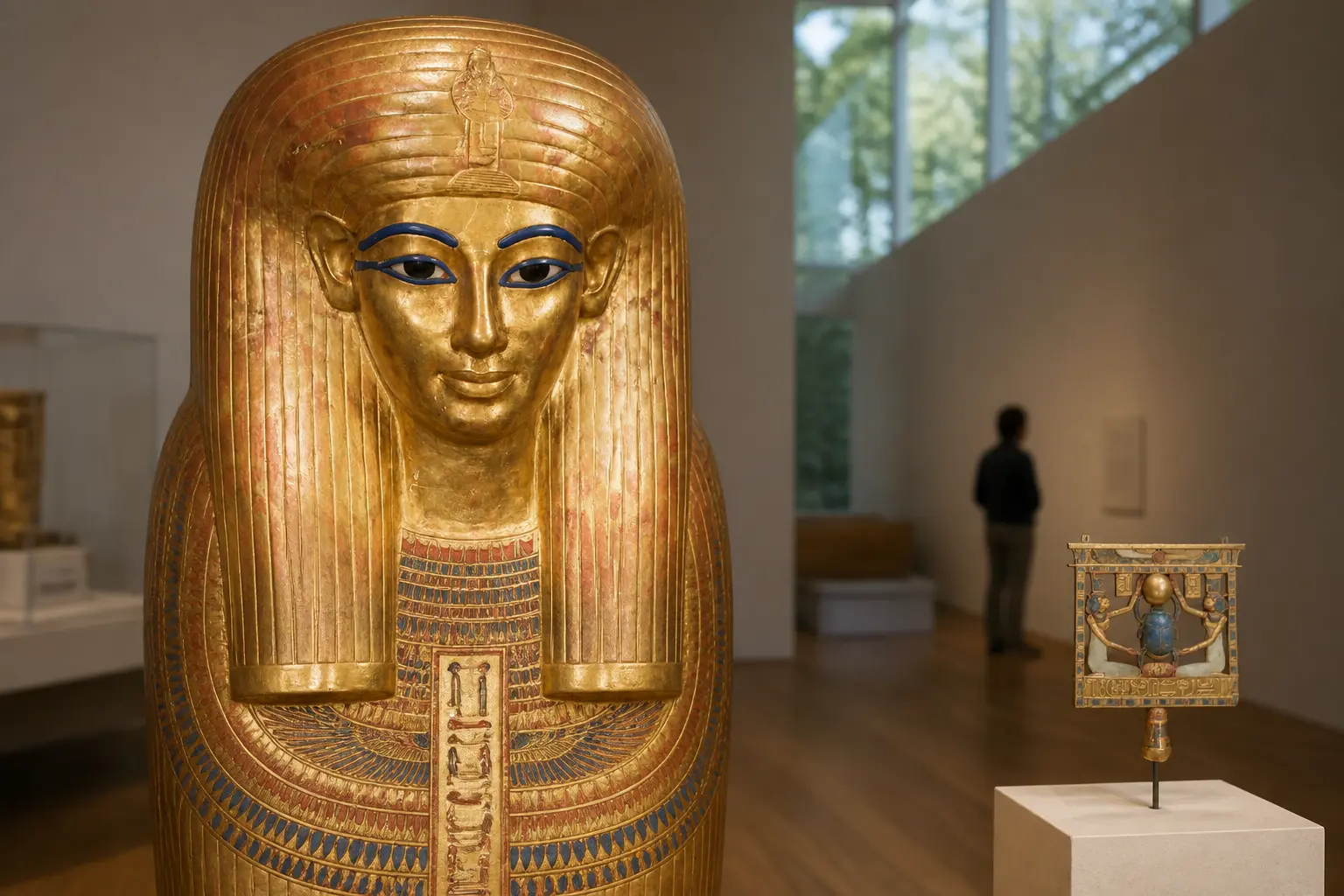
Gold That Still Stops Crowds
The opening galleries deliver the expected dazzle. Thuya’s outer anthropoid coffin lid, from the Valley of the Kings tomb KV 46 under Amenhotep III, stands 86 by 26½ by 37 inches. Wood covered in gilded stucco carries inlays of blue glass, obsidian eyes and red glass. It traveled from the Egyptian Museum in Cairo.
Nearby sit a gold-and-lapis pectoral of Amenemope, the armchair of Princess Sitamun, and treasures linked to Queen Ahhotep and the so-called Silver Pharaoh Psusennes I. His collar alone weighs 9.5 pounds and ranks as the heaviest known piece of ancient jewelry.
| Object | Period / Ruler | Key Material | Source Museum |
|---|---|---|---|
| Thuya outer coffin lid | Dynasty 18, Amenhotep III | Gilded stucco, glass, obsidian | Egyptian Museum, Cairo |
| Amenemope pectoral | Dynasty 21 | Gold, lapis lazuli | Egyptian Museum, Cairo |
| Sitamun armchair | Dynasty 18, Amenhotep III | Wood, gold leaf | Egyptian Museum, Cairo |
| Psusennes I collar | Dynasty 21, Tanis | Gold, lapis, carnelian, jasper | Egyptian Museum, Cairo |
These pieces match the iconic works visitors fly to Cairo to see. Dreyfus called them masterpieces of Egyptian art. The prior Ramses the Great show at the same museum drew 312,114 visitors between 2022 and 2023, and timed tickets are again in force.
The materials themselves tell a second story. Gold leaf, lapis, carnelian, jasper, glass and obsidian appear again and again. The same workshops that served the palace also refined the techniques on view in the quieter rooms later. Spectacle and craft share a single supply chain.
Scale reinforces the point. An 86-inch coffin lid and a 9.5-pound collar do not arrive by accident. They require organized labor, specialized knowledge and a court willing to spend without limit. The opening galleries make that investment visible before the exhibition ever names the workers.
Everyday Life Frozen Like Pompeii
The Golden City section changes the temperature. Discovered in 2021 by Zahi Hawass near Luxor’s west bank, the settlement known in antiquity as the Dazzling Aten served as the industrial and administrative support hub for Amenhotep III’s palace at Malkata. It is the largest ancient city ever uncovered in Egypt.
Hawass’s team found three districts with serpentine walls still standing nearly ten feet high. Workshops produced faience jewelry, textiles and leather. Bakeries, grinding stones and meat-processing areas sat beside houses and offices. Sealings named the place THn Itn. When Akhenaten shifted the capital to Amarna and elevated the Aten, the city emptied almost overnight. Streets, jars and tools stayed where workers left them.
- Date range: ca. 1390-1352 BC, reign of Amenhotep III
- Scale: largest known workers’ city of its type
- Condition: suddenly abandoned, streets and workshops intact
- US debut: first North American display of its artifacts
On view are a baby rattle, a headrest, inscribed meat vessels, amulet molds and a stone mill. Dreyfus said the city shows everyday life in a way no royal tomb can. “This is unique. You never have exhibitions like this.”
Visitors on opening days echoed the shift. One noted how little the people differed from us and how sophisticated their solutions looked. Another lingered on the time spent perfecting hard materials. The gold dazzles. The rattle humanizes.
The sudden abandonment is what preserves the evidence. Because the city emptied almost overnight, the layout of work and home remains legible. A visitor can stand before a mill or a mold and see the same division of labor that once supported the palace at Malkata. The objects are small. The implication is not.
Heritage Hits Home for Bay Area Egyptians
Anthony Khalil, a San Francisco resident of Egyptian descent, brought his family and called the hometown display significant. Seeing the crafts and timeless expressions shared with the world felt inspiring, he told local reporters.
California Lieutenant Governor Eleni Kounalakis previewed the show and met Hawass. She posted that the 130 rare artifacts document over 3,000 years and appear for the first time in North America right here in San Francisco.
It was an honor to meet world-renowned Egyptologist Dr. Zahi Hawass, who made many major archeological discoveries, such as the lost Golden City.
Kounalakis wrote that after the early look. The catalogue that accompanies the exhibition is by Hawass himself. For diaspora families the objects close a loop that usually requires a flight to Cairo, where the full Tutankhamun collection now in Cairo draws its own crowds at the Grand Egyptian Museum.
The local response therefore runs on two tracks at once. One track is civic pride that the premiere landed in San Francisco. The other is personal recognition that the crafts and expressions on view still feel familiar. Both tracks keep the exhibition from reading as pure tourism.
How the Show Reaches Beyond the Gold
The afterlife galleries close the circuit. Egyptians saw death as a new beginning, not an end. The heart still had to be weighed against the feather of heart weighed against the feather of ma’at. A heavy heart meant destruction by Amamet. Even the pharaoh faced the test.
Beer, thick and nutritious, served as daily food and currency. Hatshepsut ruled as king for two decades and had herself depicted with male attributes to claim the throne. These details sit beside the jewelry and remind visitors that the civilization ran on systems far wider than any single sarcophagus.
The same appetite for Egyptian culture shows up in contemporary Bay Area tables. Michael Mina’s Egyptian-Mediterranean dining experience in Santa Monica pulls the flavors forward, while the de Young keeps the original craftsmanship under glass.
Taken together, the later galleries refuse to let the story end with treasure. A society that treated beer as currency and required every heart to face the same judgment was never only about royal display. The exhibition keeps returning to that wider base.
Tickets Timed for a Long Run
The exhibition stays up until the end of January 2027 before moving to the Kimbell in Fort Worth. Hours run 9:30 a.m. to 5:15 p.m. Tuesday through Sunday. Timed entry manages crowds. General adult tickets sit near $20, with student and senior discounts and free admission for visitors 17 and under. Members receive limited complimentary tickets by level; additional ones cost $28 versus the $40 public rate for extras.
- Free audio tour via Bloomberg Connects app on personal phones
- Guided tours daily at 11:30 a.m.
- Late Night Editions party August 20, 6-10 p.m.
- Egyptian music concert September 26 at 1 p.m.
Anticipated demand mirrors the Ramses run. Visitors already call the craftsmanship a privilege to see in person. The gold will fill social feeds. The Golden City objects may change how those same visitors remember the pharaohs long after the tickets expire.
The long run also gives the quieter rooms time to work. A visitor who returns months later already knows the coffin lid. That second visit can linger on the rattle, the headrest and the mill. The schedule itself becomes part of the argument.
The City That Makes the Gold Matter
Without the Golden City material, the exhibition would still dazzle. With it, the dazzle acquires a cost and a workforce. The same reign that produced Thuya’s coffin and Sitamun’s armchair also required bakeries, leather shops and faience molds within walking distance of the palace.
The dates line up cleanly. Amenhotep III’s rule supplies both the royal objects and the settlement that supported them. When the capital later shifted, the support city emptied and left its evidence behind. The exhibition simply places the two halves in adjoining rooms.
- ca. 1390-1352 BC – Amenhotep III reigns; the Dazzling Aten functions as industrial hub
- 2021 – Hawass team uncovers the three districts and standing walls
- August 1 opening – first North American display of the city’s artifacts begins at the de Young
- January 31, 2027 – San Francisco run ends; the show moves to the Kimbell
That sequence turns a spectacular loan into a coherent narrative. Visitors leave knowing not only what the court looked like but who fed, clothed and provisioned it. The rattle and the collar finally share the same sentence.
What Remains After the Tickets Expire
The Ramses exhibition proved the appetite: 312,114 visitors in a single earlier run. Treasures of the Pharaohs arrives with the same timed-ticket discipline and a longer calendar. The difference lies in the balance of objects.
Royal gold still opens the show and will still dominate photographs. Yet the domestic pieces from the 2021 dig give the memory a second layer. A visitor can recall the weight of Psusennes I’s collar and, in the next breath, the shape of a child’s rattle. Both impressions travel home.
For Bay Area families with Egyptian roots the second layer carries extra force. The crafts on view no longer require a flight to Cairo to be seen at full scale. The loop closes in a local museum, under local light, for a run that lasts into 2027.
The show leaves San Francisco with a clearer map of who built the gold and how ordinary people lived beside it.
