
Egypt drew 19 million international visitors in 2025, a 21 percent jump from the prior year, while tourism revenues hit record territory near $16.7 billion in the fiscal period. The man overseeing the surge is Sherif Fathy (also rendered Fathi Attia), the aviation executive who became Minister of Tourism and Antiquities in July 2024.
His second-order move has been simple: treat hotels, pyramids, Red Sea resorts and new North Coast airports as one connected product instead of separate silos.
From EgyptAir Cockpit to the Tourism Desk
Fathy brought more than three decades of airline work when he took the oath. He chaired EgyptAir from August 2015, served as Minister of Civil Aviation in 2016, and earlier held senior posts at KLM in the Netherlands and Northwest Airlines in the United States. He also directed IATA’s Middle East and North Africa region and sat on airline alliance boards.
That résumé shows in the numbers. Charter traffic rose 32 percent in 2025 with flights from 193 cities. New direct EgyptAir routes to Chicago and Los Angeles expanded the U.S. gateways to five. Al Alamein International Airport on the North Coast logged a 57 percent passenger jump in the first part of 2026, hitting 266,600 travelers as more carriers added service.
The same network logic now shapes domestic itineraries. Travelers can land at a coastal airport, reach Giza or Luxor by improved roads, and finish on the Red Sea without the old multi-transfer friction. Fathy has repeatedly called the approach “unmatched diversity,” packaging heritage, beaches, medical tourism, eco-sites and events into single trips.
Record Arrivals and the Revenue Climb
Official tallies show the trajectory clearly.
| Year / Period | Arrivals (millions) | Change | Revenue notes |
|---|---|---|---|
| 2024 | 15.7-15.8 | +6% range | About $15.3 billion |
| 2025 full year | 19 | +21% | Fiscal 2024/25 near $16.7 billion; calendar figures cited near $18 billion |
| Q1 2026 | 5.6 | +15.6% to +43% vs prior-year Q1 variants | $5.1 billion, up roughly 34% from $3.8 billion |
| 2026 target | ~21 | +10.5% | On path to 30 million by 2028-2030 |
Fathy told interviewers the growth beat the global average of about 5 percent and reflected both safety perceptions and product quality. Currency devaluation after earlier shocks also made Egypt relatively affordable, amplifying demand once air seats returned.
Air Links Turn Scattered Sites Into One Trip
The practical change is itinerary design. A visitor can now combine the Giza plateau, Luxor temples and Aswan with Red Sea diving or North Coast beaches inside one ticket package. New Alamein and expanded coastal capacity make the northern summer season stretch into autumn.
- Charter growth of 32 percent and service from 193 cities feed both heritage and beach hotels.
- Electric buses and reorganized roads on the Giza plateau cut pollution and speed visitor movement.
- Green certifications for hotels and dive centers support longer stays and higher-spending eco segments.
- U.S. route expansion and last-minute booking patterns show demand holds even when advance planning dips.
- Private capital follows: multi-hotel Marriott deals across Ras El Hekma, West Cairo and Ain Sokhna signal confidence in the connected product.
That same logic underpins the Emirati tourism PPP investment model and the larger Ras El Hekma North Coast project progress, both of which rely on reliable air and road access to turn land into rooms.
Grand Egyptian Museum Opens After Years of Stops
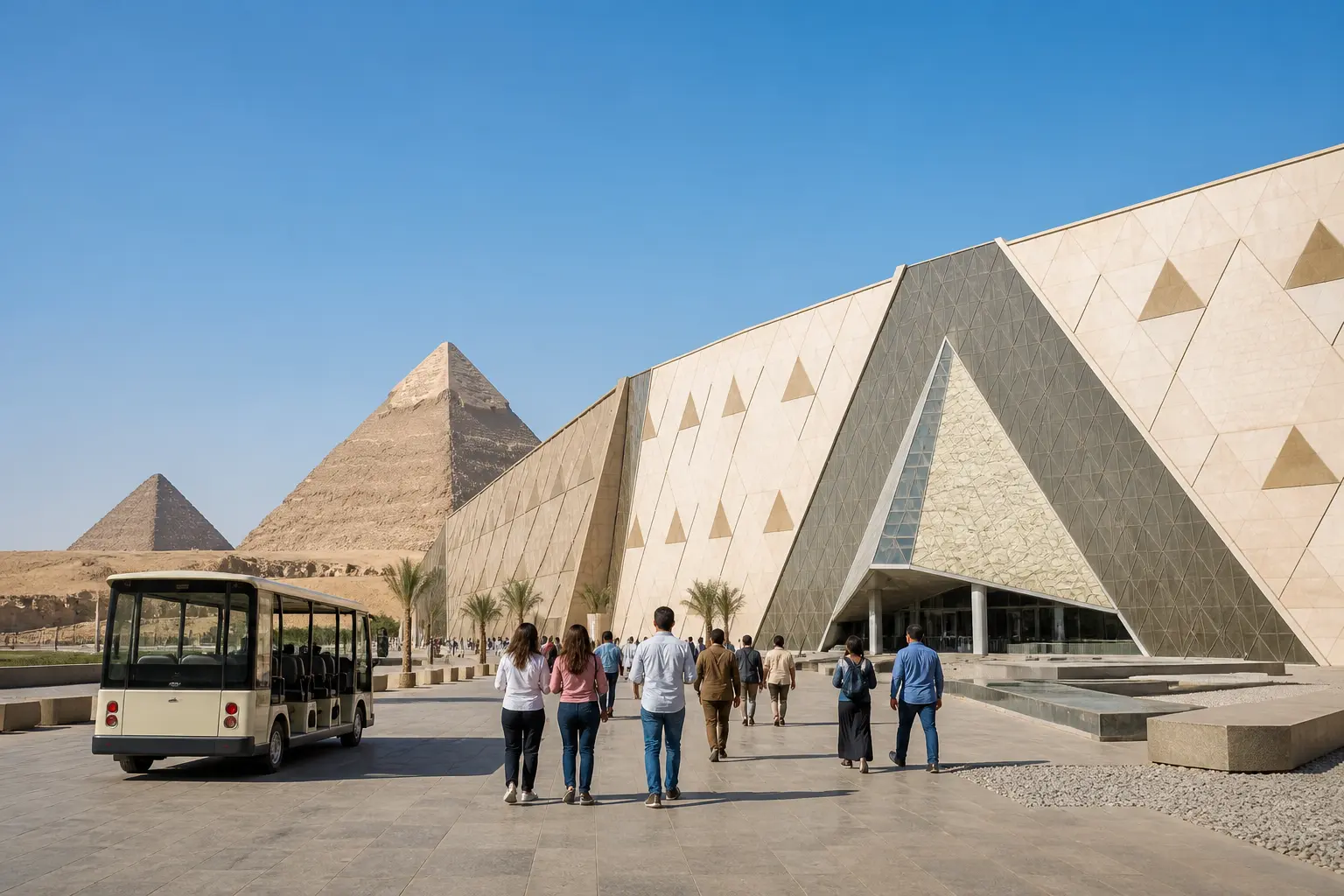
The largest single new draw is the Grand Egyptian Museum beside the Giza pyramids. After repeated delays tied to Covid, regional wars and economic pressure, VIP inauguration landed on 1 November 2025 with public access following days later. The complex houses tens of thousands of artifacts, the full Tutankhamun collection, and a working restoration center.
The Grand Egyptian Museum is an ambassador for the future of tourism to Egypt. We are uplifting most of our museums and archaeological sites for the future.
Fathy said that in a June 2026 TravelPulse interview. Pre-opening daily visitors sat at 5,000-6,000; officials projected a sharp rise once all galleries opened. Ticket prices for foreigners were later set to move from $30 to $35 in late 2026 while Egyptian rates rose modestly. The official Grand Egyptian Museum site now handles the full public experience.
Fathy has also pushed surrounding services: higher-end restaurants on the plateau, festival programming, and easier multi-site movement so guests linger longer and spend more.
Soft Power Travels and New Finds Keep Arriving
Outside the country, temporary exhibitions act as advance marketing. “Ramses and the Gold of the Pharaohs” has circulated major capitals with the coffin of Ramses II and Saqqara finds; “Treasures of the Pharaohs” stopped at San Francisco’s de Young Museum with more than 130 pieces alongside Zahi Hawass. Egyptian pavilions at FITUR Madrid and ITB Berlin keep tour-operator deals flowing.
At home, joint missions continue to clear tombs, embalming workshops and jewelry caches from Saqqara to Luxor. Restoration work on Upper Egypt temples and historic Cairo mosques and churches reopens sites for visitors. The Ministry monuments and sites portal tracks many of these reopenings. Repatriation of looted pieces remains a standing priority.
French arrivals rose 31 percent in 2025 and another 20 percent into 2026, one data point showing European markets responding to the cultural push.
Fuel Costs and Regional Headwinds Still Bite
The picture is not friction-free. Higher jet-fuel prices and constrained supply raise ticket costs. Regional conflict creates safety headlines even when Egypt itself records no attacks and rebounds within two or three months after each shock. Some operators reported cancellation spikes while others saw only single-digit drops; last-minute booking has become the norm.
Key pressures and counters:
- Fuel and airlift: airline incentives and new long-haul seats offset some cost.
- Perception: official messaging stresses border security and separate evaluation from neighboring flashpoints.
- Capacity: hotel rooms and airport gates must keep pace with the 30-million ambition.
- Spending mix: value-for-money after devaluation still draws volume; luxury and experience segments are the next push.
Fathy has been blunt that economic pressure on travelers is now a larger near-term issue than security. The Egypt Tourism Authority destination guide and the Fathi Attia professional speaker profile both frame the same diversity-and-access message he repeats at industry events.
The Path Toward 30 Million
Targets remain ambitious: roughly 21 million in 2026 and 30 million annual foreign arrivals by the late 2020s. Success hinges on sustained air capacity, hotel stock, electronic visa rollout, and the ability to keep stitching new products into the same network. The aviation DNA Fathy brought to the job is already visible in the charter map, the coastal airport traffic and the multi-stop itineraries that convert one-time pyramid visitors into longer-stay guests. The numbers so far back the bet.
