
A Dutch archaeological mission from Leiden University has uncovered a 3,000-year-old tomb in the Sheikh Abd el-Qurna necropolis on Luxor’s West Bank, Egypt’s ministry of tourism and antiquities said on Sunday. Inscriptions inside the tomb identify its owner as a man named Paser, and based on the artistic style of the decoration, archaeologists date the monument to the Ramesside Period of the New Kingdom. The find is the latest tile in a year of stacked archaeological discoveries across the country.
Tourism revenues rose 56.1% to $16.7 billion in the fiscal year ending 30 June, the highest level in seven years per Central Bank of Egypt data cited by the Information and Decision Support Center. Nearly 19 million tourists visited in 2025, a 21% increase from 2024. Fitch Solutions expects arrivals to rise another 4.5% to 18.6 million in 2026 and revenue to climb toward $19 billion by 2029. The ministry has been pairing fresh finds with high-profile tomb reopenings, among them the Amenhotep III tomb in October 2025, to keep Egypt near the top of the region’s visitor circuit. Dr. Carina van den Hoven leads the team that uncovered Paser’s tomb, where her project has run since 2018.
A Tomb Surfaces at Sheikh Abd el-Qurna
The discovery was made by a team led by Dr. Carina van den Hoven of Leiden University during the mission’s current excavation season. The dig sits in the lower part of Sheikh Abd el-Qurna, the hillside necropolis that holds private tombs of officials, priests and administrators connected to the temples and royal institutions of Thebes. Van den Hoven has directed archaeological research at the site since 2018 in cooperation with Egypt’s Supreme Council of Antiquities. The work began with Theban Tomb 45 as its starting point and spread across a wider footprint in 2025.
Hisham El-Leithy, Secretary-General of the Supreme Council of Antiquities, said inscriptions inside the tomb identify its owner as a man named Paser. Based on the artistic style of the decoration, archaeologists believe the monument dates to the Ramesside Period, the final phase of the New Kingdom whose kings included Ramesses II and Ramesses III. Research at the site is ongoing, with specialists hoping to identify every individual buried within the tomb and reconstruct their biographies.
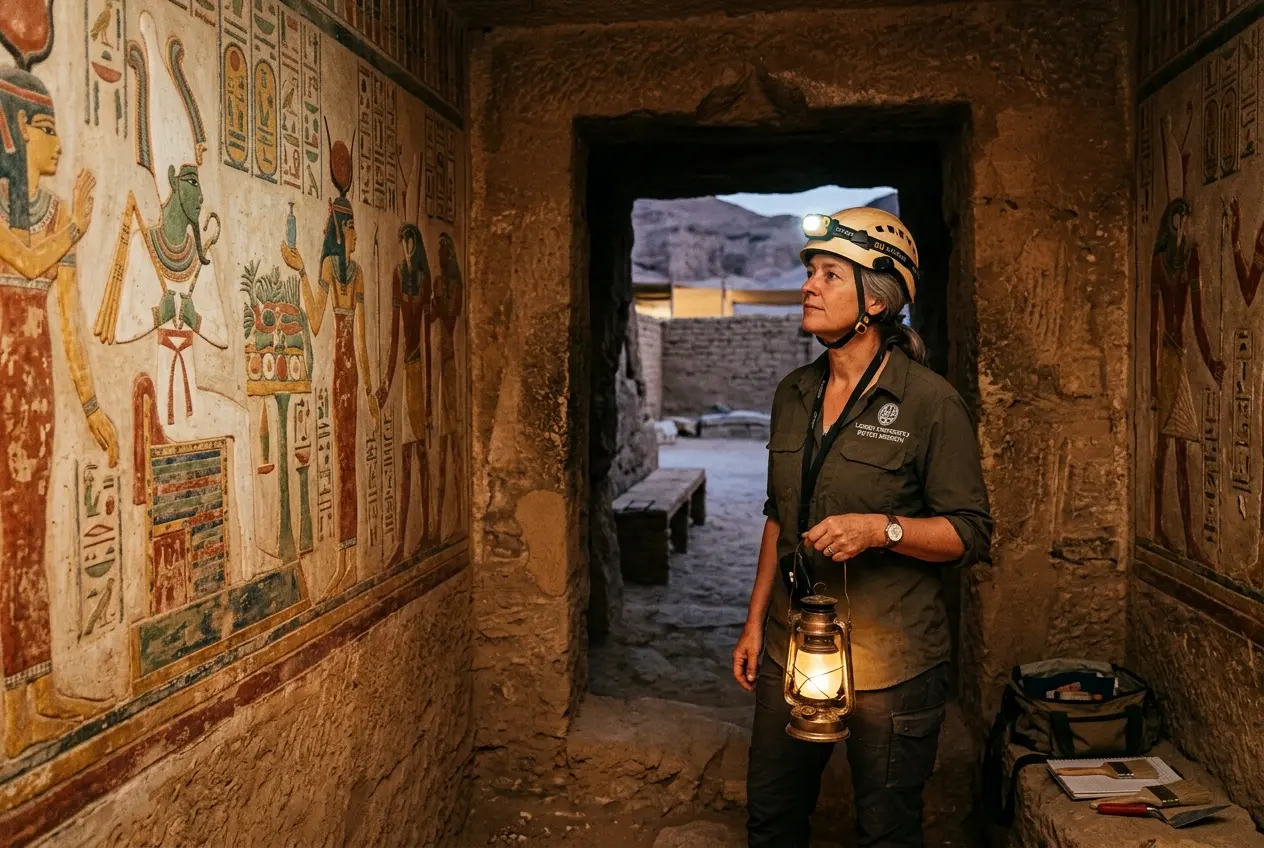
The Architecture Paser Left Behind
Architecturally, the monument follows the characteristic layout of private New Kingdom Theban tombs. According to Mohamed Abdel Badie, head of the Egyptian Antiquities Sector, it comprises an open forecourt leading to a rock-cut chapel with the traditional inverted T-shaped plan, beneath which lie underground burial chambers.
Several features survived in remarkably good condition. A mudbrick bench with a central niche sits in the courtyard, intended to hold a funerary stela. A staircase bordered by sloping ramps leads toward the tomb’s entrance. Builders cut the chapel directly into the hillside rock, the standard method for Theban private tombs of the era.
The decorated walls preserve scenes bearing the name of Paser. Portions of the painted decoration remain veiled beneath a thin layer of accumulated soil, but visible scenes depict the tomb owner worshipping various deities inside shrines and seated with his wife before an offering table. Specialists will work in coming seasons to lift the dust layer and document the full cycle of painted scenes.
The Lower Qurna Project’s Bigger Mandate
The Dutch mission working around the Paser tomb is a long-running research effort, with roots going back to 2018. Van den Hoven launched the project in 2018, according to the Dutch mission’s project documentation, with Theban Tomb 45 as its starting point.
Since 2025 the team has carried out fieldwork across a large area of Lower Sheikh Abd el-Qurna. That footprint includes Theban Tombs 45, 133, 136 and 137, plus five structures numbered -290, -528, -529, -530 and -531 whose identities are not yet fixed. The fieldwork is funded by the Gerda Henkel Stiftung, with add-on support from the Netherlands Institute for the Near East and the Leiden University Centre for Digital Humanities.
The research mandate is hybrid from the start, mixing excavation with preventive conservation. The lower Sheikh Abd el-Qurna tombs sit at the bottom of the mountain and already show clear evidence of past flash flooding, Leiden’s project page explains. Marl in the tomb structures means flooding threatens not only the fragile painted decoration but the stability of the tombs themselves. Climate change is expected to increase the frequency and intensity of those events, so the project pairs inside-tomb conservation with debris removal and drainage work outside.
The nearby TT45 was first decorated during the 18th Dynasty and reused in the Ramesside period, illustrating how burial spaces in the area could pick up new occupants and meanings over several centuries. The mission’s next phase will focus on structural stabilization, conservation and the restoration of the painted decoration at Paser’s tomb. Further finds are expected as the team moves into that stabilization season.
She expressed optimism that continued work at the site would lead to further discoveries and contribute to a more complete understanding of one of the Theban Necropolis’ most important burial areas.
The line comes from Carina van den Hoven, the mission’s director, in Egypt’s Supreme Council of Antiquities statement, and she framed the year ahead as a stabilization-and-restoration season. The same statement ties her optimism to the breadth of Lower Sheikh Abd el-Qurna, where the team expects new finds to keep accumulating.
- 2018: project launch year, with Theban Tomb 45 as the starting point.
- 9: Theban tombs and structures under active study since 2025 (TT45, TT133, TT136, TT137 plus -290, -528, -529, -530, -531).
- 1: lead funder, the Gerda Henkel Stiftung.
A Pattern of Discoveries Across Egypt
On the heels of a Greco-Roman cemetery reported at Tel Kom Aziza in the northern Beheira governorate, per the Beheira cemetery discovery in June 2026, the Paser find is part of a year of archaeological news flowing out of Egypt. That excavation uncovered varied burial styles, including painted plaster and barrel-shaped pottery coffins, simple burial pits cut directly into soil and mud-brick-lined tombs. Wild boar burials also surfaced at the site, a rare find given the animal’s association in ancient Egyptian belief with the deity Set. Older settlement layers beneath the cemetery carry the site back through the Old Kingdom, New Kingdom and Late Period, before its use as a Greco-Roman necropolis. Dr. Hisham El-Leithy of the Supreme Council of Antiquities led that work, joined by Mohamed Abdel-Badie, head of the Ancient Egyptian Antiquities Sector.
Closer to Luxor, a separate dig at the Dra Abu el-Naga necropolis announced in May uncovered 10 wooden coffins in good condition inside the southeastern part of the tomb of Roy, an 18th Dynasty royal scribe. Studies on the four 18th Dynasty coffins include one bearing the name of Merit, identified as a chantress of Amun, and a Ramesside-period second coffin bearing the name Padi-Amun, who served as a priest in the Temple of Amun. The remaining coffins come from the Late Period of Egypt, 664 to 332 BCE.
That work followed on the WV22 tomb reopening in October 2025, when Egypt unveiled the restored burial chamber of Amenhotep III in the Valley of the Kings after more than two decades of restoration led by a Japanese-supported team working alongside UNESCO. Khaled, head of the Supreme Council of Antiquities, called WV22 one of the most important tombs in the valley and pointed to two decades of delicate work rehabilitating walls, sealing cracks in columns, cleaning ceiling stars and reassembling more than 200 fragments of the red-granite sarcophagus lid. Reopens like WV22 sit alongside fresh finds like Paser’s to keep the country’s older circuit drawing visitors while newer sites come online.
- 13 July 2026: Paser tomb uncovered at Sheikh Abd el-Qurna, Luxor.
- 8 June 2026: Greco-Roman cemetery excavated at Tel Kom Aziza, Beheira.
- May 2026: 10 wooden coffins uncovered at Dra Abu el-Naga necropolis, Luxor.
- 5 October 2025: Amenhotep III tomb WV22 reopened, Valley of the Kings.
Tourism’s $16.7 Billion Bottom Line
Egypt’s ministry framed the Paser find as part of a yearlong drumbeat of archaeological news, with the decade-high tourism GDP report supplying the macro context. Tourism revenues rose 56.1% to $16.7 billion in the fiscal year ending 30 June, the highest level in seven years per Central Bank of Egypt data cited by IDSC; nearly 19 million tourists visited in 2025, a 21% increase from 2024.
The plan sets a target of attracting 30 million visitors a year by 2030. Fitch Solutions expects arrivals to rise 4.5% to 18.6 million in 2026 and revenue to climb toward $19 billion by 2029. The government is targeting a roughly 60% jump in tourism and antiquities investment to EGP 116.2 billion ($2.4 billion) in fiscal 2025/26. Archaeological discoveries themselves more than doubled in 2023 to 115 finds from 57 a year earlier. Key infrastructure projects include the Grand Egyptian Museum, the Giza Pyramids area redevelopment and the National Museum of Egyptian Civilization.
- 1,300 hotels operating nationwide at end of 2025.
- 17,000 registered tourist vehicles.
- 2,240 tourism companies nationwide.
- 179.3 million tourist nights, up 16.4% year over year (Central Bank via IDSC).
