
Argentina trailed Egypt 2-0 with 11 minutes of regulation time to play on Tuesday in Atlanta. Then they scored three times in 14 minutes. Lionel Messi curled in the equalizer, his record-extending 21st World Cup goal, and Enzo Fernandez headed in the winner in stoppage time to complete a 3-2 comeback. FIFA’s official match report lists the three Argentina goals as Romero in the 79th minute, Messi in the 84th, and Fernandez in the 90+2.
Egypt’s coach Hossam Hassan called the result ‘injustice’ and said he would not watch another match of the tournament. He blamed the officiating of French referee François Letexier, a disallowed Egypt goal, and a noon kickoff his team had objected to before the Atlanta last-16 tie.
How Argentina Clawed Back From 2-0 Down
Argentina looked out. Their bid to become the first team to win back-to-back World Cup titles since Brazil in 1958 and 1962 was slipping away in the Georgia heat, and the clock was running down. Then Cristian Romero rose to head in a corner in the 79th minute, and the stadium shifted. The Argentina bench, which had been silent for an hour, was on its feet.
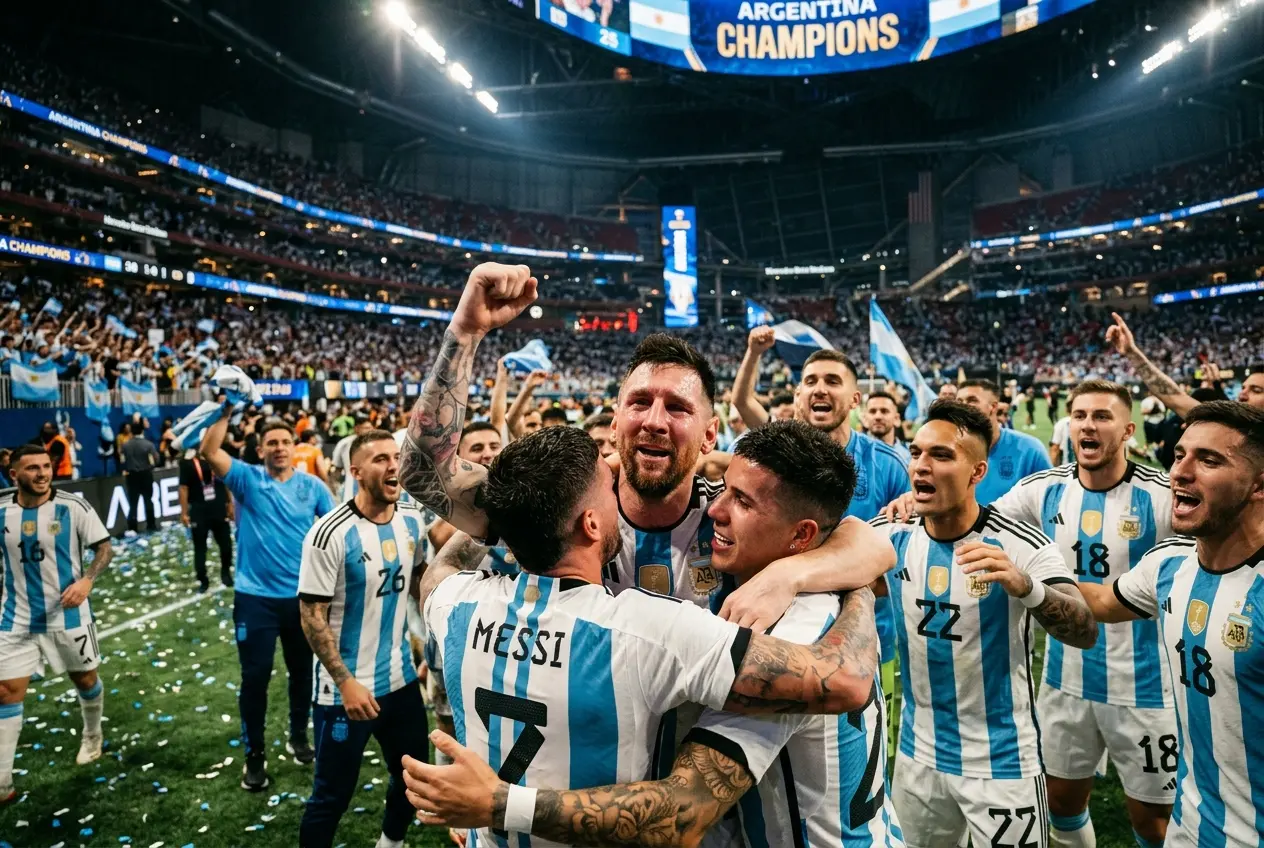
Messi equalized five minutes later, finishing off a move he had started with a run from deep, his eighth goal of the tournament. The shot curled past Mostafa Shobeir and into the net, and the Atlanta crowd erupted. Fernandez completed the turnaround in the 90+2 minute, rising to meet a cross and sending Argentina into the quarterfinals. His header was, according to FIFA, the 3,000th goal in World Cup history. The Argentina bench emptied at the final whistle.
Coach Lionel Scaloni could barely speak in his post-match remarks, pausing for long stretches. Messi was in tears on the pitch, surrounded by teammates who had refused to accept the game was over.
- 15th minute: Yasser Ibrahim heads Egypt in front from Marwan Attia’s cross.
- 21st minute: Messi’s penalty is saved by Mostafa Shobeir after Haissem Hassan fouls Nicolas Tagliafico.
- 67th minute: Mostafa Ziko finishes a counter-attack to make it 2-0 to Egypt.
- 79th minute: Cristian Romero heads Argentina back into the match.
- 84th minute: Messi curls in the equalizer, his record World Cup goal.
- 90+2 minute: Enzo Fernandez heads the winner.
I can’t look up, I’m sorry. I’m really emotional right now. What a group of players. That’s it, I’ve got to go.
Argentina coach Lionel Scaloni, speaking to FIFA after the match in Atlanta.
Egypt’s First-Hour Lead and Shobeir’s Wall
Egypt had arrived in the last 16 after beating Australia on penalties in the previous round, a first-ever World Cup knockout win for the Pharaohs, with Mohamed Salah’s Panenka sealing it. They started in Atlanta as if they belonged in the knockout stage, pressing high and winning the physical battles across the back line. Yasser Ibrahim got ahead of Lisandro Martinez to meet Marwan Attia’s cross and head Egypt in front in the 15th minute, silencing the pro-Argentina crowd. Argentina were given an immediate chance to level when Haissem Hassan tripped Nicolas Tagliafico in the box, but Messi saw his penalty saved by Mostafa Shobeir, who dived to his left to push the ball wide.
Messi hit the post later in the half, and Shobeir pulled off another save to stop Julian Alvarez from close range, keeping the Egypt lead intact. According to FIFA, Shobeir became only the fourth goalkeeper to save two penalties in games at a single World Cup, joining Jan Tomaszewski, Brad Friedel, and Wojciech Szczesny. Argentina went into the break a goal down, and the question was whether they could find a way back against a team that had already taken their best shot and survived.
The Records Messi Set on the Way to 2-2
Messi’s equalizer was his 21st World Cup goal, a record he now owns outright, with Miroslav Klose’s old mark of 16 left far behind. He also broke Diego Maradona’s record for most assists at the tournament, setting the mark at nine with a pass that set up the winner.
The goal extended Messi’s own record of scoring in consecutive World Cup matches to nine games, a streak no other player has matched since records began in 1966. He became the first player in World Cup history to score in six consecutive knockout-stage matches, four in 2022 and two in 2026. The goal was his eighth of this tournament, moving him past Kylian Mbappé and Erling Haaland in the Golden Boot race and tying Guillermo Stabile’s Argentina record from 1930. Messi also became the first man to fail to convert two penalties in a single World Cup, excluding shootouts, having missed against Austria in the group stage and again against Egypt.
Argentina’s comeback set its own records, too. It was the first time a reigning World Cup champion had come back to win from trailing by two or more goals, and the first World Cup knockout match won in regulation time after a two-goal deficit with 15 minutes left. The win extended Argentina’s unbeaten World Cup streak to 11 games, their longest ever, dating back to the 2022 tournament in Qatar.
The records fall in clusters around Messi, and the 3,000th World Cup goal, scored by Fernandez, landed in the same week. The context for both is a team chasing a back-to-back title that no champion has won since Brazil in 1958 and 1962, a run that ended 64 years ago. Scaloni’s side had already been pushed to extra time by Cape Verde in the previous round, and they were pushed again here. Argentina’s path through this tournament has been tight, with two of their last three matches going to extra time. They are, in Scaloni’s words, a group that does not know when it is beaten.
- 21: Messi’s World Cup goals, the all-time record
- 9: Consecutive World Cup matches with a goal (record)
- 6: Consecutive knockout-stage World Cup matches scoring (record)
- 3,000: World Cup goals scored before Fernandez’s winner
- 11: Argentina’s unbeaten World Cup streak
Egypt’s Coach Calls It ‘Injustice’
Egypt’s coach saw it differently. Hossam Hassan said his side had ‘suffered injustice’ and were ‘treated unfairly,’ and he pointed to French referee François Letexier, whose appointment his federation had objected to before the match, citing his ‘background.’ Hassan told reporters he would not watch any more matches of the tournament, a remarkable statement from a coach whose team had just taken the defending champions to the brink.
His first grievance was a video review that had ruled out a Mostafa Ziko goal in the first half, with VAR spotting a foul on Lisandro Martinez earlier in the move. Ziko’s second goal, in the 67th minute, stood, and Egypt looked destined for the quarterfinals. His second grievance was a shirt pull by Alexis Mac Allister on Hamdy Fathy in the build-up to Fernandez’s winner, which Hassan said was never checked by VAR. ‘A penalty was ruled out, was not even checked by VAR. A second goal was remarkably disallowed,’ Hassan said. ‘There has not even been a VAR check when we have all seen the image of the shirt being pulled back.’
Hassan speculated the officials had been put under pressure to keep the defending champions in the competition and Messi in the tournament. ‘Perhaps they wanted to keep the world champions in the competition. Perhaps they wanted Messi to stay in the running,’ he told BeIN Sports. ‘In football, there are sometimes external factors that go beyond the technical aspects.’
We have been treated unfairly today. We have suffered injustice.
Egypt coach Hossam Hassan, in his post-match news conference in Atlanta.
The Noon Kickoff and the Cards
Hassan also questioned the noon start time in Atlanta, four days after both teams had played 120 minutes in the previous round. ‘Whoever schedules those matches has never played football,’ he said. ‘You never schedule a game for 12pm. At noon you go for a walk or to eat brunch; you do not go to play football. When are the players supposed to eat? At 7:30am?’
The cards told their own story. Egypt finished with five yellow cards and a red card for a member of Hassan’s staff, while Argentina received none, a discrepancy Hassan also flagged. The drama peaked in the 90th minute, when Hassan was shown a yellow card for crossing his arms in front of Letexier, a gesture used to call out racial abuse. Letexier was from France, and Hassan said Egypt had objected to the appointment because of his ‘background.’ Egypt had been within minutes of the quarterfinals, the deepest run at a World Cup in the country’s history, and the sense of what might have been hung over the post-match news conference.
Argentina Meet Switzerland in Kansas City
The quarterfinal is set for Saturday in Kansas City, Missouri, against Switzerland, who booked their place by beating Colombia 4-3 on penalties after a goalless 120 minutes in Vancouver.
It is Switzerland’s first World Cup quarterfinal since 1954, a 72-year gap that is the longest in tournament history and a sign of how hard the road has been for a nation that has qualified for every World Cup since 1966 without ever quite clearing the last-eight hurdle in the modern era. Argentina will be favored, but Scaloni’s side has been taken to extra time in two of its last three matches, and Switzerland held them to a draw at the 2014 World Cup before losing in extra time. Messi has created nine chances against Switzerland in World Cup play, more than against any other opponent, per ESPN’s stats compilation.
Argentina’s bid to repeat as champions is still alive, and the records keep falling with each game Messi plays. The next test is a Swiss side that has waited 72 years for this stage and has nothing to lose. Scaloni, asked after the match what drove the comeback, said simply: ‘What a group of players, brother.’
