
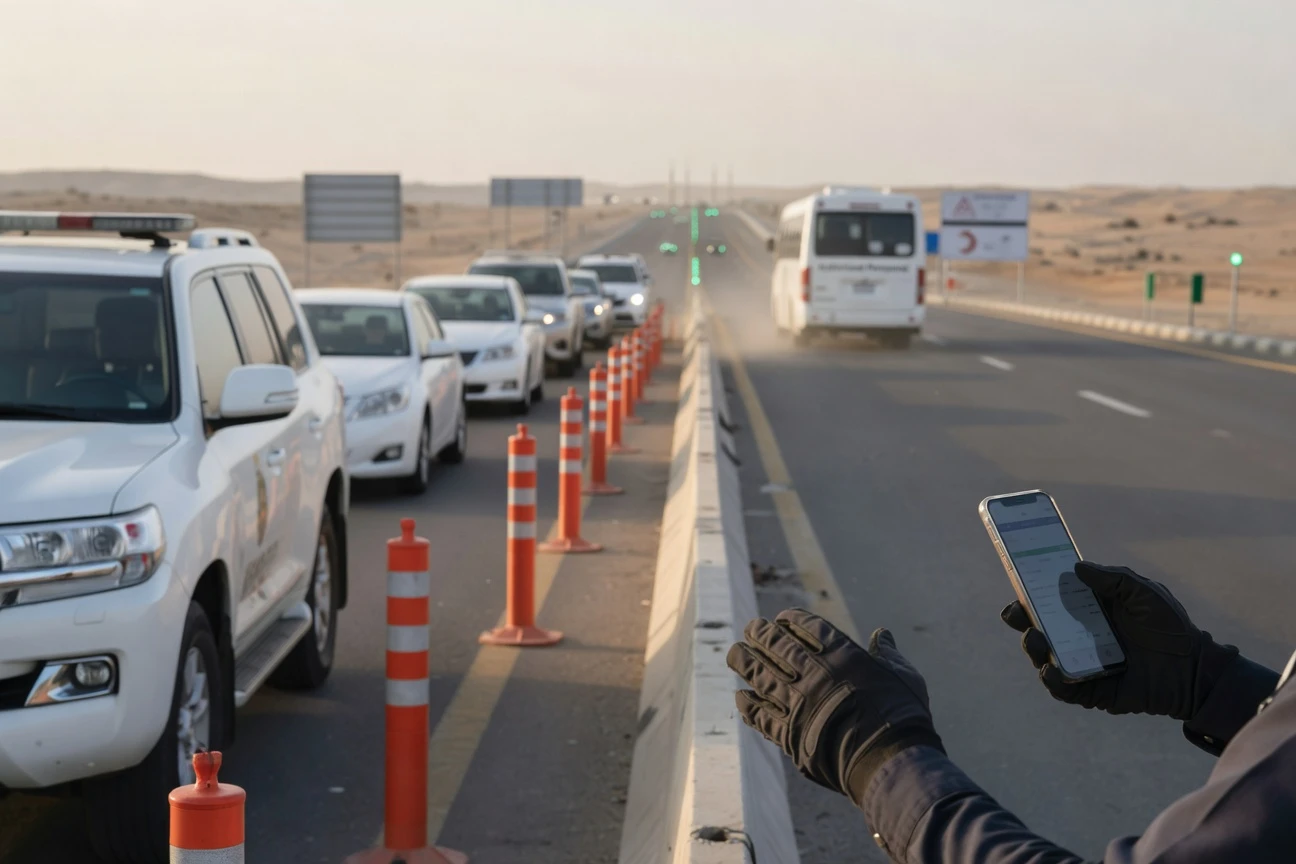
Saudi Arabia’s Hajj vehicle ban is now in force at the holy sites, barring unauthorized cars from Mina, Muzdalifah and Arafat through Dhu Al-Hijjah 13, which falls on May 30. The measure turns the road into a permit checkpoint, with security forces checking who can enter, who can drive and which vehicles can move during the most crowded days of the pilgrimage.
The timing matters. The cordon began as more than a million pilgrims were already moving toward Makkah, and it sits inside a wider campaign against fake Hajj services, forged permits and drivers carrying people without official authorization.
The Cordon Starts at the Road
The Hajj Security Forces for Traffic Affairs announced the restriction in an official vehicle restriction notice carried by the Saudi Press Agency (SPA, Saudi Arabia’s official state news agency). The rule covers the holy sites, the cluster of ritual areas where road space can become a safety issue in minutes.
For a pilgrim, that means the first question at the checkpoint is no longer simply where the vehicle is going. It is whether the driver, passengers and car match the permit records that Saudi authorities can verify. That is why May 30 is more than an end date. It is the outer boundary of the traffic cordon around the core rites.
- May 30 – the date corresponding to the end of Dhu Al-Hijjah 13, when the vehicle restriction is due to expire.
- SAR100,000 – the upper fine Saudi authorities say can apply to transporters and others involved in Hajj permit violations.
- 19 languages – the number supported by Tawakkalna for Hajj services, including permit display and related pilgrim tools.
That mix of roads, phones and fines is the point. Saudi Arabia is trying to remove unregistered movement before it reaches the bottlenecks where crowd control is hardest.
The Permit System Now Runs Through Apps
The roadblock only works if the permit system is readable in the field. In April, the Saudi Ministry of Interior, the agency responsible for domestic security, said residents wishing to enter Makkah must hold official permits, with exceptions for Makkah-issued residency documents, Hajj permits and work permits for the holy sites issued electronically through Absher Individuals and Muqeem, both integrated with Tasreeh, the unified digital permit platform, according to the Hajj entry arrangements announced by the Interior Ministry.
Tawakkalna, Saudi Arabia’s national services app, is now part of that front line. The Saudi Data and AI Authority (SDAIA, the government data and artificial intelligence body) says the app allows pilgrims, workers, Makkah residents, private-sector employees, domestic workers and vehicle permit holders to display Hajj season permissions. In practical terms, the phone screen becomes the credential.
| Permit Or Status | Who It Covers | Checkpoint Meaning |
|---|---|---|
| Hajj permit | Registered pilgrims | Allows the holder to perform Hajj and enter controlled areas when other conditions are met. |
| Makkah residency document | Residents whose permits are issued in Makkah | Creates an exception to the resident entry bar during the season. |
| Holy-sites work permit | Approved workers, service staff and volunteers | Lets essential staff reach work areas tied to pilgrim services. |
| Vehicle permit | Authorized transport, supervisors and service providers | Allows cleared vehicles through when ordinary cars are blocked. |
| Visit visa | Visitors without Hajj authorization | Does not authorize Hajj and can trigger penalties inside Makkah or the holy sites. |
The Tawakkalna Hajj permit service also matters for workers. A bus may be authorized, but the person in it still needs the right document. That creates two checks where there used to be one.
The Penalty Ladder Targets Drivers First
Saudi officials have put the sharpest financial threat on the people who move unauthorized pilgrims, not only on the pilgrims themselves. The Interior Ministry said in April that fines can reach Saudi riyals (SAR, the Kingdom’s currency) 100,000 for some facilitators, including people who transport visit visa holders to Makkah or the holy sites during the restricted period, under the Hajj permit violation penalties.
That changes the incentive for private drivers, informal operators and anyone tempted to sell a seat into the holy sites. The pilgrim risks a fine and removal. The transporter risks a business-ending penalty, prison, public naming and possible loss of the vehicle. In this system, the driver carries the heaviest risk.
- Transporters can face fines of up to SAR100,000, imprisonment and public naming if they carry people without valid Hajj permits.
- People attempting to perform Hajj without permits can face fines of up to SAR20,000.
- Expatriate violators can face deportation and a 10-year ban on re-entering Saudi Arabia after serving penalties.
- Authorities can seek court orders to confiscate vehicles used in transporting violators.
Recent enforcement has moved beyond warnings. On May 13, the ministry said Hajj security forces at Makkah entry points apprehended five expatriates and 14 Saudi citizens for transporting 29 people without permits. On May 19, it announced penalties against seven violators accused of transporting 13 pilgrims without authorization.
Fake Campaigns Turned the Crackdown Digital
The road cordon is also a response to a fraud market that now starts on social media. Fake ads promise accommodation, transport or entry documents to people who missed official channels or cannot afford licensed packages. By the time those buyers reach a checkpoint, the public safety problem has already been created.
Makkah security patrols have announced multiple arrests this month involving fake Hajj services. In one case, authorities said two Indonesian residents were detained after allegedly posting misleading ads and possessing fake Hajj wristbands and cards. In another, security patrols said forged Hajj cards and tools used in the fraud were seized, according to the fake Hajj service arrest notice.
The pattern matters because fraudulent campaigns sell more than a forged document. They sell a route around logistics that official Hajj planners need to control: where people sleep, when they move, what buses they board and whether medical teams know where they are. A fake wristband can look like a small crime until a heat emergency or crowd surge turns it into a missing-person problem.
That is why Saudi Public Security keeps pairing arrest notices with reporting numbers. The public is being asked to report violations through 911 in Makkah, Madinah, Riyadh and the Eastern Region, or 999 elsewhere in the Kingdom. The appeal is part law enforcement, part crowd management.
The Memory of a Deadly Season Shapes the Rules
The stricter permit push follows a painful recent record. The U.S. Centers for Disease Control and Prevention, a government public health agency, notes in its Saudi Arabia Hajj and Umrah travel guidance that more than 1,300 heat-related deaths were recorded during the 2024 Hajj. Saudi officials later said many of those outside formal permit channels had walked long distances without adequate shelter.
There is also the scale problem. The General Authority for Statistics (GASTAT, Saudi Arabia’s official statistics agency) said 1,673,230 pilgrims performed Hajj in 2025, including 1,506,576 from outside the Kingdom, based on Ministry of Interior records in the official Hajj pilgrim count. A system that large cannot treat unauthorized movement as a side issue.
Permits are often discussed as paperwork. During Hajj, they also map people to tents, buses, hospitals, food distribution and scheduled movement between ritual sites. Unregistered pilgrims often sit outside that map. They may still reach Makkah, but they do so without the services designed for the official flow.
The vehicle ban should be read in that light. Cars are not only cars during Hajj. They are moving clusters of people whose presence can either be counted, timed and served, or discovered when a checkpoint stops them.
Pilgrims Face a Narrower Path Into Makkah
For authorized pilgrims, the immediate effect should be less chaotic road movement inside the holy sites. Fewer private cars mean more space for licensed buses, emergency vehicles and service crews. The harder experience may fall on residents, workers and travelers who do not realize that a normal visa or a familiar route into Makkah is no longer enough.
Travelers following wider Saudi safety conditions have already been watching airport and route risks across the region; iAqaba has also tracked the Saudi transit safety question for Riyadh and Jeddah. Hajj adds a separate local rulebook. A flight into Jeddah or a legal stay in the Kingdom does not grant access to the holy sites.
The Supreme Court of Saudi Arabia confirmed that standing at Arafat falls on Tuesday, May 26, with Eid Al-Adha the following day, according to the Dhul-Hijjah calendar announcement. That places the vehicle cordon across the most sensitive ritual window, when pilgrims move from Mina to Arafat, then Muzdalifah and back.
If the checkpoints keep unauthorized cars out without slowing approved buses and emergency vehicles, the policy will look like traffic planning. If they catch forged permits and informal transport networks before peak movement, it will look like something more consequential: a test of whether Saudi Arabia can make the permit system visible on the road.
Frequently Asked Questions
When Does Saudi Arabia’s Hajj Vehicle Ban End?
Saudi authorities say the holy-sites vehicle restriction runs until the end of Dhu Al-Hijjah 13, which corresponds to May 30. The wider Makkah entry rules and Umrah permit suspension run to Dhu Al-Hijjah 14, or May 31, under Ministry of Interior arrangements.
Who Is Allowed to Enter the Holy Sites During the Ban?
Entry is limited to people and vehicles with valid permissions, including pilgrims with Hajj permits, Makkah residents with local residency documents, workers with authorized holy-sites permits and vehicles cleared for Hajj transport or service operations.
Can a Visit Visa Holder Perform Hajj?
No. Saudi Arabia says visit visas of any type do not authorize Hajj. Visit visa holders who enter or remain in Makkah or the holy sites during the restricted period can face fines and other penalties.
How Are Hajj Permits Checked?
Permits can be shown through Tawakkalna and are linked to Tasreeh. Security personnel can verify them at checkpoints and within the holy sites, including worker, resident, pilgrim and vehicle permits.
Which Emergency Number Reports Hajj Violations?
Saudi Public Security asks the public to call 911 in Makkah, Madinah, Riyadh and the Eastern Region, or 999 in other Saudi regions, to report Hajj regulation violations.
Disclaimer: This article is for informational purposes only and covers travel, security and legal-compliance risks during Hajj. Rules and penalties can change quickly, so pilgrims, residents and transport operators should consult official Saudi authorities or qualified advisers before acting. Figures and dates are accurate as of publication.
