
IMEC, the India-Middle East-Europe Economic Corridor, now has a harder job than cutting transit time between Mumbai and Mediterranean ports. After the Strait of Hormuz crisis exposed how much energy and freight still depend on narrow waters, the corridor has to become a wartime bypass system with several usable routes, not a single signature line.
The useful question for Europe is no longer whether the route can be revived after regional war. It is whether Brussels, Paris, Berlin and Rome can turn a peacetime connectivity plan into infrastructure that survives the gray zone between open war and open trade.
The Corridor Was Drawn for a Different Middle East
The original plan had a clean geometry. India would connect by sea to the Arabian Gulf, Gulf states would move goods onward by rail and road, and Europe would receive the traffic through Mediterranean ports after a northern leg that touched Jordan and Israel. The official IMEC memorandum of understanding named Saudi Arabia, the European Union, India, the United Arab Emirates, France, Germany, Italy and the United States as participants.
That document was deliberately light. It called for a railway, port links, electricity cables, digital connectivity and clean hydrogen pipes, but it also said the text was an initial political commitment. In plain English, IMEC was an architecture sketch, not a construction contract.
does not create rights or obligations under international law
The sentence sits in the memorandum for a reason. It gave leaders room to announce a grand corridor at the G20 in New Delhi without settling financing, border procedures, security guarantees or the political question that now sits at the center of the plan: how much of Gulf access to Europe should depend on Israel.
Cinzia Bianco, a visiting fellow at the European Council on Foreign Relations, and Arturo Varvelli, head of ECFR Rome and a senior policy fellow, argue in the ECFR corridor redesign paper that the Iran war has made that weakness visible. Their core point is blunt: a route conceived for normalization politics is now being tested by a region where infrastructure itself becomes a target.
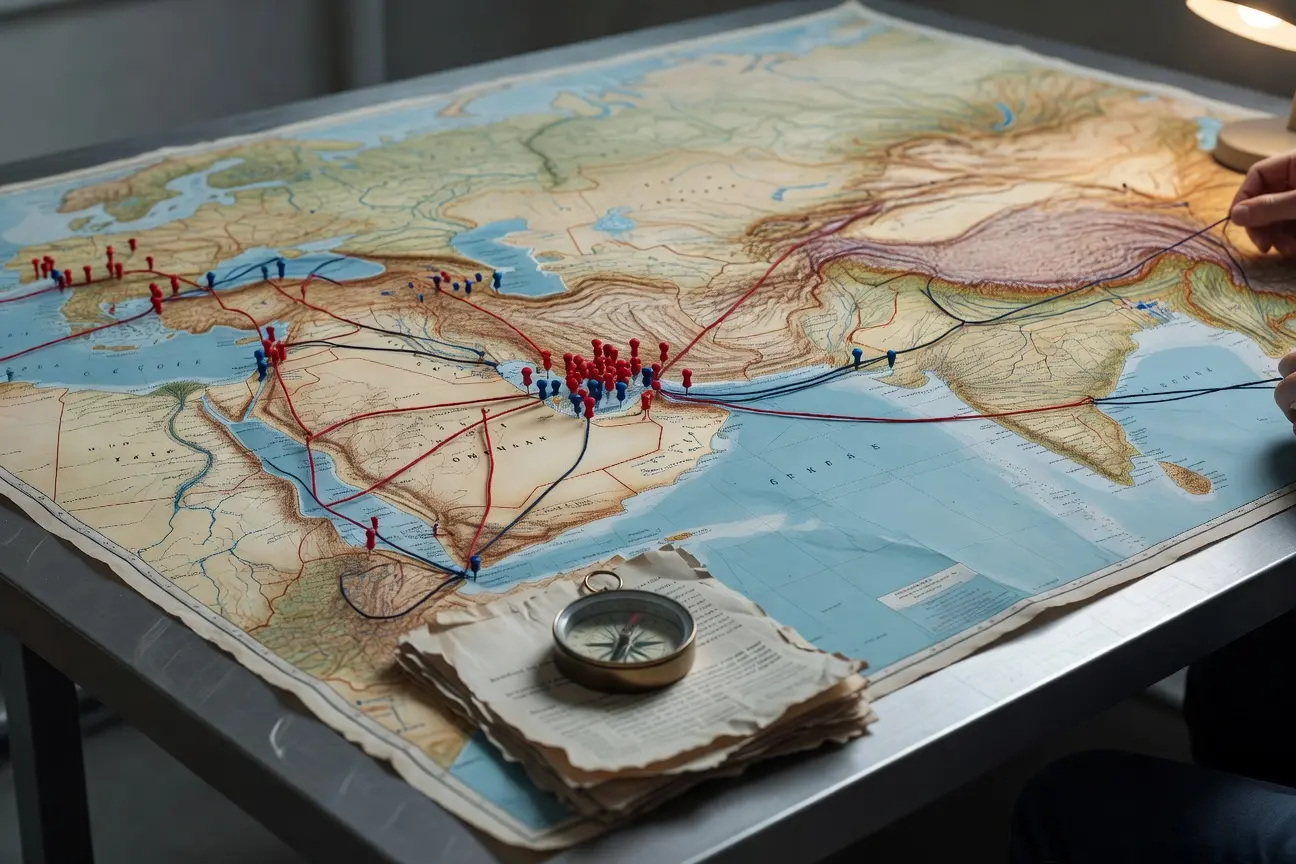
Hormuz Turned Redundancy Into the Main Product
The Strait of Hormuz is the number that changed the corridor debate. The International Energy Agency (IEA, the Paris-based energy security body) says nearly 20 million barrels per day of oil moved through the strait in 2025, about a quarter of seaborne oil trade. It also says Qatar and the UAE account for almost a fifth of global liquefied natural gas (LNG, gas chilled for shipment by tanker) exports that would be exposed by a closure.
- 20 million barrels per day of crude oil and oil products crossed Hormuz on average in 2025, according to the IEA.
- 3.5 to 5.5 million barrels per day of crude could potentially be redirected through Saudi and UAE bypass routes, leaving a large gap in a full disruption.
- 80 percent of oil passing through the strait is destined for Asia, which makes India a direct stakeholder rather than a bystander.
Europe imports a small direct share of crude from the strait, but that is the wrong comfort. A closure pushes up global energy prices, reroutes tankers, tightens insurance and forces Gulf exporters to choose which customers get scarce bypass capacity. The shock travels through prices before it travels through customs forms.
The US Energy Information Administration (EIA, the statistical arm of the US Energy Department) gives the practical bottleneck. Saudi Arabia has the East-West crude oil pipeline to Yanbu on the Red Sea, while the UAE has a line to Fujairah outside Hormuz. The EIA’s Hormuz chokepoint analysis estimated about 2.6 million barrels per day of available bypass capacity in those two systems during a disruption. That is useful insurance, but it is not enough to replace the strait.
The Old Map Has One Political Fuse
IMEC’s first map placed Israel in a role that looked commercially elegant before the Gaza war and strategically brittle after it. Haifa offered a Mediterranean exit. Jordan offered a land bridge. Saudi Arabia and the UAE offered Gulf scale. The problem is that every additional crisis in Gaza, Lebanon, Yemen or Iran raises the cost for Gulf rulers of appearing to route strategic trade through Israel.
| Route Element | Original Value | Stress Point | Redesign Lesson |
|---|---|---|---|
| Israel and Haifa | Mediterranean access for the northern leg | Political exposure for Gulf states during regional war | Keep as one option, not the only gate |
| Saudi Red Sea outlets | Oil and cargo access away from Hormuz | Still vulnerable to Bab al-Mandab risk near Yemen | Pair with inland and Arabian Sea alternatives |
| UAE to Fujairah | Direct Gulf of Oman access beyond Hormuz | Pipeline capacity is limited | Treat as emergency capacity, not a full substitute |
| Oman ports | Asian-side entry outside the strait | Less central in the first IMEC blueprint | Bring Salalah, Duqm and Sohar into route planning |
That is why the ECFR argument matters. Excluding Israel would probably break the politics with the United States, India and some European governments. Making Israel indispensable could break the politics with Saudi Arabia and other Arab partners. The middle course is redundancy by design.
Redundancy sounds dull until a strait closes. Then it becomes the product. A corridor with two ports, two rail legs and two political permissions is slower to draw on a summit poster, but it has a better chance of moving freight when missiles, mines or public anger shut one branch.
Saudi Arabia Is Already Building Around the Blueprint
Riyadh is not waiting for Europe to settle the question. NEOM, the Saudi development company chaired by Crown Prince Mohammed bin Salman, said in April that Port of NEOM, Pan Marine and DFDS had enabled a European multimodal land bridge moving truck-carried freight from Europe to Egypt and onward into the Gulf through northern Saudi Arabia.
The route is modest compared with the full IMEC vision, but it shows the new direction. Egypt, Safaga, NEOM and inland Gulf roads are becoming a live logistics chain while the larger diplomatic design remains unsettled. The Port of NEOM also says its Terminal 1 will build toward 1.5 million twenty-foot equivalent units (TEUs, the standard measure for container volume) of capacity, with a 900-meter quay wall and automated cranes.
- Egypt becomes a workaround because it gives Saudi Arabia a Mediterranean-facing partner without putting the whole route through Israel.
- NEOM becomes a logistics hinge because its Red Sea position can connect Gulf cargo with Egyptian ferry and trucking services.
- Oman becomes harder to ignore because Salalah, Duqm and Sohar sit outside the Strait of Hormuz and can serve Asian cargo flows.
- Qatar remains exposed at sea but has air cargo capacity and LNG scale that make it too important to leave outside crisis planning.
None of this replaces IMEC. It changes the negotiation. Europe is no longer designing on a blank page; it is joining a set of routes that Gulf states are already testing because the chokepoints have become expensive.
Bab al-Mandab Is the Warning on the Other Side
Hormuz is only half the problem. The Bab al-Mandab Strait, between Yemen and the Horn of Africa, links the Red Sea to the Arabian Sea and the Suez Canal system. Houthi attacks from Yemen turned that passage into a shipping risk from late 2023 onward, pushing carriers toward the Cape of Good Hope and away from the shortest Asia-Europe sea lane.
UN Trade and Development said Suez Canal transits had fallen to an average of 33 per day by mid-October 2024, 55 percent lower than a year earlier, while rerouting around Africa raised costs and emissions. The World Bank separately found that, by the end of March 2024, traffic through the Suez Canal and Bab al-Mandab had dropped by half, while navigation around the Cape of Good Hope doubled.
This is where a simple Hormuz bypass can mislead policymakers. Saudi Arabia’s Red Sea coast avoids the Persian Gulf, but it still points toward a corridor that can be squeezed near Yemen. If the new IMEC depends too heavily on Red Sea routes without a southern Arabian option, it swaps one narrow waterway for another.
Hadramawt, in eastern Yemen, is one of the harder ideas in the ECFR paper for that reason. A Saudi-to-Arabian Sea corridor through Yemen would require local bargains among rival factions and serious outside money. It would also give Europe a way to support a route that bypasses both Hormuz and Bab al-Mandab. That is not a near-term fix. It is the kind of unattractive, politically heavy option that starts to look rational when the clean maps fail.
Europe’s Redundancy Test
Europe’s role should be to finance boring resilience. That means feasibility studies, customs digitization, port upgrades, insurance frameworks, crisis hotlines and rules that let cargo switch routes quickly when one branch is unsafe. It also means resisting the temptation to sell IMEC as an anti-Iran bloc. Corridors that look like military alignments invite attacks; corridors that include more stakeholders raise the cost of disruption.
The European Commission has already kept the digital side alive. In 2025, it said the EU-Africa-India Digital Corridor, centered on the Blue Raman submarine cable system, would deliver 11,700 kilometers of subsea connectivity linking Europe, East Africa, the Middle East and India. That project matters because data cables face the same core problem as ports and pipelines: a route with no backup is a hostage.
The next version of IMEC should therefore look less like a line and more like a switchboard. Haifa can be one plug. Egypt can be another. NEOM, Fujairah, Salalah, Duqm, Sohar, Qatar and Jordan all deserve defined roles. Syria and Iraq may become future branches if their politics allow it. No single node should be able to stop the system.
If European leaders redesign IMEC around redundancy, the corridor may survive the region it must cross. If they try to revive the original map with new language and no backup routes, the next crisis will redraw it for them.
