
Egypt Cypriot gas exports moved a step closer this week after QatarEnergy, Qatar’s state energy company, ExxonMobil, the US oil and gas major, and Egypt signed a Memorandum of Understanding (MoU, a framework for negotiations) to study moving offshore Cyprus discoveries through Egyptian liquefied natural gas plants to buyers in Europe. The deal gives Cyprus a route to market, while putting Cairo at the choke point between East Mediterranean reserves and European cargoes.
The agreement is early stage. No final investment decision has been taken, and the gas will not move until pipeline, fiscal and sales contracts are finished. But the shape is now clear: Cyprus owns the discoveries, international majors own the development risk, and Egypt owns the gatekeeper asset.
The MoU Turns Egypt Into the Midstream Gate
QatarEnergy said in the QatarEnergy MoU announcement that the three parties will study the potential development and commercialization of gas discoveries in Cyprus through Egypt’s existing gas and liquefied natural gas (LNG, gas chilled into liquid form for ship transport) export infrastructure. That phrasing matters. This is not a shipping contract yet. It is a study of whether upstream gas, subsea pipeline capacity, Egyptian processing and European demand can be made to fit one commercial model.
Mostafa Madbouly, Egypt’s prime minister, witnessed the signing ceremony in the New Administrative Capital, according to the Egyptian government signing notice. The same notice said the arrangement is meant to link Cypriot discoveries with Egypt’s gas infrastructure, including liquefaction and re-export complexes, and to turn those resources into economic value for Egypt and the field partners.
That is the second-order story. Europe sees another non-Russian supply option. Cyprus sees its first plausible export lane. Egypt sees fee income, domestic supply optionality and a way to make old coastal plants matter again.
- 7 Tcf – the approximate combined size Cyprus officials cited for Glaucus and Pegasus in Block 10, with Tcf meaning trillion cubic feet.
- 700 MMscf/d – the daily contract quantity in the main Aphrodite supply period, with MMscf/d meaning million standard cubic feet per day.
- 12.0 MTPA – Egypt’s combined named LNG capacity at Idku and Damietta, with MTPA meaning million tonnes per annum.
The Route Solves Cyprus’s Infrastructure Problem
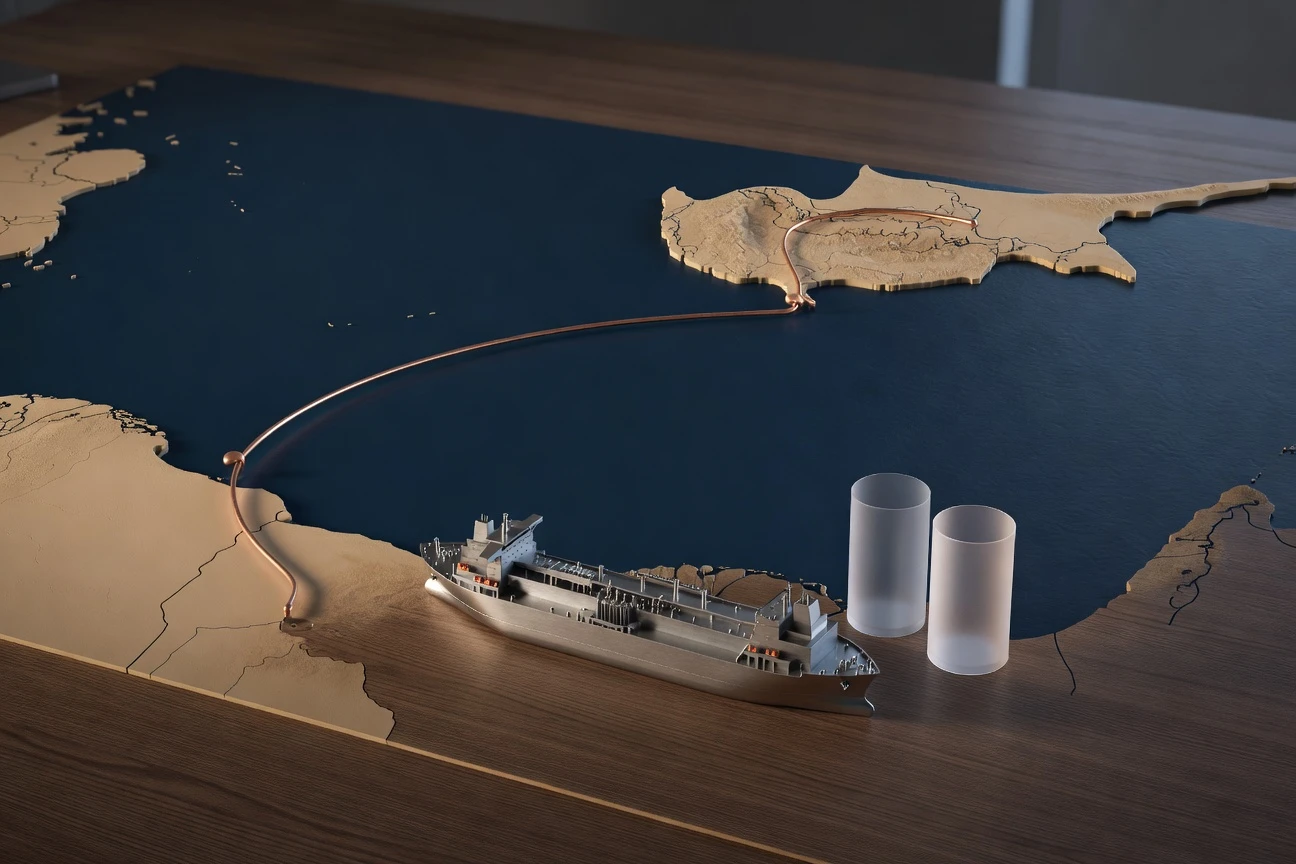
Cyprus has gas in the ground and no liquefaction plant onshore. That has been the island’s basic problem since the Aphrodite discovery in Block 12 in 2011. A domestic LNG plant would require scale, money and time. A direct line to Europe would carry heavy offshore engineering risk. Egypt already has the coastal kit.
The US Energy Information Administration says Egypt is the only country in the Eastern Mediterranean with operational LNG export capacity and notes that Cyprus is planning to use Egyptian LNG infrastructure through a subsea pipeline to Egyptian processing and liquefaction facilities. It also says the proposed EastMed pipeline to Europe has stalled, even though studies continue. That makes the Egyptian option the practical route to market, not simply the nearest one.
| Export Route | Advantage | Open Problem |
|---|---|---|
| Cyprus to Egypt LNG | Uses existing Idku and Damietta infrastructure and can serve either domestic Egyptian demand or cargo markets. | Needs pipeline agreements, fiscal approval, firm gas sales terms and a final investment decision. |
| EastMed Pipeline | Would give a direct political link from Cyprus and Israel toward Greece and Europe. | High cost, deep-water engineering and a long schedule have kept it from becoming the lead option. |
| Cyprus LNG or Floating LNG | Would give Cyprus more direct control over exports. | Requires large capital spending and enough feed gas to justify dedicated liquefaction. |
NewMed Energy, the Israeli gas producer that owns 30% of Aphrodite, has already shown how the Egyptian route can be written into contracts. Its April term sheet covers all recoverable Aphrodite gas, a 15-year supply period, and one possible 5-year extension. That commercial model now sits beside the QatarEnergy and ExxonMobil track in Block 10.
QatarEnergy Brings a Second Set of Incentives
QatarEnergy’s role is easy to misread. The company is already one of the world’s dominant LNG suppliers, so a few Cypriot cargoes would not change its global position. The strategic value sits elsewhere: it is a partner with ExxonMobil in Cyprus, a partner with ExxonMobil in other gas ventures, and a company with long experience selling molecules into different markets under long contracts.
Block 10 gives it a specific reason to care. ExxonMobil found Glaucus there in 2019, Pegasus followed in 2025, and Cyprus officials said the partners made a declaration of commerciality for both fields on March 30, 2026. Commerciality does not put gas on a tanker. It says the discoveries have moved from attractive geology to a project that can be developed if buyers, infrastructure and capital line up.
For QatarEnergy, that creates optionality. It can help shape the export path before the largest checks are written. It can deepen its working relationship with Egypt, where the state wants outside capital and regional gas flows. And it can keep ExxonMobil’s Cyprus gas from being stranded by the same export politics that slowed other East Mediterranean plans.
The benefits are not one-way. Egypt gets a marquee state energy company in the discussion. ExxonMobil gets a partner with LNG marketing depth. Cyprus gets more than one corporate sponsor pushing for a route south.
Europe Gets Diversification, Not a Rescue Plan
The European part of the story is important, but scale should cool the rhetoric. The European Commission says Russian pipeline gas imported to the EU fell from 137 billion cubic meters (bcm, a common annual gas volume unit) in 2021 to 18 bcm in 2025, while Russia’s pipeline share of EU gas imports fell from 41% to about 6%. Against that gap, Cypriot gas is useful. It is not a swing supply source for the continent.
That still leaves room for value. Europe no longer needs one giant replacement for Russian pipeline gas. It needs overlapping suppliers, flexible LNG cargoes, storage discipline and lower demand. Egyptian LNG made from Cypriot feed gas would add one more Atlantic Basin source with a shorter voyage to Mediterranean terminals than US Gulf Coast cargoes.
The politics also work better than the old direct-pipeline dream. LNG cargoes do not require a single route through every maritime dispute in the basin. They require liquefaction capacity, shipping availability and buyers willing to sign terms. That is why Cairo’s existing plants matter more than a map line drawn from Cyprus toward Greece.
Price will decide how much of the gas goes to Europe instead of Egypt’s own market. If Egyptian demand is tight, Cairo may prefer to keep molecules at home or use them for petrochemicals and fertilizer. If domestic supply improves, re-export becomes easier. The same infrastructure can serve both choices, which is exactly why Egypt wants to sit in the middle.
Bottlenecks Sit in Cairo and Port Said
Plant capacity is the easy number. The Gas Exporting Countries Forum lists Idku at 7.2 MTPA and Damietta at 4.8 MTPA in the GECF liquefaction plant table. Available capacity is harder. Egypt’s domestic gas balance has tightened in recent years, and gas that enters the country can be pulled toward power plants and industry before it becomes an export cargo.
That tension gives Cairo bargaining power. It can market the same infrastructure to Cyprus as an export route, to Europe as diversification, and to domestic users as energy security. The commercial risk remains local because Egypt must balance those demands while keeping foreign partners confident that cargoes will move when contracts say they should.
The NewMed Aphrodite filing points to Port Said as the final delivery point, with the offshore handover at the Cyprus-Egypt maritime border. That geography turns the project into a midstream negotiation as much as an upstream one.
- Government authorizations still have to be completed by Egypt and Cyprus for signed project documents.
- Binding gas sales contracts must replace preliminary term sheets.
- Pipeline laying, operation and connection agreements need to be finished.
- Aphrodite Midstream Company has to be formed and financed for the transmission project.
- Egypt’s parliament must approve fiscal terms if the final package follows the NewMed structure.
Each item is ordinary for a cross-border gas project. Together, they explain why a headline deal can be meaningful and still leave years of execution risk.
First Gas Still Depends on the Final Investment Decision
The most important date is not the signing ceremony. It is the final investment decision (FID, the point at which partners commit capital to build). In NewMed’s Aphrodite transmission filing, the Host Government Agreement (HGA, a state-level framework for pipeline rights and obligations) gives the parties 12 months to negotiate additional agreements, then requires an FID within another 12 months after those agreements are signed. It also refers to a Fiscal Regime Agreement (FRA, the tax and fiscal package for the transmission project) needing Egyptian parliamentary approval within 6 months of the HGA signing.
That structure is a useful warning for the QatarEnergy and ExxonMobil track. Commercial discovery is not enough. A route through Egypt needs laws, tariffs, construction responsibility, buyer commitments and a gas price formula that survives Brent moves, LNG market cycles and regional security shocks.
Cyprus President Nikos Christodoulides has presented first Cypriot gas sales to Europe through Egypt as a target for the end of the decade, and Cypriot officials have treated recent approvals as a shift from exploration toward exploitation. The target is plausible only if paperwork and engineering move in parallel rather than one after the other.
If Cairo keeps domestic demand, fiscal approvals and pipeline work aligned, Cyprus gets its first export path and Egypt gets paid for the route. If one of those pieces slips, the MoU remains a signed map without gas moving through it.
