
Jordan’s Al Aqsa warning on May 22, 2026 put a familiar Jerusalem flashpoint back in a sharper frame: who controls the 144-dunam compound, who regulates entry, and whether ritual acts by Israeli extremists are starting to turn a contested access issue into a direct challenge to the site’s status quo.
The Foreign Ministry’s latest condemnation followed what it called an attempt to bring sacrificial offerings into one of the courtyards. That detail matters. For Amman, the danger is cumulative: repeated incursions, holiday timing, and acts that look less like visits than claims of authority.
The Friday Incident Hit the Custodianship Nerve
Amman did not treat Friday’s incident as a single provocation. In the May 22 Petra statement on the incursions, the Ministry of Foreign and Expatriates Affairs said extremists had attempted to desecrate the holy site by bringing sacrificial offerings into a courtyard of Al Aqsa Mosque/Al Haram Al Sharif.
Ambassador Fu’ad Al-Majali, Foreign Ministry spokesperson, said the acts formed part of repeated attempts to impose new realities at the compound. His phrasing was familiar, but the timing gave it force. The incident came on a Friday, the central weekly day of Muslim prayer, and during Shavuot, a Jewish holiday tied in religious tradition to offerings and harvest rituals.
- May 22, 2026 – Jordan issued its latest condemnation after the offering attempt.
- 144 dunams – the full area Jordan says is reserved exclusively for Muslim worship.
- Article 9 – the treaty clause that records Israel’s respect for Jordan’s special role in Muslim holy shrines in Jerusalem.
The charge from Jordan was direct. Officials described the incident as an infringement on the sanctity of the site and a violation of international law. In Amman’s reading, the issue is not crowd control at a sensitive place. The issue is who gets to define permissible conduct inside the compound.
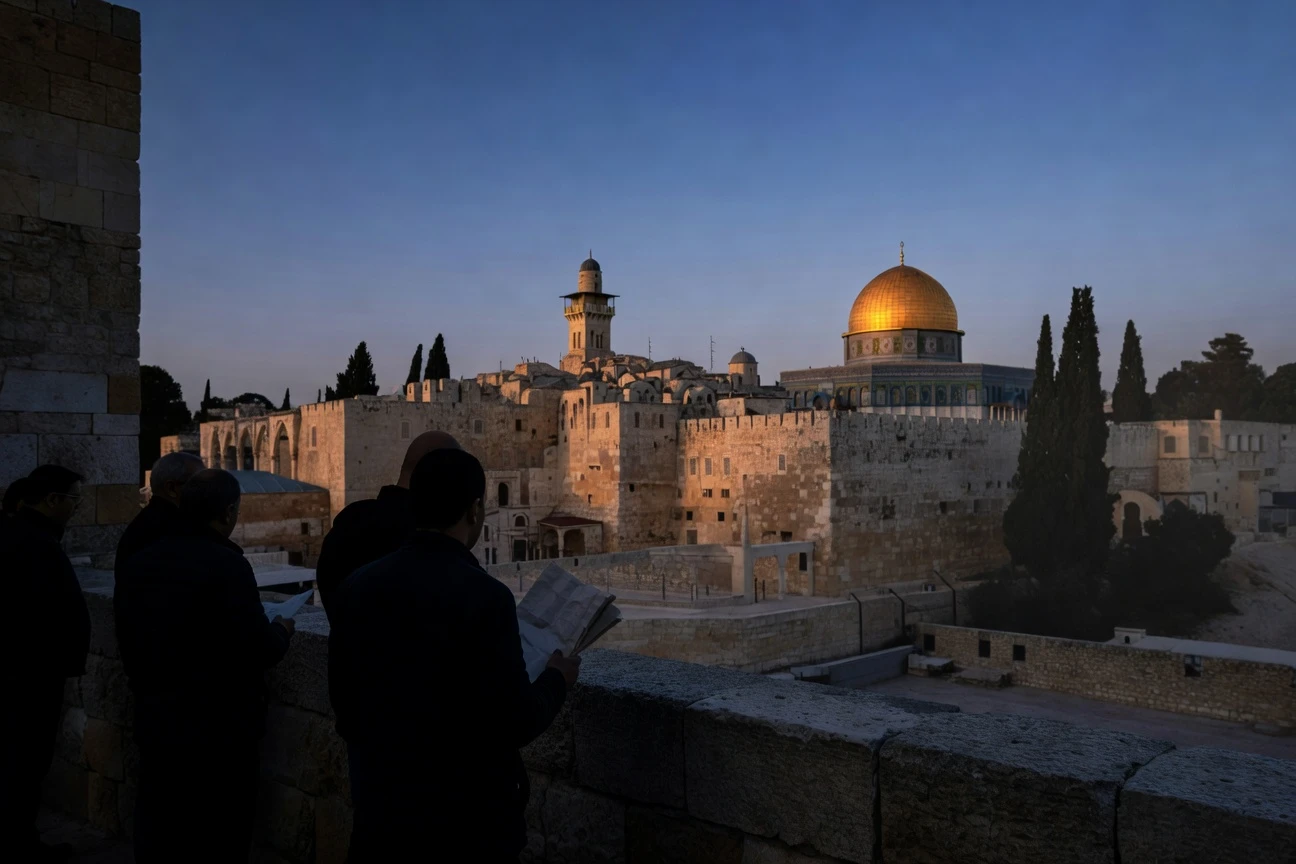
Why Friday Changed the Risk
The compound carries different names and meanings. Muslims refer to it as Al Aqsa Mosque or Al Haram Al Sharif. Jews know the same elevated platform as the Temple Mount. Those names are not cosmetic. They carry competing histories, legal claims and religious expectations into a small walled space in occupied East Jerusalem.
Under the traditional arrangement invoked by Jordan and many international actors, Muslims pray at the compound while non-Muslims may visit under restrictions. The most sensitive line concerns prayer and ritual by non-Muslims. Once a visit includes offerings, flags, organized prayer or religious garments, Jordan reads it as a move from access into worship.
Israel has no sovereignty over Al-Aqsa Mosque / Al-Haram Al-Sharif.
That sentence came from the Jordanian ministry’s statement. It is the spine of Amman’s case. Jordan links sovereignty, custodianship and entry control, while Israel has long maintained that it is responsible for security in Jerusalem. The gap between those positions widens whenever activists test the edges of what Israeli police allow at the gates.
Israel’s formal public line has been different from the activist demand. In an Israeli Foreign Ministry briefing on the Temple Mount status quo, then Foreign Minister Yair Lapid said Israel was committed to a formula in which Muslims pray and non-Muslims visit. Jordan’s objection is that repeated practice on the ground is making that line harder to believe.
The Status Quo Has Competing Owners
The phrase status quo sounds settled. In Jerusalem, it often means the opposite. Each side uses it to defend a different boundary. Jordan emphasizes religious administration and exclusive Muslim worship. Israel emphasizes security control and access. Activist groups seek to expand Jewish prayer and ritual at the site.
| Actor | Core Claim | Control Point | Main Risk |
|---|---|---|---|
| Jordan | The whole compound is an exclusive Muslim place of worship. | Jerusalem Awqaf Department regulates affairs and entry. | Ritual acts create a precedent for temporal or spatial division. |
| Israel | Security authority remains with Israeli police while the stated status quo is preserved. | Gate access, policing and public order decisions. | Police tolerance of ritual acts blurs the official line. |
| Temple activist groups | Jewish prayer and ritual should be allowed on the mount. | Holiday visits, public pressure and symbolic acts. | Small actions can trigger regional escalation. |
This is why the offering attempt drew a stronger reaction than another routine condemnation might suggest. A ritual object inside the courtyard is a claim in physical form. It does not need legislation to change expectations. It only needs repetition, police tolerance and a holiday calendar.
Jordan’s Leverage Is Legal More Than Military
Jordan’s power at the site rests on custodianship, treaty language and diplomatic recognition. The Hashemite role is presented by Amman as a historical duty that began with Sharif Hussein bin Ali in 1924 and was reinforced by later agreements. The Jordanian Department of Palestinian Affairs says the Hashemite custodianship agreement with Palestine signed on March 31, 2013 affirmed King Abdullah II’s role in protecting Jerusalem’s Islamic and Christian holy sites.
The Israel-Jordan peace treaty gives that role a bilateral anchor. In Article 9 of the Israel-Jordan peace treaty, Israel said it respects the present special role of the Hashemite Kingdom of Jordan in Muslim holy shrines in Jerusalem and would give high priority to Jordan’s historic role in permanent status negotiations.
That language does not give Jordan a police force inside Jerusalem. It gives Amman a recognized legal and diplomatic platform. When Jordan says the Jerusalem Awqaf Department (Waqf, the Jordan-linked Islamic endowment authority that administers the site) is the sole legal body managing the compound’s affairs, it is invoking that platform as much as religious history.
The limit is clear. Jordan can protest, summon diplomats, build Arab and Muslim coalitions, and push the issue in international forums. It cannot by itself decide what Israeli police do at a gate on a Friday afternoon. That gap between recognized custodianship and practical control is the pressure point.
The Ritual Question Carries the Spark
Visits to the compound are already sensitive. Ritual acts change the temperature because they introduce a claim of religious use by non-Muslims in a place Jordan defines as reserved for Muslim worship. The offering attempt therefore landed in a category Amman views as more dangerous than symbolic speech outside the walls.
Four features make the ritual issue combustible:
- Physical proof – an offering, prayer garment or flag turns an abstract demand into an action inside the courtyard.
- Holiday repetition – activists can return to the same calendar dates each year, making each incident a test case.
- Gate authority – every successful entry raises questions about who checked, who allowed and who can stop the next attempt.
- Regional audience – Jordan, Palestine, Egypt, Saudi Arabia, Türkiye and other governments treat changes at the site as a Muslim world issue, not a municipal matter.
A joint statement in April by Jordan, the United Arab Emirates, Indonesia, Pakistan, Türkiye, Saudi Arabia, Qatar and Egypt showed how quickly the issue leaves bilateral channels. The ministers said in the April 23 statement on Jerusalem holy sites that the full compound spans 144 dunums and that the Awqaf is the sole legal authority responsible for managing its affairs.
International Action Has a Narrow Menu
Jordan’s call for firm international action sounds sweeping. The tools available are narrower. The United Nations Security Council can debate Jerusalem. The International Court of Justice (ICJ, the United Nations court) can strengthen the legal record. Governments can issue warnings, call in ambassadors and press Israel privately to restrain ministers, police commanders and activist groups.
Those actions matter because they raise the cost of drift. The ICJ advisory opinion on the occupied Palestinian territory in July 2024 addressed Israel’s policies and practices in the occupied Palestinian territory, including East Jerusalem. Jordan’s latest language draws from that legal universe, especially when it calls Israel the occupying power and rejects unilateral measures in the West Bank.
Still, international law rarely moves faster than facts on the ground. A gate opened once can be opened again. A ritual object carried once can become a campaign image. A police decision made for public order can look, to the other side, like a constitutional change without a vote.
That is the hidden stake in the May 22 statement. Amman is trying to stop precedent before it hardens into practice. Israel’s formal line says there is no plan to divide the site. The credibility of that line now depends less on speeches than on whether the same kind of act is prevented the next time a holiday and a Friday prayer crowd meet in Jerusalem.
If the offering attempt remains an isolated breach, Jordan’s warning may fade into the long file of Al Aqsa condemnations; if it becomes a repeatable tactic, the status quo will be tested at the gates rather than in communiques.
