
Saudi Arabia’s housing market saw residential transactions halve in the first quarter of 2026, according to Knight Frank’s Q1 2026 Saudi housing analysis, but the property consultancy says the long-term demand story has not broken. Sales of homes across the kingdom fell 50 percent year on year during the January to March period.
Transaction values fell 57 percent year on year over the same window, Knight Frank said, with Faisal Durrani, the consultancy’s partner and head of research for the Middle East and North Africa, pointing to the Iran war, an affordability squeeze in Riyadh, and a sharp drop in mortgage activity as the three forces at work. The consultancy’s broader view is that the underlying demand picture remains intact even as the immediate deal flow thins.
Transactions Halved Across the Kingdom
Residential transaction volumes fell sharply in Q1 2026, the steepest contraction in Knight Frank’s running series of Saudi housing data. The detail behind that headline, a drop in transaction values to $5.86 billion, is the picture the consultancy wants readers to hold.
- 29,493 residential deals in Q1 2026, down 50 percent year on year
- SR22 billion in transaction values, down 57 percent year on year
- 82 percent year-on-year drop in Riyadh transaction volumes and values
- 25 percent year-on-year decline in new residential mortgage contracts, January to April 2026
- 6.3 percent year-on-year rise in Riyadh apartment values
The decline reached Jeddah, the Dammam Metropolitan Area, Makkah and Madinah as well, though none by the margin Riyadh recorded. In a Q1 2026 release reproduced by Knight Frank’s Q1 2026 housing press release, the consultancy described the slowdown as a sharp adjustment layered on top of an affordability problem that predated the war. The pattern fits Knight Frank’s earlier observation that affordability in the capital had been tightening well before the February 28 escalation.
Behind the headline slump, the mortgage book is shrinking. New residential mortgage contracts and the total value of mortgage lending both fell during the first four months of 2026. Knight Frank’s reading is that the moderation is being driven by affordability pressures that were already in place before the war.
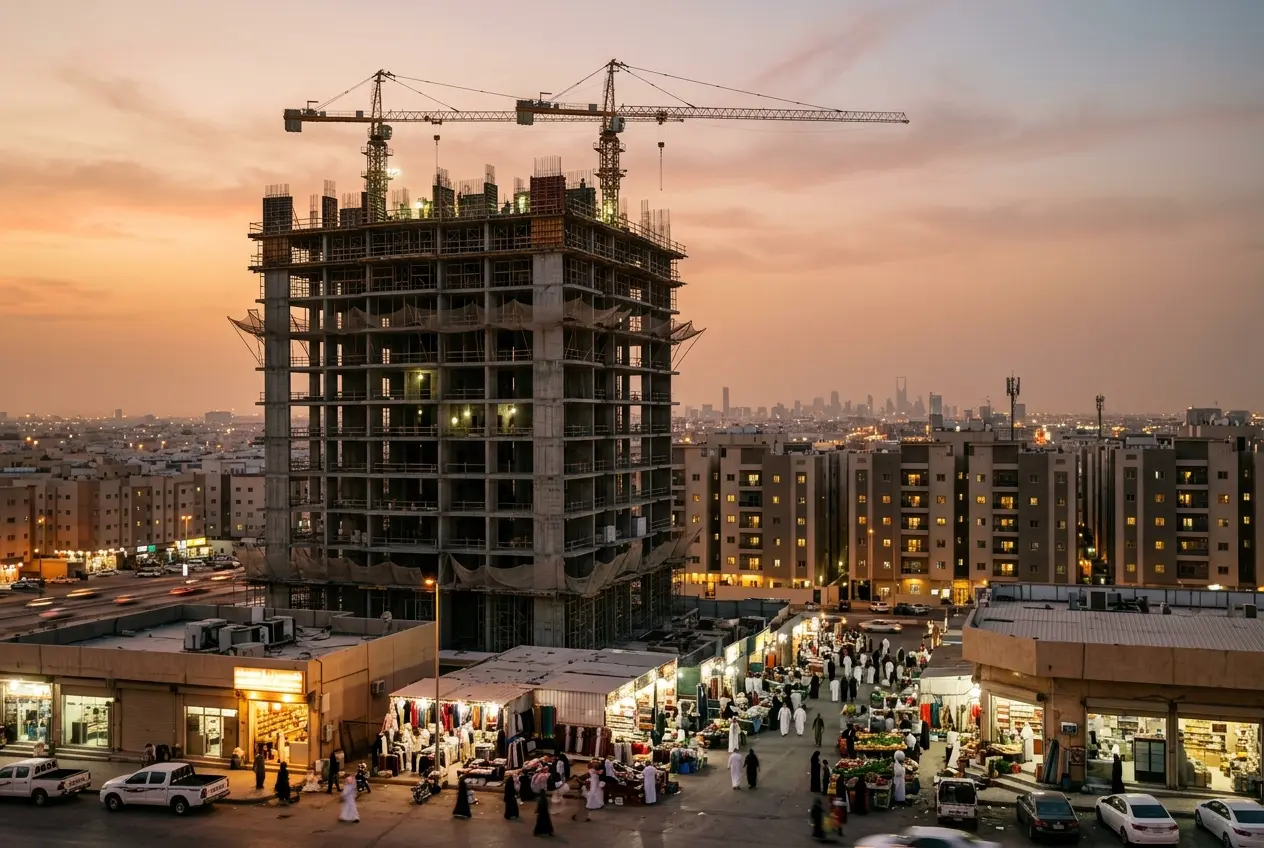
Why Buyers Sat on the Sidelines
The regional conflict introduced a new variable into Saudi home buying, and Knight Frank named three. The first is heightened nervousness, with prospective buyers reluctant to commit to their largest financial decision during a period of geopolitical uncertainty. The second is anticipation, with some households delaying purchases in the hope of getting a better deal if prices retreat. The third is the affordability pressure that pushed the moderation into motion before the war began. Knight Frank’s framing matters because the third force, not the war, is the one the consultancy says was already shaping the market in 2025.
The three forces are not new in Saudi Arabia, but they landed on a market that was already under strain.
Predictably, the regional conflict has added to the weight of factors contributing to the slowing in residential sales activity that was evident well before the regional conflict began. The moderation in residential transaction activity reflects the well-entrenched affordability pressures, particularly in Riyadh, rather than a weakening of underlying demand.
Faisal Durrani, partner and head of research for the Middle East and North Africa at Knight Frank, in the Q1 2026 release.
That affordability pressure is showing up in the lending numbers. New residential mortgage contracts fell 25 percent year on year in the first four months of 2026, and the total value of mortgage lending dropped 34 percent over the same window.
Knight Frank’s framing matters because it tells the reader what is driving the slump. The moderation reflects affordability in the capital rather than any collapse in the demand for housing. That distinction is the spine of the consultancy’s long-term outlook.
Where the Slowdown Bit Hardest
Riyadh carried nearly the entire national decline. The capital’s transaction volumes and values fell 82 percent compared with the same period in 2025, the steepest single-city drop in the data Knight Frank published. The city’s growing role as a regional corporate and tourism hub has pulled its housing prices sharply higher, and the affordability ceiling is now showing up in the deal count.
| City | Property type | YoY change Q1 2026 |
|---|---|---|
| Riyadh | Apartments | +6.3% |
| Riyadh | Villas | +4.9% |
| Jeddah | Apartments | +2% |
| Dammam Metropolitan Area | Apartments | +2.3% |
The price picture is the one piece of data that does not match the slump. Knight Frank attributes the Riyadh disparity to a long-running imbalance between buyer budgets and planned supply in the capital, an imbalance the war has now amplified rather than created.
Jeddah, the Dammam Metropolitan Area, Makkah and Madinah also recorded weaker activity, though none by the margin Riyadh posted. The pattern across the four cities suggests the war and the affordability ceiling are concentrated where prices had run hardest. For developers, the data points to a need to recalibrate unit sizes and price points to match the budgets of the Saudi households now sitting on the sidelines.
Prices Moved the Other Way
The most surprising element of the Q1 numbers is what happened to prices. Apartment values in Riyadh rose 6.3 percent year on year during the first quarter, and villa prices added 4.9 percent. Apartments in Jeddah climbed 2 percent, and the Dammam Metropolitan Area added 2.3 percent.
Knight Frank explains the divergence as a timing artifact. The price figures reflect the peace-time months of January and February, before the conflict’s full weight showed up in deal data. The implication for Q2 is straightforward: if the war keeps buyers on the sidelines, the next round of price prints will test whether the resilience in values can hold on a smaller pool of closed deals. The consultancy’s Q1 commentary does not assign a probability to that outcome, but the same report flags the construction sector’s 20 percent rise in costs as a separate pressure on developer pricing.
The 830,000-Home Demand Story
Knight Frank’s long-term demand case rests on a simple demographic arithmetic. The consultancy forecasts a need for 830,000 homes across the kingdom by 2034, counting only the growth in the Saudi national population. Population growth, rising homeownership rates, and ongoing government housing initiatives together form the picture the consultancy is betting will outlast the war. The forecasts assume a steady build-out of mortgage support and a continued role for the National Housing Co. in delivering large-scale supply.
That demand is already being channelled through three government programs that sit at the heart of the kingdom’s housing push:
- Sakani, the Housing Program’s main delivery platform for subsidized homes
- Tawazon, a new platform that opens up serviced residential land in Riyadh at capped prices of SR1,500 per square meter
- National Housing Co., the state developer behind large-scale master-planned communities
Homeownership among Saudi nationals has climbed from 47 percent in 2016 to more than 66 percent in 2025, and the kingdom’s stated target is 70 percent by 2030, a goal set out in the housing program’s 70% homeownership goal. The jump reflects years of subsidy, mortgage support, and a build-out of supply that is set to keep expanding. The reform backdrop is also moving: a new property ownership framework for non-Saudis took effect in January 2026, a shift detailed in Knight Frank’s Destination Saudi 2026 report.
Supply Is Still Set to Grow
The supply pipeline is not waiting for the war to settle. Riyadh’s residential stock is forecast to grow from about 2.7 million units in 2025 to more than 3.3 million units by 2030, Knight Frank said. The expansion in the capital is the largest single piece of the kingdom’s housing build.
- Riyadh residential stock: about 2.7 million units in 2025
- Riyadh residential stock: more than 3.3 million units forecast by 2030
- Jeddah housing stock: 1.47 million units projected by 2030
- Dammam Metropolitan Area supply: approaching 1 million units by 2030
Housing stock in Jeddah is projected to reach 1.47 million units, and supply in the Dammam Metropolitan Area is expected to approach 1 million units over the same window. Durrani put the gap plainly in his comments to Arab News, calling the imbalance between buyer budgets and planned housing stock the largest in the market today. The mismatch is the one variable the consultancy treats as structural rather than cyclical, and the reason Knight Frank’s long-term call rests on price and unit-mix adjustments rather than a demand revival.
Reforms and the Office Market Next Door
Two policy moves in 2026 are reshaping the demand side. The updated Law of Real Estate Ownership by Non-Saudis came into force on January 22, opening property purchase to residents, non-residents, and non-Saudi companies for the first time under a single national framework, a transition covered in REGA’s non-Saudi ownership law taking effect. Ownership in Makkah and Madinah is restricted to Saudi companies and Muslim individuals, but the rest of the kingdom is now open to international capital. The framework also opens ownership in Riyadh and Jeddah to a broader pool of buyers, with restrictions based on the Geographic Zones Document set to be published in the first quarter of 2026.
A five-year freeze on residential and commercial rental increases in Riyadh, ordered in September 2025, is the second lever. The cap is designed to support residents and businesses facing rising occupancy costs, and to give developers a clearer cost horizon at a moment when construction costs are up by an average of more than 20 percent since the start of the year.
Separately, Saudi Arabia’s office market continued to show strength in Q1 2026, with Grade A office rents in Riyadh rising 2.5 percent year on year to SR2,770 per square meter and occupancy at 97 percent. The Regional Headquarters Program has now attracted more than 700 multinational firms, surpassing the original 500-company Vision 2030 target. Foreign investment licenses rose to 5,516 in Q1 2026, up from 4,615 a year earlier. Knight Frank’s view is that appetite from global businesses to expand in the region may stay subdued while uncertainty around the conflict’s conclusion remains, a stance likely to weigh on Q2 data when it’s released. The same report notes that the supply pipeline is also expanding, with Riyadh’s office stock forecast to grow from approximately 6 million square meters in 2025 to more than 10.6 million square meters by 2032.
