
Iran and Egypt finished 1-1 in their World Cup Group G match at Seattle’s Lumen Field on Friday, June 26, in a stadium local organizers had designated the Pride Match of this tournament. The result earned Egypt a place in the round of 32 and put Iran out.
Mahmoud Saber put Egypt ahead in the fifth minute, sliding a low shot through the legs of Iran goalkeeper Alireza Beiranvand. Ramin Rezaeian answered nine minutes later, pouncing on a shot parried by Egypt goalkeeper Mostafa Shobeir. The match then settled into 90-plus minutes of back-and-forth, with rainbow flags fluttering inside the bowl and both federations’ pre-match objections standing without any on-pitch acknowledgment from the players.
Egypt and Iran End Level at 1-1 in Seattle
Egypt’s Saber opened the scoring inside five minutes, and Rezaeian equalized in the 14th, for a game that started as a sprint and finished in chaos. Iran’s Shoja Khalilzadeh appeared to bundle in a free kick in second-half stoppage time before a video-assistant replay check waved it off for offside, capping the night in the Lumen Field press box rather than the scoreboard.
The 1-1 draw played out in front of the stadium’s third straight sellout at the 2026 World Cup. Iran entered the night needing a win or a favorable result elsewhere to guarantee its place in the round of 32. Egypt had already booked their progress with a 3-1 win over New Zealand on June 21 and had more margin for error. The match finished level, with both teams walking off the pitch with a point and the Group G picture only partly decided.
| Egypt 1-1 Iran, 2026 FIFA World Cup, Group G | |
|---|---|
| Date | Friday, June 26, 2026 (kickoff 8:00 p.m. PDT) |
| Venue | Lumen Field (Seattle Stadium), Seattle |
| Attendance | 66,925 (third straight sellout) |
| Goals | Mahmoud Saber 5′ (EGY); Ramin Rezaeian 14′ (IRN) |
| Managers | Hossam Hassan (Egypt); Amir Ghalenoei (Iran) |
| Notable | Shoja Khalilzadeh strike disallowed for offside after VAR review in stoppage time |
A Pride Match FIFA Refused to Endorse
Seattle’s local World Cup organizing committee decided to brand the June 26 fixture as a Pride Match well before the December 2025 draw that placed Egypt and Iran on it. FIFA never signed on. “There will be no Pride Match at the World Cup,” Gianni Infantino told the Swiss magazine Weltwoche in January 2026. “There will be a FIFA World Cup match in Seattle, and on the same day, events organised by external organizations will be taking place in the city.”
FIFA’s posture held through the spring. The body pointed reporters back to the Weltwoche line whenever asked about the Seattle branding. By Thursday, June 25, FIFA had confirmed that rainbow flags would be permitted inside stadiums at all World Cup matches this summer, citing the FIFA World Cup 2026 Stadium Code of Conduct in its ruling on rainbow flags at the Egypt-Iran match. The body also reiterated that it had no authority over Seattle Pride’s programming outside the gates. The carve-out let FIFA defend inclusive in-bowl rules without ever adopting the host city’s label.
Louise Chernin, who chaired the host committee’s Pride Match Impact Council, had started planning the day “nearly a year and a half ago,” she told Politico on Friday. Her team worked under FIFA’s restrictive sponsorship rules, choosing local artists over official logos so the day would feel like Seattle and not a commercial pitch. The committee’s framing carried no FIFA endorsement, just the host city’s Pride Match Impact Council branding.
Inside the bowl Friday, FIFA’s stadium code governed. Outside it, Seattle’s Pride programming held the day.
The Flags Inside the Bowl
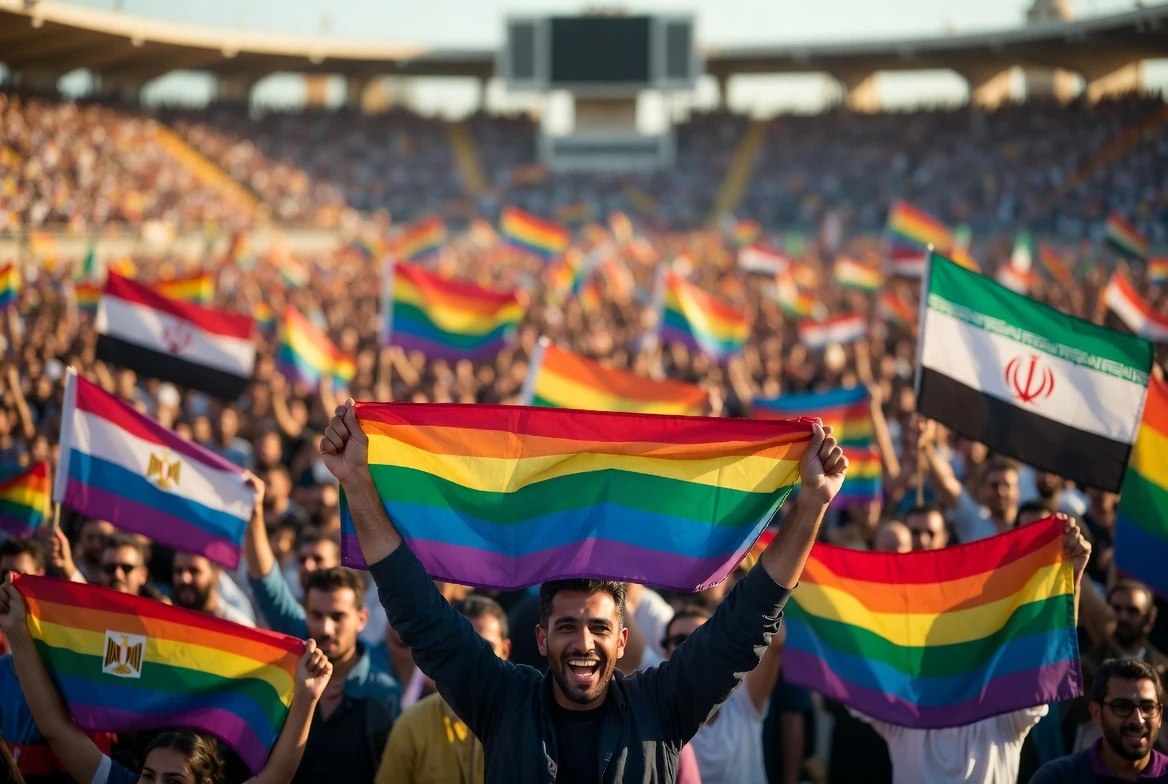
Rainbow flags fluttered among Iranian and Egyptian banners inside Lumen Field as the teams walked out. Pre-match programming on the pitch held to the no-Pride line both federations had been promised. The pre-game Pride Match activations had been routed to the streets around the stadium by design.
Anthony Vega, 50, stood outside the stadium three hours before kickoff, in his first World Cup after winning a ticket lottery, holding a rainbow flag he had marched with at his first Pride in 1991. “If one or two kids in Iran or Egypt see who we really are as Americans and how we are accepting, especially here in my home, that could change the lives for a lot of people,” Vega said, walking toward the gates. One Egypt supporter carried a cardboard sign that spelled out PRIDE as Proud, Respectful, Inclusive, Diverse, Egyptian. Paul Kahl, a West Seattle native in a purple shirt, said he had no trouble entering: “I think there’s a difference between the fans of a country versus the government of a country.”
Inside, by halftime, some Pride Match attendees said they were disappointed by the lack of in-stadium Pride celebrations. Hunter Schafer, of Seattle, wearing a rainbow headband, called it “a little disappointing” but said she had not expected more from FIFA. The host committee had planned its main Pride Match activations around the city, leaving the in-bowl programming to FIFA’s stadium code. The players kept their post-game answers short: Iran’s Rezaeian, asked about the Pride Match designation, replied: “I don’t have any idea about that,” and Egypt’s Mahmoud Saber told reporters in Arabic that it was “not my business.” Stacy Harbour, who brought 20 young people from an LGBTQ+ nonprofit invited by the host committee, said she was glad the two teams happened to be Egypt and Iran: “This is an opportunity to show the world what Seattle is.”
The Six-Month Dispute That Preceded Kickoff
Iran and Egypt went public with their objections well before either team touched American soil. The day after the December 2025 draw, the Egyptian Football Association sent a formal letter to FIFA Secretary General Mattias Grafström rejecting “in absolute terms” any Pride ties to the fixture on cultural and religious grounds. Iranian Football Federation president Mehdi Taj called the Seattle Pride Match branding “an irrational move that supports a certain group.”
Iran sharpened the demand in a written statement a day before the match, asking FIFA to ban Pride flags inside the stadium and refuse any “ceremonies or promotional activities” tied to the LGBTQ+ community. FIFA rejected the request, the line the body had held through how Egypt and Iran pressed FIFA on the Pride Match since the December draw. The body pointed again to its Stadium Code of Conduct, which permits flags representing sexual orientation and gender identity within size limits. At Iran’s pre-match press conference in Seattle, FIFA executive director of public relations Daniel Marin read the federation’s statement asking reporters to stick to football. Iran manager Amir Ghalenoei, asked about the Pride festivities, refused to be drawn further.
- December 2025: World Cup draw places Egypt and Iran at Lumen Field on June 26.
- December 2025: Egyptian FA writes to FIFA Secretary General Mattias Grafström rejecting Pride displays at the match.
- January 2026: FIFA President Gianni Infantino tells Weltwoche there will be no Pride Match at the World Cup.
- June 25: Iran’s federation asks FIFA to ban Pride flags inside the stadium; FIFA rejects.
- June 26: Match kicks off at 8 p.m. PDT; rainbow flags flutter inside; in-bowl programming neutral; match ends 1-1.
Two days before kickoff in Seattle, Egypt’s Hossam Hassan invoked FIFA’s “respect and fair play” rules to defend Iran’s right to be treated equally at the tournament, in light of the US travel restrictions that had shaped Iran’s group stage so far. “We respect the rules of respect and fair play that are there for everyone to abide by and any guidelines set by FIFA,” Hassan told reporters at a Thursday Seattle press conference, captured in Egypt coach Hossam Hassan’s FIFA fair-play appeal. Ghalenoei had made his position plain earlier in the tournament with “We are here for football, not politics.” Hassan and Ghalenoei spoke through club interpreters at the same Thursday press conference.
We respect the rules of respect and fair play that are there for everyone to abide by and any guidelines set by FIFA.
Hossam Hassan, Egypt’s head coach, said it through a club interpreter at a Thursday press conference in Seattle, two days before the match. Iran manager Amir Ghalenoei answered in Farsi, calling the Group G finale a meeting of “two teams playing together who have ancient civilisations.”
The Hidden Stakes for Iran’s and Egypt’s Queer Diaspora
Both federations claimed in writing to be speaking for their national communities. The people with the most lived stake in Friday’s game were neither in Cairo nor in Tehran: they were in Seattle, watching their homelands on television while they sat in the stands in rainbow colors. Some had spent decades pushing for a stadium large enough to hold two identities at once.
Egypt’s most famous same-sex reckoning of the modern era came in September 2017, when rainbow flags waved at a Mashrou’ Leila concert in Cairo triggered mass arrests and forced anal exams that human rights groups called torture, documented in Egypt’s 2017 crackdown after the Mashrou’ Leila flag. Iran’s record runs longer than that, with the death penalty on the books for same-sex relations. On the US side, the symbolism was sharper: the Seattle committee includes Eric Wahl, brother of late football journalist Grant Wahl, who was detained by Qatari security for wearing a rainbow shirt at the 2022 World Cup. Grant Wahl died a month later, of an aortic aneurysm, while covering the Argentina-Netherlands quarter-final in Qatar.
I told Grant not to poke the bear, but Grant was Grant. There are queer people in Qatar, in the Middle East, and he wanted to highlight the hypocrisy. He loved soccer, but not with blinkers on.
Eric Wahl, a member of the Seattle Pride Match Advisory Committee, set out the personal stakes behind the day in remarks captured in Eric Wahl on the Seattle Pride Match. The committee called Friday’s match a once-in-a-generation chance to put Seattle’s Pride on the world map.
An Egyptian-American Voice in a Red Jersey
Noha Mahgoub, a 43-year-old Democratic legislative aide in Washington state and a lesbian raised in Egypt, arrived at Lumen Field on Friday in a red Egyptian national team jersey, a black hat emblazoned YALLA, and red, white, and black tricolor face paint. “I’ve seen Pride shirts. I’ve seen Pride face paintings,” she said from a concourse minutes before the anthems. “It’s been really great, but I’m seeing a lot more Egypt and Iran and people cheering for their countries and singing their songs.”
An Iranian-American Voice on Behalf of Iran
Bookda Gheisar, a senior director of equity, diversity, and inclusion at the Port of Seattle who emigrated from Iran in 1981, used the pre-match coverage to push back at the framing that Iran was monolithic on the question: “There are many of us who do want that, but also our country is right now in the middle of a crisis and these players are facing tremendous challenges.” People inside Iran, she added, are “organizing and advocating for change.”
Where Group G Now Stands
Egypt’s draw moves the Pharaohs into the round of 32 as Group G runners-up, paired against Australia, the runner-up of Group D (the 2026 FIFA World Cup Group G standings). Mohamed Salah had already scored his 65th international goal during Egypt’s 3-1 win over New Zealand on June 21 in Vancouver. Iran exits the tournament, finishing third in Group G with three points from two draws and dropping below Senegal in the best-third-placed tiebreaker after Algeria drew Austria 3-3 in Group J. Belgium beat New Zealand 5-1 at BC Place in Vancouver to win the group. The Pride Match designation does not travel to the round of 32.
| Pos | Team | Pld | W | D | L | GF | GA | GD | Pts |
|---|---|---|---|---|---|---|---|---|---|
| 1 | Belgium | 3 | 1 | 2 | 0 | 6 | 2 | +4 | 5 |
| 2 | Egypt | 3 | 1 | 2 | 0 | 5 | 3 | +2 | 5 |
| 3 | Iran | 3 | 0 | 3 | 0 | 3 | 3 | 0 | 3 |
| 4 | New Zealand | 3 | 0 | 1 | 2 | 4 | 10 | -6 | 1 |
The Egyptian and Iranian squads will not meet again at this tournament. Egypt’s fans in Lumen Field left with the round-of-32 ticket and rainbow flags visible alongside national banners in the stands, while Iran’s players left the pitch without advancing and without having to address the Pride Match branding to anyone’s satisfaction. Egypt plays Australia in the round of 32 in the next round of fixtures. Iran’s tour ends with the squad still under the same requirement to leave the US the day the match ends, with the team set to cross back into Mexico within hours of full time on Friday.
Frequently Asked Questions
When did Egypt and Iran play at the 2026 World Cup?
Egypt faced Iran at 8 p.m. PDT on Friday, June 26, 2026, at Lumen Field in Seattle. The match ended 1-1.
Why did Egypt and Iran object to the Pride Match?
Both federations wrote to FIFA asking that the Pride Match branding and any LGBTQ+-themed programming be removed from the fixture. The Egyptian Football Association said it rejected any Pride ties “in absolute terms.” Iranian Football Federation president Mehdi Taj called the original Pride Match branding “an irrational move that supports a certain group.”
Was FIFA endorsing the Pride Match?
FIFA confirmed Thursday, June 25, that rainbow flags would be permitted inside its World Cup stadiums under the FIFA World Cup 2026 Stadium Code of Conduct, subject to size limits and rules against items deemed political. FIFA President Gianni Infantino told the Swiss magazine Weltwoche in January 2026 that the body was not endorsing a “Pride Match” label and pointed to events organized by external organizations in Seattle.
What comes next for Egypt after the draw?
Egypt advanced to the round of 32 as Group G runners-up and is set to play Australia, the runner-up of Group D. Iran exited the tournament, finishing third in Group G with three points from two draws and dropping below Senegal in the best-third-placed tiebreaker after Algeria drew Austria 3-3 in Group J.
