
Austrian-American physicist Heinz von Foerster and two colleagues published a short paper in the journal Science on November 4, 1960, that fixed Friday, November 13, 2026, as the date human population would reach infinity under then-prevailing trends. The date is now weeks away. The world has not ended. Population sits near 8.3 billion and is still growing, just far more slowly than the old curve required.
The paper was never a prophecy of asteroids or plagues. It was a hyperbolic fit to two thousand years of rough headcounts that produced a mathematical singularity. Social media has spent the summer of 2026 stripping the context and selling the calendar date as doomsday. The real irony is sharper: the very slowdown that canceled the singularity has already locked in a different set of pressures, aging workforces and a projected global peak this century.
What the 1960 Science Paper Said
Von Foerster, then at the University of Illinois, worked with Patricia M. Mora and Lawrence W. Amiot. They gathered 24 population estimates spanning roughly the year 0 to 1958. The data showed growth faster than simple exponential. Doubling times were shrinking. They fitted a two-parameter model of the form dN/dt = a0 N^(1+k). The best fit put k near 1, which produces a finite-time blow-up.
The equation that stuck in later retellings is roughly N = 1.79 × 10^11 / (2026.87 – t)^0.99. At t equal to late 2026 the denominator hits zero and N heads to infinity. They labeled that instant “doomsday” because the clever population would annihilate itself by pure crowding. Their own phrasing, quoted in contemporary coverage, was blunt: “Our great-great-grandchildren will not starve. They will be squeezed to death.”
For obvious reasons, to shall be called ‘doomsday,’ since it is on that date that N goes to infinity, and the clever population annihilates itself.
Heinz von Foerster, Science, November 1960, via TIME
The authors chose November 13 because it was a Friday the 13th and, neatly, von Foerster’s own 115th birthday. He was born November 13, 1911, in Vienna. He died in 2002 at 90, long before the calendar date arrived. Contemporaries treated the piece as half-serious warning and half mathematical joke. Critics immediately pointed out the nine-month human gestation limit and the fact that biological systems do not sustain accelerating growth forever.
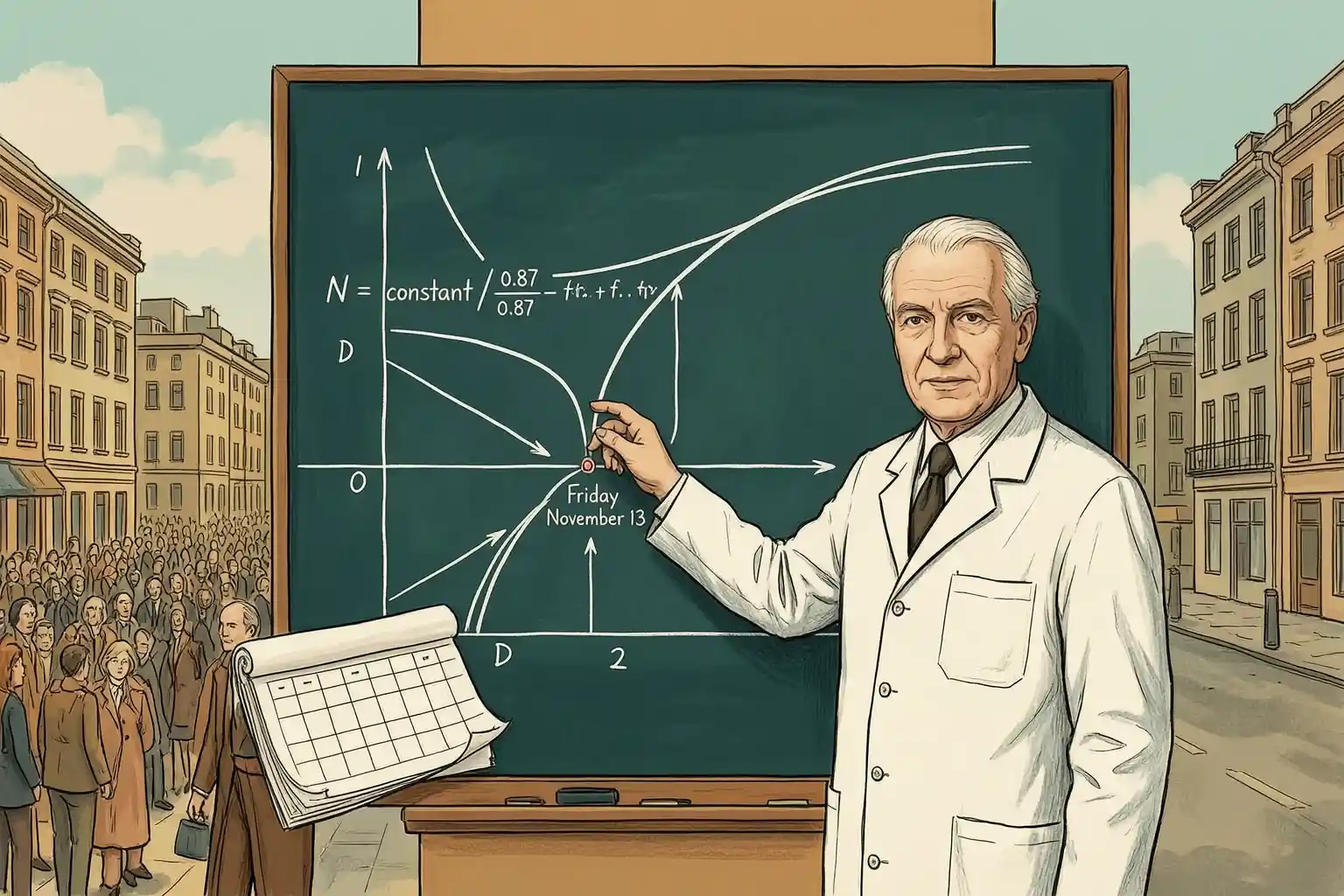
Why the Model Landed on That Exact Friday
Hyperbolic growth is the mathematical cousin of the positive-feedback story: more people invent more technology, which supports still more people, which invents still more. Von Foerster’s group treated the historical acceleration as real and simply extrapolated it. At the halfway mark in 1994 the actual population was running slightly ahead of the 1960 schedule. By 2010, with a quarter of the interval left, updated fits already showed the model no longer held.
The singularity date itself carried an uncertainty band of roughly plus or minus five years. Friday the 13th was the most theatrical point inside that band. It was never meant as an oracle. It was a spotlight on the consequence of unchecked acceleration.
- November 4, 1960: Science publishes “Doomsday: Friday, 13 November, A.D. 2026.”
- 1963: Global population growth rate peaks near 2.2-2.3 percent.
- 1970s-1990s: Demographic transition accelerates in more countries; fertility begins its long decline.
- 2010: Mathematicians revisit the fit and find post-1960 data break the original parameters.
- Mid-2020s: Annual growth sits near 0.83-0.86 percent; social media rediscovers the old paper.
That sequence is the entire story of why the date survives only as curiosity.
How Population Growth Bent After 1960
In 1960 the world held about 3 billion people. Today it holds roughly 8.3 billion. Absolute numbers rose, yet the relative growth rate fell by more than half. Doubling time lengthened from roughly 32 years to something closer to 80 years. The change was not a mystery. It was the demographic transition: falling death rates first, then falling birth rates as education, urbanization, women’s labor force participation and access to contraception spread.
Global total fertility now stands near 2.3 live births per woman, down from 3.3 around 1990. More than half of all countries already sit below the 2.1 replacement level. The UN World Population Prospects 2024 revision projects the total will keep rising for another five or six decades, reach a peak near 10.3 billion in the mid-2080s, then drift slowly downward to about 10.2 billion by 2100.
| Metric | Around 1960-63 | 2025-26 |
|---|---|---|
| World population | ~3.0 billion | ~8.3 billion |
| Annual growth rate | ~2.2 percent | ~0.83-0.86 percent |
| Approx. doubling time | ~32 years | ~80-83 years |
| Global fertility (TFR) | Well above 4-5 | ~2.3 |
The original model assumed the historical acceleration would continue. Once fertility turned permanently downward, the hyperbolic path was abandoned. Population still grows from demographic momentum (the large number of women already of childbearing age), but the engine of ever-faster doubling is gone.
The 2026 Viral Remake
Accounts such as Night Sky Now recirculated the 1960 title this summer with dramatic framing. One post drew millions of views and a community note that walked readers back to the original tongue-in-cheek math. Replies split between genuine alarm, jokes about Friday the 13th, and sharp corrections pointing out that fertility rates “crashed long ago.” The pattern is familiar: a precise historical date plus the word “doomsday” outperforms any careful explanation of singularities and carrying capacity.
Von Foerster himself had a documented sense of humor about the reaction. He and his co-authors answered critics in later Science letters by insisting that hypotheses live or die by data fit, not by a priori claims about what populations “should” do. The data after 1960 simply stopped fitting. That outcome does not make the original exercise worthless. It makes it a clean demonstration of how quickly a long historical trend can reverse once social conditions change.
- Original paper title treated as literal prophecy
- Community notes and reply threads restoring the mathematical context
- Clickbait cycles that resurface every few years as the date nears
- Persistent public appetite for calendar-based endings over slow demographic arithmetic
The same platforms that amplify the scare also host the quickest fact-checks. The net effect is a brief spike of anxiety followed by a return to the quieter numbers.
What the Fertility Collapse Leaves Behind
Canceling the singularity did not cancel demographic pressure. It relocated it. The ten key messages on the 2024 projections note that one in four people already lives in a country whose population has peaked. Sixty-three countries and areas have already passed their maximum. Another 48 are projected to peak between 2025 and 2054. Sub-Saharan Africa continues to drive most remaining growth, while East Asia, Europe and parts of Latin America face shrinking working-age cohorts.
By the late 2070s people aged 65 and older are projected to outnumber those under 18. Life expectancy has recovered from the pandemic dip and continues to rise. The main driver of growth through mid-century is momentum from past high fertility, not current high fertility. That momentum fades. Societies that once fretted about infinite crowds now confront pension systems, care burdens and labor shortages designed for younger age structures.
TIME magazine’s 1960 write-up of the paper already noted that von Foerster did not literally expect infinity. He wanted a “peoplo-stat,” some social control on family size, before the curve steepened beyond easy correction. In a sense the world built that control organically through development and choice. The control worked so well that the opposite problem arrived on schedule instead.
Von Foerster’s Wider Career and the Model’s Afterlife
The doomsday equation was a small piece of a larger career. Von Foerster directed the Biological Computer Laboratory at Illinois, helped shape second-order cybernetics, and sat among the Macy Conferences circle with Norbert Wiener, Warren McCulloch and others. His name attaches to an age-structured population equation still used in demography. The 1960 paper sits inside that body of work as a provocative data fit rather than a central theorem.
Later analysts, including a 2010 Canadian Mathematical Society presentation by Brad Willms, simply appended post-1960 observations and watched the singularity disappear. Power-law logistics and hyperlogistic alternatives then produce finite carrying capacities. The original exercise remains useful as a cautionary tale about extrapolation and as a historical marker of the last moment when hyperbolic growth still looked plausible.
Readers hunting biography will find von Foerster’s cybernetics and lab career documented in standard references, including his Vienna roots, wartime radar work, and long Illinois tenure. The doomsday date was always a side project with a sharp title.
Frequently Asked Questions
What exactly did Heinz von Foerster predict for November 13, 2026?
He and co-authors fitted historical population counts to a hyperbolic growth model whose mathematical solution reaches infinity on that date if the pre-1960 acceleration never slowed. They called the singularity “doomsday” because infinite density is physically impossible; the real point was that growth of that form cannot continue.
Was the prediction meant as a literal end of the world?
No. Contemporary coverage and later recollections treat it as a tongue-in-cheek, attention-getting extrapolation. Von Foerster used the drama to argue for deliberate population regulation before technology and social forces made correction harder.
Why did the doomsday equation stop working?
Global fertility began a sustained decline after the early 1960s as part of the demographic transition. Once birth rates fell, the positive feedback assumed in the model broke. Growth rates peaked around 1963 and have trended downward ever since, lengthening doubling times dramatically.
What is the current world population and projected peak?
Mid-2026 estimates sit near 8.3 billion. The UN medium variant projects continued growth to a peak of roughly 10.3 billion in the mid-2080s followed by a gentle decline, driven mainly by falling fertility and aging rather than catastrophe.
Is November 13, 2026, still significant for any demographic reason?
Only as the anniversary of a famous failed extrapolation and as von Foerster’s birthday. No official projection, census calendar or scientific body assigns special meaning to the date beyond the historical paper.
On November 13 the calendars will turn and the planet will keep the same number of people it had the day before, give or take a few hundred thousand births and deaths. The equation that once pointed at infinity now points only at the distance humanity has already traveled from the growth path of 1960.
